
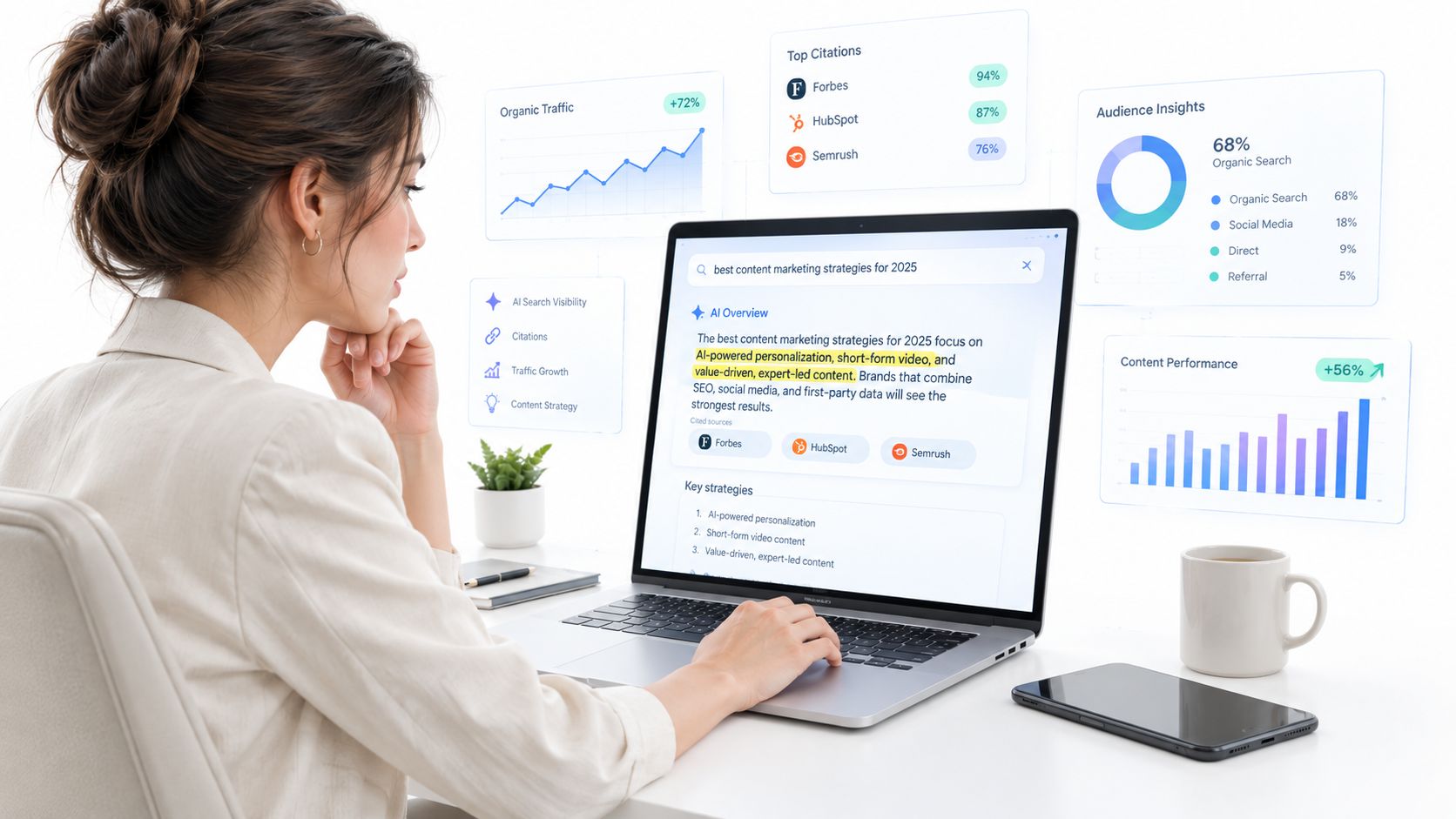
You update a page, watch it reach the first page, and still see fewer clicks than the ranking suggests. Then you search the target query yourself and find an AI Overview answering the question before your result appears. The page may still be performing well in traditional SEO, but the visibility opportunity has moved from ranking alone to being selected as a cited source.
I've found that distinction changes the entire workflow. Instead of asking only, “Can this URL rank in the top ten?”, I ask, “Does this page contain a clean, trustworthy passage that Google can use to answer the query?” The tactics overlap with established SEO, but the execution becomes more deliberate. The answer needs to be accessible, early, precise, and supported by a page that demonstrates broader authority.
Tabla de contenido
- Why AI Overviews Changed Search Visibility
- How AI Overviews Choose Which Pages to Cite
- Finding the Right Queries to Target for AI Overviews
- Structuring Content to Earn AI Overview Citations
- Monitoring Performance and Refining Your Optimization Workflow
- Putting Your AI Overview Strategy Into Action
Why AI Overviews Changed Search Visibility
A page can keep its organic position and still lose clicks. The searcher may receive a useful AI Overview before reaching the conventional results, so visibility now depends partly on whether Google selects a page or passage to support that answer.
Google launched AI Overviews in the United States on May 14, 2024, after introducing the experience as Search Generative Experience in 2023. By October 2024, Google said it had expanded to additional countries and languages. Ahrefs' historical overview of Google AI Overviews records that expansion and its implications for search visibility.
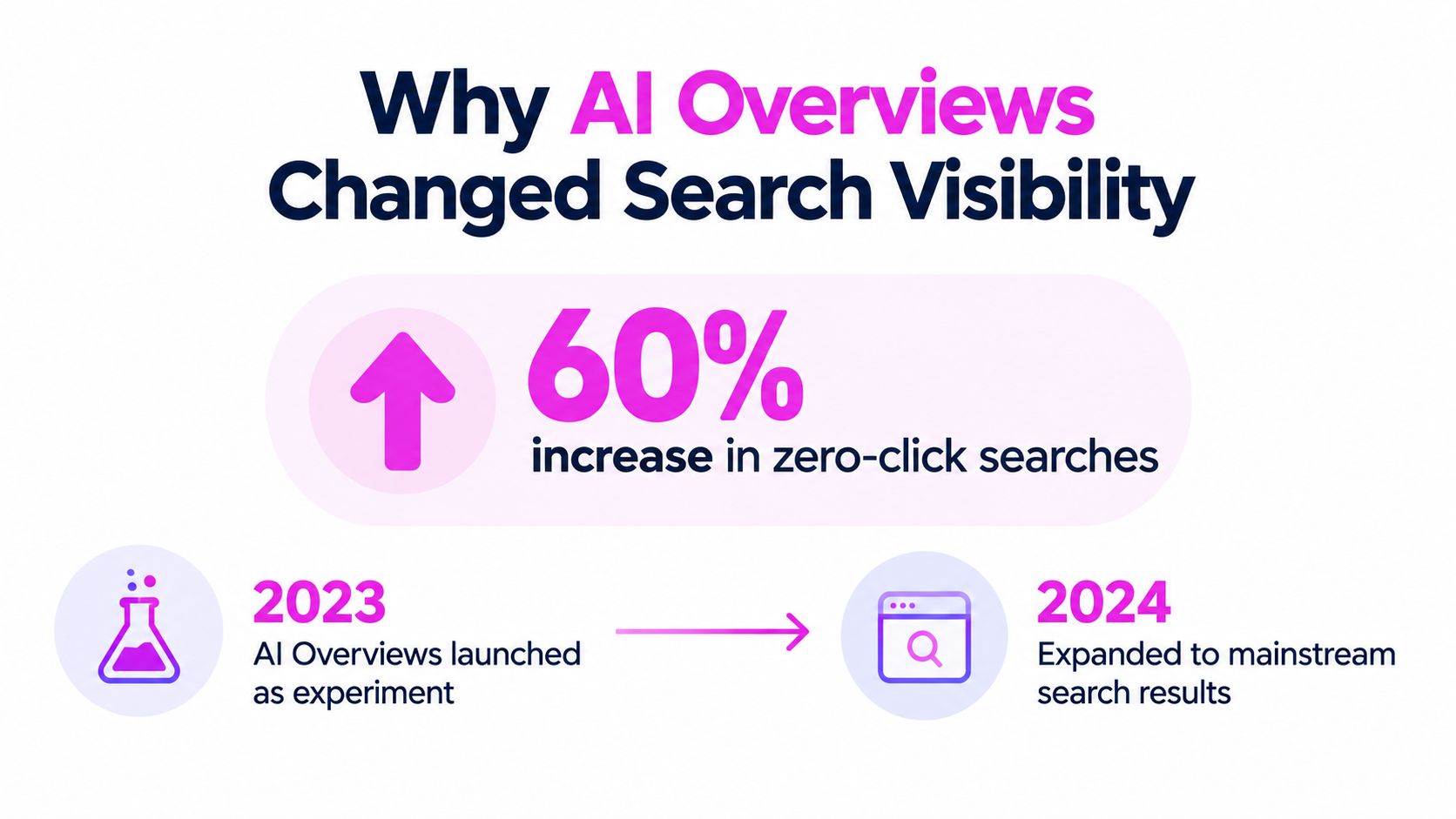
The analytics signal is often a click decline without a matching ranking decline. Reported measurements found AI Overviews on around 9.46% of keywords y 16% of U.S. desktop searches, while volume-weighted exposure exceeded 54.61% of searches because the feature appeared more often for high-traffic informational queries. The figures are from Ahrefs' analysis of AI Overview prevalence, which is already cited above for the historical context.
These measurements answer different questions. Keyword prevalence shows how often the feature appears across tracked terms. Volume-weighted exposure estimates how much search activity those terms represent. A smaller set of broad questions can therefore affect more visits than many low-volume keywords.
Ranking and citation are different jobs
A ranking records a page's position in the conventional results. A citation indicates that Google selected the page, and sometimes a specific passage, to support an AI-generated response. Strong rankings can improve the chance of being considered, but they do not guarantee citation.
The practical failure is easy to find: a page ranks on page one, yet its direct answer sits below a long introduction. Improving the ranking may increase eligibility, while leaving the passage hard to extract. Put the answer near the beginning, match the query's language, and add evidence that resolves ambiguity.
The broader discipline is covered in this Answer Engine Optimization guide from Machine Marketing. A focused workflow is more useful for execution: identify the query, engineer an early answer block, verify that search systems can access it, then track citation visibility separately from organic rank.
Regla práctica: Treat organic ranking as eligibility evidence, not the final objective. The passage that answers the question is the asset Google may cite.
How AI Overviews Choose Which Pages to Cite
A page can rank well and still miss an AI Overview citation. In practice, citation selection depends on whether Google can match the page to the query, extract a clear passage, recognize useful signals, and access the content technically. These filters operate together, so a failure in one can exclude an otherwise relevant URL.
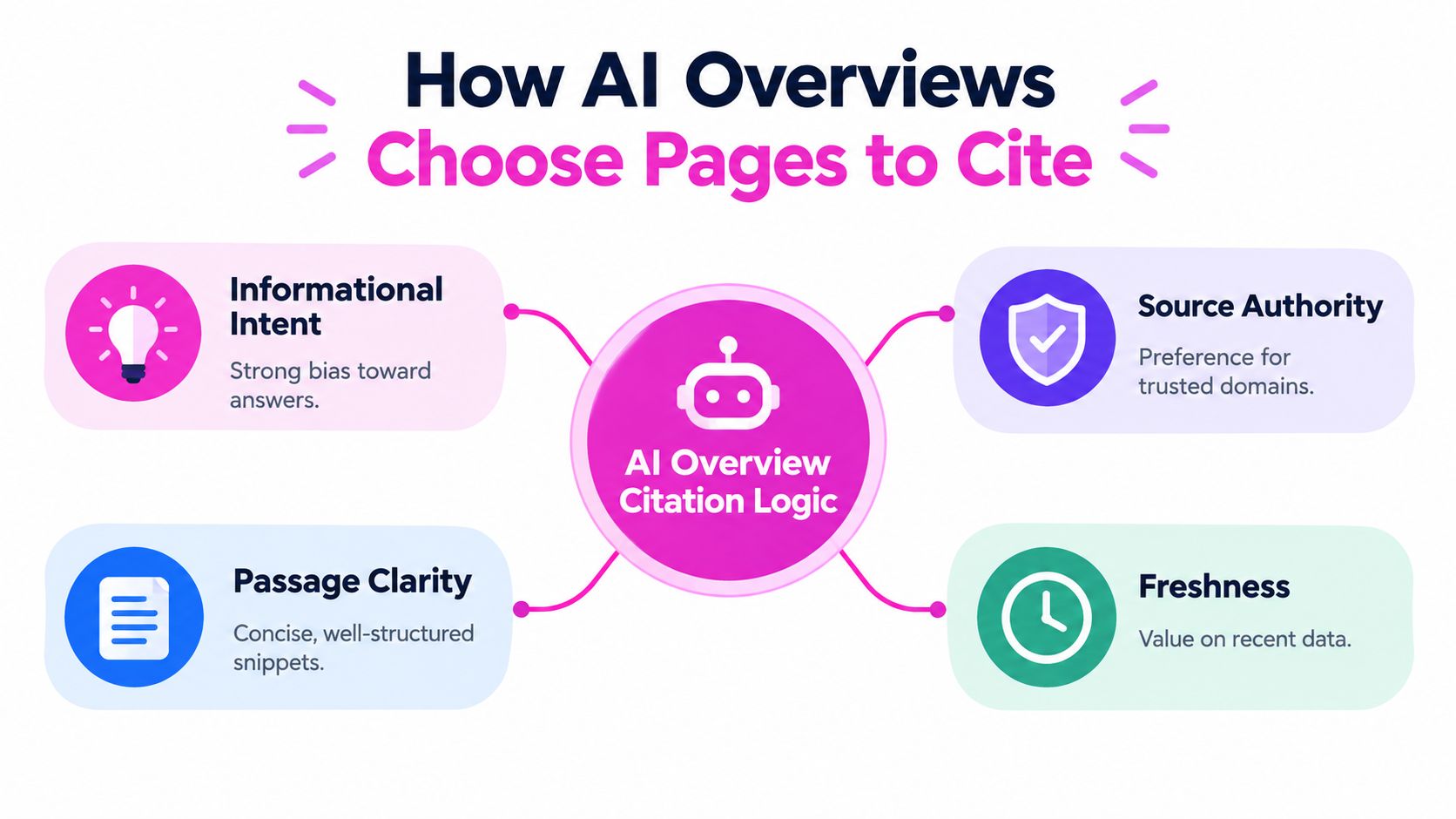
Informational intent comes first
Semrush's study of 200,000 AI Overviews descubrió que 80% of desktop y 76% of mobile overviews targeted informational keywords. The study also reported an average of 11 links per overview, with responses averaging 119 words on desktop y 91 words on mobile. Semrush's AI Overview study documents these findings.
That distribution affects page selection. A product page may fit a commercial query, but an explanatory guide, comparison, glossary, or process document usually offers more passage-level material for a synthesized response. The strongest target is a query whose intent calls for a concise explanation, not merely a keyword with search demand.
Rankings help, but they do not decide citation
AI Overviews draw from the conventional index, yet ranking and citation remain separate outcomes. A 16-month study found that overlap between AI Overview citations and organic rankings increased from 32.3% to 54.5%. More than half of cited pages were already ranking organically. The finding, discussed in Semrush's linked study above, supports ranking work without treating rankings as the finish line.
Ahrefs-based industry coverage found that only 38% of AI Overview citations came from top-10 pages in March 2026, compared with 76% in July 2025. The remaining citations were split almost evenly between pages ranking 11–100 and pages beyond 100. DesignRush's reporting on the Ahrefs citation findings describes the change.
The workflow implication is direct. Track organic position as an eligibility signal, then inspect whether the page contains an early, self-contained answer block that Google can quote or summarize. A page outside the top ten can still earn a citation when its passage resolves the query clearly.
Authority includes platforms beyond articles
Around 52% of AI Overview citations came from community and platform surfaces, including Reddit, YouTube, and LinkedIn, according to LoudScale's coverage of AI Overview citation patterns. Article optimization alone can therefore leave citation opportunities unaddressed.
YouTube is a practical example. A citation-pattern study reported that YouTube represented 5.6% of all citations y 18.2% of citations for results whose sources did not rank in Google's top 100 for the same keyword. Search Engine Journal's report on YouTube citations shows how video can support visibility when the related webpage is not a conventional ranking leader.
Technical access still sets the floor. Google's Search Essentials guidance emphasizes helpful, reliable, people-first content that Google's systems can access. AirOps' explanation of citation eligibility reports that cited sources must be indexed and eligible for standard search snippets before passage-level optimization can matter. Check crawlability and indexation before rewriting an answer block.
Finding the Right Queries to Target for AI Overviews
I don't begin with a list of every keyword containing a question word. I begin with the existing SERP and ask whether Google is already generating an overview for the query. If the feature doesn't appear consistently, the optimization case is weaker, especially when the page requires significant rewriting.
Build a trigger-first shortlist
Start with the queries your important pages already rank for, then filter them by intent and observed AI Overview presence. Use keyword discovery tools, Google Search Console query exports, People Also Ask results, and competitor pages to expand the list. The aim is to find query clusters, not isolated phrases.
For each candidate, record:
- Query language: Preserve the wording searchers use, including modifiers such as “how,” “why,” “best,” “difference,” and “steps.”
- Intent type: Prioritize explanations, comparisons, definitions, and troubleshooting where a synthesized answer makes sense.
- Current source set: Note which domains and formats appear in the overview, including articles, videos, forums, and documentation.
- Your URL: Map the query to the page that should answer it, rather than allowing several pages to compete.
- Citation gap: Mark whether your domain is absent, mentioned without a citation, or cited through a page that needs improvement.
I use clustering before editing because several similar queries often belong on one page. SemDash can support this workflow with keyword discovery, People Also Ask and People Also Search suggestions, keyword clustering, live SERP analysis, and an AI Overviews visibility view that lists triggering queries and cited URLs. It's useful to treat that data as an observation layer, not as proof that a page will remain cited.
Weight opportunity by search behavior
A query can trigger an overview without representing meaningful exposure. The historical prevalence data from Ahrefs' AI Overview research shows why volume-weighted exposure matters. Broad informational queries may account for a much larger share of search activity than their raw keyword count suggests.
I therefore score opportunities using qualitative tiers:
| Priority | What I look for | Typical action |
|---|---|---|
| Alto | An overview appears, the query has clear business relevance, and a suitable URL already exists | Rewrite the answer passage and supporting sections |
| Medio | The topic is relevant, but the source set is mixed or the trigger is unstable | Test a focused section before building a new page |
| Baja | The query is mainly transactional or lacks a consistent overview | Protect organic performance and avoid unnecessary restructuring |
Don't force every commercial term into an informational guide. A category page should help someone choose or buy. A supporting guide should explain the problem that leads to that decision. Keeping those jobs separate protects both relevance and conversion intent.
Track citations apart from rankings
Rank tracking answers, “Where does my URL appear?” Citation tracking answers, “Which URL does Google use in the AI answer?” Store both values by query and date. A page can gain a citation while holding the same rank, lose a citation while ranking higher, or be replaced by another URL on the same domain.
That separation prevents the most common reporting error, treating a rank increase as proof of AI Overview progress. It also tells me what to edit next. If the page ranks well but another source is cited, I inspect passage clarity and topical coverage before changing the title tag.
Structuring Content to Earn AI Overview Citations
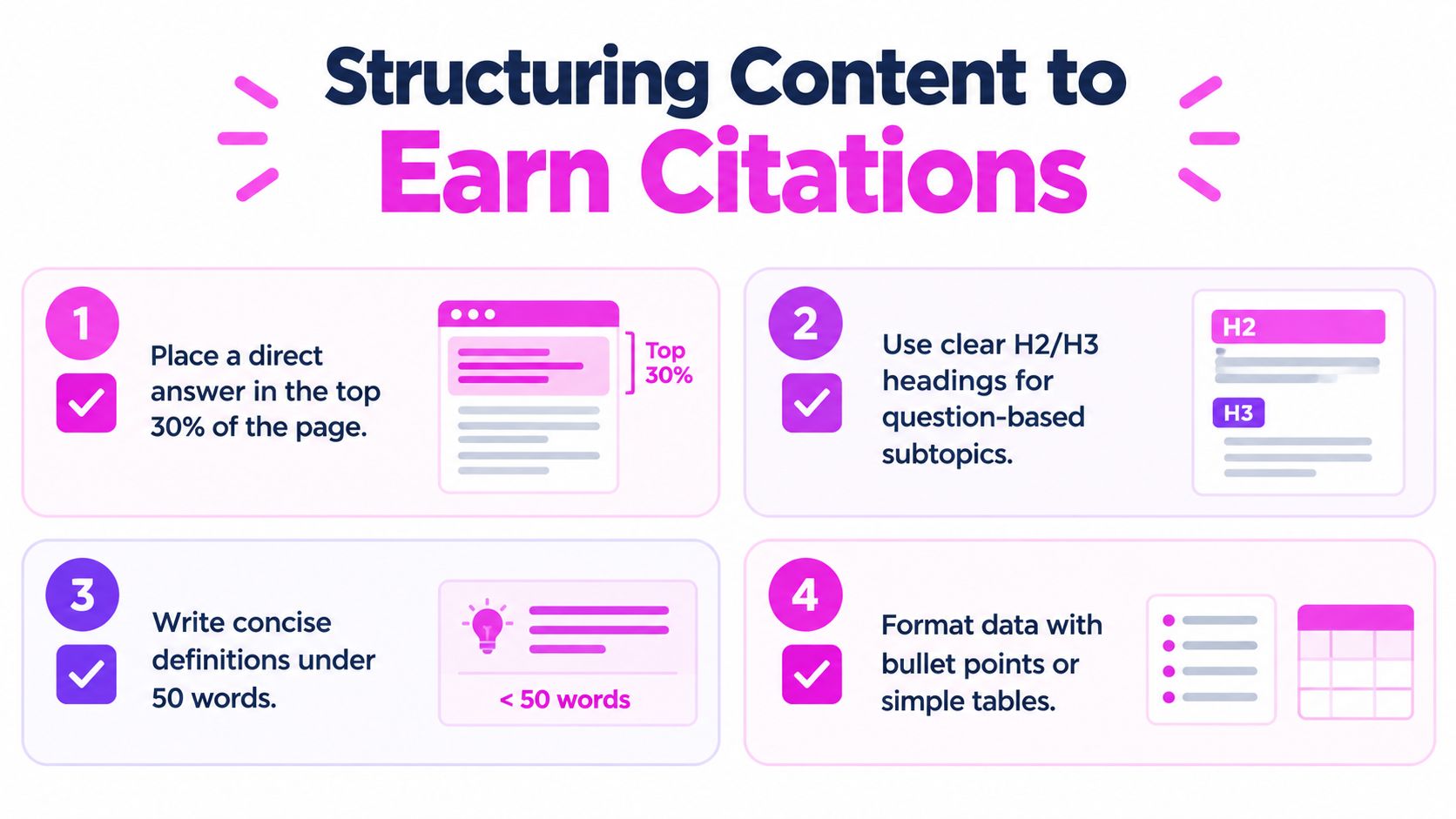
The page should answer the target question before it starts teaching every surrounding concept. In a citation-pattern study, 55% of Google AI Overview citations came from the top 30% of a page, while only 21% came from the bottom 40%. CXL's analysis of citation placement supports a simple editing decision: move the answer upward.
Put the answer where extraction is easiest
For a page targeting “how to optimize product feeds,” a weak opening might spend several paragraphs defining ecommerce discovery, describing market changes, and introducing the company. A stronger answer block would say:
How do you optimize a product feed? Make product titles descriptive, keep prices and availability current, use complete attributes, remove conflicting values, and validate the feed against the requirements of each shopping platform.
That block works because it gives Google a complete response without requiring context from the rest of the article. I'd then expand each point under question-based H2 or H3 headings, adding examples, limitations, and source references.
I keep definitions concise, often under 50 words, because a definition should resolve the question rather than become a miniature essay. For more involved questions, I use a short answer paragraph followed by a list or table. The format gives the system a compact passage and gives the reader a path into the detail.
Use the page's first third deliberately
The first portion of the page should contain:
- A direct answer to the primary query.
- The main qualification or exception.
- A short list of the steps, factors, or options that the article will explain.
- A link to the relevant supporting evidence or documentation.
This isn't a reason to cram keywords into the introduction. Google's Search Essentials documentation recommends using words people would type and creating helpful, reliable, people-first content. I write the answer in the reader's language first, then check whether the heading, title, and body use consistent terminology.
Make supporting passages independently useful
AI Overviews can assemble responses from several pages, so each section should stand on its own. Avoid paragraphs that begin with “this” or “the above process” when the passage might be extracted without its surrounding context. Repeat the subject naturally when necessary.
Use formatting that exposes relationships:
- Bullets: Best for steps, conditions, and feature lists.
- Simple tables: Best for comparisons, trade-offs, and decision criteria.
- Short paragraphs: Best for definitions and explanations.
- Descriptive headings: Best for connecting a passage to the question it answers.
Structured data can help search systems interpret page entities and content types, but it won't rescue vague writing. Add relevant markup where it accurately describes visible content, then validate the implementation. This guide to structured data for SEO is a practical reference for choosing and applying markup without treating schema as a citation shortcut.
Extend the source footprint when the query calls for it
I don't add video merely to check an optimization box. I add it when the topic benefits from demonstration, walkthrough, or visual comparison. A concise video can reinforce the same answer while creating another discoverable source surface, particularly because YouTube appears in citation datasets even when the related page lacks a top-100 organic ranking.
The mistakes are predictable: burying the answer beneath branding, writing a long FAQ that repeats the article, adding unsupported claims, and optimizing for keyword frequency instead of clarity. The page should read naturally to a person who needs the answer now. If the first passage sounds like it was written for a crawler, it probably isn't ready for citation.
Monitoring Performance and Refining Your Optimization Workflow
Publishing the revised page is the midpoint, not the finish. I create a query-to-URL record before making changes, then compare citation presence, cited URL, organic position, and SERP composition after the page has had time to be recrawled and re-evaluated.
The central report should answer four questions:
- Which target queries currently trigger AI Overviews?
- Does the domain appear in the answer or source links?
- Which exact URL receives the citation?
- Did citation status change independently of organic rank?
Use a repeatable audit cycle
A monthly review is sufficient for most established content programs, provided the team checks meaningful query groups rather than reacting to one volatile result. Start with pages that already have organic visibility and commercial relevance. Then inspect the passage Google might use, the freshness of the supporting material, and the competing formats present in the overview.
I usually sort the work into three queues:
Refresh queue: The page is relevant and indexed, but its answer is outdated, buried, or incomplete.
Authority queue: The page is clear, but competing sources have stronger external mentions, references, or format coverage.
Technical queue: The content is sound, but indexation, snippet eligibility, internal linking, or accessibility prevents reliable discovery.
That classification keeps teams from rewriting a technically blocked page or building backlinks to an answer that doesn't match the query.
Test passages, not just pages
When a cited URL disappears, I don't immediately rewrite the whole article. I compare the prior and current SERP, identify the replacement source, and examine what its answer does better. Sometimes the difference is a clearer definition. Sometimes it's a recent qualification, a table, a first-party explanation, or a video that demonstrates the process.
I then make one controlled change, such as moving the answer block higher, clarifying a heading, adding missing evidence, or consolidating overlapping sections. After the next review, I record whether the citation returned, moved to another URL, or remained absent. This gives the team a useful learning history instead of a pile of undocumented edits.
Recover authority beyond new content
Citation work can expose authority assets you already own. Unlinked brand mentions, broken backlinks, outdated references, and competitor links can all inform outreach. A relevant mention recovery request may be more efficient than producing another generic article, particularly when the existing page already answers the query well.
For measurement details and a practical reporting setup, use la guía de SemDash sobre el seguimiento de resúmenes de IA. The important discipline is to preserve the distinction between visibility, citation, ranking, y clicks. They influence one another, but one metric cannot stand in for the others.
Putting Your AI Overview Strategy Into Action
Start with one existing page and one query cluster. Confirm that the queries trigger AI Overviews, check that the page is indexed and eligible for standard snippets, then place a direct answer near the top of the article. Use the searcher's wording, make each supporting passage understandable on its own, and assign every target query to one deliberate URL. This workflow tests passage-level answerability instead of assuming a strong page ranking will produce a citation.
Review the citation set before editing. If articles dominate, strengthen the page's answer and supporting evidence. If YouTube, Reddit, or LinkedIn appear often, contribute useful information on those platforms instead of treating your blog as the entire evidence base. If another page on your site is cited, consolidate overlapping answers or strengthen the page that should serve as the canonical source.
Avoid rewriting introductions without improving the answer, treating top-10 rankings as a citation guarantee, or adding schema to unclear content. Search fundamentals still provide the foundation, while clear passages determine whether an answer system can use the page as evidence.
For visibility beyond Google, this 2026 guide to ranking in ChatGPT provides broader context. Track AI Overview visibility separately from organic rank, citations, and clicks. A page can rank well without being cited, or earn a citation without generating a click.
SemDash can help identify queries that trigger AI Overviews, check whether your domain is mentioned, and map citations to the exact URLs Google selects. Visit SemDash to connect AI Overview visibility with keyword, SERP, competitor, and backlink research, then prioritize the next page update.