%20(1)-B86R08ZzwhPzS6UZbG3mSxRWPCwGwn.png)


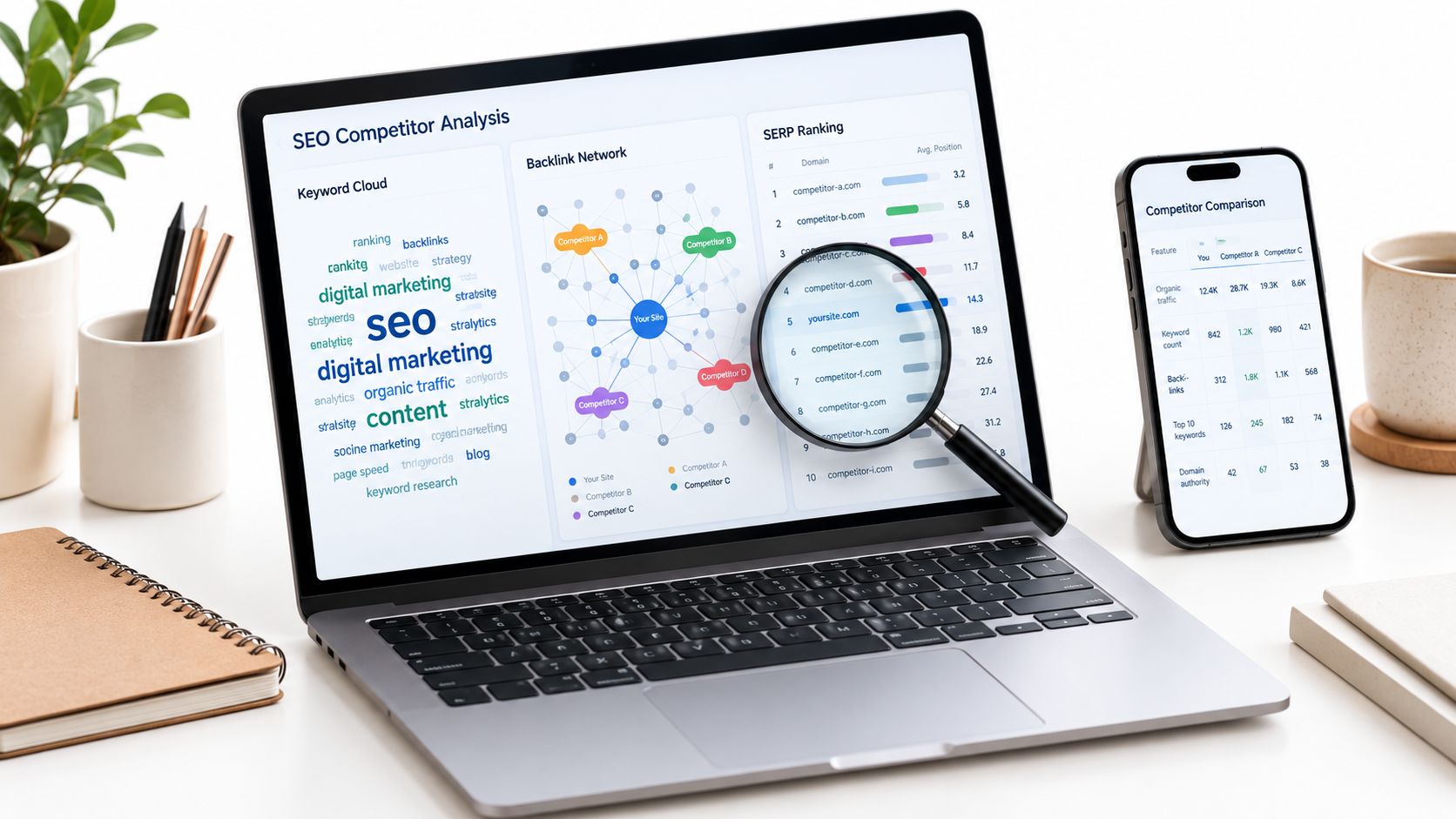
The most popular advice about competitor analysis tools is also the least useful: choose the platform with the longest feature list. That approach usually leaves teams paying for overlapping keyword databases, backlink reports, rank tracking, and dashboards while nobody answers the question that triggered the research.
I choose a tool by the competitor question I need to answer. Which pages are winning? Which keywords create that advantage? Which links support those pages? How are the SERPs changing? Is the competitor gaining through organic search, paid search, or another channel? What should we do next? That approach also matters for competitive intelligence for B2B brands, where a useful finding needs to influence a decision rather than fill a presentation.
I've evaluated the platforms below by data coverage, URL-level detail, SERP and backlink depth, workflow speed, quotas, pricing clarity, and fit for agencies, solo SEOs, e-commerce teams, and in-house growth groups. The market is moving toward browser-based competitive intelligence. Cloud deployment accounted for 61.58% of the marketing analytics market in 2025 in one estimate, while another placed cloud-based software above 63%, según DataIntelo's marketing analytics market analysis.
SemDash is assessed alongside established suites and specialist tools, not treated as a universal winner. The right choice depends on whether your main job is page reverse-engineering, backlink discovery, traffic intelligence, SERP history, agency reporting, or specialist link analysis.
Tabla de contenido
- 1. SemDash
- 2. Semrush
- 3. Ahrefs
- 4. Similarweb
- 5. Moz Pro
- 6. SpyFu
- 7. SISTRIX
- 8. Serpstat
- 9. SE Ranking
- 10. Majestic
- Top 10 Competitor Analysis Tools Comparison
- Choose the Workflow You Will Actually Use
1. SemDash
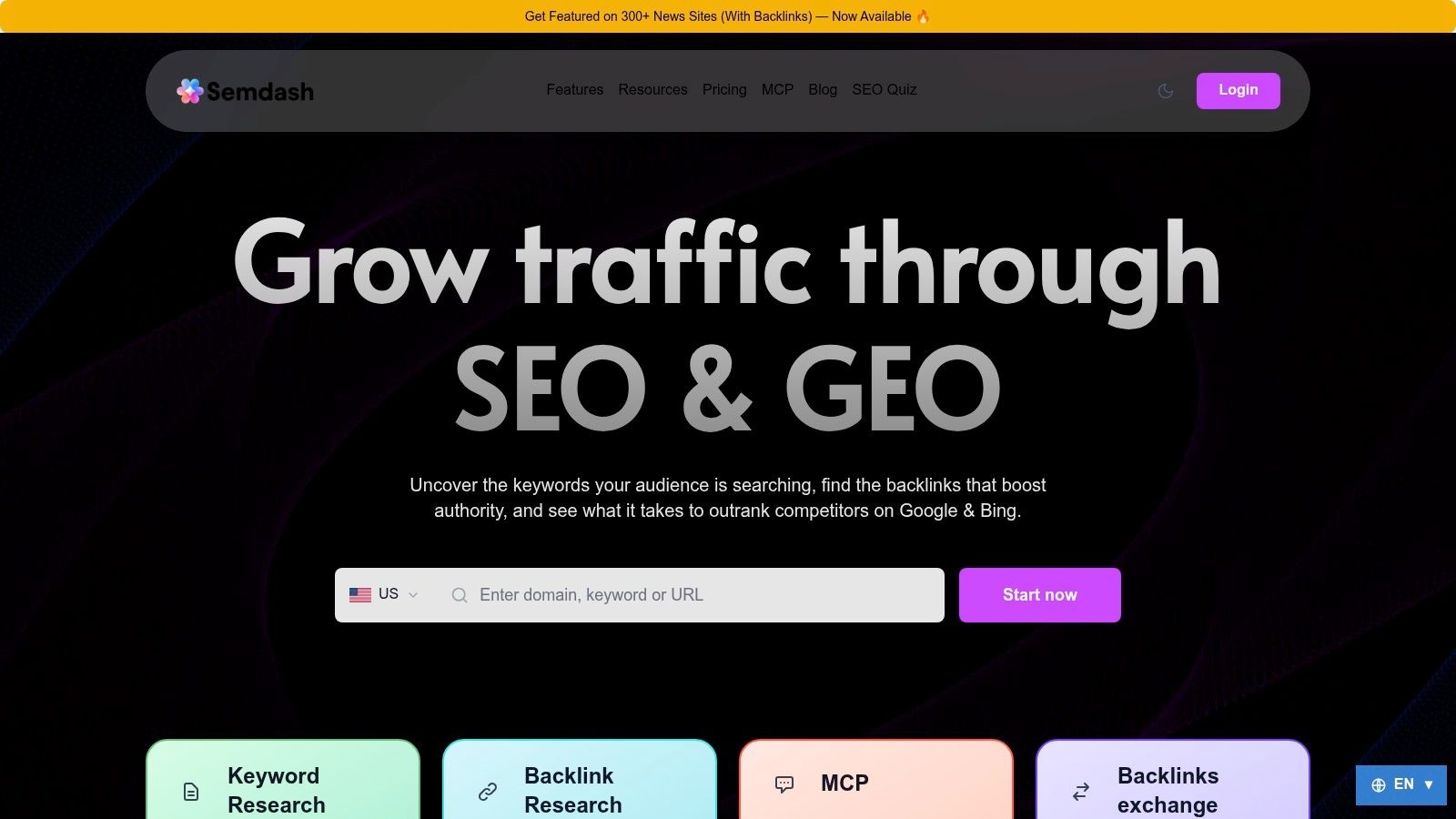
SemDash fits teams whose competitor workflow starts with a domain or page and ends with a specific content, SERP, or outreach decision. It combines competitor discovery, content planning, SERP research, and link reclamation in one workspace. I would assess it before buying several specialist tools that repeat the same keyword and backlink work.
Its clearest strength is URL-level analysis. Domain Keywords and Keyword Gap reports show the terms driving a competitor's visibility and the exact pages ranking for them. That detail changes the recommendation. A keyword opportunity may require a new article, product page, category page, or update to an existing asset. Without the ranking URL, you are still guessing.
SemDash places keyword, backlink, and SERP data in the same workflow. Its published product information describes 6.6 billion Google keywords updated in the last 30 days, a 2.7 trillion-link index with more than 15 billion links crawled in the last 24 hours, and about 600 million SERPs refreshed monthly in its SEO research product information. The useful point is not the database scale by itself. Fresh competitor pages, recent link discoveries, and historical SERP context can be examined without moving between separate systems.
Where SemDash earns its place
Use Keyword Gap to separate organic opportunities from paid-search overlap, then inspect the competitor URLs before assigning work. Backlink Gap identifies domains linking to competitors but not to your site. Anchor text and page context make outreach more targeted, while unlinked brand mentions and broken-link recovery support reclamation work that keyword-first platforms often leave aside.
The 12-month SERP history helps explain why a competitor page gained or lost visibility. Intent and volatility signals support a practical choice: refresh, expand, consolidate, or leave the page alone. Keyword clustering, People Also Ask, People Also Search suggestions, and AI-assisted briefs then turn the findings into an editorial plan rather than a term list.
SemDash also tracks la visibilidad en los Resúmenes de IA, including queries that trigger domain mentions and the exact URLs cited in Google's AI answers. That gives teams a way to examine citation coverage alongside conventional rankings and backlinks. MCP connections to Claude or ChatGPT can provide those assistants with live SEO data instead of requiring pasted exports.
Regla práctica: Use SemDash to identify the page, keyword, SERP change, or referring domain that deserves action. The database size is not the deliverable.
The trade-off is coverage consistency. Some power users report fewer keyword matches for certain domains than they find in larger incumbent platforms. Public tier pricing was not included in the available product information, so verify quotas, bulk analysis limits, and enterprise requirements before committing. A free trial and “get started for free” option are available. Tutorials, an SEO Academy, live calls, a roadmap, and interfaces in English, German, Polish, and Spanish support adoption.
Mejor para: Page-level competitor reverse-engineering, content planning, AI citation visibility, SERP history, and link reclamation.
2. Semrush
Semrush remains the safest broad-suite choice for agencies and marketing teams that need SEO, paid search, reporting, site auditing, and competitive research under one login. I reach for it when the question extends beyond organic rankings and includes ad history, market comparisons, technical health, or client-facing reporting.
The platform's Domain and Keyword research workflows are useful for finding competitor overlap, top pages, paid terms, and content gaps. Position Tracking supports location and device comparisons, while Site Audit connects competitive discovery with the technical work required to compete. That breadth is the reason Semrush appears in so many agency stacks, but breadth also creates a risk: teams can spend more time navigating modules than deciding what to do.
Semrush has also added an AI Visibility module for monitoring brand and competitor presence in AI-generated answers, including prompts, citations, and sentiment. That makes it a more current option than a traditional SEO-only suite. Buyers should still test whether the prompts, engines, locations, and reporting outputs match their specific AI-search workflow before treating the module as a replacement for dedicated citation analysis.
For agencies, reporting is one of Semrush's clearest advantages. Scheduled reports, project organization, position tracking, and add-ons support recurring client work. The downside is budget complexity. Additional seats, report capacity, historical data, and expanded usage can change the total cost considerably, particularly for a small team that only needs competitor keyword and backlink analysis.
I'd choose Semrush over Ahrefs when paid search, technical audits, reporting, and broader digital marketing coverage matter as much as links. I wouldn't buy it beside another broad suite without a documented gap. A comparison of Semrush and Similarweb is useful when traffic intelligence is part of the decision.
Mejor para: Agency reporting, broad SEO and SEM coverage, paid-search intelligence, and teams wanting one established platform.
3. Ahrefs
Ahrefs is the tool I'd select when competitor analysis starts with backlinks, top pages, and content gaps. Its Site Explorer workflow makes it easy to move from a competitor domain to the keywords, pages, referring domains, and link patterns that support its organic visibility.
The strongest use case is reverse-engineering a competitor's content engine. I'll inspect Top Pages to find pages attracting search demand, then compare those URLs with their referring domains and ranking terms. That combination shows whether a page wins because it satisfies intent well, has accumulated strong links, or benefits from both. Content Gap and Link Intersect workflows are similarly practical when the output needs to become a publishing or outreach queue.
Ahrefs also includes Keywords Explorer, Rank Tracker, Site Audit, and Content Explorer. Verified site owners can use Ahrefs Free, while broader research runs through a credit-based system. Credits are not bad, but they require discipline. Bulk exports, repeated site audits, and exploratory work can consume access faster than expected, so I'd model a real month of research before selecting a tier.
The platform's main limitation is scope. Ahrefs is excellent for organic search, but it isn't the natural first choice for paid-search history, broad traffic-channel intelligence, or agency reporting across every marketing channel. It can also become expensive when several people need access or when a team runs heavy research workloads.
I'd choose Ahrefs instead of Semrush when backlink depth and content-gap analysis are the primary buying criteria. I wouldn't pay for both just because one dashboard feels more familiar. Use SemDash's comparison of Ahrefs and Majestic when the decision comes down to general SEO coverage versus specialist link analysis.
Mejor para: Backlink discovery, top-page analysis, content gaps, and organic competitor research.
4. Similarweb
Similarweb answers a different question from Ahrefs and Semrush: how does a competitor's digital traffic appear to be distributed across channels? That makes it valuable for growth, strategy, e-commerce, and market-sizing work where organic visibility is only part of the picture.
I use Similarweb when a ranking report doesn't explain the business. Two competitors can rank for similar terms while relying on very different acquisition models. Traffic and engagement estimates, channel breakdowns, audience information, and marketing-channel comparisons help identify whether a competitor is leaning on search, referrals, direct visits, display, social, or paid activity.
The platform also includes SEO Intelligence features such as organic overviews, keyword research, rank tracking, site audits, and backlinks. Its AEO Intelligence tools extend the analysis into AI brand visibility, sentiment, and citations. That combination is useful for a growth team that needs traffic context alongside search data, but it can be excessive for an SEO specialist who only needs keyword gaps and referring domains.
The biggest trade-off is data interpretation. Traffic estimates are directional, especially for smaller sites, and shouldn't be presented as first-party analytics. I use them to compare patterns and channel mix, not to claim that a competitor receives an exact volume of visits. Higher-end capabilities, API access, and data feeds typically require enterprise discussions, while self-serve access is more suitable for initial benchmarking.
Similarweb is a poor substitute for a page-level SEO tool. It can tell you how a competitor's digital presence is shaped, but you'll still need SemDash, Ahrefs, or Semrush to inspect the exact pages and links behind organic performance.
Mejor para: Traffic intelligence, channel mix, audience benchmarking, and market-level competitor sizing.
5. Moz Pro
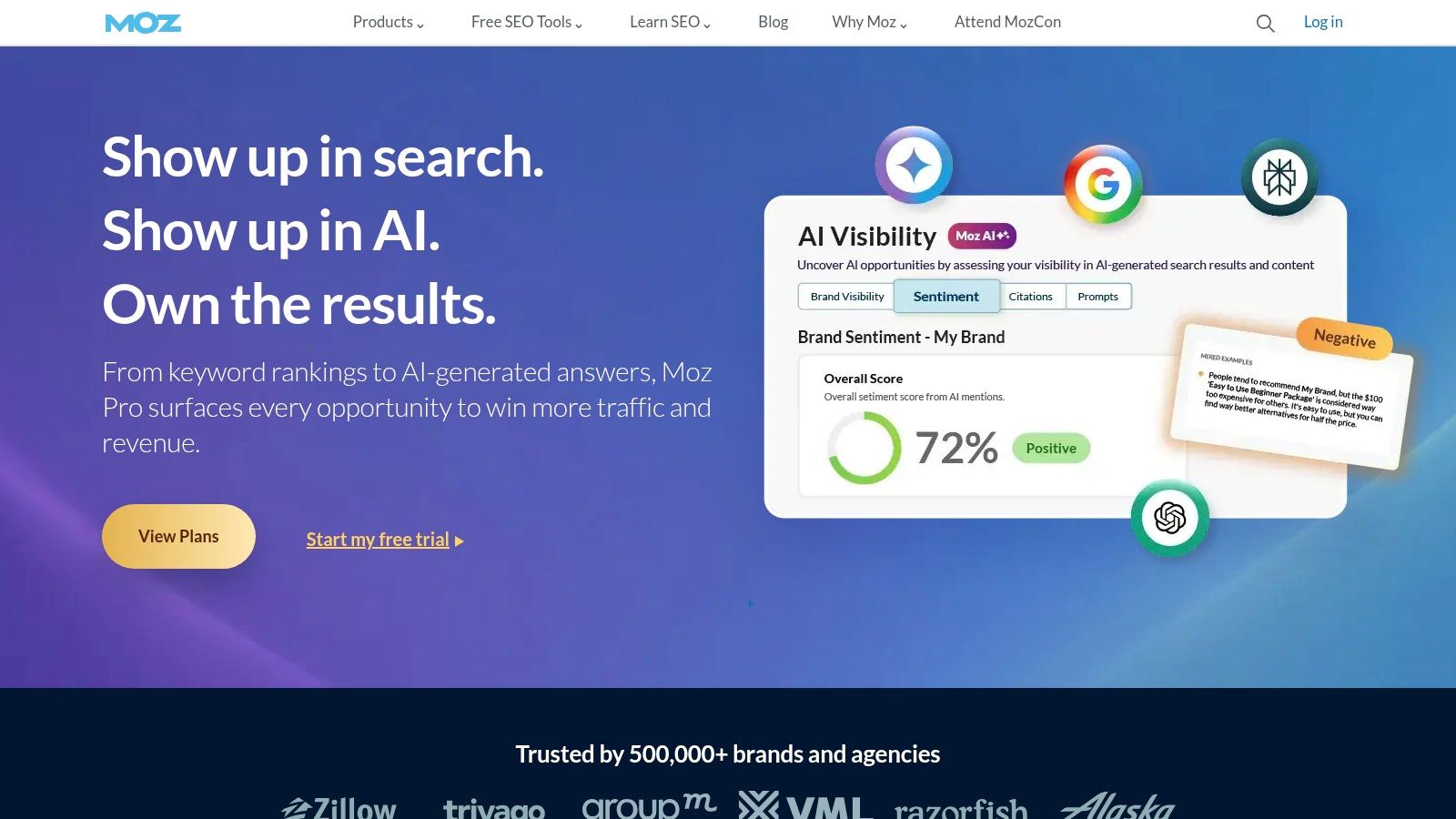
Moz Pro is the most approachable option in this list for teams that want structured SEO workflows without the density of a large enterprise suite. Its familiar Domain Authority and Page Authority metrics make competitor conversations easier for clients and non-specialist stakeholders, although I never treat either metric as a substitute for analyzing relevance, intent, or actual ranking pages.
Keyword Explorer, Rank Tracker, Site Crawl, and Link Explorer cover the core competitive workflow. A small in-house team can compare keyword opportunities, monitor rankings, identify technical problems, and review competitor links without assembling a complicated process. Moz's learning resources and support also reduce the time required to train a new marketer.
The product works best when clarity matters more than maximum database depth. I'd use it to create an understandable baseline for a local business, small SaaS company, or agency client that needs repeatable reporting. Its plan structure and add-ons make capacity easier to inspect than some usage-heavy platforms, though teams should still check campaign, keyword, crawl, and seat limits before choosing.
Where Moz Pro falls short
Power users often find Moz's link coverage and discovery speed less complete than Ahrefs or Semrush. That difference becomes obvious when researching a large competitor, comparing many referring domains, or trying to find less prominent link opportunities. If link prospecting is the central job, I'd test the same competitor in Moz and a specialist tool before making the purchase.
Moz Pro also isn't the best choice for AI Overviews monitoring, traffic-channel intelligence, or advanced competitive paid-search research. It is a dependable SEO suite, not a complete digital intelligence platform.
Mejor para: Accessible SEO education, authority benchmarking, rank tracking, and structured workflows for small teams.
6. SpyFu
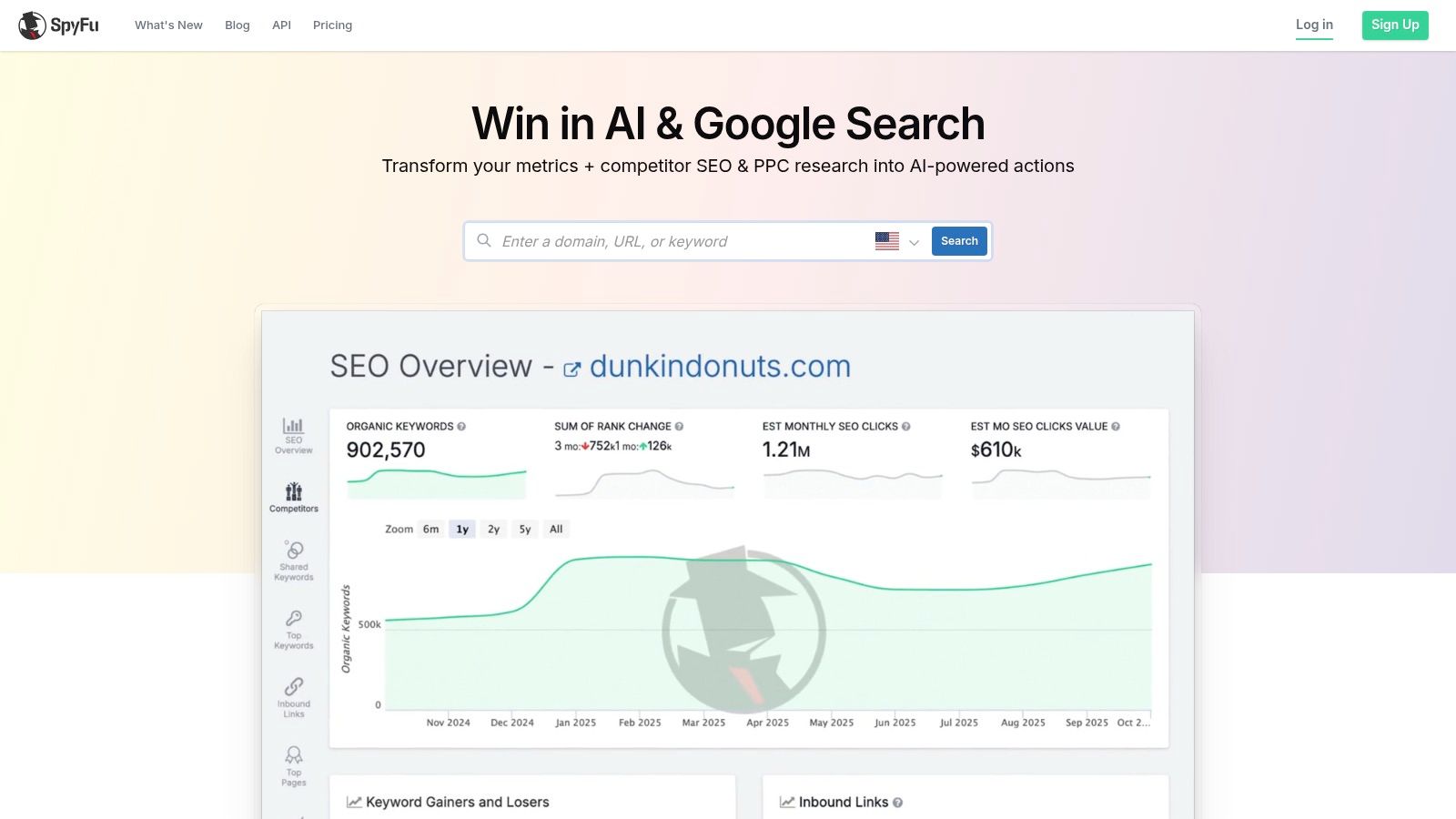
SpyFu is built for reverse-engineering competitors' SEO and Google Ads activity, particularly when paid-search history is central to the research. I'd put it on the shortlist for a lean agency or growth team that wants to inspect competitor keywords, ad copy, landing pages, and historical advertising patterns without paying for every separate module.
Its value comes from the relationship between organic and paid data. You can see which terms a competitor targets in search, how its ad messaging has changed, and which keywords appear repeatedly in its strategy. That helps distinguish a short campaign from a durable commercial priority. PPC analysts can also use ad history and ad-copy research to identify claims or offers that competitors keep returning to.
Higher Professional and Team plans offer unlimited exports and search results according to the product positioning, while API access and custom-branded reporting support larger workflows. That model can be attractive for agencies that export data frequently. It also makes SpyFu easier to budget than tools where every exploratory query consumes credits.
The main limitation is freshness and database breadth. Rank tracking refreshes weekly by default, so I wouldn't use SpyFu as the only platform for a fast-moving SERP monitoring program. Its data depth can also trail broader enterprise suites, particularly for niche markets, international campaigns, or large-scale backlink analysis.
I'd choose SpyFu when the decision involves competitor ads, long-term PPC messaging, and affordable research volume. I'd pair it with a specialist backlink or SERP-history platform rather than asking it to cover every SEO requirement. That combination avoids buying a second all-in-one suite just to obtain better ad intelligence.
Mejor para: Competitor PPC research, ad-history analysis, SEO and paid-search overlap, and budget-conscious agencies.
7. SISTRIX
SISTRIX is particularly strong when the job is understanding historical search visibility across countries, especially in European markets. Its Visibility Index gives teams a consistent way to inspect how domains and directories have changed over time, rather than relying only on the latest ranking snapshot.
That historical view changes how I investigate competitors. If a rival's visibility rises sharply, I want to know whether new content, algorithm changes, brand demand, SERP features, or a specific directory drove the movement. SISTRIX helps expose those trends and supports country-level comparisons that are useful for international SEO planning.
The platform includes keyword research, domain analysis, backlink data, a site crawler, and newer AI visibility tools such as AI Check and Prompt Tracking. The AI features are relevant when the research question expands from “where does this domain rank?” to “how does this brand appear in AI answers?” As with every AI visibility product, I'd test the tracked prompts and markets against the questions my team cares about.
SISTRIX uses modular pricing with published quotas, which is helpful for planning. The trade-off is that advanced quotas and API access sit on higher tiers, and prices are presented in euros. Teams outside Europe should confirm currency, regional coverage, and the exact country databases before purchasing.
I'd choose SISTRIX over a broader suite when historical visibility and European search markets are the decisive requirements. It isn't the simplest tool for occasional beginners, and it may not replace a full agency reporting platform. Its strength is focused trend analysis, not trying to own every marketing workflow.
Mejor para: Historical SERP visibility, European SEO research, country comparisons, and AI-answer monitoring.
8. Serpstat
Serpstat is a value-focused all-in-one platform for teams that need keyword research, domain and URL analysis, rank tracking, audits, backlinks, and scheduled reports without moving immediately into a premium enterprise suite.
Its competitor workflow is straightforward. Start with a domain or URL, inspect ranking keywords and visible pages, compare gaps, then add the findings to a rank-tracking or reporting process. Top-100 SERP tracking is useful for teams that want to monitor a broader field than only first-page results. That can expose emerging competitors before they become established threats.
Serpstat also supports AI Overviews keyword tracking and integrations with large-language-model workflows, including MCP and other LLM connections. API access begins at the Team tier according to the product positioning, which gives agencies and internal data teams a route into automation without requiring a separate enterprise procurement process.
The trade-off is execution speed. The interface and crawling can feel slower than premium suites during larger research jobs, and the brand has less market familiarity than Semrush or Ahrefs. That matters when clients expect a specific platform or when multiple analysts already know a competing workflow.
I'd select Serpstat when quotas and annual value matter more than the smoothest interface. Before signing up, I'd run the same competitor domains through Serpstat and one incumbent, compare URL-level keyword coverage, inspect backlink freshness, and test a scheduled report. If the findings support the decision just as well, the lower operating cost can be meaningful.
Mejor para: Affordable all-in-one research, Top-100 SERP tracking, API access, and LLM-connected workflows.
9. SE Ranking
Clasificación SE balances rank tracking, competitor research, audits, on-page checks, reporting, and white-label workflows. I'd recommend it to small and mid-sized agencies that need a practical platform for recurring client work but don't need every advanced feature found in the largest suites.
The rank tracker is the operational center. Multi-location and device tracking let an agency separate local visibility from national performance, while competitor keyword and traffic research add context to client reporting. Website Audit and on-page checks help turn a competitor comparison into an implementation list rather than a monthly chart.
SE Ranking is also useful when reporting is part of the buying decision. White-label options and higher-tier API access support agency workflows, and the interface is generally approachable for teams that need to onboard several users. Add-ons can extend capacity without forcing a full enterprise procurement process.
The pricing caveat deserves attention. Official pricing cards can vary by locale, and Core, Growth, and Enterprise allowances differ. I wouldn't compare only the headline plan. I'd check how many projects, keywords, locations, competitors, crawls, report recipients, and API requests the actual team needs.
SE Ranking is not necessarily the best choice for the deepest backlink research, the broadest traffic intelligence, or advanced AI citation analysis. Its value comes from balance. If your agency needs a reliable central system for rankings, audits, competitive research, and client reporting, that balance may matter more than having the largest individual database.
Mejor para: Small and mid-sized agencies, rank tracking, white-label reporting, and balanced SEO operations.
10. Majestic
Majestic is the specialist choice when competitor analysis is primarily a link problem. It shouldn't be mistaken for a complete SEO suite, but it remains useful when the team needs deeper link context than its general platform provides.
Site Explorer centers on Trust Flow, Citation Flow, and Topical Trust Flow. I use those signals as screening aids, not as automatic judgments about link quality. A relevant link from a page with real topical alignment can matter more than a high aggregate score from an unrelated site, so the metrics need to be followed by page review and outreach qualification.
Majestic is useful for competitor link-gap analysis, prospecting, campaigns, reports, and large-scale backlink discovery. Topical context can help separate a competitor's genuinely relevant authority from links that are unlikely to transfer useful relevance to your own project. That distinction makes the tool valuable for agencies working in competitive sectors where generic link counts don't explain much.
The limitation is clear. Majestic doesn't provide the keyword, technical, content, paid-search, or SERP-history depth required for full competitor analysis. You'll need to pair it with SemDash, Ahrefs, Semrush, or another general SEO platform. That isn't necessarily wasteful. A specialist can be cheaper and more useful than buying a second broad suite whose backlink module overlaps with the first.
I'd choose Majestic when outreach quality and link topology are the primary deliverables. For a small site that only needs occasional competitor research, its narrower scope may not justify a separate subscription. For a link-focused agency, publisher, or consultant, it can add the missing layer.
Mejor para: Specialist backlink analysis, topical link context, Trust Flow research, and link prospecting.
Top 10 Competitor Analysis Tools Comparison
| Herramienta | Core features (✨) | Data scale & quality (★) | Value / Pricing (💰) | Público objetivo (👥) |
|---|---|---|---|---|
| SemDash 🏆 | ✨ Keyword (6.6B), Backlinks (2.7T), 12‑mo SERP history, AI Overviews, clustering | ★★★★★ Large, frequently refreshed datasets; URL‑level mapping | 💰 Budget‑friendly, free trial, competitive plans | 👥 Agencies, in‑house growth teams, solopreneurs |
| Semrush | ✨ All‑in‑one: keywords, backlinks, site audit, Position Tracking, AI Visibility | ★★★★★ Broad historical data, enterprise‑grade | 💰 Higher cost; modular add‑ons can raise total | 👥 Agencies, enterprises, marketing teams |
| Ahrefs | ✨ Backlink‑led Site Explorer, Keywords Explorer, Rank Tracker | ★★★★★ Market‑leading backlink index, fast competitor reports | 💰 Mid–high pricing; credit model, limited free tier | 👥 SEOs focused on backlinks & competitor research |
| Similarweb | ✨ Traffic & engagement analytics, channel mix, SEO overview, AEO | ★★★★☆ Strong real‑user panel & market benchmarks | 💰 Enterprise‑priced; self‑serve options available | 👥 Product teams, market analysts, enterprises |
| Moz Pro | ✨ Keyword Explorer, Site Crawl, Link Explorer, DA/PA metrics | ★★★★ User‑friendly metrics, moderate link depth | 💰 Mid‑priced with clear plans & add‑ons | 👥 Small teams, beginners, agencies seeking approachable tools |
| SpyFu | ✨ SEO + PPC competitor research, long ad history, rank tracking | ★★★☆☆ Decent database; weekly rank refresh | 💰 Low‑cost, generous exports on higher plans | 👥 Budget agencies, PPC‑focused competitors |
| SISTRIX | ✨ Visibility Index, deep historical trends, AI visibility checks | ★★★★☆ Strong EU coverage, precise historical visibility | 💰 EUR pricing; modular tiers, enterprise costs for API | 👥 EU teams, analysts needing long‑term trends |
| Serpstat | ✨ Keyword/domain analysis, Top‑100 rank tracking, AIO/LLM integrations | ★★★★ Competitive quotas; good mid‑tier data | 💰 Very competitive annual pricing, sizable quotas | 👥 SMBs, agencies on a budget, LLM‑integrated workflows |
| Clasificación SE | ✨ Rank tracking, site audits, reporting, white‑label, API on higher tiers | ★★★★ Reliable tracking, multi‑location/device | 💰 Good value per seat, transparent Core/Growth/Enterprise tiers | 👥 Small‑mid agencies, consultants |
| Majestic | ✨ Backlink explorer, Trust/Citation/Topical Flow metrics | ★★★★ Strong link‑signal metrics; backlink‑focused | 💰 Low entry for backlink needs; narrow scope | 👥 Link analysts, specialists pairing with other suites |
Choose the Workflow You Will Actually Use
The best competitor analysis tools don't win because they contain the most modules. They win when they answer a defined question quickly enough for someone to act on the answer. A keyword gap that never becomes a page brief, a backlink report that never becomes outreach, and a traffic estimate that never changes a market decision are all expensive forms of unused information.
Start by mapping the workflow you need:
- Content planning: Use domain and page-level keyword gaps to find terms competitors rank for, then inspect the exact URLs and SERP intent before assigning a new page or update.
- Link acquisition: Use backlink gaps, referring-domain comparisons, anchor context, and linkable competitor pages to build a qualified outreach list.
- Market sizing: Use traffic estimates, channel breakdowns, audience data, and competitive intelligence to understand how rivals acquire attention. Treat estimates as directional, not as first-party analytics.
- Content updates: Use historical SERPs, volatility signals, intent changes, and ranking-page comparisons to decide whether to refresh, consolidate, expand, or redirect a URL.
- Agency scale: Prioritize reporting, white-label delivery, project capacity, user access, quotas, scheduled reports, and API availability over an impressive but unused feature list.
Test representative domains before buying. Use one large competitor, one smaller competitor, one international or local competitor if relevant, and your own domain. Run the same comparisons in every shortlisted platform. Check whether each tool finds the same ranking pages, keywords, referring domains, SERP changes, and traffic patterns. Differences are not automatically proof that one platform is wrong, but they show where each database and methodology needs interpretation.
Pricing deserves the same practical treatment. Verify current tiers, seats, credits, exports, historical access, API limits, location coverage, and reporting allowances. The SEO tool market is expanding, and one estimate places it at $5.8 billion in 2025 with a projection of $17.4 billion by 2034, while another projects growth from $7.12 billion in 2025 to $14.55 billion by 2031, as reported by DataIntelo's marketing analytics research. Buyers have more options, but they also have more overlapping subscriptions to evaluate.
Don't automatically pair Semrush with Ahrefs, or SemDash with another all-in-one platform. Buy the second tool only when it fills a documented gap, such as better traffic intelligence from Similarweb, deeper specialist link analysis from Majestic, historical European visibility from SISTRIX, or paid-search history from SpyFu. If the second platform only reproduces the same keyword and backlink workflow, move that budget into analyst time, monitoring, or implementation.
Competitive analysis also extends beyond blue-link rankings. G2's SEO tools category lists competitor analysis as a highly rated capability, scoring 9.0 out of 10 compared with an 8.0 category average in its July 2026 listing, which signals how central this workflow has become for buyers. The same category lists Semrush with 3,275 reviews and a 4.5 out of 5 rating, according to G2's SEO tools category. Those signals support adoption, but they don't tell you which platform fits your data, workflow, or budget.
For most teams, the sensible starting point is one general platform and one clearly defined outcome. SemDash is a practical first evaluation when you want consolidated competitor discovery, URL-level content planning, keyword and backlink gaps, 12-month SERP intelligence, AI Overviews citation tracking, and link reclamation in one workspace. Semrush or SE Ranking may be better for agency reporting, Ahrefs or Majestic for link-heavy research, Similarweb for traffic and channel intelligence, SpyFu for paid-search history, and SISTRIX for historical visibility in European markets.
The decision isn't “which tool is best overall?” It's “which tool will my team open when a competitor moves, and what will we do with the evidence?” Choose the platform that makes that next action obvious, verify it with real domains, and keep the stack lean enough that the analysis becomes part of the operating rhythm rather than another unused dashboard.
SemDash brings competitor keyword and page discovery, backlink gaps, SERP history, AI Overviews citation tracking, content planning, and link reclamation into one cloud-based SEO workspace. If that workflow matches your needs, visit SemDash to test the platform, review current access options, and see whether it can replace overlapping competitor research tools in your stack.