%20(1)-B86R08ZzwhPzS6UZbG3mSxRWPCwGwn.png)


Most competitor backlink analysis starts with the wrong question: “How many backlinks does this site have?” That number is usually a distraction. A large export can contain irrelevant domains, duplicate links, weak placements, and relationships your business could never credibly reproduce.
The useful question is narrower: which domains link to several relevant competitors, publish links in your topic, and have a realistic reason to link to your site? That shift changes the work from exporting lists to reading patterns, qualifying opportunities, and planning outreach around conversion math.
Tabla de contenido
- Why Most Competitor Backlink Analysis Fails
- Selecting the Right Competitors for Backlink Research
- Running a Backlink Gap Analysis and Reading the Data
- Turning Gap Data into Link Acquisition Opportunities
- Building an Outreach Plan With Realistic Conversion Math
- Common Mistakes That Waste Your Link Building Budget
- Your Competitor Backlink Analysis Workflow Checklist
Why Most Competitor Backlink Analysis Fails
Most practitioners open Ahrefs, Semrush, or another backlink tool, enter one competitor, and export every referring domain. The spreadsheet looks impressive, but it rarely tells you what to do next. A single competitor may have links from major publications, unrelated directories, old campaigns, partnerships, or pages built around assets you don't have.
The tool isn't the problem. The export-and-blast method is. A domain that links to one competitor may have done so because of a unique relationship, a local event, a proprietary study, or a one-off news story. Treating that link as universally replicable wastes research time and outreach capacity.

Overlap is stronger than volume
I start with three to five direct competitors, then look for referring domains that link to multiple rivals but not to my site. This intersection is valuable because it combines topical relevance with demonstrated willingness to link. If a publication has already linked to several sites in the same search cluster, I have evidence that the editorial fit may exist.
A raw backlink count can't provide that context. One site can have many links from a small set of domains, while another has fewer links from a broader group of relevant publications. For acquisition planning, I care more about the number and quality of plausible referring domains than the total number of backlinks.
Regla práctica: Treat a domain linking to multiple relevant competitors as a priority signal, not an automatic outreach target.
The multi-competitor intersection approach also protects against scale bias. The largest brand in a market may have links from outlets, institutions, and partnerships that a smaller company can't realistically reproduce. I benchmark against the median or closest page-one competitors instead, because their link opportunities better reflect the SERP cluster I'm trying to enter.
Cold outreach reinforces the need for precision. A large study of 12 million emails reported an 8.5% reply rate, while summaries of well-run campaigns place email-to-backlink success around 3–5%, según backlink outreach benchmark data. If the target list is weak, even polished copy won't rescue the campaign.
Selecting the Right Competitors for Backlink Research
The competitor with the largest backlink profile may be the least useful benchmark. A national brand can sell the same service while ranking for different queries, and a specialist publisher can compete for your search terms without offering a similar product.
For backlink research, start with search competitors: sites ranking for the keywords and page types you need to improve. Business competitors provide market context, but their links may come from brand recognition, partnerships, or assets unavailable to your business. Those domains can inflate the opportunity list without improving its usefulness.
Build a practical competitor set
Use a defined selection process:
- Define the target cluster. Group the keywords tied to the page, service, or topic you want to grow. Keep commercial and informational intent in separate pools.
- Identify recurring ranking domains. Review the target results and record domains that appear repeatedly within the same topical cluster.
- Remove obvious scale outliers. Keep major publishers and household brands for context, but do not let their links set your acquisition priorities. Their placements may depend on reach, reputation, or partnerships you cannot reproduce.
- Choose three to five close rivals. Select sites with comparable audiences, content formats, topical focus, and search visibility. The link-gap workflow from Authority Builders also recommends identifying genuine SEO competitors before qualifying domains by relevance, authority, and traffic.
- Check page-level similarity. Match the competitor's ranking page to your own intent and format. Compare guides with guides, category pages with category pages, and tools with tools.
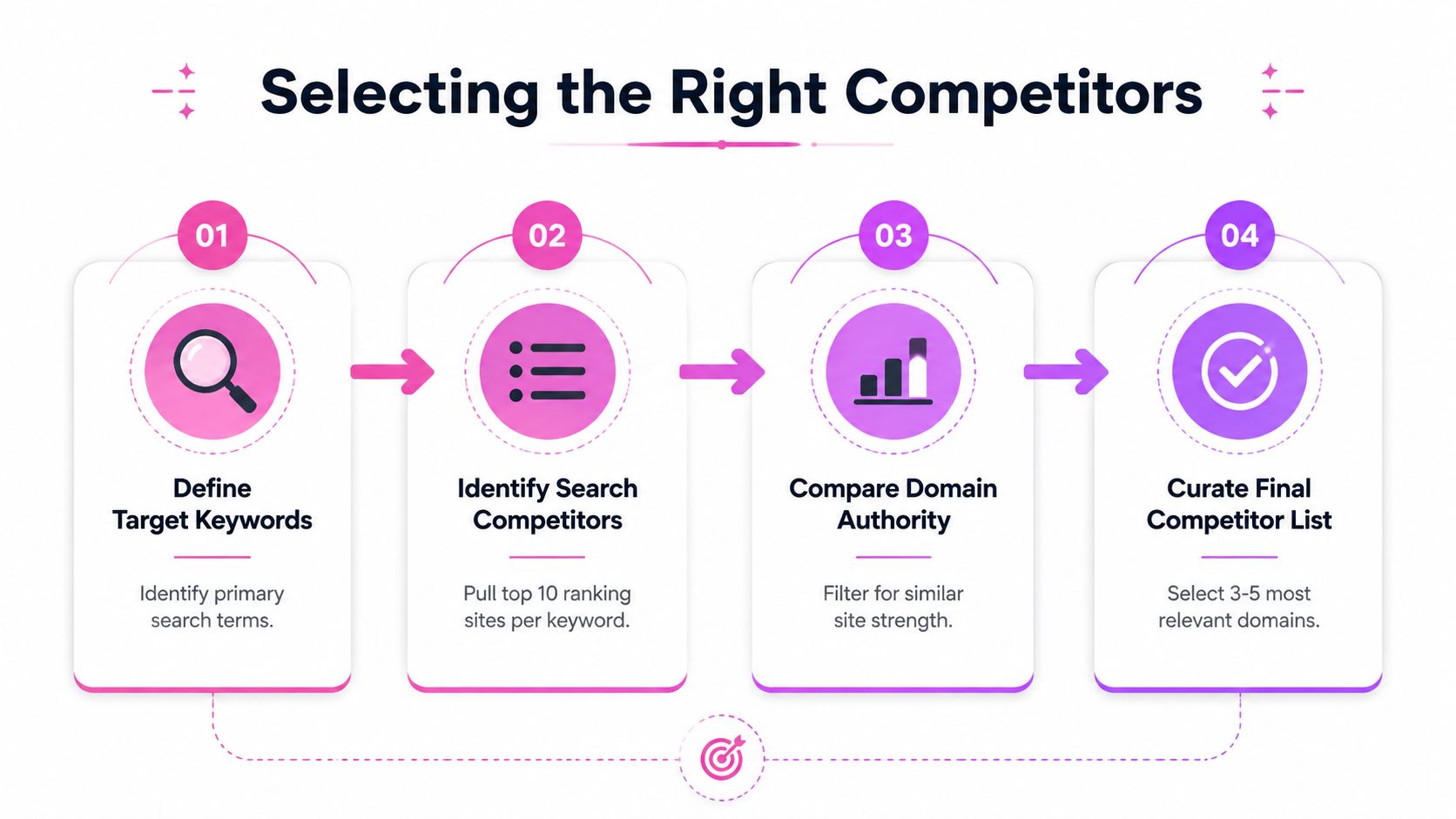
The goal is a closest useful comparison group, not the strongest domain in the market. A smaller specialist ranking beside you can expose attainable resource pages, niche publications, partnerships, and editorial formats that a global brand's profile conceals.
I separate domain-level research from page-level research. Domain analysis maps the wider set of referring sites, while page analysis shows which assets attract links for a specific query. I use both views before building an intersection across several competitors. A domain linking to multiple relevant rivals is a stronger replication signal than one appearing only because of a single competitor's unusually large authority profile.
That distinction matters for outreach math. A tightly filtered list gives each prospect a clearer reason to receive a pitch, while a large export mainly creates more contacts to qualify. Prioritize domains with repeated, relevant linking behavior before judging them by inflated authority metrics.
Running a Backlink Gap Analysis and Reading the Data
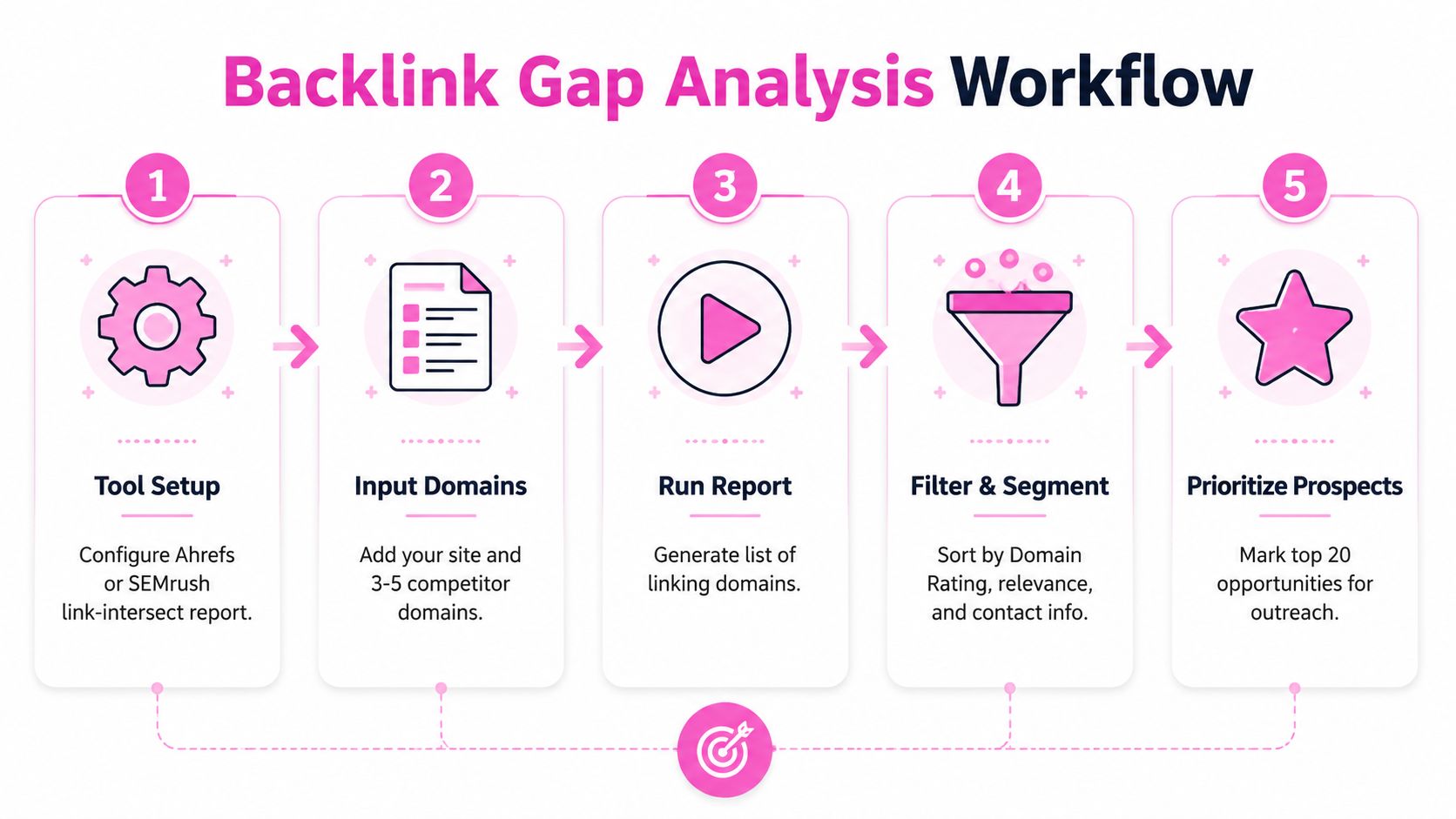
Once the competitor set is stable, run a multi-competitor link-intersect report with your domain and the selected rivals. The initial output shows domains linking to competitors but not to you. Treat it as a filtering exercise, not a prospect list. A referring domain may contain several opportunities, each with a different level of relevance and practical access.
Empieza con overlap count. A domain linking to several comparable competitors usually deserves earlier review than one linking to only one, provided the subject and page type fit. Then inspect the exact linking pages, destination URLs, link attributes, anchor text, and surrounding copy. Repeated appearances across relevant competitors are stronger evidence of a replicable pattern than a single link from a dominant site.
Read the page, not just the domain
A domain-level metric can show authority, but it cannot show whether the site accepts editorial contributions, maintains resource pages, cites original research, or adds links to existing articles. Open the linking page and check:
- What earned the link? Identify whether it was a guide, data asset, product page, interview, calculator, study, or contributed article.
- Where is the link placed? Body copy, author bio, resource list, sidebar, footer, and navigation imply different acquisition routes.
- What does the anchor say? Branded or descriptive wording can reveal the linked page's role. Repeated commercial anchors are a warning, not a template.
- Does the page still receive attention? Recent activity, current links, and maintained content make a prospect more useful than a neglected archive.
- Would my page improve the article? If not, remove the domain from the active outreach queue.
Revisar referring domains, total backlinks, dofollow share, and anchor text together. The actionable signal often appears at page and anchor level rather than in domain totals. The link-building outreach analysis also cautions against pursuing high-DR sites that rarely place editorial links.
Rank prospects by evidence of fit and access. A domain linking to several rivals but offering no comparable page may sit below a less authoritative publication that regularly cites useful resources and has a clear editorial route. Record the observed link type, likely contact, matching asset, and any reason the placement may be difficult.
For domain and page-level backlink discovery in one workflow, use SemDash Backlink Research to inspect referring domains, linked pages, anchors, and competitor gaps.
The finished report should contain a short, reviewed queue, not thousands of unchecked rows.
Turning Gap Data into Link Acquisition Opportunities
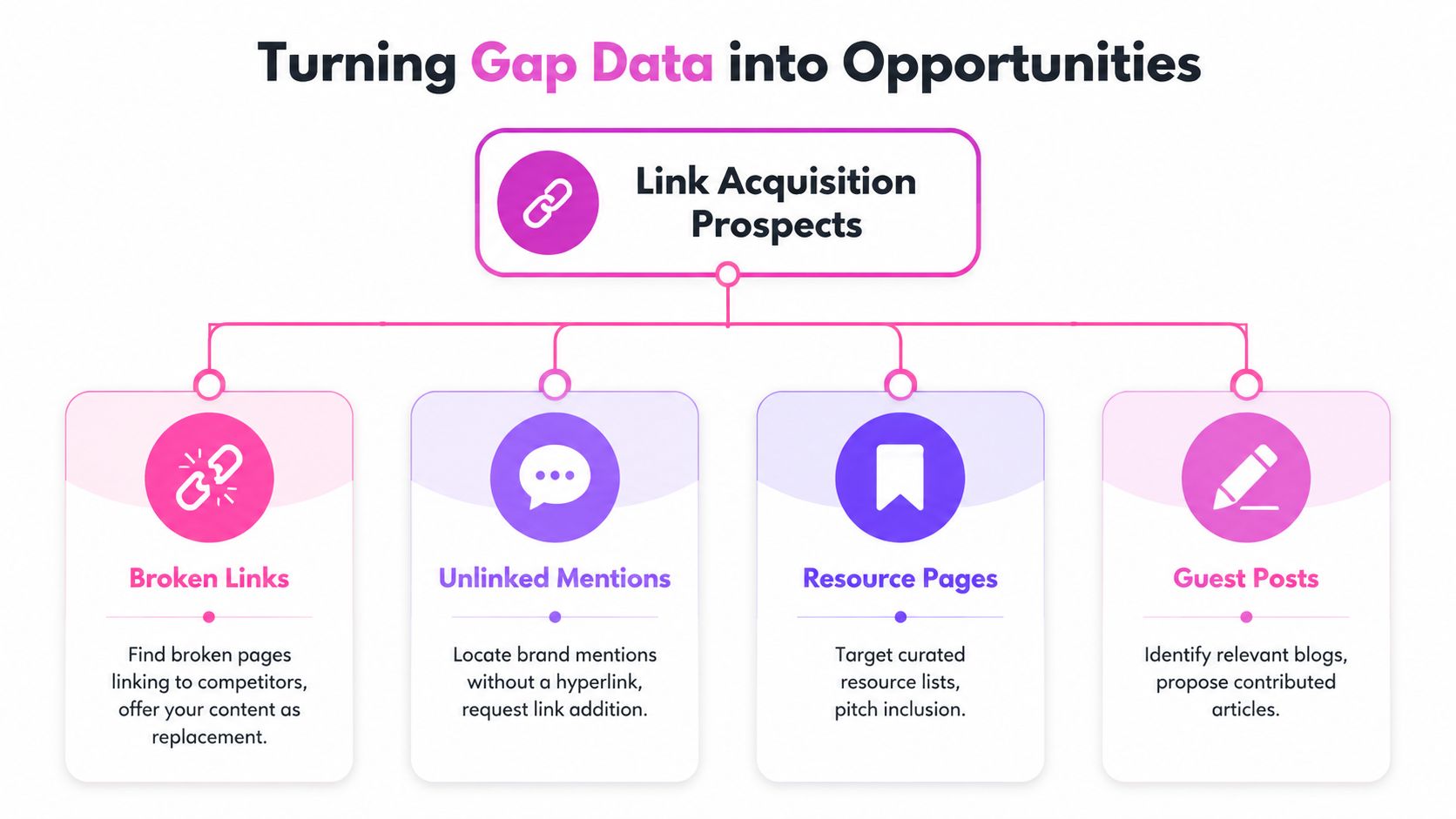
A gap report earns its place in a campaign only when each prospect has a plausible acquisition route. Multi-competitor intersections help here. A domain linking to three competitors is more useful than a domain appearing once, but only if the linked pages reveal a repeatable editorial reason. Classify the opportunity before writing an email.
Broken links need a matching replacement
Broken-link building starts with a dead outbound URL, not a generic request for exposure. Find the page that formerly met the destination's purpose, then create or select a replacement with comparable depth and intent. After that, identify pages still linking to the dead resource and explain why your page fits.
The replacement must match the original job. A short overview will rarely substitute for a detailed guide, tool, or reference page. The Moz broken-link workflow covers checking high-value pages and filtering for 4xx status codes, a useful process for finding dead assets across competitors and the wider market.
Resource pages reward clear relevance
Resource pages state their purpose, which makes qualification faster. Prioritize collections that already include comparable guides, tools, or educational references. Outreach should name the relevant section and show what the proposed resource contributes. A homepage pitch gives the editor no clear reason to add it.
Competitor-only domains need context
A domain linking to several competitors is a lead, not proof of replicability. Inspect the linked assets and the surrounding editorial pattern. If the intersection consists of original research, prepare a credible research asset. If the links sit in contributed articles, assess whether a relevant editorial proposal fits the publication. If they cite existing content, improve a page that can answer the same reader need.
This filtering prevents inflated authority metrics from driving the queue. A lower-authority publication with a visible fit and a workable editorial route can be more valuable than a larger domain that rarely links out.
Unlinked mentions are a separate recovery queue
An unlinked mention names a brand, product, or person without a hyperlink. The publisher may already recognize the entity, so this is reclamation rather than cold prospecting. Use the unlinked brand mention workflow to find the mention, verify that the destination would help readers, and contact the relevant editor.
According to unlinked mention research summary, around 20% of digital PR placements arrive without a link on first publication. Treat that figure as a reason to audit existing coverage, not as a forecast for every campaign. Point to the exact wording and suggest the most useful destination URL. A focused correction request usually has a stronger rationale than a broad backlink ask.
Guest posts and link insertions may also appear in a competitor gap. Review the linking page, anchor context, and publication standards before pursuing them. The intersection matters only when the underlying placement can be reproduced without compromising relevance or editorial quality.
Building an Outreach Plan With Realistic Conversion Math
A qualified prospect list improves efficiency, but it cannot make outreach predictable. Most targeted contacts will not produce a link, even when the domain is relevant and the email reflects its content. The useful forecast starts with your own campaign history, segmented by prospect type and placement format.
The published benchmarks below provide a planning baseline, not a promise. One large study reported an 8.5% reply rate from 12 million emails, while well-run campaigns place email-to-backlink conversion around 3–5%, según outreach conversion benchmarks. That range implies roughly 20–30 targeted sends for one backlink when the list is qualified and the offer fits.
| Métrica | Benchmark | Source Context |
|---|---|---|
| Cold outreach reply rate | 8.5% | Large study of 12 million emails, Arvow |
| Email-to-backlink success | 3–5% | Summaries of well-run campaigns, same benchmark source |
| Targeted sends per backlink | Roughly 20–30 | Practical implication of the cited conversion range, same benchmark source |
| Generic cold-email response | 3.43% | Newer outreach benchmarks, Backlynk |
| Response lift from three or more follow-ups | 160% | Reported comparison with a single email, same benchmark source |
Use the math to set workload, then adjust it by opportunity quality. A broken-link prospect needs a credible replacement explanation. A resource-page editor needs a concise reason to include the asset. A publication linking to several competitors needs a pitch matched to the content format it already accepts.
Follow-ups should introduce new information or a different angle. The benchmark reports that three or more follow-ups can lift responses by 160% compared with a single email, but that result does not justify repeated messages to poor-fit prospects. Stop when the recipient declines or the page no longer supports the proposed link.
Track sends, replies, positive replies, placement discussions, and live links as separate stages. That breakdown shows whether the constraint is list quality, offer fit, copy, or fulfillment. If replies are healthy but placements remain scarce, the message may create curiosity without offering a page an editor can confidently publish. Adjust the asset or qualification rules before increasing send volume.
Common Mistakes That Waste Your Link Building Budget
The costliest mistake is treating a high authority metric as proof that a backlink is worth pursuing. A domain can show strong DR while offering links only through sponsorships, paid placements, or closed relationships. Inspect the actual placement before assigning value. A topical publication with consistent editorial citations may offer a more realistic path than a prestigious site with no accessible route.
Use these checks before adding a prospect to an outreach queue:
- Classify the placement type. Separate editorial mentions, sponsorships, directories, contributed content, and partner links. A strong metric does not make every placement replicable.
- Inspect the destination page. Its format indicates the offer required, such as a replacement resource, data point, contributed article, or product explanation.
- Check anchor context. Reproducing a competitor's commercial anchor can create an unnatural pattern instead of improving relevance.
- Verify the publisher's maintenance. A neglected page, inactive editor, or broken submission process can consume outreach time without producing a placement.
A related error is mixing search competitors with business competitors. A commercially important brand may be irrelevant to the SERP cluster. Including it can fill the gap report with links earned through brand reach, partnerships, or media attention that your team cannot reproduce.
Static reports hide changing opportunities
A backlink export is a snapshot. Competitors gain and lose links, pages disappear, and resource lists change. Practitioner guidance recommends checking new and lost links over the past 30 days instead of relying only on static referring-domain totals, as discussed in this competitor backlink analysis guide.
Recent changes create two practical leads. A newly earned placement may reveal an active editorial relationship. A lost competitor link may identify a page where your current resource is a credible replacement. Neither signal is clear in a lifetime backlink count.
Avoid copying suspicious patterns. Irrelevant clusters and repeated manipulative anchors are warnings, not acquisition models. Remove them from the replicable opportunity set and keep your budget focused on placements with a plausible editorial rationale.
Your Competitor Backlink Analysis Workflow Checklist
I use the following checklist to turn competitor backlink analysis into a repeatable operating process rather than a one-time spreadsheet.
- Define the search cluster. Choose the pages and keywords you want to improve. Keep intent and content type consistent.
- Select three to five search competitors. Favor close page-one rivals over the biggest brands. Confirm that their ranking pages serve a comparable audience and intent.
- Run the intersection report. Add your domain and the competitor set. Isolate domains linking to competitors but not to you.
- Sort by overlap. Put domains linking to multiple competitors ahead of isolated referring domains, then review topical relevance and likely placement.
- Inspect the exact link. Record the linking page, destination URL, anchor wording, link attribute, surrounding copy, and apparent acquisition path.
- Qualify the publisher. Check whether the site is maintained, topically appropriate, and capable of making an editorial decision. Don't let a strong authority score replace this review.
- Classify the opportunity. Use categories such as broken link, resource page, competitor-only editorial placement, guest contribution, or unlinked mention.
- Prepare the asset first. Create the replacement guide, data page, comparison, tool, or updated resource before contacting the publisher.
- Write a segment-specific pitch. Mention the exact page and explain the concrete benefit to its readers. Avoid uniform templates.
- Set realistic expectations. Use the cited outreach benchmarks to size the campaign, but judge performance by positive replies and live links, not sends alone.
- Track outcomes. Record contact status, response, proposed URL, placement status, anchor, and date verified.
- Refresh the report. Review new and lost links over the past 30 días, using the recency-focused competitor analysis guidance to catch decaying opportunities and recent competitor activity.
The workflow works because each stage reduces uncertainty. Competitor selection removes unrealistic comparisons, intersection analysis surfaces demonstrated demand, page inspection reveals the acquisition path, and segmentation gives the outreach a credible reason to exist.
Use that process on a focused cluster first. Build the asset, contact the highest-fit prospects, record what editors accept, and use those observations to improve the next intersection report.
SemDash brings keyword, SERP, domain, page, and backlink gap research into one workspace, so you can move from competitor discovery to qualified link prospects without rebuilding the analysis across separate tools. Visit SemDash to inspect competitor backlink profiles, compare overlapping referring domains, and turn the findings into a practical acquisition plan.