

Most SEO advice still starts with the same question: How do we reach position one? That question is incomplete now. I care about rankings, but I care more about whether a searcher clicks, whether an AI-generated answer cites the page, and whether the brand remains memorable when Google answers the query without sending a visit.
Organic search still supplies the largest share of trackable website traffic. BrightEdge's historical research reported 51% in 2014, 53% in 2019, y 53.3% in a 2024 synthesis, compared with about 5% from social media and roughly 15% from paid search (BrightEdge's organic traffic research). That makes SEO too important to manage as a vanity ranking exercise.
The practical shift is simple: increase organic search traffic by engineering clicks and citations, not by publishing more pages or chasing every head term. Here's the operating system I'd use after seeing pages rank well while their sessions, leads, and revenue weakened.
Tabla de contenido
- Why Most Organic Traffic Advice Stops Working in 2026
- Set a Real Baseline Before You Touch Anything
- Target Keywords by Intent and Gap, Not Volume Alone
- Build a Content Engine Around Refresh, Not Just Output
- Technical SEO Fixes That Quietly Unlock Rankings
- Acquire Links the Way Editors Actually Give Them
- Your 90-Day Organic Growth Operating Cadence
Why Most Organic Traffic Advice Stops Working in 2026
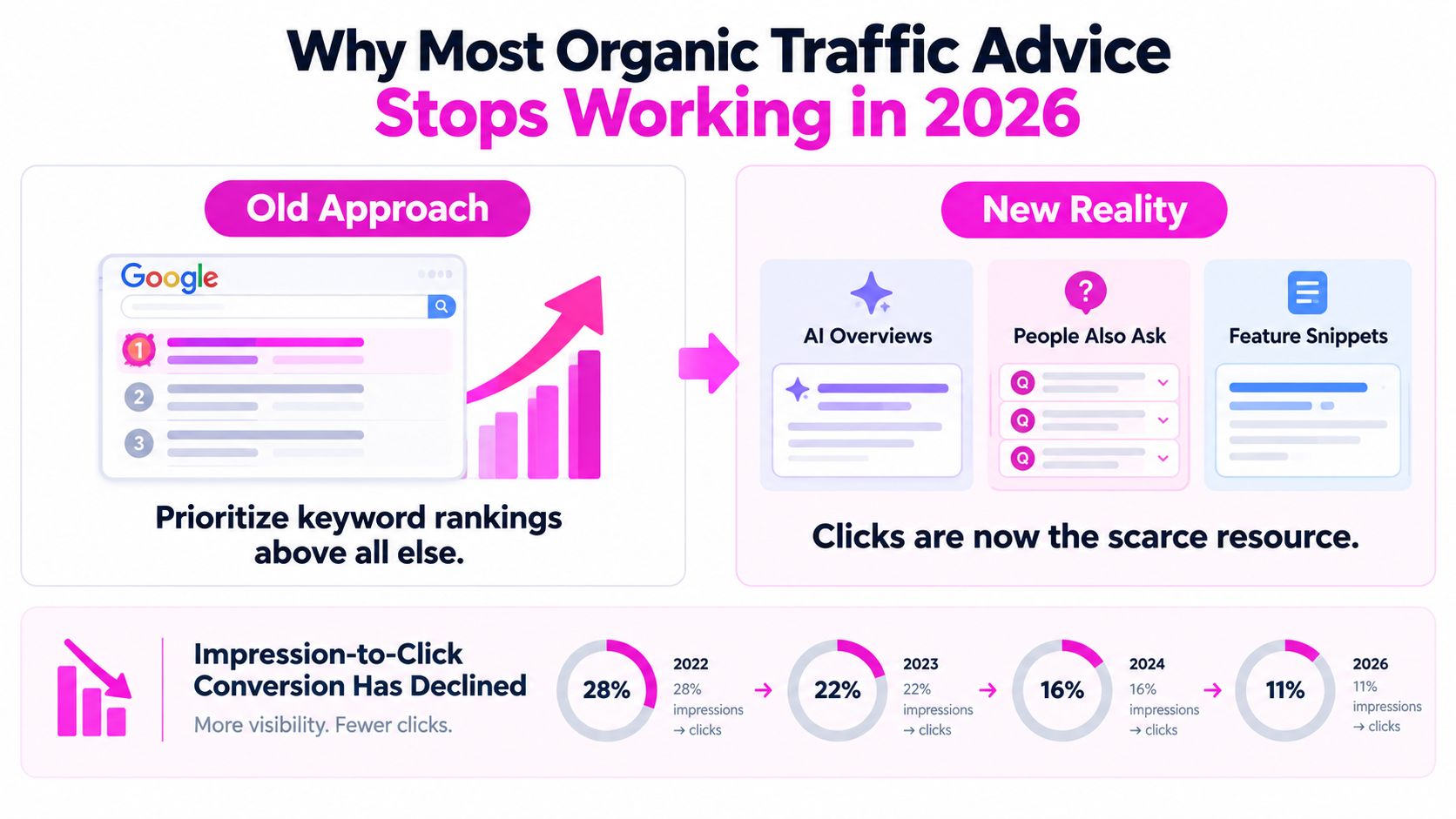
A page can hold its ranking and still lose the value of that ranking. AI Overviews, expanded People Also Ask results, and featured snippets increasingly answer informational queries before searchers reach a blue link. Stable positions can therefore hide a shrinking opportunity to earn visits.
A randomized field experiment found that AI Overviews reduced outbound organic clicks by 38% on queries where they appeared. Zero-click searches also rose from 54% to 72% (the field-study coverage from The Stack). That result changes how I evaluate SEO work. Visibility alone is no longer enough. A page needs to attract the click, contribute information that an AI answer can cite, or create a reason to continue to the site.
The new search math
Traditional SEO treated the results page as a contest for roughly ten comparable links. Current SERPs combine answer boxes, related questions, shopping or local features, and fewer visible organic listings. Your page competes with other sites and with Google's ability to satisfy the query without a visit.
Top positions still carry value. Advanced Web Ranking reported that, in July 2026 on Google US desktop, position one averaged 20.02% organic CTR, position two 10.36%, and position three 3.89% (Advanced Web Ranking's organic CTR study). Different studies report different rates because their datasets and methods vary, but the practical conclusion holds: moving into the top results can still produce meaningful gains when the SERP leaves room for clicks.
I use three tests for every priority query: Can this page rank? Can its result earn the click? Can it become a useful cited source if the visit disappears?
Broad informational terms often produce the weakest return. They attract heavy competition and face strong exposure to answer features. I would rather win a narrower commercial investigation query with a clear comparison page than spend months pushing a generic definition into a SERP where Google already supplies the answer. That prioritization favors pages with durable click or citation value, not rankings that look impressive in a report but generate little business.
Set a Real Baseline Before You Touch Anything
I don't begin with a content calendar. I begin by writing down what the site currently earns from Google, which pages earn it, and what kind of demand sits behind those clicks.
Use the previous full month as the operational benchmark, as recommended in this SEO benchmarking workflow. A complete month avoids partial-period noise and gives the team a repeatable comparison point. Keep a longer historical view as context, because a 16-month window can help separate ordinary movement from the effects of a Google core update, but use the prior full month as the clean working baseline.
Build the Search Console view
In Google Search Console, open Performance and set:
- Search type: Web
- Date: Previous full month
- Comparison: Previous period, then previous year when seasonality matters
- Search appearance: Review separately where available
- Queries: Exclude brand terms for the non-branded view
- Páginas: Export landing-page data and classify each URL by template
Create separate query groups for branded, non-branded informational, y non-branded commercial demand. The exact filter depends on your brand vocabulary, so maintain a regex list that excludes the brand, product names, misspellings, and navigational variants. Save the filters instead of rebuilding them from memory.

Google Search Console gives you impressions, clicks, and CTR, with CTR calculated as clicks divided by impressions (Google Search Console metric definitions). I flag high-impression pages with falling CTR as the likely AI-cannibalized set. Pages with declining average position but stable impressions belong in the algorithm-shaken set. They need different responses, one focused on click appeal and citation value, the other on relevance, authority, or technical stability.
Reconcile the visit data
In GA4, open Reports, then Acquisition, then Traffic acquisition. Filter the session default channel group to Organic Search, and save explorations that break performance down by landing page, branded versus non-branded query proxy where available, device, and conversion event. GSC measures search behavior before the click. GA4 measures what happened after it, so neither tool can replace the other.
I write down total organic clicks, organic sessions, non-branded clicks, branded share, landing-page conversions, and the top movers. If a team can't reproduce that report next month, it hasn't built measurement yet. For teams evaluating external digital products, a separate app testing in directory resource can also help when technical quality assurance needs to sit alongside SEO reporting.
Target Keywords by Intent and Gap, Not Volume Alone
High search volume is a poor default for growth. I have watched pages rank for impressive terms while sending little qualified traffic because the page type missed the SERP, competitors had stronger authority, or an AI Overview answered the query before a click happened. Keyword research should therefore begin with the click and citation opportunity, not the volume column.
Choose two or three competitors that outrank you on money pages. Ignore sites that only publish polished blog content unless they compete for the same commercial queries. Compare their product, category, comparison, and solution URLs, then inspect the live SERP for each gap. Before assigning a term to a writer, identify whether Google prefers a comparison, category page, video, forum discussion, calculator, or direct answer.
Use this keyword type framework to organize the research. Score each opportunity across four criteria:
- Business fit: Does the query connect to a product, service, or audience we can serve?
- SERP winnability: Can our current domain compete with the pages ranking today?
- Content cost: What format, evidence, design, and maintenance will the page require?
- AI Overview risk: Is the useful answer likely to appear without a visit, or does the user need a source, tool, comparison, or transaction?
| Enfoque | Time to Rank | Conversion Rate | AI Overview Risk | Mejor para |
|---|---|---|---|---|
| Broad head terms | Slow and authority-dependent | Often mixed | High for basic informational queries | Category ownership and brand recall |
| Intent clusters | Moderate, with supporting pages | Stronger when mapped to a funnel stage | Moderate, depending on query format | Building topical coverage around a commercial problem |
| Long-tail questions | Often faster when competition is lighter | Frequently stronger because the need is specific | Lower when the query requires experience or evaluation | Qualified discovery and conversion support |
| SERP-feature opportunities | Depends on format and competition | Variable | High if Google can answer directly | Citation visibility, snippets, and selective clicks |
Long-form content can earn links, but length is not a publishing brief. A large backlink and content study found that pages over 3,000 words earned 77.2% more referring-domain links than pages under 1,000 words, while most posts still earned no backlinks (Backlinko's content study). A separate analysis found that the relationship between content length and organic traffic weakened after about 2,000 words and eventually turned negative (analysis of content length and traffic). I cover the intent, proof, and decision points the query demands, then stop.
My planning rule assigns 70% of new content budget to long-tail terms and intent clusterscon 30% reserved for one or three authority plays per quarter. That allocation favors qualified clicks now while preserving room for assets that attract citations, links, and brand recall. It is a working split, not a universal law.
Build a Content Engine Around Refresh, Not Just Output
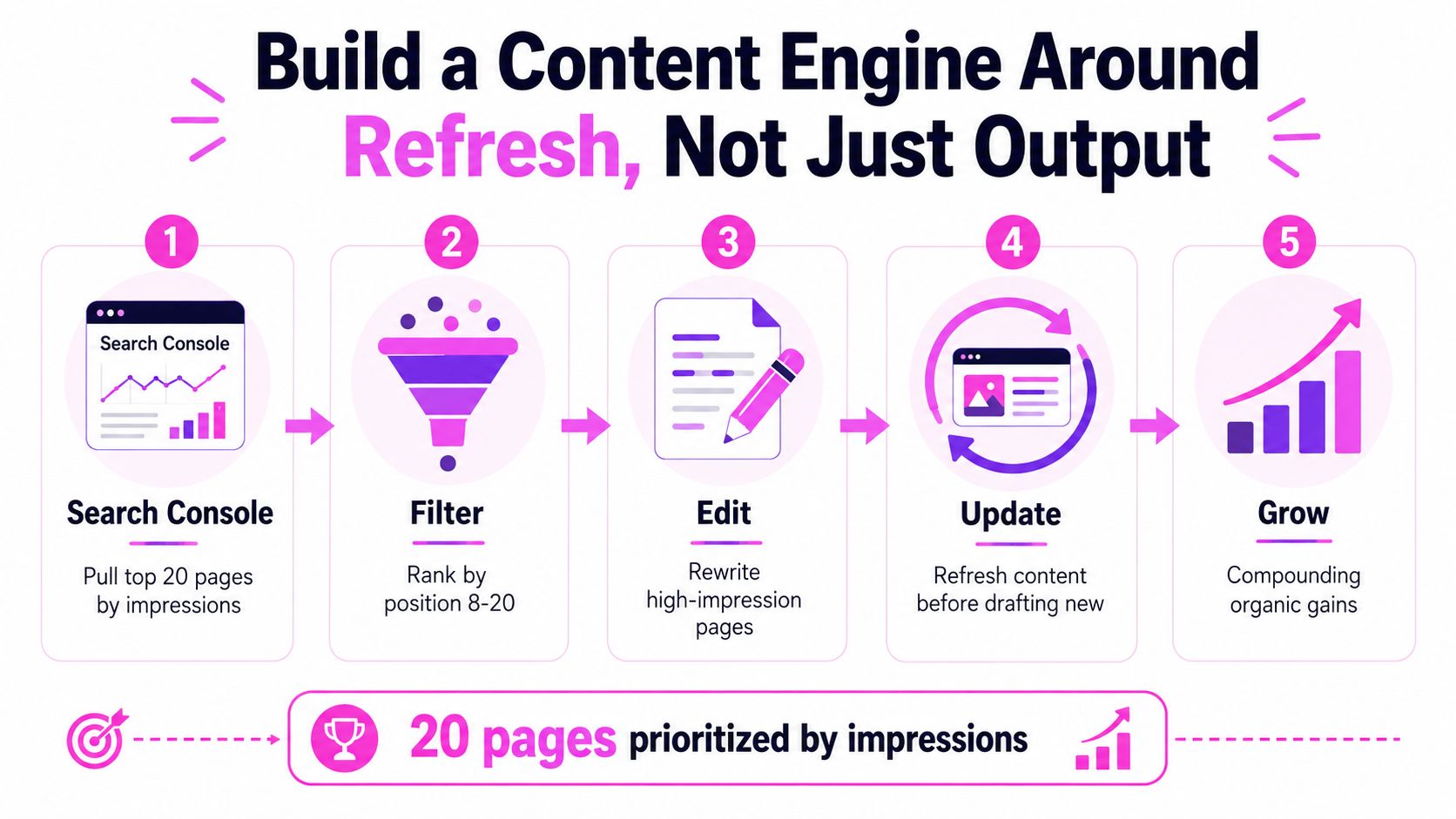
The highest-return content task is often already sitting in Search Console. I export the top 20 pages by impressions, filter for URLs ranking around positions 8 to 20, and compare each page with the current SERP. Those pages have evidence of demand and a realistic path to more clicks. A new article starts with no such evidence.
A study of more than 1,000 refreshed articles reported an average 43% organic traffic lift over six months, while other cited refresh experiments reported 106% average gains y una base de datos de 260.7% increase over 14 days in one relaunch case (content update impact study). I treat those figures as evidence that refreshes deserve serious priority, not as a promise for every site. Results depend on the starting page, query intent, competition, and quality of implementation.
My refresh brief
Before editing, I record the target query, the page's current clicks and impressions, the ranking URL, secondary queries, internal-link targets, the current title, and a proposed meta description. I then review the top results, People Also Ask questions, and the sources appearing in AI answers. The rewrite must answer the primary question immediately, ideally in the opening passage, rather than making readers work through a brand introduction.
I also check whether the intent changed. A guide that once ranked for “best platform” may now face comparison pages, product-led explainers, or review content. If the page type is wrong, better prose won't solve the problem.
Ship refreshes in two-week batches, add links from authoritative topical parents, and monitor CTR and average position weekly. Google's representative has stated that word count isn't a ranking factor, so I remove filler rather than adding paragraphs to reach an arbitrary target (Search Engine Land's discussion of content length).
Thin pages that overlap a target should be merged when consolidation creates a clearer resource. I only return a URL as 410 when it has no meaningful traffic or backlink history. Changing URLs casually can discard accumulated equity, so preservation and redirection decisions belong in the brief, not after publication.
Technical SEO Fixes That Quietly Unlock Rankings
Technical SEO rarely produces a dramatic spike on its own. Its value is that it removes ceilings from content, links, and internal architecture. A brilliant page can't earn traffic if Google can't index the canonical version or if the site repeatedly wastes crawl resources on faceted URLs.
Check indexation before optimizing copy
I inspect the live URL in Search Console, compare it with the indexed URL, and verify the canonical relationship. Then I compare the XML sitemap with the intended canonical set. Parameter pages deserve special attention because rules that block low-value filters can also block useful category or product URLs.
I run a crawl to find orphaned URLs, broken internal links, duplicate titles, redirect chains, and pages that have impressions but no meaningful internal support. For every orphan, I identify the closest topical parent and add a contextual link. Navigation isn't only a user experience issue. It also determines whether important pages receive discoverable pathways and internal authority.
Fix the bottlenecks that users feel
For Core Web Vitals, I use the targets of INP under 200 milliseconds, LCP under 2.5 seconds, and CLS under 0.1 as engineering goals (Yotpo's technical SEO guidance). The fixes I've shipped include reserving image dimensions, using font-display: swap, adding server-side caching, and applying CSS containment to heavy above-the-fold sections. I don't approve a performance ticket because a lab score looks better. I check the actual template and the mobile experience.
Article, FAQ, and BreadcrumbList structured data can clarify page content and support eligibility for enhanced search presentation. I validate markup in Rich Results Test before deployment and remove schema that doesn't match visible page content.
| Fix | Traffic Impact | Effort | Priority |
|---|---|---|---|
| Canonical and indexation cleanup | High when valuable pages are excluded or duplicated | Moderada | Immediate |
| Internal-link architecture | Moderate and cumulative | Moderada | Alto |
| Core Web Vitals improvements | Variable, with broad UX value | Alto | High on poor templates |
| XML sitemap and crawl control | Moderate on large or faceted sites | Moderada | High when crawl waste exists |
| Structured data validation | Selective CTR benefit | Low to moderate | After page eligibility is confirmed |
I ship canonical cleanup and Core Web Vitals work as one release when both problems affect the same templates. The impact often takes 6 to 12 weeks to become clear, so I don't judge the implementation from the first few days of volatility.
Acquire Links the Way Editors Actually Give Them
Editors link to pages that help them explain a topic, support a claim, or cite original evidence. A referring-domain target in a spreadsheet does not create that reason. I plan outreach around the page's usefulness to a publication and its readers, then measure whether the link can send qualified visitors or strengthen a page that already earns demand.
For a small team, I rank tactics by editorial fit and the work required to earn them:
- Digital PR: Create original data, publish the methodology and dataset clearly, then pitch a focused list of relevant reporters with one chart and a concise takeaway. The story needs evidence and a real hook.
- Unlinked mentions: Monitor brand references and ask publishers to add the missing link. Existing recognition reduces the persuasion required. The unlinked brand mention recovery process provides a practical way to find these opportunities.
- Guest contributions: Pitch a specific article that serves the publication's audience and fills an editorial gap. Avoid link swaps and generic “write for us” pages.
- Broken-link recovery: Run this as a monthly batch. It can produce relevant placements, but research and outreach take time, and the replacement must closely match the dead resource.
| Tactic | ROI for Small Team | Monthly Output | Risk |
|---|---|---|---|
| Digital PR with original research | High when the hook is genuinely newsworthy | Low and selective | Low, if claims are documented |
| Unlinked brand mentions | High efficiency | Moderada | Baja |
| Relevant editorial guest posts | Moderada | Baja | Moderate if publisher quality slips |
| Broken-link recovery | Low to moderate | Batch-based | Low, but resource-intensive |
| Paid directories or link sellers | Poor | Variable | Alto |
I track dominios de referencia, relevance, destination pages, and anchor patterns instead of celebrating raw link volume. Exact-match anchors should remain a small part of the profile. A sharp concentration can look manipulative, especially when several links use the same commercial phrase. I review the surrounding copy and the page's actual value before pursuing another placement.
Directories, private blog networks, and sellers promising domain-rating guarantees stay off the plan. They create activity without giving editors a reason to cite the business, and they can send visitors who never become customers.
The strongest target is usually a page that already supports a commercial cluster. A link to a polished but disconnected article may improve a reporting metric while contributing little to the pages that earn clicks, citations, or conversions. Prioritize resources that answer recurring questions, contain evidence worth referencing, or make a complex buying decision easier to evaluate.
Your 90-Day Organic Growth Operating Cadence
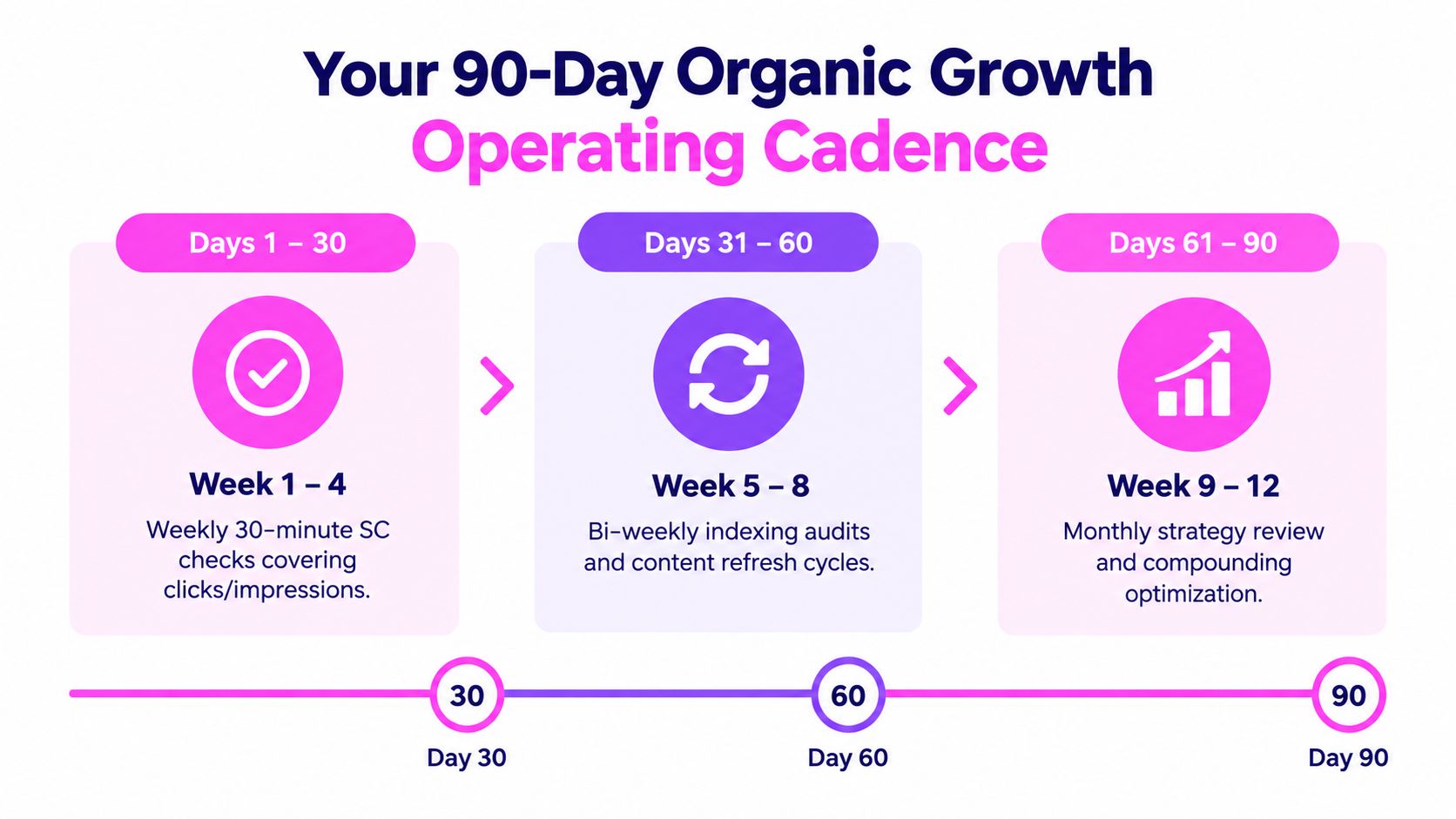
Organic growth becomes repeatable when the team stops treating SEO as a sequence of campaigns. I run it as a cadence with a short weekly inspection, a deeper monthly review, and one quarterly decision about where to concentrate effort.
Weekly checks
The weekly report takes about 30 minutes. I review Google Search Console clicks and impressions, indexing anomalies, CTR changes on priority pages, and the top positive and negative movers. I compare the data with the baseline rather than reacting to a single ranking fluctuation.
The action triggers are practical:
- Clicks down, impressions stable: Rewrite the title, description, opening answer, and SERP positioning.
- Impressions down, position down: Inspect intent match, internal links, competing URLs, and technical changes.
- Indexed pages change unexpectedly: Inspect sitemap, canonical, robots, and deployment records.
- A refreshed page moves but doesn't earn clicks: Reassess the SERP feature mix and the page's promise.
Monthly review
The monthly session compares non-branded traffic, page-level CTR, conversions, and content decay against the written baseline. I review refresh batches, newly earned referring domains, pages losing impressions, and queries where AI Overviews appear to be replacing visits with citations or no click.
At the end of the quarter, I make one strategic choice: double down on the current topic cluster or open a new topic wedge. I don't add capacity because the publishing queue is full. I add capacity when the team has a validated cluster, repeatable briefs, technical support, and enough measurement discipline to distinguish progress from seasonality.
Paste this checklist into the project tool:
- Weekly: Review clicks, impressions, CTR, indexing anomalies, and top movers.
- Monthly: Compare non-branded performance with the baseline and select refresh candidates.
- Monthly: Audit canonical URLs, sitemap coverage, orphaned pages, and content decay.
- Quarterly: Decide whether to deepen the current cluster or test a new one.
- Quarterly: Prune, merge, or redirect pages that compete without earning demand.
- Every cycle: Record the decision, owner, URL, target query, and next review date.
SemDash brings keyword, backlink, SERP, competitor-gap, clustering, and AI Overview citation data into one workspace, which can support the baseline, prioritization, and content-refresh workflow described here. Visit SemDash to map the pages and queries most likely to increase organic search traffic, then turn those findings into your next 90-day operating plan.