

You've probably got a spreadsheet right now where hundreds of keywords carry tidy intent labels, and at least a few of those labels are wrong. I know because I've shipped content from spreadsheets like that, watched it rank nowhere useful, and then opened the live SERP to find Google wanted a completely different kind of page.
Tabla de contenido
- Why Search Intent Classification Keeps Failing
- The Classic Intent Taxonomy and What It Gets Right
- Manual SERP Analysis as the Ground Truth
- Comparing Classification Methods and Their Trade-offs
- Mapping Intent Types to Content Formats
- Why Static Labels Break in the AI SERP Era
- Building a Live Classification Workflow
- Final Takeaways and Next Steps
Why Search Intent Classification Keeps Failing
I learned this the expensive way with a query that looked informacional on paper. The wording suggested research, my tool agreed, and we briefed a long explanatory guide. When I finally reviewed the live results properly, the top positions were product and category pages built for action, not articles built for learning.
We'd answered a question nobody clicking those results was asking. The page was relevant in a loose topical sense, but it failed the dominant need, and the conversion opportunity passed to competitors whose pages matched what searchers could do next.
Where the Label Breaks Down
Most failures I've audited share the same root cause. We treat search intent classification as a stable property of a keyword, inferred from modifiers like "how," "best," or "buy." Google doesn't reward that assumption, because intent is what the current results satisfy, and that can shift as formats, features, and user behaviour change.
- Modifier-only rules: "Best" can mean compare editorially, compare products to buy today, or get a quick shortlist, depending on the market.
- Tool labels taken on trust: A label imported months ago doesn't know what today's SERP looks like.
- One label per keyword: Mixed results get forced into a single box, so the brief ignores the second, often commercial, need.
If your classification can't point to the ranking pages that justify it, you don't have a classification. You have a guess with a colour code.
I don't treat intent as fixed anymore. I treat the query wording as a hypothesis, I validate it against the live SERP, and I record the dominant result pattern as the operational label I brief from. That one change has prevented more wasted content in my work than any taxonomy refinement, because it forces the format decision to match evidence you can see today, not a rule you inherited last year.
The Classic Intent Taxonomy and What It Gets Right
I still start with the classic framework, because it's a solid first pass. The three-part taxonomy associated with Andrei Broder separates queries into informacional, de navegación, y transaccional. Informational queries seek knowledge, navigational queries aim to reach a known website or page, and transactional queries seek a web-mediated activity like downloading software, purchasing, or using a service, as set out in Jansen's review of user intent research.
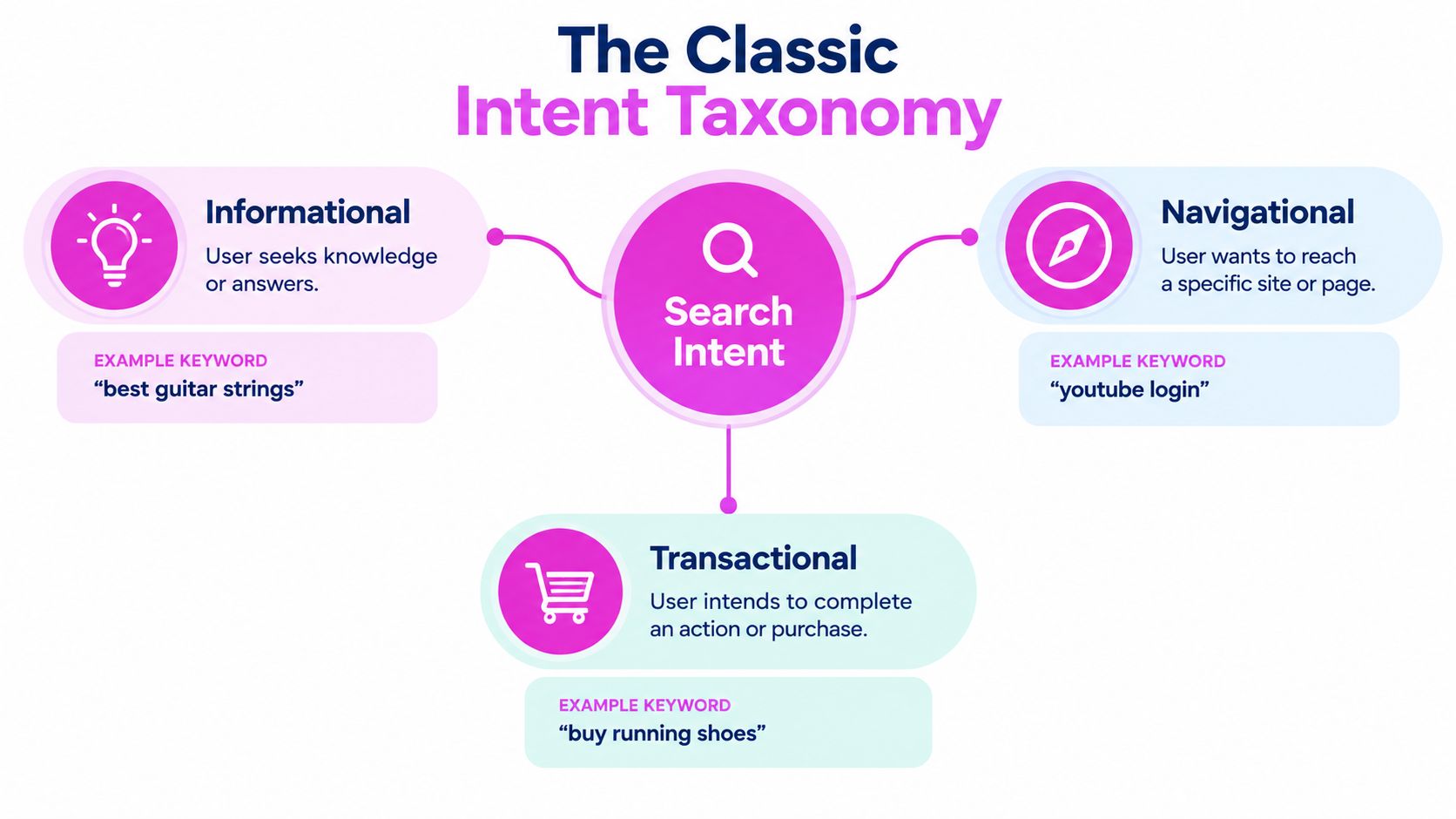
Later work refined those broad classes into subcategories including directed and undirected information seeking, advice, locating, listing, downloading, entertainment, and interaction. I use those refinements when a broad label is too blunt for a brief. "Informational" alone doesn't tell a writer whether you need a factual answer, step-by-step advice, or a list to browse.
Why One Global Rule Cannot Work
Here's the finding that changed how I build rules. In research using more than 20,000 web queries organised by topic, intent distributions varied by topic by approximately 15 to 24 percentage points, and you can trace that result in the same Jansen review cited above. The same wording pattern can imply different goals in different domains, so a universal modifier list will misfire somewhere in your set.
That is also why I cluster before I brief. When I'm planning hubs, I sanity check my intent groupings against topic clusters for editorial teams, because a cluster built around mismatched intents creates pages that compete with each other instead of supporting each other.
Regla práctica: Use the taxonomy to name your hypothesis, then use topic and SERP evidence to prove or overturn it.
The taxonomy gets one big thing right. It converts an ambiguous query into a prediction about the user's underlying task, which gives you something testable. Where teams go wrong is stopping there, as if naming the task were the same as confirming it.
Manual SERP Analysis as the Ground Truth
When I classify a keyword, I don't start with the modifier. I start with the live SERP, in the target country, and I read it like evidence. Google's own framework supports that habit, since the Search Quality Rater Guidelines from Google define intent through the query and, when relevant, location, then judge how well each result satisfies that interpreted need.
The guidelines distinguish Know, Do, Website, and Visit-in-Person, with Do covering actions like purchasing or downloading. I use those as a first pass, then I let the actual result pattern overrule them.
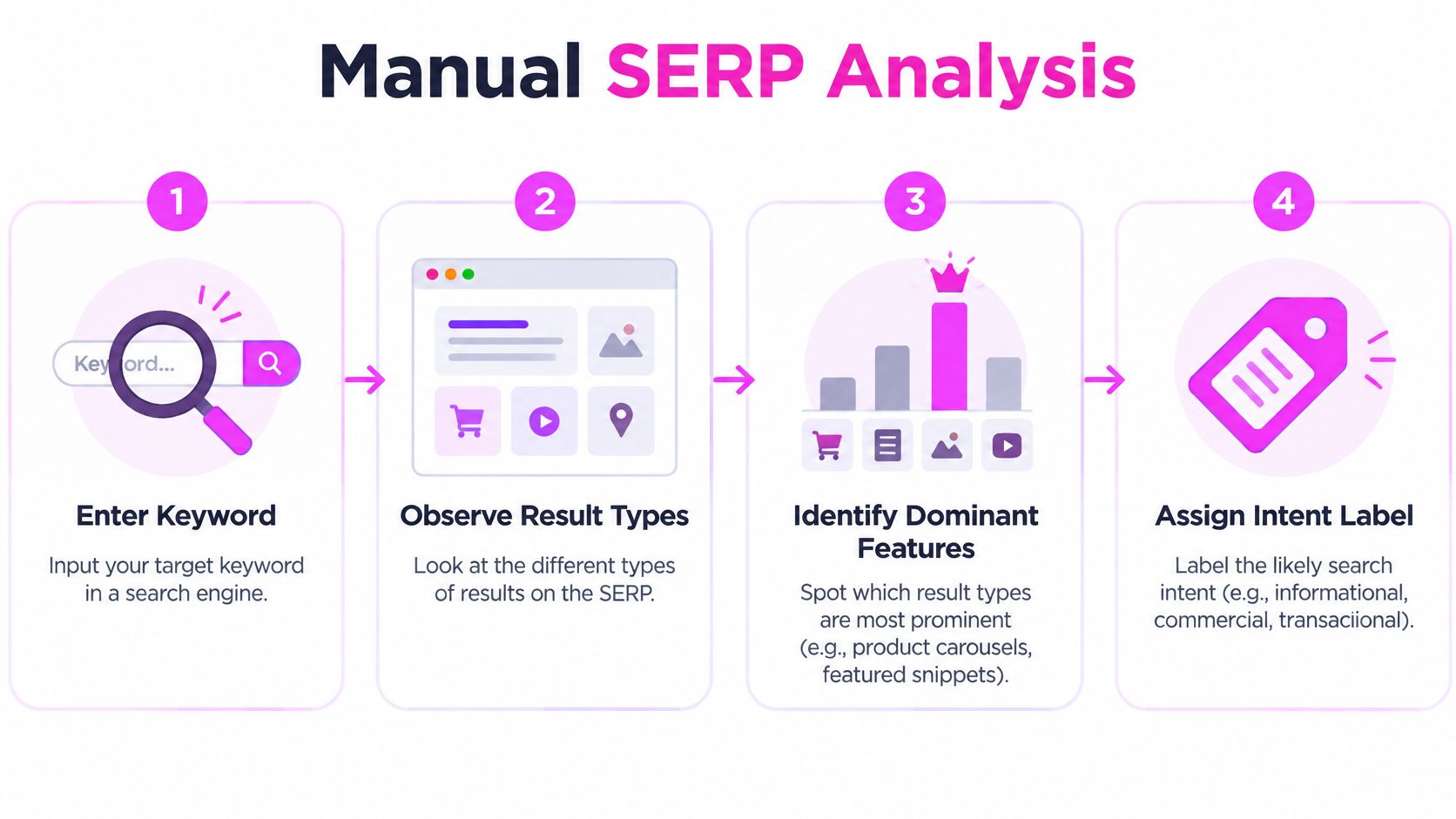
My Four-Step Manual Workflow
- Search cleanly: I run the query in the right market and device context, then ignore my assumptions for the first scan.
- Tally page types: I count how many top results are guides, product pages, category pages, tools, brand pages, or local listings.
- Read the features: I note product carousels, local packs, featured snippets, People Also Ask, video, and any AI Overview, since each feature signals a task Google expects.
- Record the dominant pattern: I write the label plus the evidence, for example "commercial investigation, mostly comparison articles with product pages below."
Take "best project management software." I don't care that "best" feels commercial in the abstract. I look for whether the results are comparison pages, product pages, review articles, or a mixture, and that mixture tells me what to build. If comparisons dominate, a pricing page won't win on relevance, however good its copy is.
If you want the deeper mechanics of reading result composition, I keep returning to a structured approach to SERP analysis in practice, because consistency matters more than cleverness here.
Handling Mixed SERPs
Mixed results aren't an error to force into one label. I record primary and secondary intent, check which page types hold the top positions rather than the whole page, and decide whether I need one page that serves the dominant task well or separate pages for separate tasks. What I won't do anymore is average a mixed SERP into a vague brief that half serves everyone.
Comparing Classification Methods and Their Trade-offs
I've used three approaches in anger, and none of them wins on every dimension. Manual SERP analysis is the most accurate method I have, and it's also the slowest. Signal-based rules scale beautifully until an ambiguous query breaks them, and AI-assisted classification is only as trustworthy as the SERP evidence and validation behind it.
Method choice matters more than most teams admit. In one large study, researchers automatically classified more than 1.5 million queries and reported that over 80% were informational, while another analysis reported 48% informational, 20% navigational, and 30% transactional, both summarised in Jansen's empirical review of intent studies. Those aren't contradictions to argue about. They're proof that dataset and method shape the answer, so your workflow needs live checks rather than borrowed percentages.
Classification Method Comparison
| Method | Precisión | Velocidad | Cost | Mejor para |
|---|---|---|---|---|
| Manual SERP analysis | Highest, evidence based | Slow per keyword | Staff time | Priority keywords, briefs, audits |
| Signal-based rules | Brittle on ambiguity | Very fast | Baja | First pass on large sets |
| AI-assisted with SERP features | Strong when validated | Fast at scale | Tooling plus review time | Large sets with spot checks |
Here's how I decide. For money keywords and pages I'm about to brief, I classify manually, because a wrong format costs more than the review time. For thousands of long-tail terms during discovery, I'll accept rules or AI assistance, but only with a sampled manual audit grouped by topic, since topic is where rules drift.
- Choose manual when the page is expensive to produce or the SERP looks mixed.
- Choose signal-based when you need a rough segmentation for reporting, not briefs.
- Choose AI-assisted when it uses ranking page types and features, not tokens alone, and when you can inspect disagreements.
The hybrid is not a compromise. It's the only setup I've seen survive both scale and ambiguity.
What failed for me was treating automation as a replacement for judgment. What works is automation for triage, human review where the money and ambiguity sit, and a feedback loop where misclassifications improve the next pass.
Mapping Intent Types to Content Formats
Classification only earns its keep when it changes what you build. I've seen well-written pages fail for a year because the format was wrong on day one, and no amount of internal linking fixes a guide competing against product pages.
My default mapping is simple, and then I adjust it to the evidence. Informacionales queries map to guides, explainers, and how-to content that answers directly. Navegacionales queries map to the brand, product, or login page the searcher already wants, with clear titles and sitelink-friendly structure rather than a blog post pretending to be a destination.
The Formats I Brief Most Often
Transaccionales intent needs a page where the action can happen with minimal friction, so product, category, pricing, booking, or download pages, with price and next step visible early. Commercial investigation sits between learning and buying, so I brief comparison articles, best-of lists, and review-style pages that help someone choose, with honest criteria and clear trade-offs instead of thin affiliate filler.
Local intent is its own discipline in my audits. If a map pack dominates, the answer is a location page and a complete business profile, not a national guide with a city name swapped in.
Auditing What You Already Have
I audit existing pages by placing the current ranking URL beside the dominant SERP pattern and asking one blunt question. Does my page type match the page types Google is rewarding? If we're ranking a blog post weakly where category pages dominate, I don't rewrite the blog post for the third time. I change the target page or build the missing format.
For mixed intent, I prefer a hub that routes clearly over a single page trying to be everything. A strong comparison hub can link down to product pages for ready buyers and sideways to guides for researchers, which satisfies both tasks without forcing one URL to cannibalise the other. The mistake to avoid is stuffing buying content into an informational guide and trying to make it do everything. Readers feel the mismatch, and so does Google.
Why Static Labels Break in the AI SERP Era
Look at a modern results page and you'll see why my old labels started expiring faster.
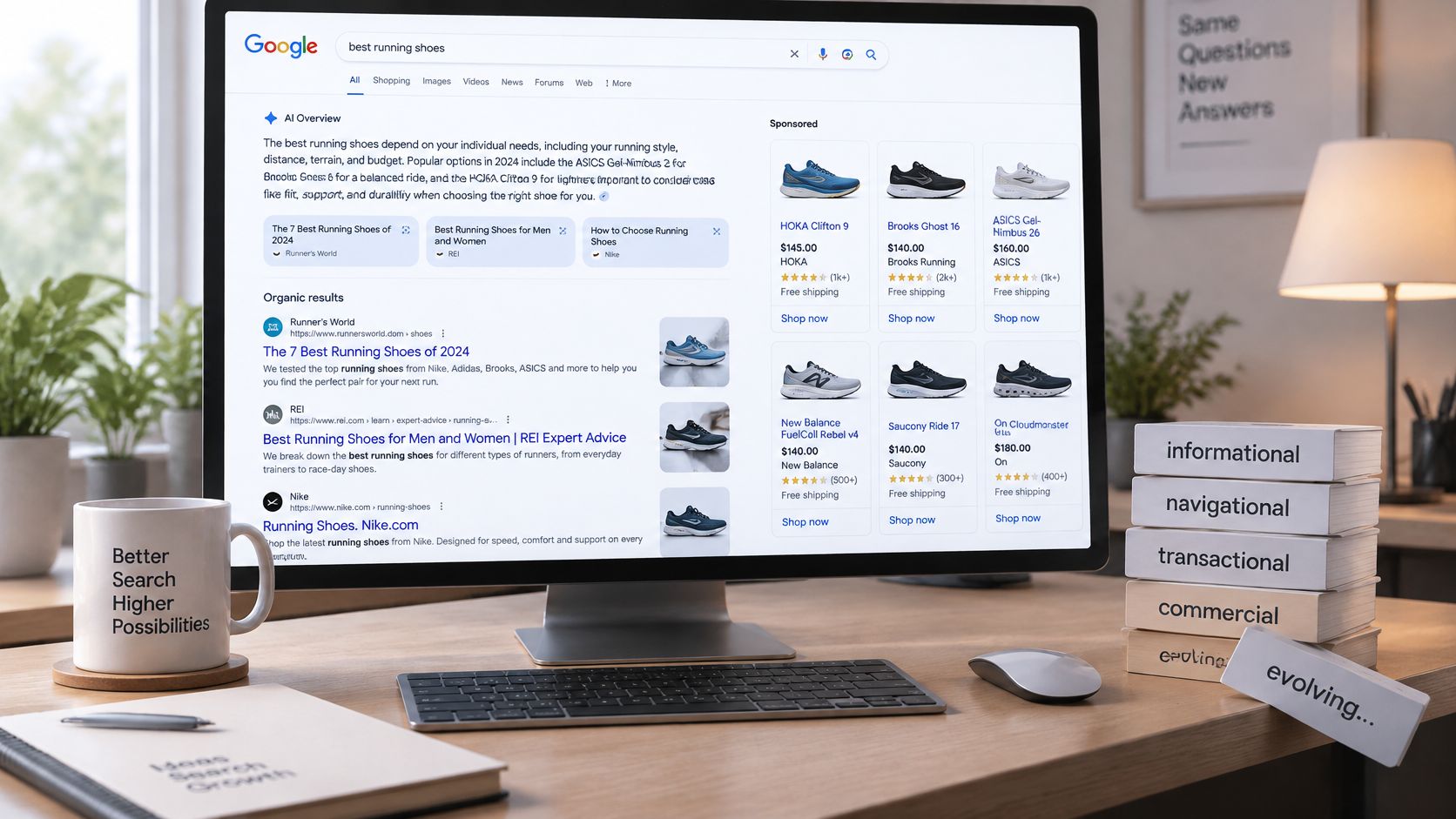
I now separate query intent de outcome intent. Query intent is what the wording suggests. Outcome intent is what the SERP encourages the user to do, such as read an AI answer and leave, compare products in place, visit a brand, or complete a transaction. A keyword can stay informational in wording while its outcome becomes zero-click, and that changes whether the page is worth building at all.
The click evidence makes this concrete. Google AI Overviews appeared on about 18% of U.S. searches in March 2025, and users clicked a traditional result on only 8% of searches when an AI Overview was present versus 15% without one, while clicks on sources cited inside the summary occurred on only about 1% of visits, according to Pew Research Center analysis of AI summaries and clicks. If your label doesn't record that, your traffic forecast is fiction.
This short walkthrough is worth watching before your next audit, because seeing the features move makes the volatility harder to ignore.
I've started checking presence and change with a flujo de trabajo de comprobación de SERP en vivo rather than relying on the label stored in my keyword sheet. Coverage has also spread beyond informational queries into commercial, transactional, and navigational searches, which means even bottom-funnel labels can shift under you. I don't panic and rewrite everything when an AI Overview appears. I ask whether my page can be cited, whether it offers something the summary can't, such as tools, first-hand testing, pricing, or local detail, and whether the keyword still justifies its priority.
Building a Live Classification Workflow
My current workflow is deliberately unglamorous. I store intent at both query level and URL level, because reporting needs the broad class while briefs need the fine-grained task. Broad labels support segmentation. Fine-grained labels, such as factual question versus advice-seeking, tell the writer what the page must do.
That hierarchy has research behind it too. The established top level separates informational, navigational, and transactional queries, and ORCAS-I work describing finer informational subcategories reported high annotator consistency for the more granular taxonomy, as discussed in research on hierarchical intent classification. Consistency matters, because two SEOs applying different private definitions will produce labels nobody can trust.
The Workflow I'd Build Again
- Classify in bulk first: I use rules or AI assistance for triage. In my stack, SemDash is one option I use for AI-assisted classification based on live SERP data alongside clustering, which speeds up that first pass.
- Validate priority keywords manually: I check the top page types, features, and AI Overview presence, then correct the label with evidence noted.
- Cluster by intent, not just topic: I group queries that need the same page type, which reduces cannibalisation between a guide and a category page chasing the same term.
- Monitor volatility: I recheck on a schedule and after ranking drops, then decide whether to expand, redesign, redirect, or deprioritise the page.
QA check I never skip: Pick a sample from each topic and market, compare the stored label against today's top results, and log every disagreement.
What I'd do differently is start that disagreement log on day one. It shows you exactly where your rules fail, often in one topic or one language market first. I also record confidence now. A forced label with low confidence gets reviewed before briefing, instead of silently poisoning the content plan.
Final Takeaways and Next Steps
If you take one lesson from my mistakes, take this. Intent is dynamic, the SERP is your ground truth, and no single signal is enough. Start today by auditing your most valuable keywords against live results, fixing the worst format mismatches first, and adding AI Overview presence to every label that matters.
Set a recurring review so labels expire on purpose rather than by accident. Watch multilingual sets especially closely, because a translated query can carry different commercial expectations in another market, and one global label will hide that. Classify with evidence, note your confidence, and you'll brief fewer pages that were doomed by their format before a word was written.
Ready to stop guessing from modifiers and start classifying from live evidence? SemDash gives you SERP history, AI-assisted intent classification, and keyword clustering in one workspace, so you can spot intent shifts and brief the right page type the first time.