Most SEO teams still start keyword research by opening a database, exporting thousands of phrases, and sorting by search volume. That feels methodical, but it often produces a spreadsheet full of topics nobody will click, pages nobody will build, and targets that don't match the business.
I use the opposite order. I start with the page that should generate the business result, inspect the live SERP to understand what searchers want, and only then use volume and difficulty to judge whether the opportunity is realistic. That SERP and intent first approach has saved me from prioritizing attractive keywords that looked valuable in a tool but delivered little commercial value in practice.
The modern SEO keyword research process is less about finding one perfect phrase and more about mapping a fragmented query universe to pages that satisfy distinct intent. Ahrefs reports that 94.74% of keywords have 10 monthly searches or fewer, while only 0.0008% exceed 100,000 monthly searches (keyword research distribution data). Long-tail coverage, clustering, and click potential aren't optional extras. They're the operating system for finding scalable opportunities.
Tabla de contenido
- Por qué la mayoría de la investigación de palabras clave falla antes de empezar
- Construyendo tu universo completo de palabras clave sin adivinar
- Filtrar por volumen y dificultad y validar la intención en la SERP
- Encontrar brechas reales que tus competidores ya monetizan
- Agrupar y mapear palabras clave a páginas sin canibalización
- Priorizar qué publicar primero y mantener las clasificaciones seguras
Por qué la mayoría de la investigación de palabras clave falla antes de empezar
The most common failure happens before anyone checks a keyword. A marketer opens SemDash, enters a broad seed term, exports every suggestion, and assumes the highest-volume rows deserve the most attention. That process confuses available data with a strategy.
I made this mistake early in a VPS hosting project. “VPS hosting” appeared to be the obvious target, but the query covered several different needs. Some searchers wanted a definition, some wanted a provider, some were comparing managed and unmanaged plans, and others needed help choosing server resources. A single generic article couldn't serve all of those people well, and a product page couldn't satisfy the educational searches without creating a poor experience.
I now begin with three questions:
- What converts: Does the business want a signup, demo request, purchase, contact inquiry, or another action?
- Which page owns that action: Is the right destination a product page, category page, comparison page, service page, or guide?
- What does the SERP reward: Are the current results educational, commercial, transactional, local, visual, or dominated by another format?
That sequence matters because Google has spent years moving away from literal repetition. SEO history traces the old era to the 1990s and early 2000s, when repeating terms on a page could influence rankings. Panda in 2011, Penguin in 2012, and Hummingbird in 2013 pushed the discipline toward content quality and user intent, as summarized in this history of SEO milestones. Keyword research therefore became an exercise in understanding meaning, not counting appearances.
Mi chequeo pre-vuelo
Before opening a keyword tool, I write down the money page, the audience problem it solves, the action I want a visitor to take, and the types of pages already ranking for the closest commercial query. I also decide which source will be authoritative for each metric.
That last point prevents a surprisingly common mess. One tool might show a different volume estimate from another, while difficulty scores can vary because each provider uses a different model. I don't average contradictory figures into a fake precision score. I select one source for volume, one method for difficulty, and the live SERP for the final reality check.
Regla práctica: A keyword earns consideration because the business can serve its intent, not because a database ranks it near the top of an export.
Construyendo tu universo completo de palabras clave sin adivinar
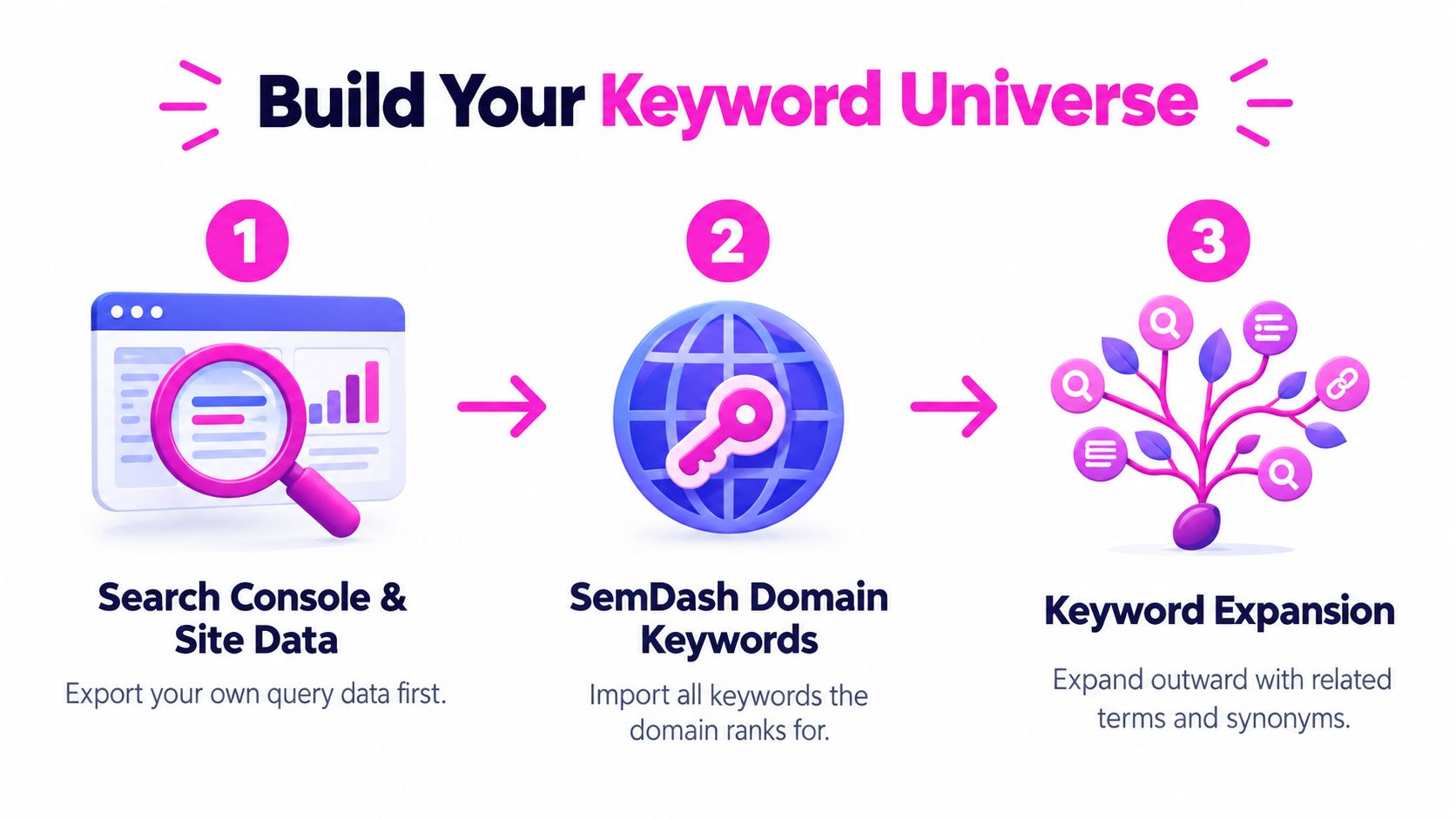
A large keyword export is not a keyword strategy. I build the initial universe from the site outward, then test each idea against the SERP before giving volume much weight. Owned data shows the language Google already connects with the domain and reveals pages earning impressions for queries nobody intentionally targeted.
I start in Google Search Console, reviewing queries, pages, impressions, clicks, and new variations. Each relevant query gets an intent label before expansion. Terms tied to existing product or service pages belong in commercial or transactional groups. Questions and definitions support informational coverage. Brand terms stay separate so they do not inflate the opportunity list.
Then I use SemDash Palabras clave de dominio to inspect the ranking footprint of the site and its competitors. I record the exact ranking URL for each term, because that page often exposes the format Google expects. A competitor ranking with a category page for one query and a guide for another gives a better content signal than a raw suggestion list. It also helps identify where one topic may need one destination URL rather than several competing pages.
Expande hacia afuera, luego detente deliberadamente
Once owned data and domain research are covered, I expand each seed with long-tail suggestions, related phrases, La gente también pregunta, y La gente también busca results. SemDash draws these discovery options from a Base de datos de 6.600 millones de palabras clave, helping surface variants that a short seed list misses. I keep questions that introduce a distinct concern and remove grammatical rewrites that would require the same page.
Long-tail demand is fragmented. Ahrefs reports that 94.74% of keywords have 10 monthly searches or fewer, while only 0.0008% exceed 100,000 monthly searches (Ahrefs keyword universe figures). That distribution is why I do not reject a query solely because its individual volume is small. I keep it when it adds a meaningful use case, audience qualifier, feature, comparison, or intent stage.
My raw list includes:
- Query: The exact phrase or close variant.
- Theme: The underlying subject, such as server security or managed hosting.
- Intent: Informational, navigational, commercial, or transactional.
- Current URL: The page already receiving impressions or ranking.
- Source: Search Console, competitor domain, SERP feature, or first-party insight.
- Brand status: Branded, non-branded, or needs review.
I stop expanding when suggestions repeat an existing meaning, fall outside the product's market, or change wording without changing the required page. The result should be a deduplicated, intent-labeled universe that is ready for SERP review and prioritization, not an unexamined export.
Filtrar por volumen y dificultad y validar la intención en la SERP
Volume and Keyword Difficulty help me narrow the list, but they don't decide the target alone. I sort by monthly search volume first because it gives me a rough traffic ceiling. Then I apply difficulty in relation to the actual SERP and the strength of the page I can build.
A lower-volume query with clear commercial intent can deserve more resources than a broad informational term. The broad term may attract many impressions but force the site into an overcrowded SERP where the user gets an answer without visiting. The specific commercial query might have fewer searches, yet the visitor already understands the problem and is evaluating a solution.
I use SemDash Keyword Difficulty as a comparison signal, not a pass-or-fail gate. I check whether the ranking pages have strong links, tightly aligned content, recognizable brands, or a format my site can realistically match. This guide to checking Keyword Difficulty is useful when separating the metric from the broader SERP assessment.
La intención es visible en el formato del resultado
I inspect the top results manually for every shortlisted cluster. If educational pages dominate, I don't force a product page into the SERP. If product pages, category pages, comparison articles, or local results dominate, I build around that format.
One expert playbook recommends treating a keyword as informational when 8 or more of the top 10 results are educational pages, and treating 6 or more matching formats among the top results as evidence that the page type should follow that dominant format (SERP intent classification guidance). I use those thresholds as practical guardrails, then investigate mixed SERPs rather than pretending every query fits one clean label.
| Ejemplo de Palabra Clave | Volumen | Dificultad | Señal de Intención SERP | Decisión |
|---|---|---|---|---|
| Alojamiento VPS | Estimación de herramienta | Estimación de herramienta | Resultados mixtos de productos, categorías y educativos | Crea un centro comercial enfocado solo si el sitio puede satisfacer la intención mixta |
| Alojamiento VPS Gestionado | Estimación de herramienta | Estimación de herramienta | Dominan las páginas de proveedores y servicios | Prioriza una página de servicio o producto |
| ¿Cómo funciona el alojamiento VPS? | Estimación de herramienta | Estimación de herramienta | Dominan las guías educativas | Crea una guía informativa |
| Alojamiento VPS para desarrolladores | Estimación de herramienta | Estimación de herramienta | Proveedores especializados y contenido comparativo | Crea una página de audiencia enfocada si la oferta lo permite |
I don't assign a dedicated URL to every phrase. A query becomes its own page when it has a distinct intent, audience, product use case, or SERP format. If the same page would satisfy the searcher, I keep the phrase as a supporting term instead.
The fastest way to waste a content budget is to treat every wording variation as a separate editorial assignment.
The final shortlist contains fewer terms than the discovery export. Each target has a volume reference, a relative difficulty judgment, a SERP format, a likely page type, and a reason it matters commercially.
Encontrar brechas reales que tus competidores ya monetizan
A competitor gap report isn't automatically an opportunity. Business competitors and SERP competitors often differ, and I care more about the sites that consistently rank for the intent I want to own than the companies that merely sell something similar.
For example, a hosting company may compete commercially with another hosting company, but the SERP may also favor a developer publication, a review site, or a documentation resource for a specific query. Those SERP competitors reveal the content standards and page formats I need to beat. A business competitor list alone can miss them.
I compare the domain against 1 to 3 close competitors, then filter branded and irrelevant terms before reviewing the results. Independent guidance recommends this focused approach, along with minimum thresholds such as at least 20 or 100 monthly searches, because broad exports can become unmanageable and exceed 100,000 keywords (focused content gap workflow). I treat those thresholds as workload controls, not universal definitions of value. A commercially important phrase can still survive below the filter when sales or customer data confirms demand.
Agrupar la brecha antes de asignarla
I don't work down the gap report row by row. I group missing and weak terms by themes such as “managed VPS features,” “VPS security,” and “VPS for development teams.” Then I inspect whether each theme points to one missing page, an update to an existing page, or several different intents.
SemDash Páginas principales y Cuota de tráfico views help identify which competitor pages carry a theme. If one competitor page ranks across many related queries, I study its structure, intent coverage, internal links, and conversion path. That tells me whether the gap is a page-level omission or a broader topical hole.
I also return to PAA and PASF after the main themes are clear. These features are useful for finding unanswered subquestions, but they become noise when copied wholesale. I keep questions that help a reader choose, implement, compare, or overcome an objection. I discard questions that merely rephrase an existing heading.
Later in the workflow, I use the gap backlog to inform content briefs. For now, each theme needs a priority, a primary intent, a proposed URL, and a short explanation of why the competitor visibility matters. That produces a manageable editorial queue instead of a vanity spreadsheet.
The best gap is rarely “everything a competitor ranks for.” It's the intersection of a real customer need, a SERP format the site can match, and a page that supports a business objective.
Agrupar y mapear palabras clave a páginas sin canibalización
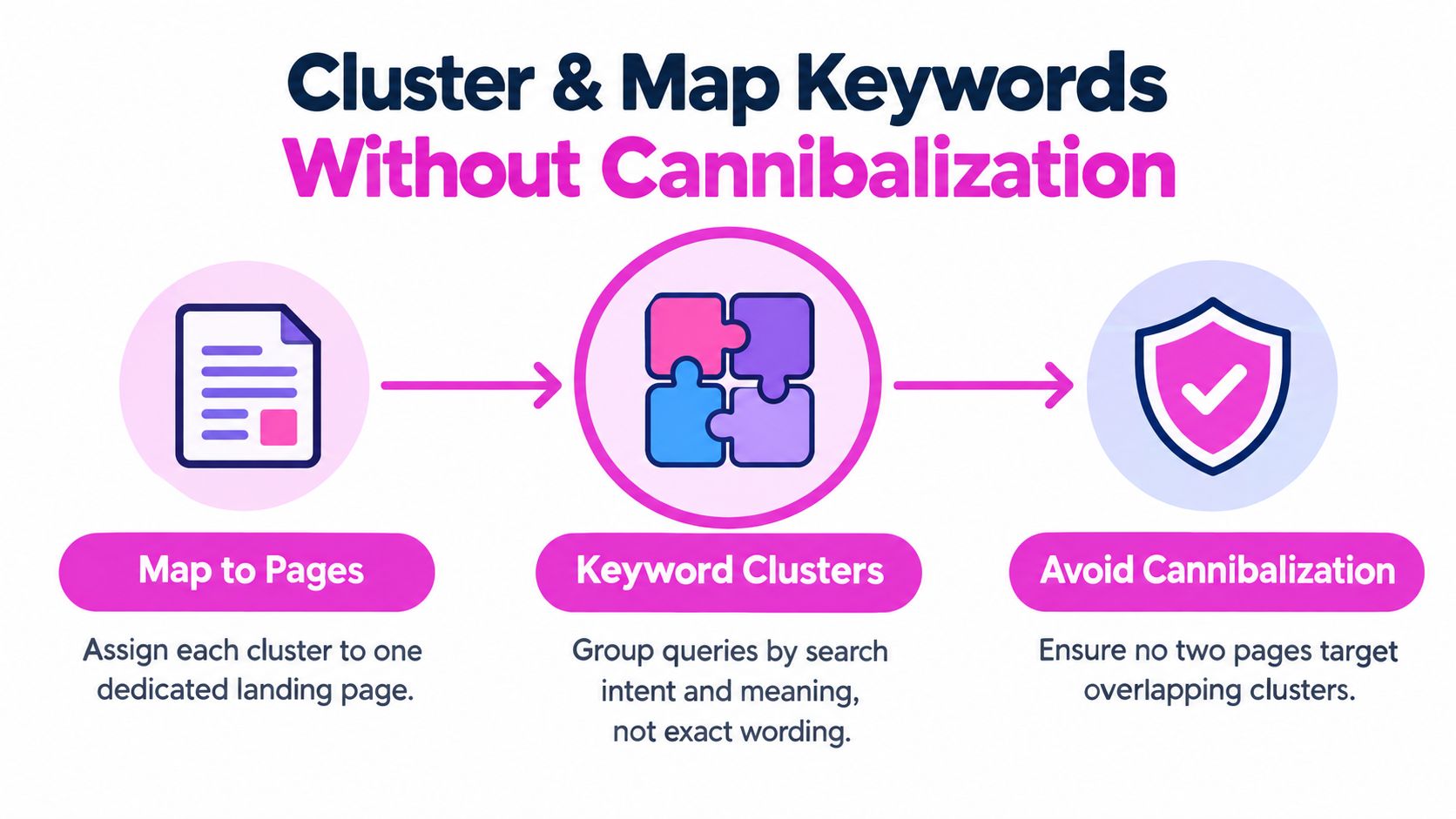
Keyword clustering should start with the SERP, not the spreadsheet. Group queries by meaning, search intent, and required answer, then check whether Google returns the same page type and decision context. “Best VPS for developers” and “developer VPS hosting” may share one URL when the results serve the same comparison need. A query about configuring a VPS after purchase needs a different page, even if it repeats the same core noun.
SemDash keyword clustering speeds up the first grouping. I still inspect borderline SERPs because automated similarity cannot reliably distinguish a product comparison from a technical implementation query. I also check whether the results show an AI Overview or another SERP feature that could reduce click potential. Volume helps prioritize only after the query has a viable organic opportunity.
For a practical walkthrough of the grouping method, see our guide to keyword clustering.
Dar a cada intención un propietario
Each cluster gets one primary URL, with supporting queries recorded beneath it. My map includes the cluster name, primary keyword, secondary terms, intent, SERP format, current ranking URL, preferred URL, page type, and the required action, such as create, update, merge, or redirect.
This prevents keyword cannibalization, which occurs when multiple pages on one domain target the same or similar intent and compete in rankings. The result can be diluted traffic and weaker authority signals. I assign one primary URL, then consolidate or redirect overlapping pages where appropriate, following Moz's guidance on keyword cannibalization.
I audit internal links at the same time. If exact or close-match anchors point to several URLs for one intent, I revise them so the preferred page receives the clearest signal. A page that still earns impressions is not automatically worth keeping separate. Retaining overlapping pages can preserve confusion instead of useful coverage.
La superposición de palabras no siempre es superposición de intenciones
Google Ads match behavior shows why surface wording can mislead. Google says exact match prefers an identical query when eligible, phrase match includes searches covered by exact match plus additional searches, and broad match reaches related searches (Google Ads match type definitions). I use the underlying meaning to form a cluster, then verify the choice against organic results.
Search Console exposes cases where two URLs receive impressions for the same query. I select the stronger owner by comparing intent, links, content quality, and business role. Useful material moves to that URL, while the weaker page is merged, redirected, or retired when appropriate. Internal anchors then point consistently to the chosen page.
Before approving a new URL, ask: Does this searcher need a different answer from the answer provided by an existing URL? If the answer is no, expand the existing page instead. A clean map gives writers a precise brief and keeps one search intent tied to one accountable URL.
Priorizar qué publicar primero y mantener las clasificaciones seguras
My publishing queue ranks clusters by four factors: intent fit, conversion potential, visibility feasibility, and SERP risk. A topic rises when it maps cleanly to a business action, the page type matches the SERP, and the site has a credible path to visibility. A topic falls when the SERP answers the query directly or the required format is outside the team's capabilities.
AI Overviews make the click-potential check essential. One 2025 analysis found AI Overviews on 6.49% of tracked keywords in January, rising to nearly 25% in July and remaining at 15.69% in November. Navigational queries triggering AI Overviews rose from 0.74% to 10.33% over the same period (Semrush AI Overviews study). I don't automatically reject an affected keyword, but I reduce its traffic priority when the SERP can fully answer the question without a visit.
Mi ciclo semanal de mantener, cambiar o eliminar
Each week, I review the historical SERP for priority clusters, check whether the dominant intent has shifted, and inspect AI Overview visibility where data is available. Then I take one of three actions:
- Publish: The cluster has clear intent, a defensible page type, and a realistic route to visibility.
- Improve: An existing URL owns the intent but needs stronger coverage, internal links, better conversion paths, or updated evidence.
- Consolidate or skip: Multiple URLs compete, or the SERP offers weak click potential relative to the business goal.
I keep the keyword map live after publication. Search behavior changes, competitors launch new pages, and SERP formats shift. A process that ends with the editorial brief will eventually recreate the same blind spots it was built to remove.
The next practical move is to choose one commercial topic, inspect its SERP, export owned queries, build a focused universe, and map every meaningful cluster to one URL. That sequence gives the team a publishable plan without allowing volume to dictate the strategy.
SemDash brings domain keyword discovery, Keyword Gap analysis, long-tail and SERP suggestions, historical SERP checking, AI Overviews visibility, and keyword clustering into one research workflow. Use it to build an intent-led keyword map, identify the pages worth creating or consolidating, and visit SemDash to start your next research project.