%20(1)-B86R08ZzwhPzS6UZbG3mSxRWPCwGwn.png)


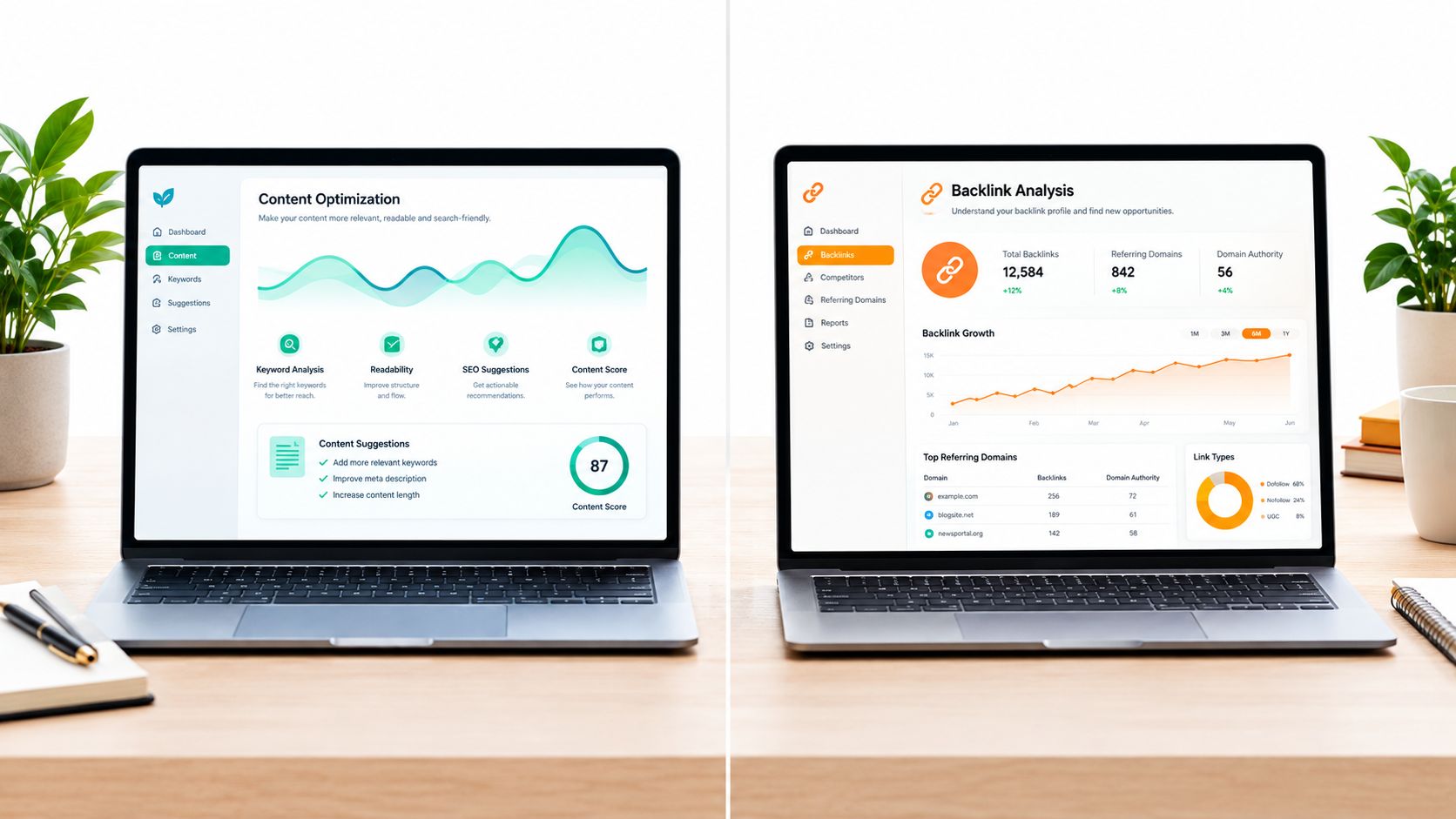
A higher Surfer content score can coexist with disappointing business results. That's because ranking is only one step in the search workflow, and Google's AI Overviews are making the value of a conventional organic click less predictable. Research reported by Ars Technica found that searches with an AI Overview produced clicks to conventional results at roughly 8%, compared with 15% when no overview appeared, while only about 1% of AI Overviews generated a click on a cited source.
That changes how I evaluate Surfer SEO vs Ahrefs. I don't ask which platform has the longer feature list. I ask where my workflow is losing momentum: discovering viable topics, validating competitors, improving a page, earning authority, or proving that the work produced qualified outcomes.
Tabla de contenido
- Why I Stopped Asking Which Tool Is Better
- Two Origins, Different DNA
- Keyword Research and Competitive Intelligence in Practice
- Content Optimization and the Quota Trap
- The Hidden Measurement Gap Most Comparisons Miss
- Who Should Use Which Tool and When
- How to Implement a Cleaner Workflow
Why I Stopped Asking Which Tool Is Better
I once opened Surfer's Content Editor for a page that looked like an obvious optimization opportunity. The draft was thin in a few places, so the recommendations were useful, but I still hadn't answered the harder questions. Was the query commercially relevant? Were the current results weak enough to challenge? Which competitors were earning links, and could my site realistically compete?
I switched to Ahrefs before rewriting the page. The research changed the brief. The keyword looked attractive at first, but the ranking pages served a different intent from the one my draft addressed. Surfer could help me improve the page I had, but Ahrefs helped me decide whether that page deserved the investment.

The tools solve different problems, so my working comparison looks like this:
| Workflow question | Surfer SEO | Ahrefs |
|---|---|---|
| What does it help me do first? | Improve a selected page or draft | Discover demand, competitors, and links |
| Strongest layer | Page-level content execution | Keyword, backlink, SERP, and technical research |
| Useful output | Content score, terms, structure, and coverage guidance | Keyword opportunities, competitor pages, backlink intelligence, and audits |
| Limitación principal | Not a replacement for a backlink index or full technical crawler | Not a writer-focused, live content editor |
| Best handoff point | After intent and target query are settled | Before the page brief and outreach plan are finalized |
That distinction matters for a new site, an established content library, and a post-publication review. A new site usually needs demand discovery and competitive qualification first. An existing page may benefit from Surfer's page-level guidance. After publication, neither tool alone closes the loop on links, qualified visits, assisted conversions, and the changing value of a SERP impression.
Regla práctica: Choose the tool that addresses your current bottleneck, not the tool with the most impressive feature inventory.
The rest of my workflow follows that logic. Ahrefs helps me determine what to pursue and why. Surfer helps me execute the selected page with more consistent on-page coverage. Measurement then determines whether either intervention mattered.
Two Origins, Different DNA
Surfer SEO and Ahrefs behave differently because they grew from different technical and commercial starting points. Surfer emerged in Wrocław, Poland, in 2017, initially as a side project and content-optimization tool built by a small SEO-agency team. Its early workflow analyzed Google's top-ranking pages for a target keyword, then translated patterns such as structure, keyword usage, and approximate length into recommendations for writers and editors. The history is documented in this independent Surfer SEO review.
Ahrefs originated in Singapore in 2011 as a backlink-indexing product. That six-year founding gap reflects two different views of SEO software. Surfer began with the page in front of the editor. Ahrefs began with the web around the page, especially links, crawled relationships, and competitor discovery.
Surfer later expanded into research, audits, writing, and optimization. Ahrefs expanded from backlink intelligence into keyword research, competitive intelligence, and a technical Site Audit. Those expansions make the products look more similar in a pricing page comparison, but their center of gravity remains visible in daily use.
The page layer and the market layer
Surfer's Content Editor evaluates a draft against the current SERP and produces a live 0–100 content score, semantic-term recommendations, and structural guidance around word count, headings, and images. That makes it useful once I've chosen the query, understood the intent, and know what the page needs to accomplish. An independent comparison also describes Surfer as strongest in this page-level execution role, while noting its lack of a comparable backlink index and full technical crawler. See the Surfer SEO analysis from AnalyzeBench.
Ahrefs is more useful upstream. I use it to discover demand, inspect ranking pages, compare competitors, review backlink strength, and prioritize technical work. Its historical foundation makes it naturally suited to questions such as, “Which pages already win this market?” and “What authority signals support those results?”
The practical architecture is simple. Ahrefs shapes the opportunity. Surfer shapes the page. Neither score should be mistaken for a ranking probability. Surfer's content score measures on-page coverage, while Ahrefs' metrics help me triage a market that still requires manual intent and SERP inspection.
Keyword Research and Competitive Intelligence in Practice
I rely on Ahrefs first when I'm building a content plan from an uncertain starting point. Its Keyword Difficulty uses a 0–100 scale intended to estimate how difficult it may be to reach Google's top 10, as explained in the Ahrefs Keywords Explorer documentation. I use that score to sort opportunities, not to approve or reject them automatically.
A low score can still hide a poor opportunity. The SERP may be dominated by trusted domains, the intent may be incompatible with my product, or the result format may demand something my team can't create. A higher score can be workable when the current pages answer the query badly or miss an important commercial angle.
My review sequence is:
- Cluster the demand: Group related terms around a page-level topic rather than assigning every variation to a new URL.
- Inspect intent: Read the results and classify the dominant format, such as comparison, guide, product page, or troubleshooting content.
- Reverse-engineer competitors: Review top pages, traffic-driving terms, referring domains, and pages by links.
- Qualify the business case: Separate informational visibility from queries that can support a product journey.
- Write the brief: Hand the writer one primary query, a clear intent, supporting questions, and a reason the page should exist.
For competitor analysis, the useful question isn't “How do I copy this page?” It's “Which demand and authority gaps can my site address better?” The resource on how to outrank rivals with better keywords is useful here because it frames competitor research around gaps rather than simple imitation. I also use SemDash's SEO competitive intelligence workflow when I want keyword, page, and competitor observations organized into a planning process.
The free-view problem
Restricted access can distort research decisions. Ahrefs' free Site Explorer view exposes up to 1,000 backlinks and keywords at once, según Ahrefs' free access documentation. That isn't the same as saying the underlying index contains only those rows. It means I shouldn't treat the visible list as a complete profile for a large competitor.
I record strategically relevant results first, including referring domains, pages with strong traffic potential, and keywords tied to commercial pages. I don't casually export the first visible rows and call that a competitor strategy.
Surfer can provide useful topical context after I select a query, but it isn't where I start for market-level discovery. If I open a Content Editor before validating intent, I'm optimizing a hypothesis rather than a page with a defensible role.
Content Optimization and the Quota Trap
Surfer becomes most valuable after the brief is settled. My first step is to finalize the target keyword, page intent, audience, and desired action before creating the primary Content Editor document. That sounds minor, but it prevents a common waste pattern: creating multiple editors for a head term and several supporting long-tail terms, then abandoning most of them.
Every successfully created Content Editor counts as one usage against the account's subscription limit, según Surfer's Content Editor documentation. Separate exploratory documents can consume quota even when I never publish the drafts.

I use a simple sequence:
- Lock the query: Choose one primary target after checking intent and competing pages.
- Set the editorial boundary: Decide what the page must explain, what it shouldn't claim, and where the conversion path belongs.
- Create one editor: Build the document only after those choices are made.
- Draft for the reader: Cover the problem naturally instead of inserting terms mechanically.
- Review the recommendations: Treat terms, headings, and length as diagnostics, not commands.
- Edit for accuracy and usefulness: Remove suggestions that weaken the message or introduce irrelevant subtopics.
Surfer's Auto-Optimize can add relevant NLP terms while attempting to preserve the article's existing message. I find it useful for identifying omissions and speeding up a first pass. I don't use it as an automatic publishing button, because a term can be statistically common in the SERP and still be wrong for the reader, the product, or the page's intent.
Score discipline
The Content Editor's 0–100 score is best interpreted as an on-page coverage diagnostic. It can expose a thin explanation, an unaddressed subtopic, or a structure that differs sharply from the current result set. It can't tell me whether my page has authority, whether the searcher will trust the brand, whether internal links support the URL, or whether the query produces commercially valuable clicks.
I use the score to ask better editing questions:
- Did I answer the main task more clearly than competing pages?
- Did I include supporting concepts because they help the reader, or because the tool suggested them?
- Does the page satisfy the dominant format without becoming a copy?
- Can a subject-matter expert verify every important claim?
For teams formalizing this process, the SEO content brief example from SemDash provides a useful place to separate search intent and page requirements from later optimization checks.
I also keep Ahrefs' toolbar allowance in mind. When SEO metrics are displayed in the browser, each URL consumes an export row, and a traditional 10-result SERP can consume 10 export rows when metrics are requested for all results, as explained in Ahrefs' SEO Toolbar guidance. I leave the metrics bar off during casual browsing and enable it only for SERPs I'm actively analyzing.
The Hidden Measurement Gap Most Comparisons Miss
Most comparisons stop when the article is optimized or the keyword list is exported. That's where my evaluation starts to become more demanding. A page can satisfy its Content Editor recommendations, rank visibly, and still fail to attract qualified visitors, earn links, or assist a conversion.
Neither Surfer nor Ahrefs directly performs link acquisition. Neither one, by itself, proves that a content change created business value. Ahrefs can expose link gaps and ranking movement, while Surfer can guide on-page coverage, but I still need a measurement layer that connects the work to outcomes.
Ranking isn't the same as value
AI Overviews make ranking-only reporting even less reliable. The Ars Technica report on Pew Research data found conventional-result clicks at roughly 8% for searches with an AI Overview, versus 15% without one, and reported that only about 1% of AI Overviews generated a click on a cited source. A separate Authoritas study reported per-query publisher CTR declines of 47.5% on desktop y 37.7% on mobile when an AI Overview appeared, as covered in the same analysis of AI Overview click behavior.
That doesn't make rankings irrelevant. It means I segment the portfolio before deciding what success should look like:
- AI Overview presence: Does the query regularly produce a generated answer?
- Citation eligibility: Can the page provide an original, verifiable answer worth citing?
- Conversion value: Does a visit support a product, lead, or retention outcome?
- Brand demand: Could visibility matter even when the user doesn't click?
- Volatilidad de las SERP: Is a position stable enough to justify sustained investment?
I track conventional clicks separately from generated-answer visibility. A page that earns citations or strengthens branded demand may deserve investment even when click volume behaves differently from traditional organic reporting.
Measurement also needs a clear taxonomy. For example, I distinguish a new linking domain from a new backlink, a non-brand click from total organic traffic, and a first-touch conversion from an assisted conversion. The practical principles behind influencer attribution methods are relevant here because attribution only helps when teams define the contribution they're trying to measure before reviewing the numbers.
The metric that matters is not the score you can raise most easily. It's the outcome that tells you whether the page earned its place in the strategy.
Who Should Use Which Tool and When
The right choice depends on where work is currently stuck.
Choose Surfer SEO when the team already has a validated topic and needs a repeatable page-level editing process. Content teams, writers, and editors benefit most when they need live guidance on semantic coverage, structure, and draft completeness. It's particularly practical for refreshing an existing page where the intent is clear and the main issue is execution.
Choose Ahrefs when uncertainty exists before writing begins. I'd prioritize it for competitor discovery, keyword qualification, backlink research, link-gap campaigns, and site-wide technical diagnostics. Its value increases when the team needs to understand an entire market rather than improve one URL.
| Current bottleneck | Starting point | Why |
|---|---|---|
| We don't know which topics deserve investment | Ahrefs | Research demand, competitors, intent, and links |
| We have a sound brief but inconsistent drafts | Surfer SEO | Standardize page-level coverage and editing |
| Competitors earn links we can't explain | Ahrefs | Inspect referring domains, linked pages, and gaps |
| An existing article needs an on-page refresh | Surfer SEO | Compare the page with the live SERP |
| Technical problems affect many URLs | Ahrefs | Use a site-wide crawler and issue prioritization |
| We need to know whether rankings created value | Neither alone | Connect SEO data to analytics and conversion reporting |
Agencies often pair the tools because their production model has two separate handoffs. A strategist uses Ahrefs to select the opportunity and define the competitive context. A writer or editor uses Surfer to execute the page. The agency then measures performance outside the editor and research interface.
If one subscription is all the budget allows, I start with the bottleneck that blocks revenue or learning. A content-heavy team with a strong existing roadmap may get more immediate value from Surfer. A site without a defensible topic pipeline, link strategy, or technical baseline should start with Ahrefs.
For teams wanting a separate workspace for keyword, backlink, SERP, competitor, and AI Overview research, SemDash combines those functions with AI-assisted content briefs and page-level planning. I treat it as an alternative or complement to the two-tool setup, depending on how much of the discovery and measurement workflow I want consolidated.
How to Implement a Cleaner Workflow
I don't decide between tools from a demo. I run a controlled test that gives each platform a fair job.
Start with equivalent pages
Select comparable topics with similar intent and business value. Record each page's baseline ranking distribution, non-brand clicks, referring domains, and conversion contribution before making changes. Don't compare a mature commercial page optimized in Surfer with a new informational page researched in Ahrefs. The subjects need enough similarity for the result to teach you something.
Then assign the work according to each platform's strength:
- Discover in Ahrefs: Review demand, Keyword Difficulty, intent, competitor pages, and backlink patterns.
- Build the brief: Define the primary query, supporting questions, internal links, differentiator, and conversion role.
- Optimize in Surfer: Create one Content Editor document, draft naturally, and use recommendations to find coverage gaps.
- Publish with controls: Keep title, URL, internal-link changes, schema, and other technical edits documented.
- Measure outside the editor: Track rankings, non-brand clicks, new linking domains, assisted conversions, and AI Overview visibility.
- Review at 30, 60, and 90 days: Use the same measurement windows for each equivalent page.
El 30, 60, and 90-day checkpoints are useful because they separate early indexing movement from more durable evidence. I don't declare a workflow successful because one URL moved quickly. I look for a pattern across ranking distribution, qualified clicks, authority growth, and conversions.
Keep the handoffs explicit
The biggest implementation mistake is letting the writer inherit an unqualified keyword. A clean brief should state why the page exists, which intent it serves, what competing pages miss, and what the reader should do next. Surfer can then focus on coverage rather than deciding the strategy in the middle of drafting.
The second mistake is treating every visible metric as a complete dataset. Ahrefs' free-view ceiling and toolbar export consumption make casual browsing less reliable than a saved research process. Record the pages and domains that influence a decision, and document filters so another team member can reproduce the analysis.
Migrate without losing learning
When moving from one tool to the other, preserve the decision history rather than exporting every available row. Keep the target keyword, intent classification, selected competitors, baseline rankings, referring domains, content changes, and publication date. Those fields let me compare outcomes even when the interface or metric definitions differ.
For a new Ahrefs-to-Surfer workflow, I import only validated target queries and briefs. For a Surfer-to-Ahrefs workflow, I begin with the pages that have clear strategic value, then inspect their competitors, links, and technical context. I don't rebuild the entire content library before testing the process on representative pages.
Finally, connect the data that answers the business question. Rank tracking without clicks can overstate value. Clicks without conversion context can reward the wrong topics. Link growth without relevance can create activity without authority. The cleaner workflow is the one that lets the strategist, writer, outreach specialist, and analyst make decisions from the same page-level record.
If you're ready to replace tool comparison with a measurable SEO workflow, SemDash brings keyword, backlink, SERP, competitor, and AI-assisted brief capabilities into one research environment. Use it to validate opportunities, map target URLs, and monitor the evidence that connects search visibility with business outcomes.