The most popular backlink audit advice is often the least useful: export every link, sort by a “toxic” score, and start building a disavow file. That workflow creates administrative activity, but it rarely answers the question that matters, which links are affecting business-critical pages, and what action is justified?
I treat backlink quality analysis as a triage and decision problem, not a metric collection exercise. A link can look weak in a spreadsheet yet send relevant visitors, while a link with an impressive authority metric can be irrelevant, templated, or placed in a pattern that offers little durable value. The job is to separate meaningful signals from noise, protect assets that help, and remediate patterns that create a credible risk.
Google's introduction of PageRank established the foundational principle: a page is evaluated partly through the number and quality of pages linking to it, with links from high-PageRank pages weighted more heavily than links from low-PageRank pages. That history still matters because backlinks aren't interchangeable units. Their value depends on source authority, relevance, placement, and the wider link graph. The academic discussion of PageRank explains why weighted link evaluation became more meaningful than simple link counting.
Tabla de contenido
- Why Most Backlink Audits Miss the Real Problem
- The Core Signals That Define Backlink Quality
- How to Score and Prioritize Links That Actually Matter
- High-Quality Versus Low-Quality Link Patterns in the Wild
- An Audit Workflow Built Around SemDash Backlink Data
- Remediation Moves Beyond the Disavow Button
- When Disavow Helps and When It Is Wasted Effort
- Your Backlink Quality Analysis Checklist
Why Most Backlink Audits Miss the Real Problem
The most common mistake is starting with a score instead of a question. A toxic-score spreadsheet tells you which URLs a tool dislikes according to its model, but it doesn't tell you why the link exists, whether the page is indexed, whether users visit it, or whether the target page gained or lost visibility around the same period.
I've seen teams spend days reviewing rows that had no meaningful relationship to their rankings, while overlooking a small group of referring domains linking to their most valuable commercial pages. The spreadsheet looked thorough. The diagnosis wasn't.
Regla práctica: Never decide what to remove until you've mapped the links to affected pages, acquisition patterns, traffic, anchors, and relevant ranking changes.
The scale of the backlink economy makes this triage essential. A study of 11.8 million Google search results found that the top result had 3.8 times more backlinks than results in positions 2 through 10, with the top-ranked page averaging 213 backlinks compared with 56 for positions 2 through 10. The same industry benchmark reports that 94% of content receives zero backlinks, meaning only 6% of pages earn even one external link. The backlink statistics source illustrates why a few meaningful links can sit inside a large volume of irrelevant or duplicated data.
Start with outcomes, not thresholds
I begin by identifying:
- Revenue pages: Which linked pages support leads, sales, demos, or high-value actions?
- Visibility changes: Which pages lost rankings, impressions, or qualified traffic?
- Link intent: Was the link editorial, earned, paid, inserted, automated, or generated by a template?
- Action cost: Can the link be improved, removed, ignored, or escalated?
This approach prevents false precision. A “toxic” label is a prompt for inspection, not a verdict. The useful output of an audit is a prioritized queue with evidence and an owner, not a larger export.
The Core Signals That Define Backlink Quality
I evaluate each link through several signals because no single metric captures quality. A relevant contextual link from a modest but real publication can be more useful than a powerful homepage link that has no topical connection to the target page.
Authority is a filter, not a conclusion
Domain Rating, Domain Authority, Trust Flow, organic traffic, and referring-domain counts help estimate the strength of a source. I use them to identify which links deserve a closer look, not to approve or reject a link automatically.
Majestic's Trust Flow is designed to represent backlink quality, while Citation Flow is more closely associated with link quantity. A page with higher Trust Flow than Citation Flow is typically interpreted as having a stronger quality profile. This explanation of Trust Flow and Citation Flow is useful, but I still inspect the actual page and its outbound-link neighborhood.
Unique referring domains usually matter more than repeated links from one site. An independent study of rankings for 6,000 commercially valuable keywords found that the number of unique linking domains was among the top variables associated with organic visibility, alongside Domain Authority. Majestic's study reference supports the practical preference for domain diversity over inflated link totals.
Relevance and placement reveal editorial value
I ask whether the source page serves a related audience, whether the surrounding paragraph supports the target page, and whether the link helps a reader complete a task. A contextual link inside a useful resource is different from a footer link repeated across thousands of pages.
Placement also changes interpretation. A link in the main editorial body generally provides stronger context than a sidebar, sitewide template, widget, or comment thread. Relevance and placement compound when they point to the right page. They can also cancel out much of a high authority score when the source is unrelated or the placement looks manufactured.
Anchors, freshness, and attribution add context
Branded, naked URL, and descriptive anchors usually provide a more natural profile than repeated exact-match commercial anchors from unrelated sources. I review anchor text at both domain and page level because an anchor can be reasonable for one target and suspicious for another. My deeper process is documented in this backlink anchor text analysis guide.
Freshness and crawl recency tell me whether a link is still present and discoverable. They don't prove value on their own. A recently crawled link can still be poor, while an older editorial link can remain valuable.
Finally, I separate follow, nofollow, sponsored, and UGC attributes. Attribution affects how I interpret potential ranking equity and intent, but I don't discard a nofollow link automatically. It may still send referral traffic, support discovery, or demonstrate a legitimate relationship.
| Señal | Qué Mide | Common Blind Spot | Interacts With |
|---|---|---|---|
| Dominios de referencia | Source diversity and uniqueness | Repeated links can inflate totals | Authority, relevance |
| Authority metrics | Estimated source strength | Tool scores can miss spam or irrelevance | Trust, placement |
| Relevance | Topical and audience fit | Broad publications can be misclassified | Target page, context |
| Anchor text | Descriptive and commercial language | Page-level intent gets ignored | Placement, link pattern |
| Freshness | Presence and recency | Recent discovery isn't proof of quality | Indexing, traffic |
| Follow attributes | Declared link relationship | Nofollow doesn't mean worthless | Intent, referral value |
| Tráfico de referencia | Visitor value | Low clicks may reflect niche intent | Relevance, placement |
How to Score and Prioritize Links That Actually Matter
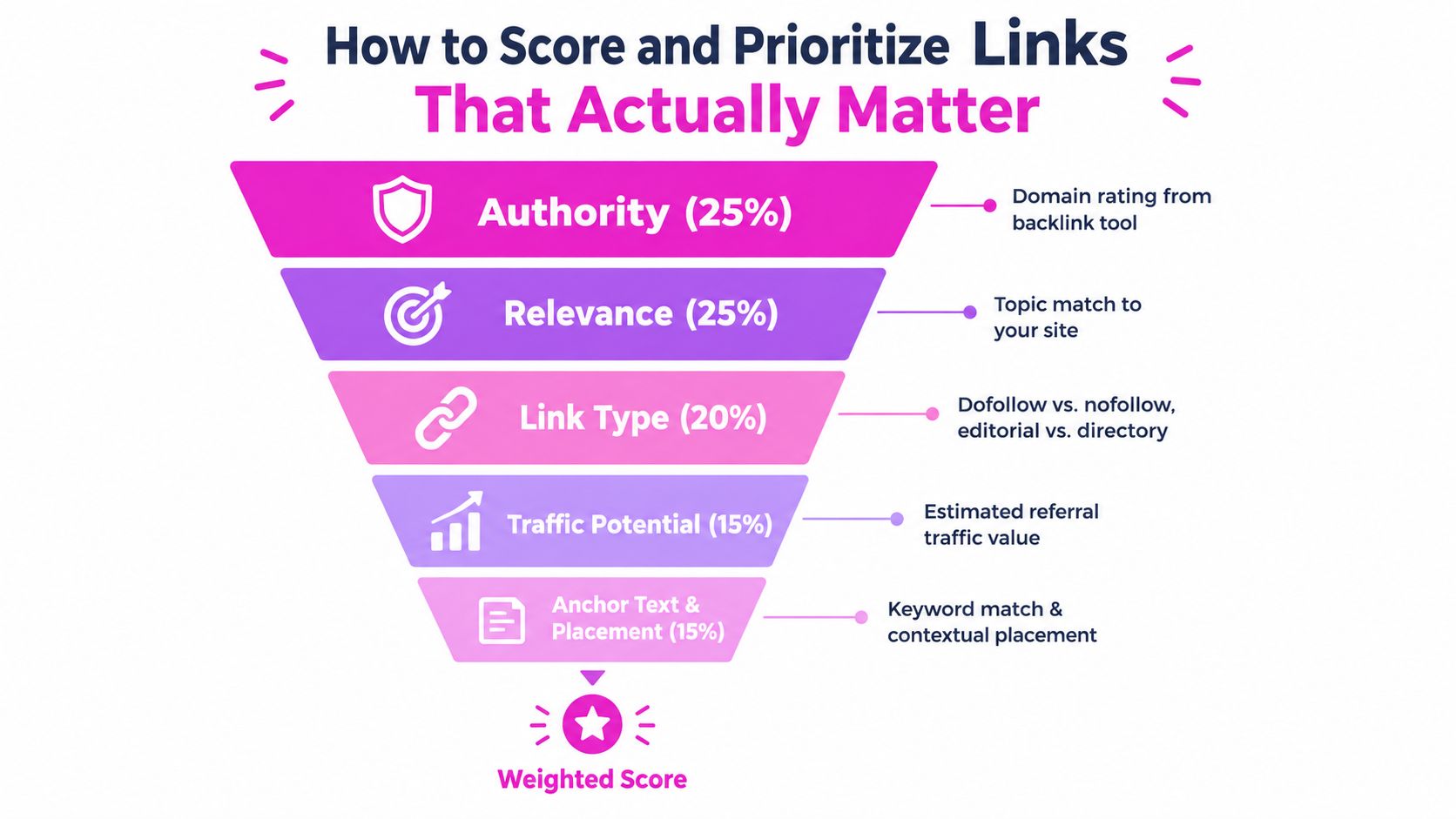
A scoring model makes an audit consistent, especially when several people review the same profile. I use a weighted score from 1 to 5 for each factor, then apply these weights:
- Authority, 25%
- Relevance, 25%
- Anchor fit, 15%
- Traffic value, 15%
- Freshness, 10%
- Follow or nofollow attribution, 10%
This model gives authority and relevance equal weight because a strong source without topical fit can be less useful than a moderately authoritative source that reaches the right audience.
A worked scoring example
Suppose a relevant industry resource links from an in-content paragraph to a commercial guide. I score it as follows:
| Factor | Score | Peso | Weighted result |
|---|---|---|---|
| Autoridad | 4 | 25% | 1.00 |
| Relevance | 5 | 25% | 1.25 |
| Anchor fit | 4 | 15% | 0.60 |
| Traffic value | 3 | 15% | 0.45 |
| Freshness | 4 | 10% | 0.40 |
| Follow attribution | 4 | 10% | 0.40 |
| Total | 100% | 4.10 / 5 |
I'd place that link in Tier A, which means protect the placement, monitor it, and look for similar editorial opportunities. A link with a total from 3.25 to 4.09 becomes Tier B, a watchlist link. A score from 2.25 to 3.24 becomes Tier C, usually an outreach or improvement candidate. Anything below 2.25 enters Tier D for removal or disavow review.
Those cutoffs are operating rules, not search-engine thresholds. A Tier D link pointing to a page affected by a manual action deserves more attention than a Tier D link sitting on an irrelevant scraped page with no visible connection to your site.
The same source can also receive different scores for different target pages. A relevant publication linking to your technical guide may be Tier A, while a forced link from that same publication to an unrelated product page may be Tier C or Tier D.
I use a backlink analysis template to record the evidence behind every score. That makes disagreements productive because reviewers can debate relevance, intent, or placement rather than arguing over an opaque tool label.
High-Quality Versus Low-Quality Link Patterns in the Wild
A healthy link profile looks coherent when I inspect it in a referring-domain export. The best links usually have a reason to exist beyond ranking manipulation. The source page serves a real audience, the target page answers a related need, and the anchor helps the reader understand where the click goes.
| Señal | High-Quality Pattern | Low-Quality Pattern |
|---|---|---|
| Editorial context | In-content citation from a relevant resource | Footer, sidebar, comment, or thread placement |
| Anchor language | Brand, URL, or descriptive phrase | Repeated exact-match commercial keyword |
| Diversidad de dominios | Distinct publications and organizations | Repeated links from one network |
| Hosting footprint | Varied ownership and site structures | Shared IP or visible class-level clustering |
| Page purpose | Useful article, research, tool, or reference | Thin page created mainly for outbound links |
| Link neighborhood | Reasonable related destinations | Many unrelated commercial targets |
| Traffic behavior | Plausible audience and referral activity | No audience signals and unusual page patterns |
| Velocity | Consistent acquisition around published assets | Sudden bursts of similar placements |
The surface metrics can mislead. A private blog network page may show a respectable authority score while carrying unrelated outbound links, thin content, and a suspicious publishing pattern. A paid insertion may also look editorial until you inspect neighboring links and the language around the placement.
I pay attention to link velocity anomalies, but I don't treat every burst as manipulation. A product launch, news mention, useful study, or viral resource can produce a genuine increase. The question is whether the new links share the same anchors, templates, source types, and target pages.
A quick scrolling test
When I'm scanning a Referring Domains report, I flag a domain for inspection if several of these appear together:
- Unclear audience: I can't explain why its readers would need the target page.
- Commercial repetition: The same keyword anchor appears across unrelated domains.
- Template placement: The link appears in a repeated footer, widget, or directory block.
- Weak neighbors: The page links to unrelated casinos, loans, software, or other commercial topics without editorial explanation.
- Ownership clustering: Multiple domains share obvious structural or hosting similarities.
- No useful destination: The link points to a page that doesn't satisfy the source article's intent.
One weak signal isn't enough. A pattern is what changes my decision.
An Audit Workflow Built Around SemDash Backlink Data
I run the audit in a fixed sequence so the analysis doesn't turn into random spreadsheet sorting. SemDash's Backlink Research workflow uses a índice de 2,7 billones de enlaces and exposes reports such as Referring Domains, Pages by Links, and Anchors. I use those reports to move from inventory to diagnosis, then from diagnosis to an action queue.

Pull, segment, and inspect
First, I pull the full backlink report for the domain and export the fields needed for review: linking domain, source URL, target URL, anchor, follow status, first-seen date, last-seen date, and available authority or traffic indicators.
Next, I switch to Dominios de referencia and sort by unique domain, authority, and relevance. I don't rank the list by authority alone. I group domains into likely Tier A through Tier D candidates, then inspect the source page for placement and editorial context.
I filter the link-type view by follow and nofollow attributes, then inspect unusual concentrations rather than chasing an ideal ratio. A high nofollow share can be entirely normal for a publication-heavy profile, while a follow-heavy profile with repetitive anchors and templated placements deserves closer scrutiny.
Use Anchors and Backlink Gap for decisions
El Anclajes report comes next. I sort by frequency and isolate exact-match commercial anchors, branded anchors, naked URLs, generic anchors, and long descriptive phrases. I then map suspicious anchor clusters to target pages. The cluster matters more than any isolated phrase.
Finally, I use Brecha de backlinks to find domains linking to competitors but not to the site under review. I qualify each opportunity by relevance, source-page quality, audience fit, and likely editorial reason before adding it to outreach. Competitive discovery is useful only when it produces a credible pitch or content idea.
For teams that need the technical profile and broader site context reviewed together, an Excellorix web audit service can complement a backlink-specific review. I still keep the link triage decisions tied to target pages and business outcomes.
My final export is a remediation queue, not a raw list. Each row includes the score, tier, evidence, proposed action, owner, and follow-up date.
Remediation Moves Beyond the Disavow Button
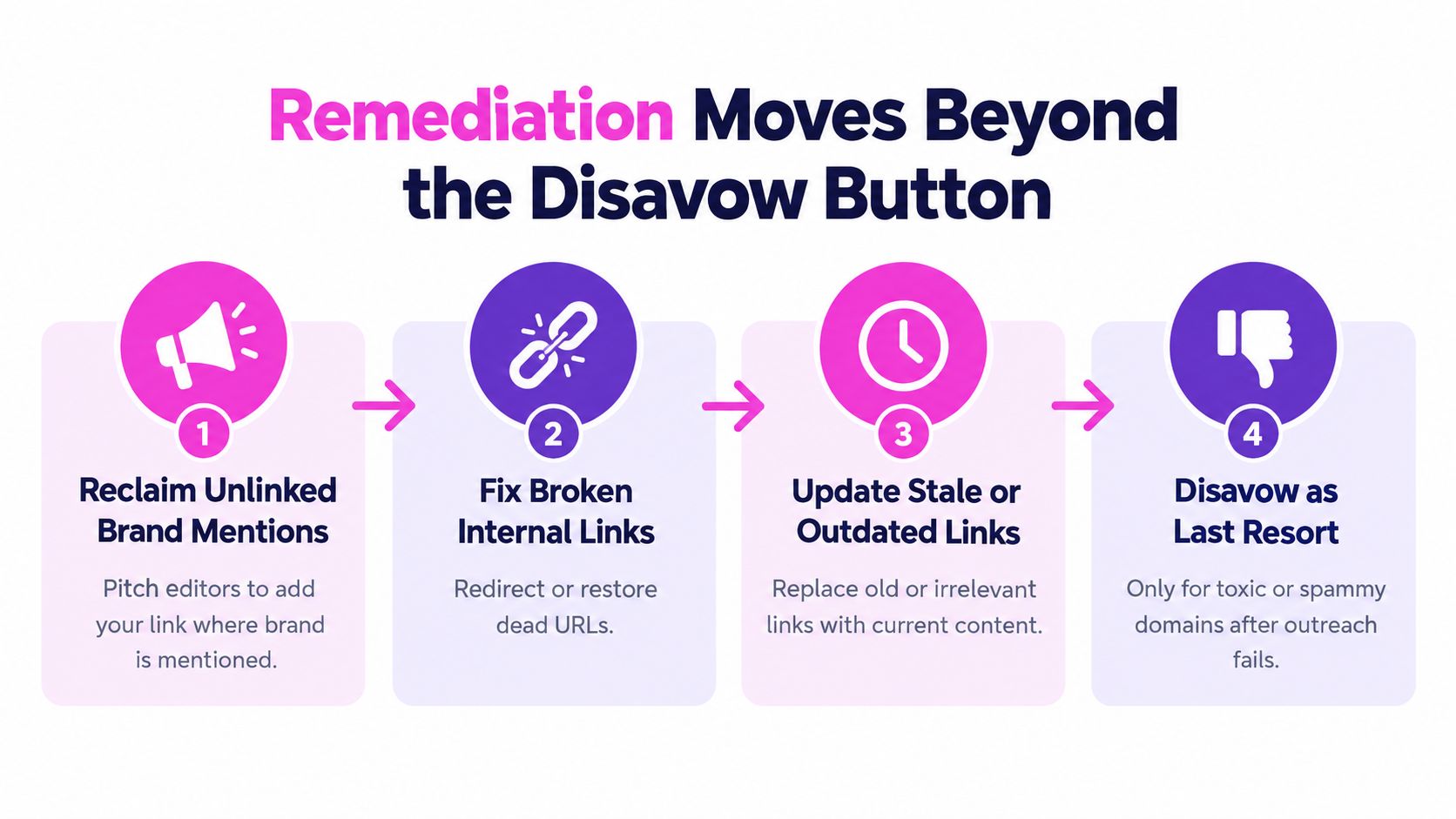
Most useful cleanup happens before disavowal. I start with links that can be improved or recovered, because changing a bad target, repairing a broken URL, or securing an editorial placement can preserve more value than removing a questionable link.
Reclaim what already exists
Unlinked brand mentions are often the easiest outreach opportunity. I identify pages that mention the company, product, research, or original data, then contact the editor with a specific destination that adds context. The request works better when I explain the reader benefit instead of demanding a link.
Broken backlinks need a similarly precise approach. If SemDash flags a source page pointing to a dead URL, I check whether the original content can be restored, redirected, or replaced with an equivalent page. I send the publisher the current destination and explain exactly what changed.
Anchor adjustments can help when an existing placement uses an overly commercial phrase. I ask the publisher whether they'd prefer a branded or descriptive anchor that matches the surrounding copy. I don't request changes on every link, because unnecessary edits can damage a legitimate editorial relationship.
The best remediation request makes the publisher's page better, not merely your backlink profile cleaner.
A practical recovery sequence
I once reviewed a profile where the team wanted to disavow a large set of old links. The first pass found several stronger opportunities: relevant brand mentions without links, a group of backlinks pointing to outdated URLs, and existing placements with anchors that could be made more natural.
We prioritized those contacts, supplied replacement URLs, and documented each response. The recovered and improved placements restored useful paths to the site, while the remaining suspicious links were assessed separately. The lesson wasn't that disavow never matters. It was that outreach and reclamation addressed identifiable losses, whereas a disavow file would only have removed links from evaluation.
Backlink Gap also turned competitor sources into outreach targets. We looked for publications that had a clear reason to cite the site, then created a pitch around a more complete resource instead of asking for a copy of a competitor's placement.
When Disavow Helps and When It Is Wasted Effort
Disavowal has a narrow job. Google says to use it when there is a considerable number of spammy, artificial, or low-quality links and those links have caused, or are likely to cause, a manual action. Google's disavow guidance makes clear that this isn't routine housekeeping for every suspicious URL.
Google defines link spam as creating links to or from a site primarily to manipulate rankings, including buying or selling links for ranking purposes. That makes intent important, but intent still needs evidence. Google's spam policies are a better reference for identifying manipulative behavior than a third-party toxic score alone.
| Escenario | Use Disavow? | Why |
|---|---|---|
| Scraped spam with no visible target-site involvement | Usually no | Google may already ignore it, and the site owner may have no control |
| Auto-generated Web 2.0 links | Usually no | Submission can create work without proving ranking impact |
| Competitor-driven negative SEO blast | Usually no | A sudden set of irrelevant links isn't automatically a site-level penalty |
| Manual action involving unnatural links | Yes, after investigation | The response should address the documented cause |
| Inherited profile from old SEO work | Sometimes | Review the pattern, removal attempts, and historical context |
| Confirmed paid-link campaign with impossible removal | Potentially | Document outreach and use disavow as a constrained remediation step |
The tool tells Google to ignore specified links. It doesn't remove those links from the web, as Google's original disavow announcement explains. I also separate reporting a spammy source page from disavowing links to my own property, because those are different actions and depend on whether I control the linking domain. Google's public guidance on that distinction reinforces the need to choose the correct workflow.
My practical test is simple: would I pay to remove this link with my own money? If yes, I try outreach first. If the profile shows a documented manual-action risk and removal isn't possible, disavow becomes defensible.
Your Backlink Quality Analysis Checklist
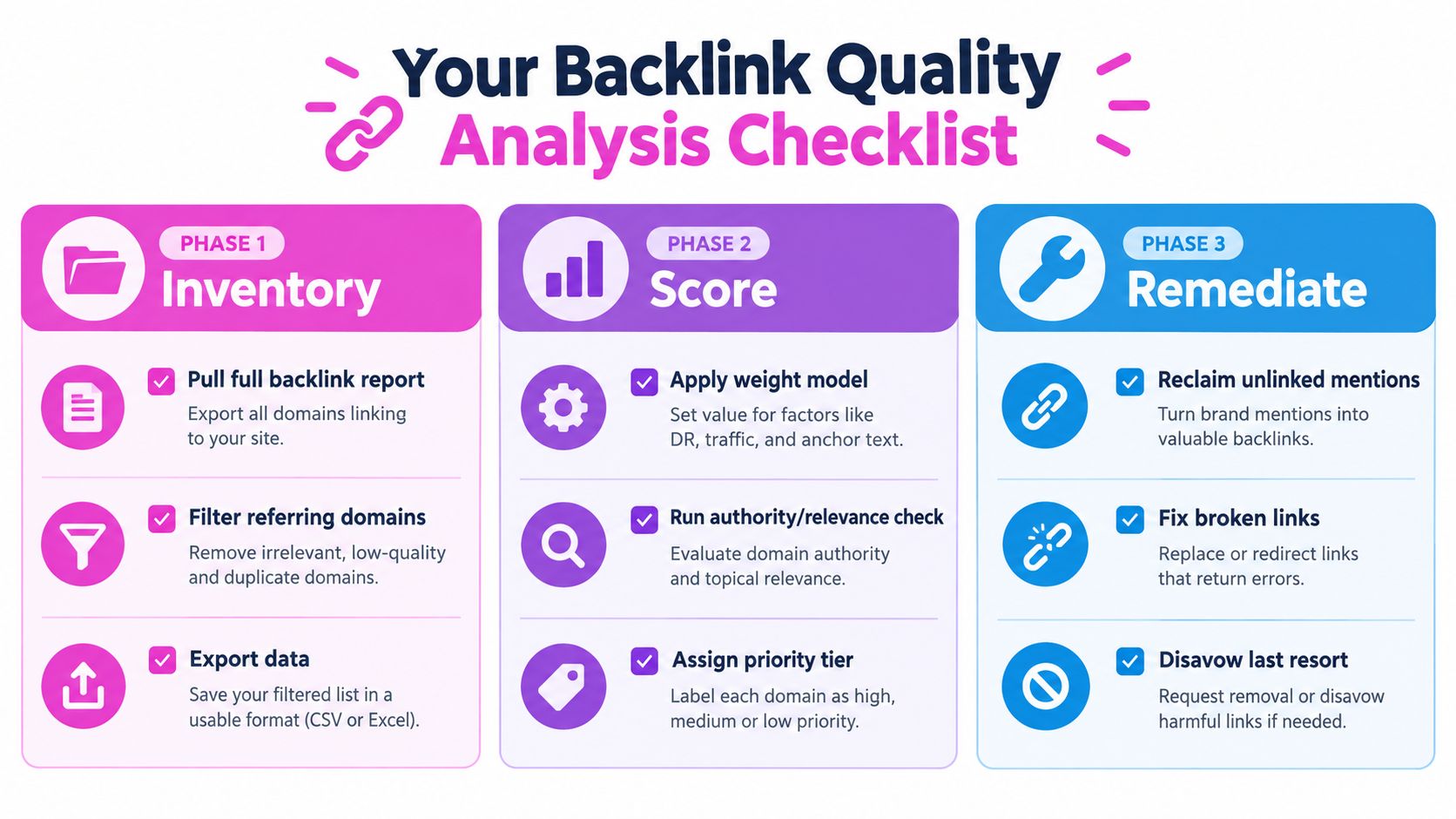
A repeatable audit should end with decisions, not a folder of exports. I use this sequence:
- Inventory the profile: Pull the full backlink report, count unique referring domains, and export source URLs, target URLs, anchors, attributes, and discovery dates.
- Segment the profile: Group links by authority, relevance, target page, placement, and source type. Look for patterns across domains rather than reacting to individual URLs.
- Score priority: Apply the weighted model for authority, relevance, anchor fit, traffic value, freshness, and attribution. Assign Tier A through Tier D, then record the evidence behind each decision.
- Remediate useful assets: Reclaim unlinked mentions, repair broken backlinks, request sensible anchor changes, and contact competitor-linked prospects that fit your editorial strategy.
- Review risk separately: Investigate paid placements, manipulative patterns, manual actions, and old link schemes. Consider disavow only after removal attempts and documented diagnosis.
Healthy profiles need a quarterly light review. Run a full audit for a migration, a significant traffic drop, or a manual-action response. After a major volatility event, isolate affected pages, compare winners and losers, and check whether link acquisition timing aligns with the decline before assigning blame to backlinks. Google's documentation on spam updates separates link-spam actions from broader ranking changes, so don't treat every update-related loss as a link problem.
The operational rule I use is blunt: if a link isn't worth the time to email about, it probably isn't worth disavowing either.
Use SemDash to inspect referring domains, anchors, follow attributes, freshness, broken backlinks, and competitor link gaps in one backlink quality analysis workflow. Visit SemDash, pull your profile, score the links tied to important pages, and turn the next audit into a prioritized remediation queue.