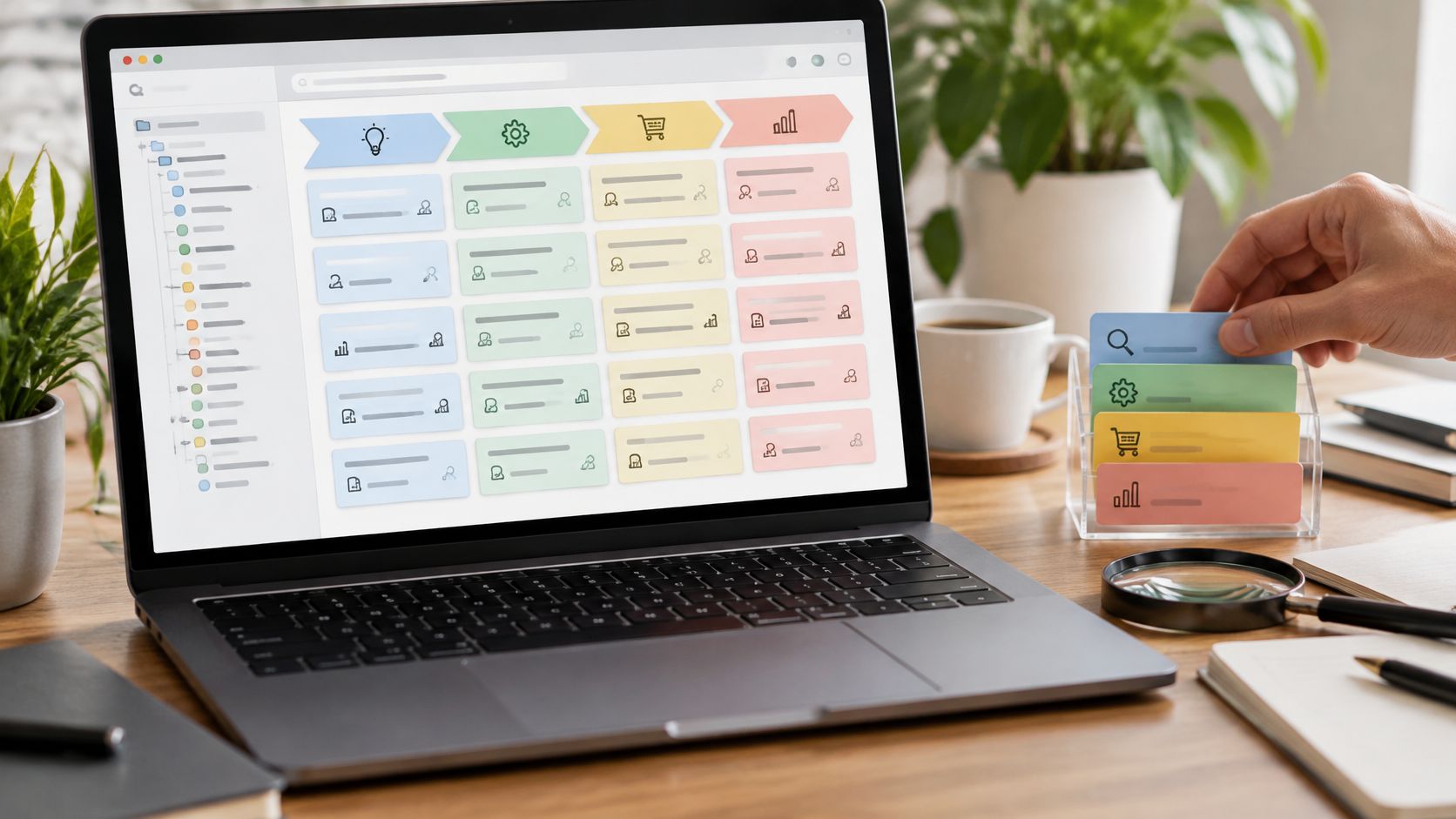


You exported forty competitor keywords and twelve referring domains last month. The sheet is still open. Not one page on the site changed. I treat that stall as a decision failure, not a research failure. Competitive analysis and strategy only earns its time when every row answers which page or segment you will change, what the gap is worth, and what it costs in effort and risk. The rest is a longer list.
Tabla de contenido
- Why Competitor Research Stalls Before It Becomes Strategy
- Six Steps to Run a Competitive Analysis
- Choosing Which Competitors Deserve a Full Benchmark
- Keyword Gaps, Traffic Share and Top Pages to Benchmark
- Backlink Gaps Worth Chasing and Ones to Skip
- Turning Findings Into a Ranked Strategy
- Tracking Competitor Visibility in AI Overviews
- Run Your First Analysis This Week
Why Competitor Research Stalls Before It Becomes Strategy
That spreadsheet is the usual starting point. Keywords sit in one tab. Referring domains sit in another. Nobody attached a question to either tab, so the export never became a brief, a rewrite, or a redirect.
Three failure modes show up more often than any tool bug.
Collecting without a decision. Rows pile up because the export was easy. Nobody named the page or segment that must move next quarter, so every keyword looks equally worth chasing.
Benchmarking the wrong rival. The brands you admire are not always the sites winning your queries. You compare yourself to a publisher with a decade of authority, then conclude you cannot rank, when a smaller site is taking your buyer.
Reporting numbers without ranking them. A gap of two hundred keywords and a gap of two keywords land in the same slide. Effort and risk never enter the sort, so the team picks the loudest row instead of the cheapest fix.
A competitor list says who ranks. A competitive analysis says which gap you can close, what it is worth, and what it costs. The path I use is short on purpose. Set the decision, pick the right rivals, measure keyword and traffic gaps, check backlink gaps for risk, then score every opportunity so the output is a ranked strategy.
Before you open a tool: which pages or segments must win for the business to grow next quarter?
Six Steps to Run a Competitive Analysis
I run the work in this order because each step narrows the next one. Skip the first and you get a long list with no owner. Skip the last and you get a sheet nobody acts on.
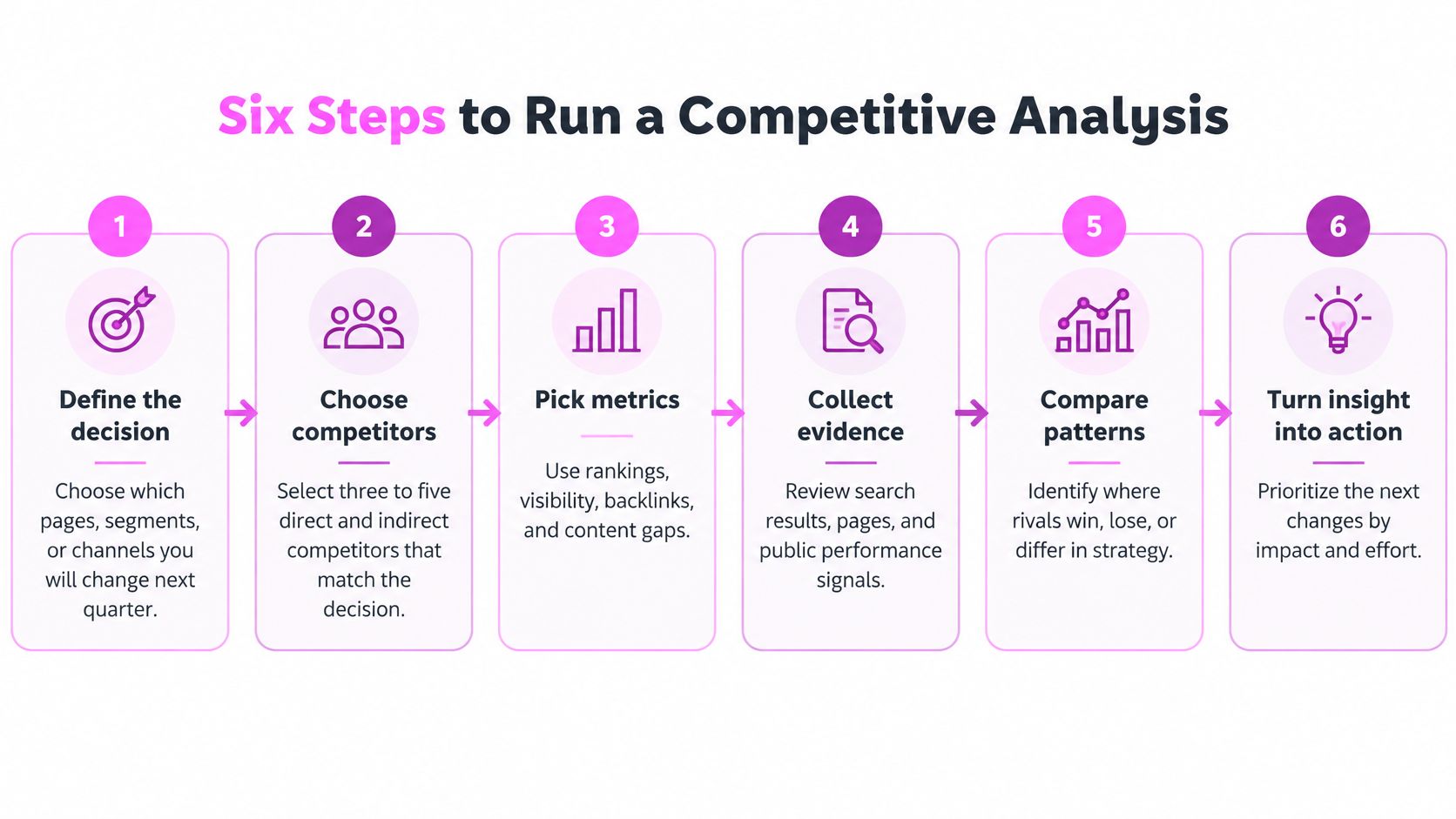
- Define the decision. Name the pages, segments, or channels you will change next quarter. That choice decides which rivals and metrics matter. Without it, every export feels relevant.
- Choose three to five competitors. Use the sites that share your target queries, not the brands you wish you were. Admiration is a poor filter. Query overlap is a better one.
- Pull keyword gaps, traffic share, and top pages. Export them into one sheet so you can see the same rival across all three views. Separate exports hide whether a "winning" page is really a thin comparison that earns almost no visits.
- Pull backlink gaps and classify each referring domain. Type and risk come before outreach volume. A domain count is a prospecting list, not a target.
- Check market structure. Ask whether a new entrant can win a defensible niche, or whether the category is already locked by a few large players. This is the step most SEO audits skip, and it changes how hard you push.
- Score every opportunity by impact, effort, and risk. Assign an owner and a deadline. This is the step that turns findings into work. Teams skip it because scoring feels slower than exporting, then wonder why the deck dies in Slack.
The same logic applies outside organic search. If you sell on a marketplace, I would read a practical walkthrough on how to compare competitors' Amazon PPC strategies before you treat ad spend as a separate sport from search. The decision, the rival set, and the score still come first.
The finished output is one page. It holds a ranked list of 8 to 12 actions. Each line has a metric, a target URL, and a deadline. If it needs a second page, you have not scored yet.
Choosing Which Competitors Deserve a Full Benchmark
The mistake that wastes the most time is benchmarking the biggest brands in the market instead of the sites competing for your queries. Category labels lie. Overlap does not.
Find the sites that actually share your SERP
Pull the domains that rank across the top results for your target keywords. A site that shows up on a large share of those queries is a SERP rival, even if its homepage looks nothing like yours. A famous brand that never appears on those queries is noise. I would rather fully benchmark three overlapping domains than skim twelve logos from an industry roundup.
Overlap still has a trap. A news site can rank for your head terms on pure authority. You will not match that on the same query this quarter. Note it, then spend the benchmark on pages where a focused site is winning with content you could build.
Three other types change what you pull
Not every threat shows up in rank tracking.
Business rivals sell to the same buyer at a similar price. Compare branded demand and conversion pages, and watch for traffic inflated by paid or social channels.
Content rivals own the guides and comparisons your readers already use. Compare their top pages and question topics. Thin pages can inflate a page count without earning traffic, so sort by visits, not by URL count.
Sustitutos are spreadsheets, agencies, or in-house teams that solve the same problem without a search result. They rarely appear in a rank tracker, and they still decide whether anyone buys.
Michael E. Porter's How Competitive Forces Shape Strategy treats industry profitability as more than a contest among existing rivals. New entrants, supplier power, buyer power, and substitutes shape the market as much as rival sites do. I use that as a checklist, not a slide. Can buyers switch cheaply? Do suppliers such as data providers or agencies control your costs? Can a substitute solve the problem with no search engine at all?
| Competitor type | How to identify it | What to pull | Watch for |
|---|---|---|---|
| SERP rival | Ranks for a large share of your target queries | Keyword gap, top pages | Big brands with authority you cannot match on head terms |
| Business rival | Sells to the same buyer at a similar price point | Traffic share, branded queries, conversion pages | Traffic inflated by paid or social channels |
| Content rival | Owns the guides and comparisons your readers use | Top pages, question-based topics | Thin pages that inflate page counts without earning traffic |
| Substitute | Spreadsheets, agencies or in-house teams solving the same problem | Problem-led and branded queries | Hard to see in rank tracking but decisive for buying |
My rule is three to five full benchmarks. Everyone else gets an alert, not a workbook.
Keyword Gaps, Traffic Share and Top Pages to Benchmark
Three reports do most of the work. Each one answers a different question, and mixing them is how teams chase the wrong page.
What each gap actually tells you
A keyword gap lists terms your rivals rank for and you do not. I only pursue terms with real search volume, using 100 or more monthly searches as a starting filter, and only when the ranking page matches an intent I can serve. A term your rival ranks for with a glossary, while you sell a product, is not your gap.
La cuota de tráfico is your slice of organic traffic inside the rival set. A share under 5 percent in a market you target is a content gap worth opening. A share that falls for two quarters in a row is a page problem, not a "we need more keywords" problem.
Páginas principales show which URLs earn the most organic traffic. I build a matching page only when the intent matches the offer. Copying a rival's traffic leader because the number is large is how you publish a page your buyer never needed.
Concentration before you push harder
Before I decide how hard to push, I size the market with the Herfindahl–Hirschman Index (HHI). Square each firm's share and add the squares. OECD guidance9/en/pdf) puts markets below 1,500 in low concentration, 1,500 to 2,500 in medium concentration, and above 2,500 in high concentration. Four firms at 40%, 30%, 20%, and 10% produce an HHI of 3,000, which is high. In that market I test a defensible niche instead of assuming broad acquisition will work.
Two mistakes distort the number. Calculating from only the top three competitors drops smaller firms, and the official method squares every firm's share. Combining segments or countries can also make concentration look lower than it is for the buyer you serve. Keep the shares and the date with the index.
Keyword difficulty is a filter, never a verdict. Pair it with the pages that rank. If two of your URLs already rank for the same query, you have cannibalization, and a new article makes it worse.
| Métrica | Where to read it | What a gap signals | Starting decision rule |
|---|---|---|---|
| Keyword gap | Domain Keywords and Keyword Gap reports | Terms rivals rank for and you do not | Pursue when monthly volume is 100 or more and the intent matches a page you can build |
| La cuota de tráfico | Traffic Share view for each rival | Your slice of organic traffic in the set | Investigate when your share is under 5 percent in a target market or falls two quarters running |
| Páginas principales | Top Pages report per competitor | URLs earning the most organic traffic | Build a matching page only when its intent matches your offer |
| Keyword difficulty | Keyword research tool | Relative competition for a query | Use as a filter, not a verdict, and combine with the ranking pages |
| URL de clasificación | mapeo a nivel de URL | Which page ranks for the query | Consolidate when two of your URLs rank for the same query |
Read the rows as rules, not as a dashboard. Volume without intent is a skip. A falling share with two URLs on one query is a consolidation job. A high HHI plus a head-term gap is a niche test, not a homepage rewrite.
Backlink Gaps Worth Chasing and Ones to Skip
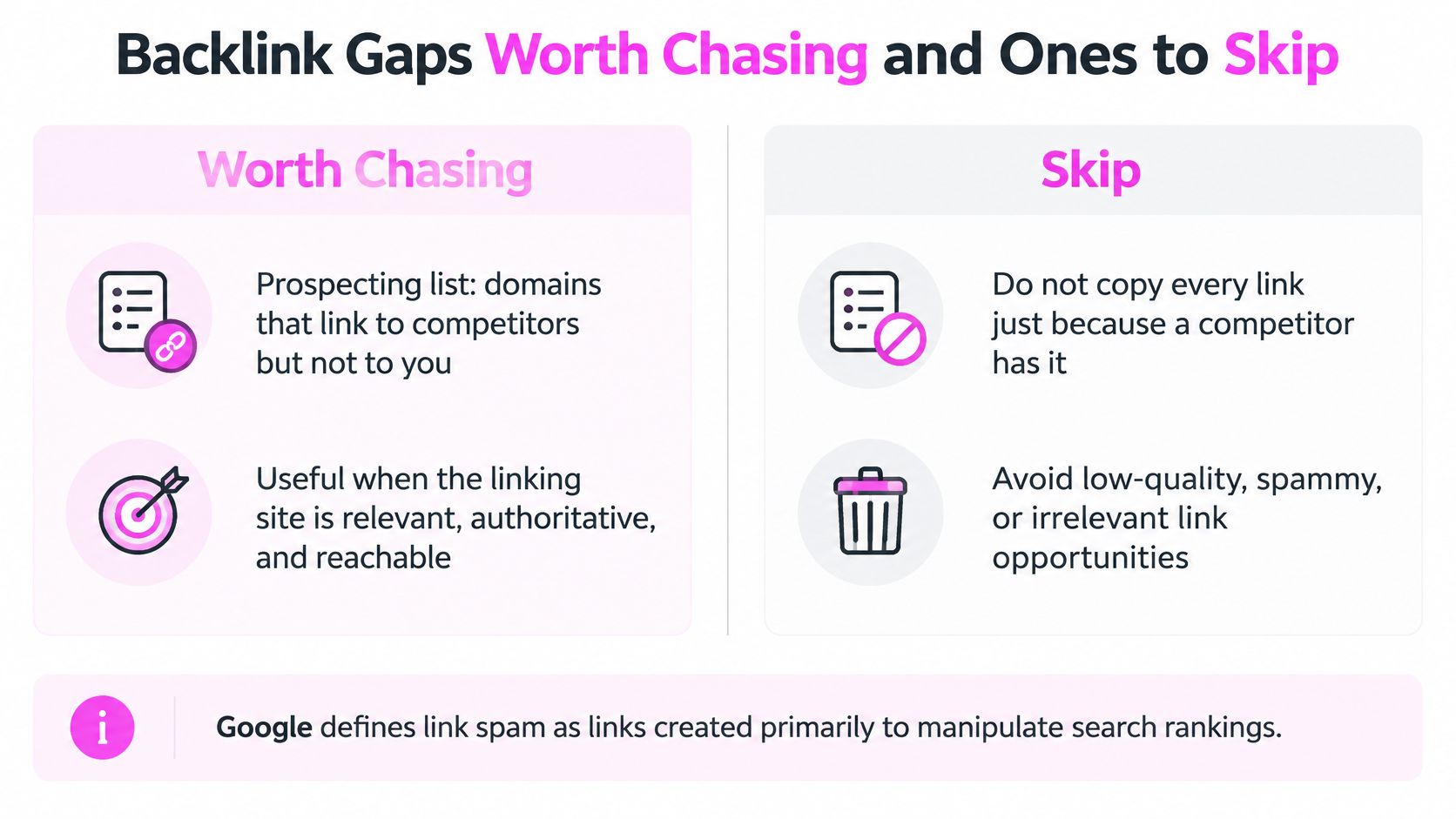
A larger link count is not a better opportunity. A backlink gap lists domains that link to your competitors and not to you. Treat it as a prospecting list. It is not permission to copy every link.
Google's spam policies define link spam as creating links primarily to manipulate search rankings. That is why I classify every referring domain before anyone writes a pitch. Copying a rival's anchor-text profile, or buying links only to rank, creates risk rather than authority.
The 300-domain cut
Say a rival has 300 referring domains. Forty are editorial and on-topic. The other 260 come from link farms or paid lists. I pursue the 40. I never touch the 260. Counting the 260 as "gap size" is how outreach calendars fill with sites that cannot send a qualified visit.
Judge what remains in this order: relevance and audience first, pitch angle second, outreach effort last. Effort is the wrong first sort. A hard pitch to the right audience beats an easy pitch to a directory nobody in your market reads.
For every opportunity I log four fields: the target page, the linking context, the audience fit, and the user value the link adds. Success is not "new referring domains this month." A common failure is celebrating that count while relevance and policy risk stay off the sheet. If you want the field-by-field workflow, I keep a longer version in this competitor backlink analysis walkthrough.
Classify the top 50 referring domains into the five buckets below. Drop any bucket that does not match your audience.
| Referring domain type | Señal | Acción |
|---|---|---|
| Editorial mention | Relevant site links to a rival's content | Pursue with a specific pitch |
| Genuine partnership | Real business relationship with a rival | Evaluate case by case |
| Directory with real audience | Listing read by your buyers | Pursue if it sends visits |
| Paid placement | Sponsored or bought link | Skip for ranking purposes |
| Manipulative pattern | Link farms or unnatural anchor clusters | Skip and do not copy |
A domain in the gap is a lead. It becomes a target only after the bucket says the link would still make sense if rankings did not exist.
Turning Findings Into a Ranked Strategy
I score each finding on impact, effort, and risk, each marked low, medium, or high from the evidence already on the sheet. Impact is the traffic or revenue the gap could move. Effort is the work to build or fix it. Risk is policy exposure plus the chance the change hurts rankings. The priority rule, not the raw gap size, decides the order.
| Opportunity type | Signal in the analysis | Effort | Risk | Priority rule |
|---|---|---|---|---|
| Ranking page mismatch | Wrong URL ranks for a target query | Low: internal links or consolidation | Baja | Fix before writing anything new |
| Content gap on high-intent query | Rival top page earns traffic you have no page for | Medium: new or updated page | Baja | Do first when one page can fully answer the query |
| Editorial link opportunity | Rival links from relevant, editorial sites | High: outreach and pitching | Medium if the link would be manipulative | Pursue when relevance and audience fit are clear |
| Narrow market segment | Low concentration with an unmet buyer need | High: product or positioning change | Alto | Test with a narrow segment before broad investment |
| AI visibility gap | Rival cited in AI Overviews for your queries | Medium: content clarity and indexing | Baja | Fix crawling and indexing first, then rewrite the cited section |
A mismatch beats a new article
Say a rival ranks for a query your buyers use, and your site already ranks, just on the wrong URL. A blog post and a product page are splitting the query. The fix is consolidation and internal links, not a third article. Effort is low. Risk is low. It goes above a fresh draft that needs research, design, and a month to get crawled.
The trade-off that surprises teams is the high-volume gap in a concentrated market. It often scores below a narrower segment with low concentration and clear buyer intent. The big query looks like more impact on a slide. The niche is the one you can win without matching a dominant publisher's authority.
Early-stage teams hit the same trap when every channel looks urgent. A focused startup marketing strategy keeps the first bets small and reversible, which is the same discipline I want on this list.
Keep the list short enough to finish
Review the scores after each release. Drop items that stopped moving. Keep no more than ten live priorities. A ranked strategy that grows back into forty rows has failed, even if every row is true.
Tracking Competitor Visibility in AI Overviews
Cited URLs can differ from the pages ranking in ordinary search results. That page-level mismatch is the useful signal: a domain-level report can show visibility while hiding which page Google cites.
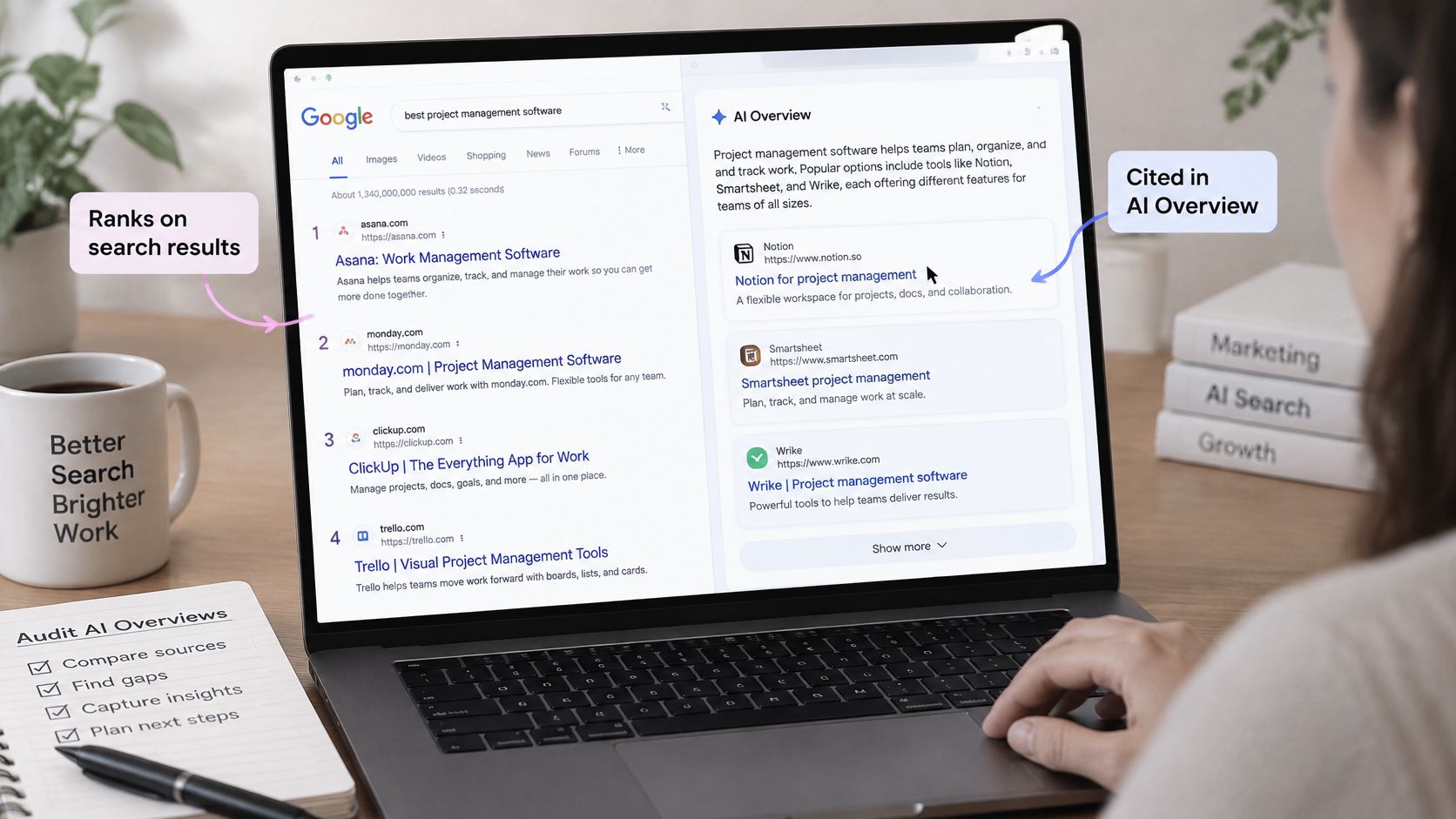
Google's guidance on AI features says the same foundational practices apply. There are no extra eligibility rules or special optimization requirements. Indexed pages eligible to appear with a standard Search snippet can also appear as supporting links.
The audit order
Check crawling and indexing first. A page blocked by robots.txt or missing from the index cannot be cited. Resolve that before rewriting content.
State important claims in clear text. Put the answer on the page in sentences, rather than relying on images or scripts to communicate it.
Link internally to the URLs you want cited. Contextual links from related guides help connect a target page to its topic.
Compare exact URLs. For each target question, record the URL cited in the AI Overview and the URL ranking in conventional results. A mismatch shows that the pages succeeding on each surface differ. Log those pairs monthly using the same query list. The guide to tracking AI Overviews at URL level explains how to make the comparison.
Creating a new page for every related query can lead to thin, overlapping content. Google warns that content variations produced mainly to manipulate rankings or generative responses can violate its scaled-content-abuse policy. A stronger approach is one authoritative page that answers the underlying topic clearly and completely.
Track AI citations alongside conventional rankings each month. Citations provide another view of visibility, while standard search results remain a separate way for pages to capture demand.
Run Your First Analysis This Week
Confirm the decision question and the three SERP rivals before you export anything else. Changing either after the data is pulled wastes the week, because every gap was filtered against a choice you just threw out.
From the scored list, pick the two opportunities with the highest impact after risk is applied. Write down the metric each one should move. Traffic share, rankings on a named query, or citations on a named question are enough. "Improve SEO" is not a metric.
Ship the first fix this week. It is usually a consolidation or an internal link change, because effort and risk are both low. A new guide can wait until that fix is live and measured.
Set a monthly review for traffic share, top-page movement, and AI citations on the target questions. Drop any item that has not moved after two reviews. Ten priorities that never get cut become the spreadsheet you started with.
SemDash keeps keyword gap, backlink gap, traffic share, and top pages in one workspace, so you are not pasting exports between tools. You can get started for free across more than 20 SEO research tools, including Keywords Search Volume and Competitor Finder, and test the workflow on a single rival before you commit a quarter to it. Start with one competitor and one gap.
SemDash brings keyword gaps, backlink gaps, traffic share, top pages, and AI Overview citations into one workspace so competitive analysis turns into a short ranked list instead of another unused export. If you want to see which rival pages and links are worth the next sprint, open SemDash and run the first gap on one competitor this week.