


You've found a keyword that looks solid, you've sketched the offer, and you're about to commit weeks of building around it. I've been in that spot, and I've learned to stop there. Before I build anything, I need to know whether people are just curious or whether they'll commit time, budget, and approval to solve the problem. That's the work of how to determine market demand.
Tabla de contenido
- Why One Demand Number Misleads You
- Six Demand Signals and What Each One Proves
- How to Run the Validation Sequence
- How to Size Reachable Demand Without Inflating It
- How to Test Stated Interest Against Real Commitment
- Decide Whether to Build, Test Again or Walk Away
Why One Demand Number Misleads You
Here's the pattern I see most often. A keyword shows healthy monthly volume, we build a landing page around it, and we get a handful of sign-ups that never become paying customers. The volume was real. The demand wasn't where we assumed it was.
I don't trust one number because it hides three different things. Attention tells you there is interest. Buying intent tells you what they want to do next. Willingness to pay tells you who commits money. A how-to query can score high on the first and fail completely on the other two.
I use the framework in the U.S. Small Business Administration guidance on market research and competitive analysis, which separates demand, whether customers want a product or service, from market size, the number of people who might be interested. It recommends direct research such as surveys, questionnaires, focus groups, and in-depth interviews, supplemented by secondary data on demographics, sales, and consumer spending.
That guidance changed how I work in one specific way. I stopped treating competitor research as a final check and started treating it as demand evidence. If competitors rank money pages, run ads, and hold traffic over time, someone is getting paid. If only blogs cover the topic, I assume the need is informational until I prove otherwise.
My working rule: No cluster advances on search volume alone. It needs attention, intent, competitor monetization, and a commitment test.
You'll get six signals to score, a validation sequence, a sizing formula, and a commitment ladder. By the end, you should be able to name exactly which evidence you're missing before you build.
Six Demand Signals and What Each One Proves
I start with the scorecard because it forces a comparison. Reading one signal at a time lets a strong number excuse a weak one.
| Señal | What It Proves | Where to Measure | Strong Reading | Weak Reading |
|---|---|---|---|---|
| Search interest | Attention exists | Keyword volume and Google Trends for the same location and period | Sustained interest across 12 months | One spike or repeated zero readings |
| Commercial intent | The query is about buying | Intent classification of the top results | Product, pricing or comparison pages rank | Only definitions and guides rank |
| Competitor monetization | Someone already gets paid for the need | Competitor domain keywords, traffic share and paid ads | Several competitors rank money pages and run ads | Only blogs and forums cover the topic |
| Persistence | The need is durable, not a news cycle | Historical SERP over 12 months | The same pages hold rankings across seasons | Ranking pages rotate after one news cycle |
| Stated interest | Customers recognize the problem | Interviews and surveys | Named workaround and a recent incident | Agreement with no workaround or cost mentioned |
| Behavioral commitment | Money or friction has been committed | Landing-page sign-ups, booked calls, deposits and paid pilots | Deposits, paid pilots or booked calls | Email captures only |
How I Read the Pattern
I don't add the rows into a single score. I look for contradictions. High search interest with weak commercial intent usually means people want an explanation, not a product. Strong stated interest with weak commitment usually means the problem is annoying but not urgent enough to fund.
My threshold is strict. A cluster needs strong readings on at least four rows, and behavioral commitment must be one of them. Surveys and search volume both overstate demand, so I won't let them carry the decision together. If commitment is missing, I haven't validated demand yet. I've only validated curiosity.
The first four signals come from research tools and public results. I check them against solid métricas de investigación de palabras clave so I'm not comparing volume from one geography with intent from another. The last two require your own work. You need conversations, a landing page, or traffic you control.
For a physical product, creators can also evaluate crowdfunding interest with PledgeBox, which is useful because a pledge is stronger evidence than a polite survey answer. I treat that as one form of commitment, not as a substitute for retention or repeat purchase.
Watch three traps in particular. A single spike can be news. A seasonal peak can disappear for ten months. An informational query can rank beautifully and never sell anything. The scorecard works because it makes those weaknesses visible before you've spent your budget.
How to Run the Validation Sequence
I run these steps in order because each one prevents a specific, expensive mistake. Skipping ahead feels faster. It usually isn't.
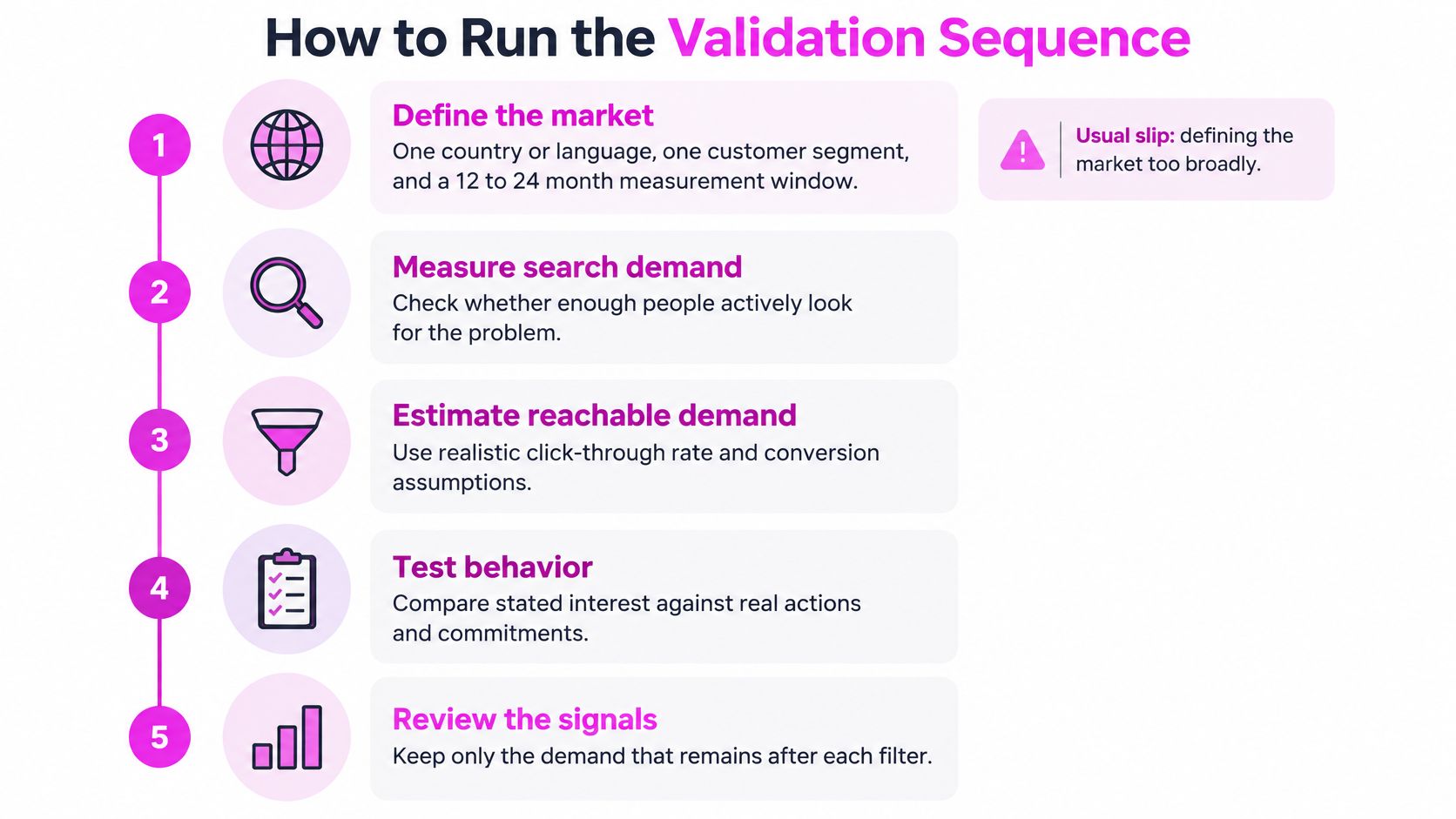
Define the market first. I pick one country or language, one customer segment, and a 12 to 24 month measurement window. Change any of those and you change the result. The usual slip is defining the market so broadly that a large aggregate hides weak demand in the segment you can serve.
Group queries by intent. Yo separo informational, commercial investigation, transactional, and branded queries before I judge volume. This step stops me from treating a how-to search as buying demand. A cluster that mixes all four will mislead every calculation that follows.
Read the live results for each cluster. I note who ranks, whether those pages sell or explain, and whether ads appear. Product pages, pricing pages, and comparison pages suggest someone monetizes the need. If only blogs and forums rank, I mark commercial intent as weak and move carefully.
Check persistence, not just presence. I pull SERP history and a comparable trend query for the same place and period. Repeated interest across seasons counts. One peak doesn't. Here I catch news-driven topics that look exciting for three weeks and then vanish.
Where People Usually Slip
Step five is where many teams rush, and it's the step I protect most.
Validate with people who recently had the problem. I run five to eight interviews and ask about the last incident, the workaround, what it cost, how often it happens, and who approved the spend. If you want a structured way to validate ideas through customer interviews, use it to keep questions behavioral instead of hypothetical. "Would you buy this?" gives you compliments. "What did you do last time?" gives you evidence.
Size the reachable portion and run a commitment test. Only now do I estimate revenue and ask for a deposit, pilot, or booked call. Doing this earlier produces a big number with nothing underneath it.
Don't move on until you have one named cluster, a dated trend for that cluster, and at least five interview notes tied to recent incidents.
I learned this sequence by doing it backwards. I once sized a market before grouping by intent, and the estimate looked great because informational volume inflated everything. The interviews later showed people wanted a free template, not a paid tool. Now I filter first and calculate second. That order saves me from building precision on top of a bad assumption.
How to Size Reachable Demand Without Inflating It
I use one formula, and I make every input earn its place.
Qualified searches × realistic click-through rate × expected conversion rate × average order value
Here's a worked example. Say you have 12,000 qualified monthly searches. At a 2% realistic click-through rate, that's 240 visits. At a 3% conversion rate, that's 7.2 customers. At a $180 average order value, your monthly revenue ceiling is about $1,296.
That number is illustrative only. I replace every input with my own measured values before I draw a conclusion, because borrowing someone else's conversion rate is how forecasts become fiction.

Where Each Input Comes From
Qualified searches come from keyword data filtered by intent, not raw volume. I count close variants that describe the same buyer once. If five phrasings describe one person with one job, adding all five volumes invents four extra buyers.
Click-through rate should reflect a realistic ranking position, not position one on day one. I use traffic estimation tools to sanity check what a page could plausibly capture, then I discount it if ads, marketplaces, or dominant brands take most clicks.
Conversion rate and order value need a source you can defend. I prefer first-party data from a test page. If I don't have it yet, I run the calculation as a range and label it as an assumption. For B2B offers, using account data for market sizing helps because named accounts with budget authority are more useful than a large, anonymous population.
What Google Trends Can and Cannot Tell You
I use Google Trends for direction and seasonality, never for buyer counts. According to Google Trends help on how search interest is calculated, Google scales each point from 0 to 100 according to the query's share of all searches in the selected geography and time range, so the score is not an absolute number of potential buyers.
That same guidance matters for weak signals. Low-volume terms may appear as zero and duplicate searches are removed, so I don't treat one-off spikes or zeros as reliable evidence. A zero can mean "too small to report," not "nobody wants this." A spike can mean a news cycle, not a market.
Sizing check: If your forecast only works at position one, with peak-season volume, and with a conversion rate you've never measured, you don't have a forecast. You have a best case.
Mistakes That Inflate the Number
| Error | Why It Misleads | Check Before You Build |
|---|---|---|
| Summing close keyword variants | Inflates volume for one buyer | Group by intent cluster and count each buyer once |
| Reading a single spike as demand | Seasonal or news-driven interest fades | Check 12 months of SERP history and repeated trend peaks |
| Using total category spending as the market | Includes purchases the offer cannot replace | Count only the spend your offer can replace in the target segment |
| Assuming one geography transfers | Growth in one market may not hold elsewhere | Test each market with its own pricing and checkout data |
| Ignoring forums and review sites | Needs appear there before they reach search | Scan community threads for the same problem wording |
The geography mistake deserves emphasis because I've made it. Strong growth in one market doesn't prove the same offer works elsewhere. Pricing, logistics, purchasing power, and incumbents change the answer. I test each market with its own checkout data before I transfer a conclusion.
I also stress test the result. I cut click-through rate in half, then conversion rate in half, and I ask whether the opportunity still covers my cost to serve. If it collapses under mild pressure, I'd rather know now than after a build.
How to Test Stated Interest Against Real Commitment
Say a founder interviews ten prospects and eight say they'd buy. I don't count that as demand. I count it as a hypothesis worth testing with friction.
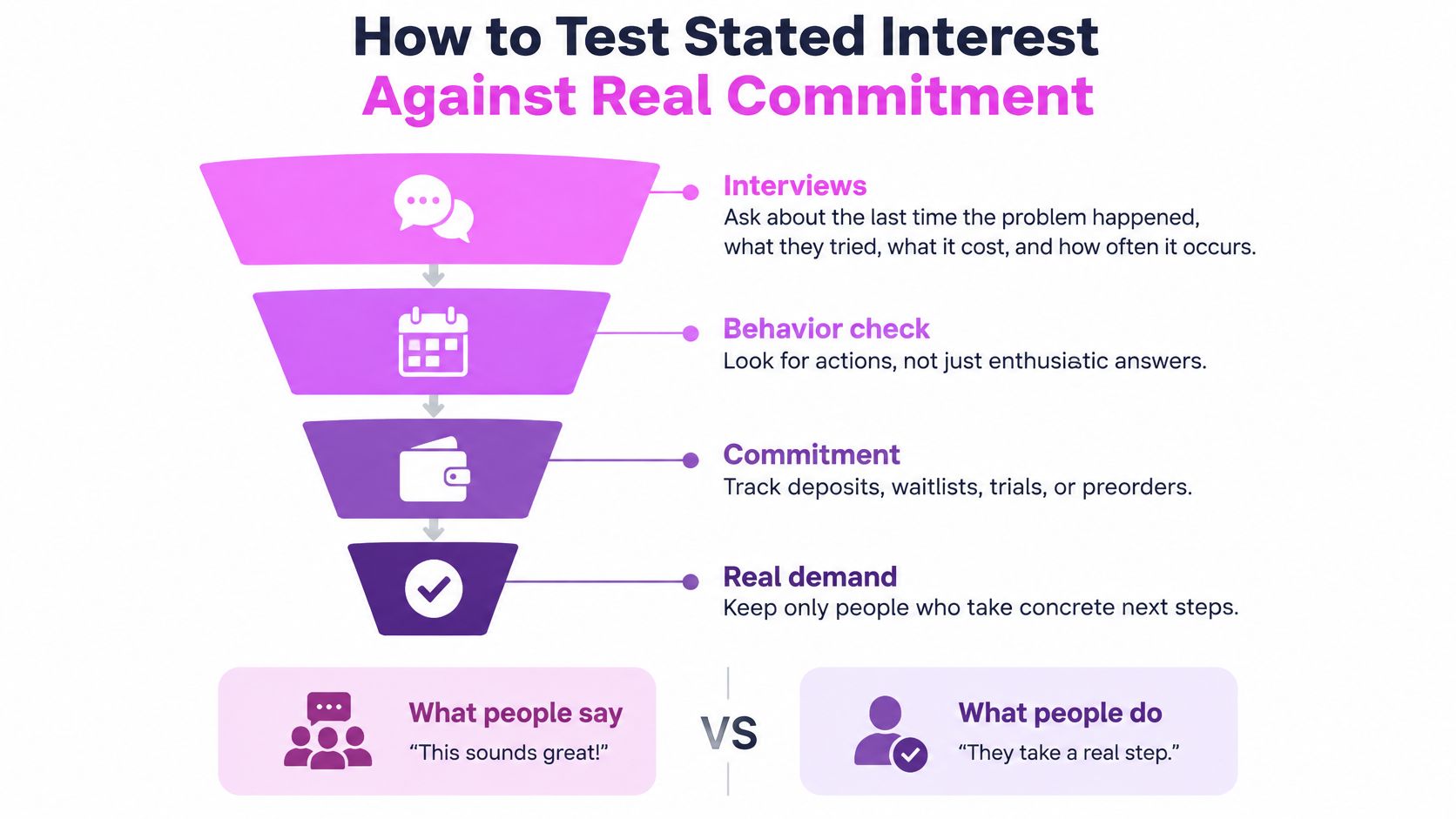
I start by asking about behavior. When did the problem last happen? What did you try? What did that workaround cost in money, time, or internal approval? How often does it recur, and who signs off on a replacement? A recent incident with a named cost is strong. General agreement with no workaround is weak.
Then I build a commitment ladder from low friction to high friction.
- Email capture: Cheap to give, weak as evidence, useful only for follow-up.
- Booked call: Costs time, so it filters casual interest.
- Qualified application: Tests fit, budget, and buying authority.
- Refundable deposit: Tests willingness to commit money before delivery.
- Paid pilot: The strongest pre-build signal because the customer pays for a real outcome.
Running the Landing Page Test
I create one landing page per leading message, keep price and fulfillment assumptions explicit, and split traffic randomly between them. I track impression to click, click to lead, and lead to qualified opportunity separately. Blending them into one rate hides where people drop out.
I also report segment-level results with confidence intervals instead of celebrating one aggregate number. A message can fail overall and work well for one segment with budget authority. The opposite happens too. Early results look promising because friends, followers, or one enthusiastic segment clicked first.
Calibration matters here. The Articos overview of BASES prelaunch testing explains that established systems adjust survey responses using historical launch databases and marketing-plan assumptions to forecast trial and repeat purchase, because the stated-to-actual buying gap is well known. I apply the same logic at small scale. I discount stated intent until observed behavior supports it.
My stop rule is simple. I don't decide on the first noisy days, and I require repeated tests before I conclude. The signal I'm looking for is a message that produces paid or high-friction commitment in at least two segments, plus customers who return, renew, or expand where repeat use is relevant.
Decide Whether to Build, Test Again or Walk Away
I force every cluster into one of three decisions. A fourth option called "promising" is how weak ideas consume quarters.
Build when the cluster passes the scorecard, the commitment test shows paid or high-friction action in at least one segment, and reachable revenue covers your cost to serve. Example: competitors rank pricing pages, interviews name a costly workaround, and a paid pilot converts. I'd build the smallest version that serves that segment.
Test again when interest is strong but commitment is weak. Example: search demand persists and interviews confirm the problem, but prospects won't book calls at your price. I'd change one variable, the message, the segment, or the price, and rerun the test. Changing all three teaches you nothing.
Walk away when competitors show no monetization and interviews produce no recent incident. Example: only definitions rank, nobody runs ads, and prospects describe the problem as occasional and free to solve. I don't keep polishing that idea.
For a practical start, enter one competitor domain into SemDash to get the full list of keywords it ranks for, with search volume, monthly traffic, Keyword Difficulty and more. Then check which of those keywords carry commercial intent and which only bring informational traffic. Semdash offers a free trial, and visitors can schedule a demo, so you can run this on your own cluster before you commit resources.
Remember what the tool can and can't do. It shows estimates, not guaranteed outcomes. The commitment test still makes the final call.
Start with one competitor domain in SemDash, pull its ranking keywords with volume, traffic, and Keyword Difficulty, and score your best cluster against the six signals before you build. If the evidence is thin, you'll know which test to run next instead of guessing.