%20(1)-B86R08ZzwhPzS6UZbG3mSxRWPCwGwn.png)


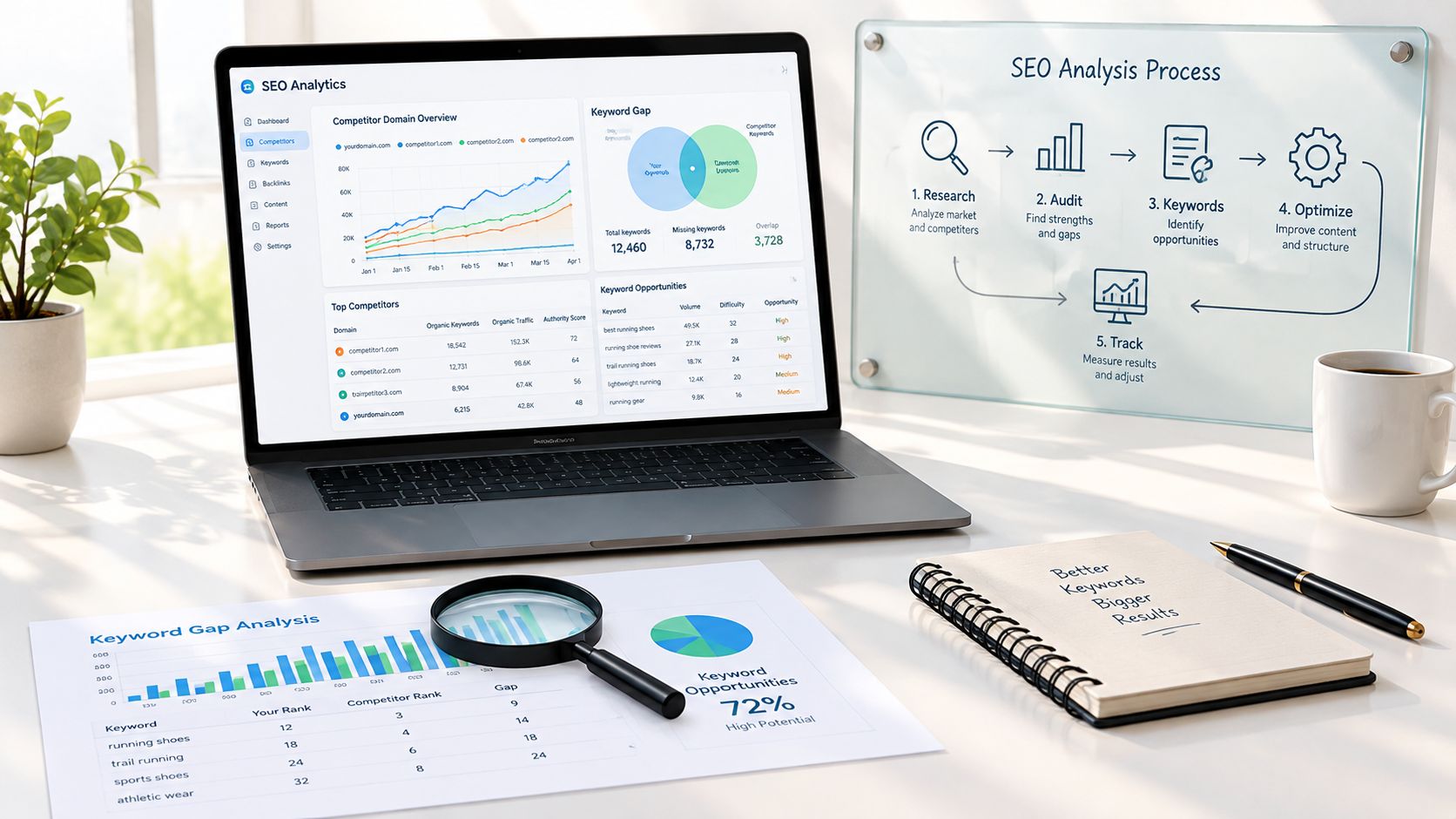
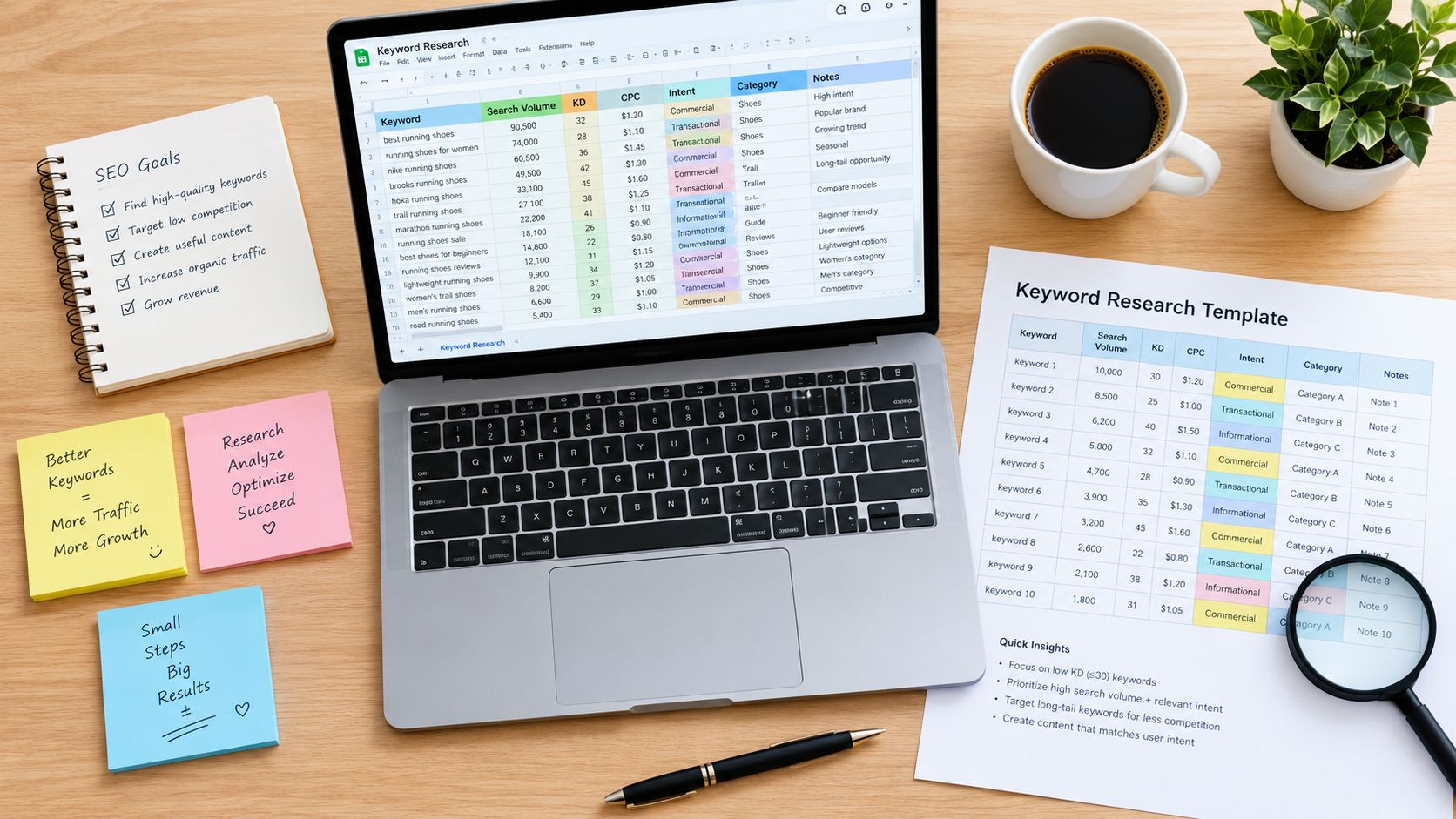
You've probably seen this happen: someone exports a competitor list, pulls keyword and backlink reports, pastes everything into a polished spreadsheet, and calls the project finished. A month later, nobody knows which page to publish, which publisher to contact, or whether a ranking change deserves a response.
That isn't competitive analysis. It's data collection without a decision attached. I treat the work as a recurring operating rhythm, where every report must answer a practical question about the next page, link, cluster, or SERP change.
Tabla de contenido
- Why Most Competitive Analyses Fail Before They Start
- Picking the Right Competitors by SERP Overlap
- Reading Domain and Page-Level Keyword Reports
- Running a Backlink Gap That Produces Real Outreach Targets
- Checking SERP History and Intent Before You Commit
- Clustering Keywords Into Page Topics, Not Lists
- AI Overviews, Reporting Cadence, and the Monthly Loop
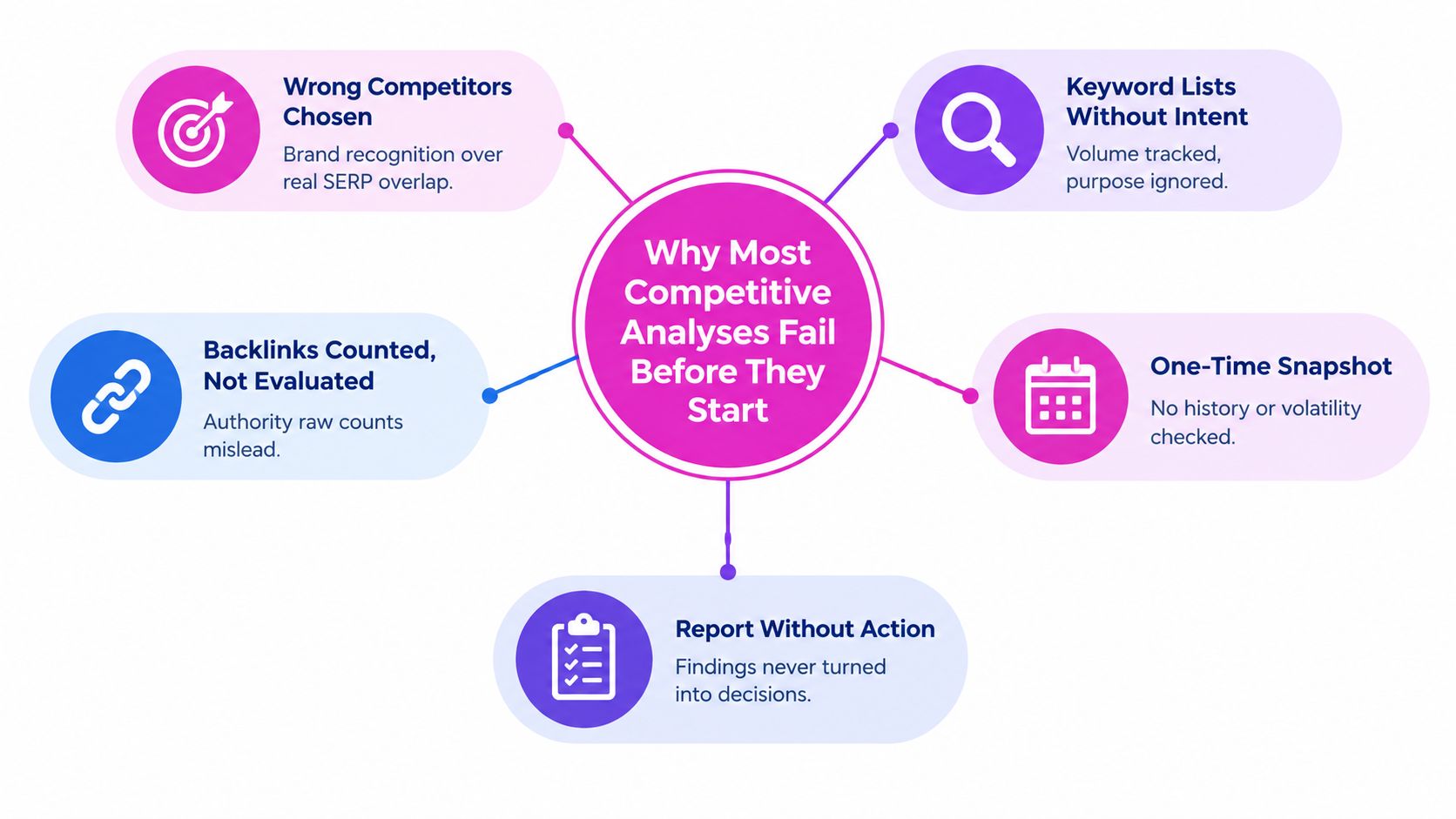
Why Most Competitive Analyses Fail Before They Start
The first mistake is choosing competitors by reputation. Your marketing competitor might be a famous brand, a cheaper substitute, or a company your sales team mentions often. Your SEO competitor is narrower: a domain or page that repeatedly appears for the search demand you need to win.
The second mistake is treating competitive analysis as a one-time site audit. Search results change, competitors publish new pages, links disappear, and intent shifts. A static report becomes misleading as soon as the market moves. I prefer a weekly operating cadence for small signals, a monthly review for decisions, and a deeper reassessment when a major entrant, pricing change, channel shift, or regulation change alters the market.
Start with the decision, not the export
Before opening a tool, write the decision the analysis must support:
- Page decision: Which topic deserves a new URL, an update, or no investment?
- Link decision: Which referring domains are realistic outreach targets?
- Cluster decision: Which queries belong together without creating cannibalization?
- SERP decision: Is the opportunity stable enough to pursue now?
- Visibility decision: Which competitors appear in AI-generated answers, and which exact URLs get cited?
A competitive analysis also needs an industry view, not just a rival list. Michael Porter's Five Forces framework, introduced in the March–April 1979 issue of Harvard Business Review, identifies rivalry, new entrants, substitutes, supplier power, and buyer power as forces shaping competitive intensity and the distribution of economic value. The Harvard Business School overview of Porter's Five Forces is useful when search competition reflects broader barriers, switching costs, or substitute channels.
Regla práctica: If a finding doesn't change what the team does next, it belongs in an appendix, not at the center of the report.
That principle also applies outside SEO. A personal brand positioning playbook can help clarify the difference between being recognizable and being meaningfully differentiated. For organic growth, I want seven concrete outputs: a defensible competitor set, domain keyword observations, page-level threats, a prioritized backlink gap, SERP history findings, page-topic clusters, and an AI citation log. Each output exists to support a decision, not to decorate a dashboard.
Picking the Right Competitors by SERP Overlap
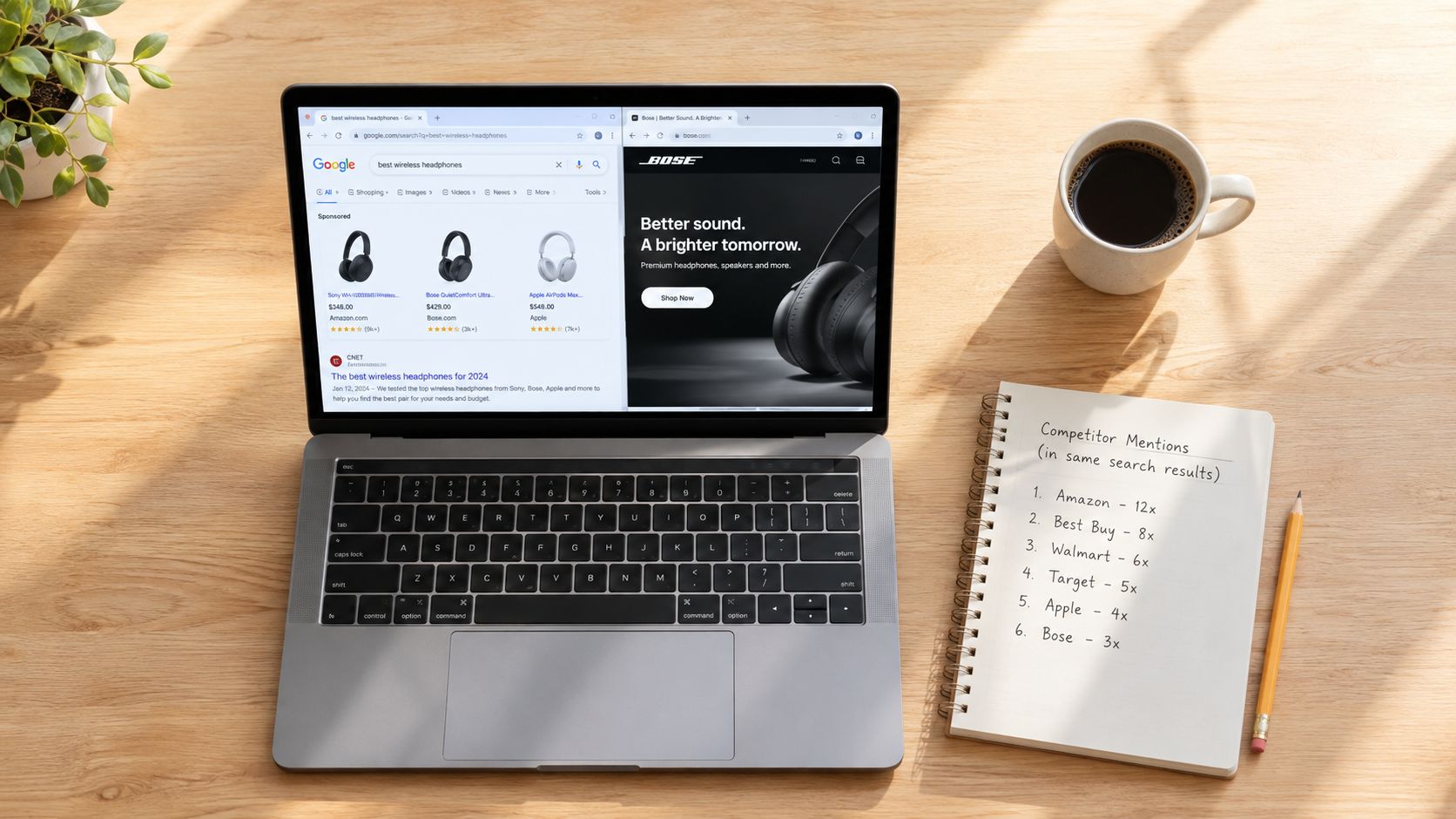
I start with the queries the business should own, not with a list of brands. Search the core product, service, problem, and use-case terms, then record the domains that appear repeatedly. A competitor that sales recognizes but that never ranks for relevant demand may matter commercially, but it shouldn't drive the SEO report.
Build two competitor groups
For primary topics, keep a focused set of three to five true competitors with meaningful SERP overlap. These are the domains I'll inspect closely because they compete for the same intent and usually offer a plausible model for content, internal linking, or authority.
Then create a wider set of 10 to 20 domains for SERP-wide monitoring. This group can include publishers, marketplaces, directories, review sites, and indirect solutions. They may not be direct business rivals, but they reveal the formats and sources Google considers relevant.
I separate the list by business model:
| Group | What it reveals | Reports I trust most |
|---|---|---|
| Direct product or service rivals | Pages and terms competing for the same buyer | Keyword gaps, page reports, backlinks |
| Publishers and media sites | Informational coverage and format expectations | SERP history, top pages, content structure |
| Marketplaces and directories | Commercial aggregation and comparison intent | SERP features, category pages, citations |
| Sustitutos | Alternative ways to solve the same problem | Industry structure, intent shifts, pricing pressure |
That classification changes the interpretation. A high-authority publisher ranking for a product query may show that Google wants comparison content, not that you need to copy the publisher's entire strategy. A marketplace ranking for a service term may indicate a distribution barrier rather than a content gap.
Delete competitors when the evidence changes
I remove a domain mid-project when its overlap came from one accidental query, when its ranking pages target a different geography, or when its business model makes the comparison strategically useless. Keeping irrelevant domains inflates the apparent gap and encourages bad recommendations.
For a more formal market boundary, I document the customer, use case, geography, substitutes, and time horizon before scoring rivalry, entry threat, buyer power, supplier power, and substitutes on a 1–5 intensity scale. The Harvard Business School Five Forces guidance supports this structure, but I don't treat the score as a forecast. I record the evidence and confidence level, then test the conclusion against customer, financial, and market evidence.
Reading Domain and Page-Level Keyword Reports
A domain keyword report tells me where a competitor has visibility. It doesn't tell me automatically where the opportunity is. The volume column represents estimated search demand, not guaranteed traffic, and a competitor's traffic estimate is a model rather than a measurement of its analytics account.
I use domain-level reports for reconnaissance. They help identify themes, commercial categories, and unexpected areas where a rival attracts demand. I don't prioritize a keyword just because it has high volume or because a competitor ranks for it. I look for a combination of relevance, intent, ranking feasibility, business value, and the quality of the page currently winning.
The URL changes the meaning
Page-level reports are where the analysis becomes useful. For every important term, I inspect the ranking URL and ask what job that page performs:
- Is it a product or service page?
- Is it a guide, comparison, glossary entry, or category page?
- Does the page match the query's commercial intent?
- Is the competitor winning because of content, internal links, brand demand, or external authority?
- Does the page rank for a whole cluster or only one isolated query?
Suppose a competitor ranks for “project management software” with a category page, while its blog post ranks for “how to choose project management software.” Those are related phrases, but they represent different page decisions. The first may call for a commercial landing page. The second may need an educational guide that supports evaluation and links into the product experience.
A domain report tells you what to investigate. A URL-level report tells you what to build, improve, or ignore.
I trust the URL column as a starting point, then verify important terms manually. Tools can associate a keyword with a URL that has changed, redirected, briefly ranked, or no longer matches the current SERP. I open the result, inspect the page, check the intent, and compare the actual competitors before turning the finding into a brief.
The useful output isn't a thousand-row keyword export. It's a short set of observations such as, “This competitor owns the comparison intent with one strong page,” or, “Several rivals rank with service pages, so a blog post would be the wrong format.” That language leads directly to a content decision.
Running a Backlink Gap That Produces Real Outreach Targets
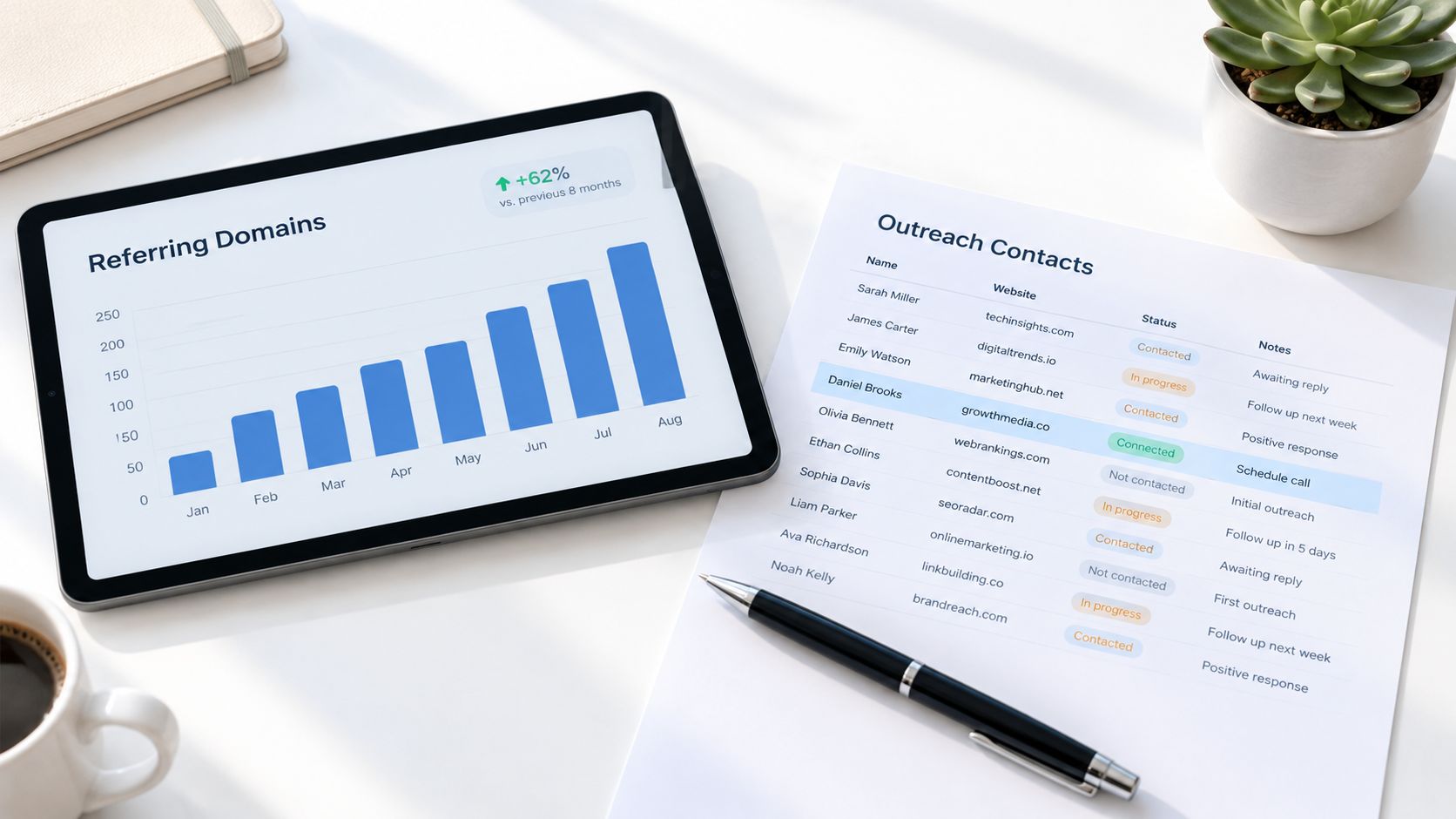
A backlink gap starts with a simple comparison: find domains that link to two or more competitors but not to your site. The raw export is rarely useful. The work begins after the report produces its candidates.
I filter each referring domain through three questions. First, does the site cover the same subject or audience? Second, does the linking page receive meaningful attention or sit abandoned in an archive? Third, does the link appear in editorial copy, or is it boilerplate in a footer, directory, forum profile, or widget?
Read the context before scoring the domain
A competitor's raw referring-domain count is a vanity metric. One relevant editorial mention can matter more to your outreach strategy than a large collection of low-context links. I inspect the surrounding paragraph, the anchor text, the page type, and whether the competitor contributed something worth referencing.
| Check | Useful signal | Weak signal |
|---|---|---|
| Topical fit | The site serves the same audience | Broad site with no relevant section |
| Link placement | Natural reference inside editorial copy | Footer, sidebar, or template link |
| Page quality | The page answers a real question | Thin directory or autogenerated page |
| Relationship potential | The publisher already covers your category | No evidence of topical interest |
| Pitch angle | You can offer a better source or fresh data | You're asking for a generic link |
I also look at the competing page's role. A publisher may link to a competitor because of an original research report, a useful tool, an expert quote, or a clear product comparison. That tells me what outreach asset I need. Sending a product homepage to a publisher who linked to a detailed study usually fails because the replacement isn't equivalent.
For a practical reference on evaluating link opportunities rather than chasing volume, I often point teams toward this guide to high quality backlinks for SEO leads. The useful mindset is qualification first, outreach second.
I keep the final list short enough to personalize. Each row should contain the domain, linking URL, competitor URL, anchor context, reason it might be relevant, contact route, and proposed asset. The competitor backlink analysis workflow follows the same principle, turning a broad gap into targets someone can pursue.
Checking SERP History and Intent Before You Commit
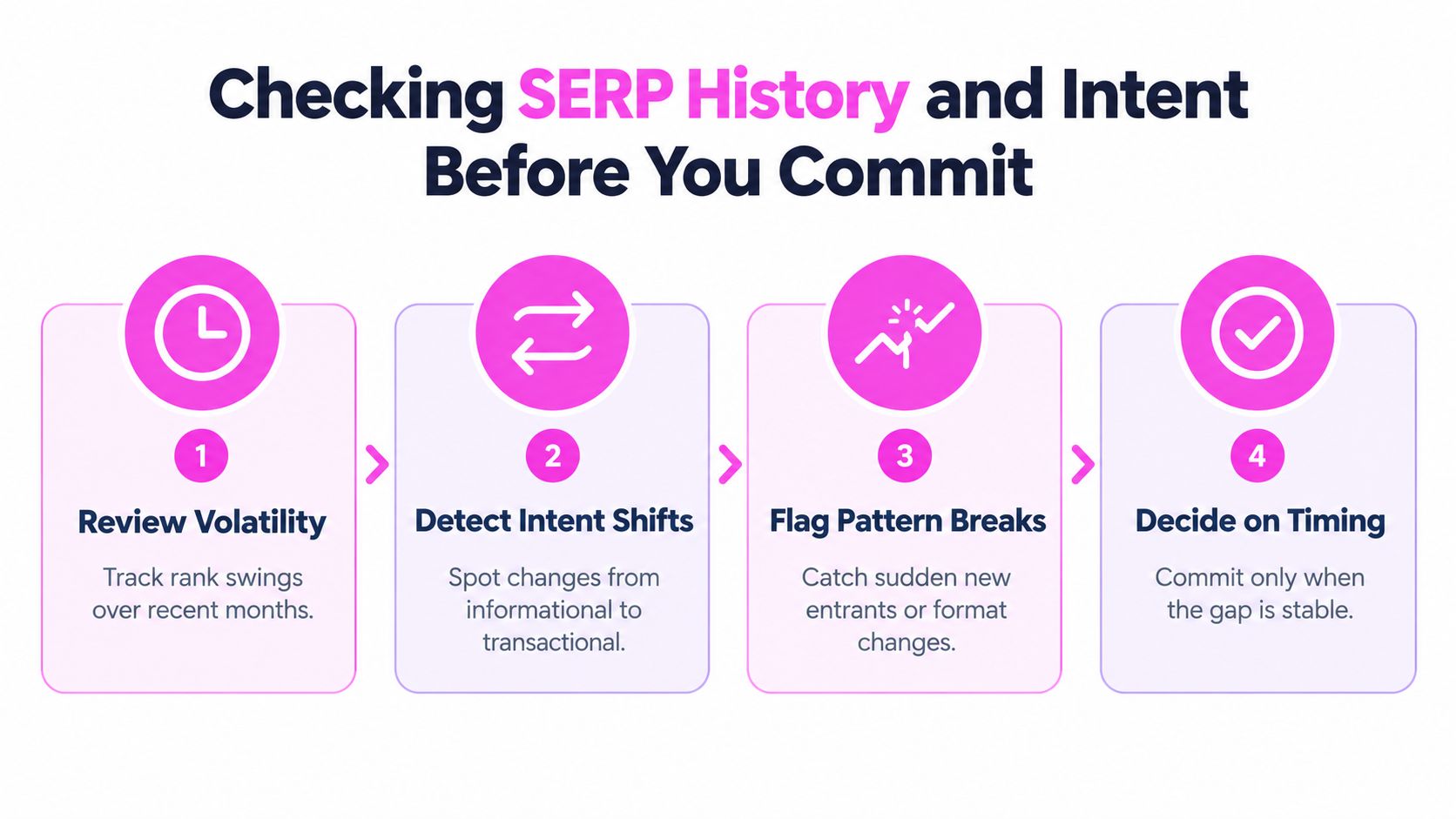
A keyword gap can look attractive because the current result is weak. SERP history tells me whether that weakness is durable or temporary. I want to know whether the same pages have held the results, whether new entrants keep appearing, and whether Google has changed the preferred format.
Read the history as a timing signal
I review the Historial de SERP de 12 meses before approving a major content brief. A stable result set suggests that relevance and authority requirements are established. Repeated reshuffling suggests either an unsettled topic or a result that Google is still testing.
I classify the pattern into four actions:
- Chase now: The intent is stable, the ranking pages are beatable, and the business value is clear.
- Change format: The query used to favor guides but now favors service pages, comparisons, video, or category pages.
- Wait and observe: New entrants or major result changes make the opportunity uncertain.
- Skip: The topic has weak business relevance or requires authority the team can't realistically build.
Volatility alone isn't an opportunity. A result page that changes constantly may punish a page that doesn't match the latest intent. I inspect titles, page types, freshness, SERP features, and the presence of forums, videos, shopping results, or AI-generated summaries.
Classify intent from what Google shows
I use four practical intent labels:
| Intent | Evidence in the live SERP | Likely page response |
|---|---|---|
| Informacionales | Guides, explanations, definitions, People Also Ask | Thorough educational page |
| Comerciales | Reviews, comparisons, “best” lists, alternatives | Comparison or evaluation content |
| Transaccionales | Product, service, pricing, booking, or signup pages | Conversion-focused landing page |
| Navegacionales | Brand or specific site results | Clear brand and destination page |
AI Overviews add another presentation layer, not a shortcut around ordinary SEO. Google says a page must be indexed and eligible for an ordinary Search snippet before it can appear as a supporting link in AI Overviews or AI Mode. Google also says there's no special schema, AI text file, or markup required for eligibility, so I check crawl access, indexability, snippet eligibility, and visible content before investigating anything supposedly AI-specific.
The key decision is whether the gap is stable enough to deserve production time. If the intent has moved from informational to transactional, updating the old format won't be enough. I'd rewrite the brief around the current result set or leave the query alone until the market settles.
Clustering Keywords Into Page Topics, Not Lists
Keyword clustering is where many audits create future cannibalization. A team sees related phrases, assigns each one to a separate brief, and then publishes several pages that answer the same question with slightly different wording.
I cluster by SERP overlap, not by lexical similarity. If two queries repeatedly share the same top-ranking URLs, they probably belong to one page topic. If the result sets diverge and the page types differ, they may deserve separate URLs.
Make the page decision explicit
Take a small group such as “technical SEO audit,” “technical SEO checklist,” and “how to audit technical SEO.” If the same guides and agency pages dominate all three results, I create one single page with a primary query and supporting variations. If “technical SEO services” returns agency service pages while the other queries return guides, I separate the commercial page from the educational guide.
A cluster becomes its own URL when it has a distinct intent, a different dominant page type, or enough unique subtopics to create a different user journey. Otherwise, it becomes a section, example, FAQ, or supporting passage on an existing page.
Planning test: If the writer would repeat the same explanation on both briefs, the queries probably belong in one cluster.
The final content plan should identify:
- Primary query: The phrase that best represents the page's intent.
- Secondary queries: Close variants that the same page can answer naturally.
- Supporting queries: Questions, subtopics, and related entities that improve coverage.
- Conversion path: The next action the page should support.
- URLs competidoras: The pages to study and eventually outrank.
I've found that a good SEO blogging guide for service businesses is useful for thinking beyond isolated blog titles and toward topics that support commercial journeys. For teams that need a repeatable process, agrupación de palabras clave turns the same principle into a page-level planning workflow.
AI Overviews, Reporting Cadence, and the Monthly Loop
I audit AI visibility query by query, not domain by domain. For each target phrase, I record whether an AI Overview appears, every cited domain, the exact cited URL, the date, location, device, and prompt wording. A competitor's general visibility doesn't tell me which page Google selected for a particular answer.
The first check is ordinary Search eligibility. Google's guidance says supporting links in AI Overviews and AI Mode depend on a page being indexed and eligible for a normal Search snippet. I verify crawl access, indexability, visible text, and snippet eligibility before anyone proposes special markup. Structured data can help Google understand content and qualify a page for supported rich-result features, but it isn't a guaranteed route into an AI-generated answer, and it must match what users can see.
Separate presence from influence
An AI citation proves that a URL was used in that answer. It doesn't prove that the answer is favorable, accurate, persuasive, or commercially influential. I record the wording around the citation and flag factual errors, weak descriptions, missing competitors, and changes across markets or languages.
Google says AI Overviews can expose users to a broader set of sources than a conventional results page, so I don't assume that the highest traditional ranking automatically wins the citation. A lower-ranking page may deserve study if it repeatedly supplies cited material. I treat that as a source-selection observation, not evidence of a ranking penalty.
My monthly report contains only items tied to action:
- Keyword gap changes: New opportunities, lost terms, and pages that need verification.
- Page-level movements: Competitor URLs gaining visibility for priority topics.
- Backlink candidates: New relevant domains and outreach status.
- SERP history: Intent shifts, volatility, and topics that changed format.
- Cluster decisions: New URLs, merged briefs, and pages at risk of cannibalization.
- AI citations: Cited URLs, absent topics, factual issues, and meaningful changes.
The cadence stays deliberately uneven. I check priority SERPs weekly, refresh keyword and page gaps monthly, review backlink opportunities monthly or when a competitor launches a major asset, and revisit clusters when new SERP evidence changes the page plan. I score the broader Five Forces assessment quarterly or after a significant market event.
One platform option is SemDash, which combines domain and page keyword reports, keyword gaps, backlink gaps, SERP history, keyword clustering, and AI Overview citation tracking in one workspace. I use the data to support a decision, then verify important findings against the live result and the actual competitor URL.
That rhythm prevents the report from becoming an archive. Every cycle should end with named owners and next actions: publish, update, merge, acquire, monitor, or stop.
SemDash helps teams connect competitor keyword and page research with backlink gaps, SERP history, clustering, and AI Overview citation checks. Visit SemDash to turn competitive analysis into a repeatable workflow tied to the next SEO decision.