%20(1)-B86R08ZzwhPzS6UZbG3mSxRWPCwGwn.png)


Most advice on how to find low competition keywords starts with a filter: set keyword difficulty below 20, keep search volume above 100, export the list, and start publishing. I've used that workflow, and it creates a convincing spreadsheet far more reliably than it creates rankings. A low score can hide a SERP dominated by major brands, pages with stronger intent alignment, or features that absorb most clicks.
The better question is not “Does this keyword have a low KD?” It's “Can my page produce a better result than the pages ranking today?” I use a workflow built around keyword mining, practical filtering, live SERP review, clustering, and validation against my own Search Console data. That process finds fewer fantasy opportunities and more targets a real site can win.
Tabla de contenido
- Why Most Low Competition Keyword Advice Fails
- What Low Competition Actually Means on a Modern SERP
- Mining Long-Tail and Question Keywords the Right Way
- Filtering by Volume and Keyword Difficulty Without Fooling Yourself
- Reading the Live SERP Before You Trust Any Score
- Clustering Keywords Into Page-Level Topics
- Validating Targets and Avoiding the Mistakes I Made
Why Most Low Competition Keyword Advice Fails
I once approved a batch of content because the target terms passed a simple score filter. The spreadsheet looked disciplined. Each keyword had manageable difficulty and enough reported volume to justify production. The problem appeared only after reviewing the SERPs. Several terms were controlled by highly relevant specialist pages, while others returned a mixed set of intents that no single article could satisfy. The content team produced useful pages, but the targeting logic had failed before writing began.
Keyword difficulty is a proxy, not a verdict. Tools estimate competition from signals such as the strength of ranking pages, links, and authority. They don't know whether your format matches the query, whether the top results are stale, or whether Google is testing several interpretations of the search.
The demand pattern also makes volume-based thinking unreliable. A 306-million-keyword analysis found that 91.8% of all search queries are long-tail keywords, while the median keyword had only 10 searches per month. Long-tail terms represented just el 3.3% del volumen total de búsqueda, which means the opportunity is distributed across many specific queries rather than concentrated in broad head terms. See the large-scale Google keyword analysis for the underlying distribution.
The filters that create false confidence
A low-volume term can be commercially valuable if it expresses a precise problem. A higher-volume term can be useless if the SERP intent doesn't match your offer. The most expensive mistake is treating a tool export as a content plan.
I now separate the process into distinct decisions:
- Mine broadly: Collect questions, related searches, competitor terms, and variations before judging them.
- Filter provisionally: Use volume and KD to remove obvious mismatches, not to declare winners.
- Audit the SERP: Look for weak incumbents, stale pages, forums, intent fragmentation, and unsuitable formats.
- Cluster carefully: Give related queries one strong page when the intent overlaps.
- Validate commercially: Estimate what a realistic ranking could deliver and whether the visitor matters.
For niche discovery beyond conventional SEO exports, the step-by-step POD niche method is a useful example of starting with specific demand rather than broad market labels. The same principle applies to SaaS, local services, ecommerce, and publishing.
Regla práctica: A keyword is low competition only after the live result page gives you a credible path to outrank the current incumbents.
What Low Competition Actually Means on a Modern SERP
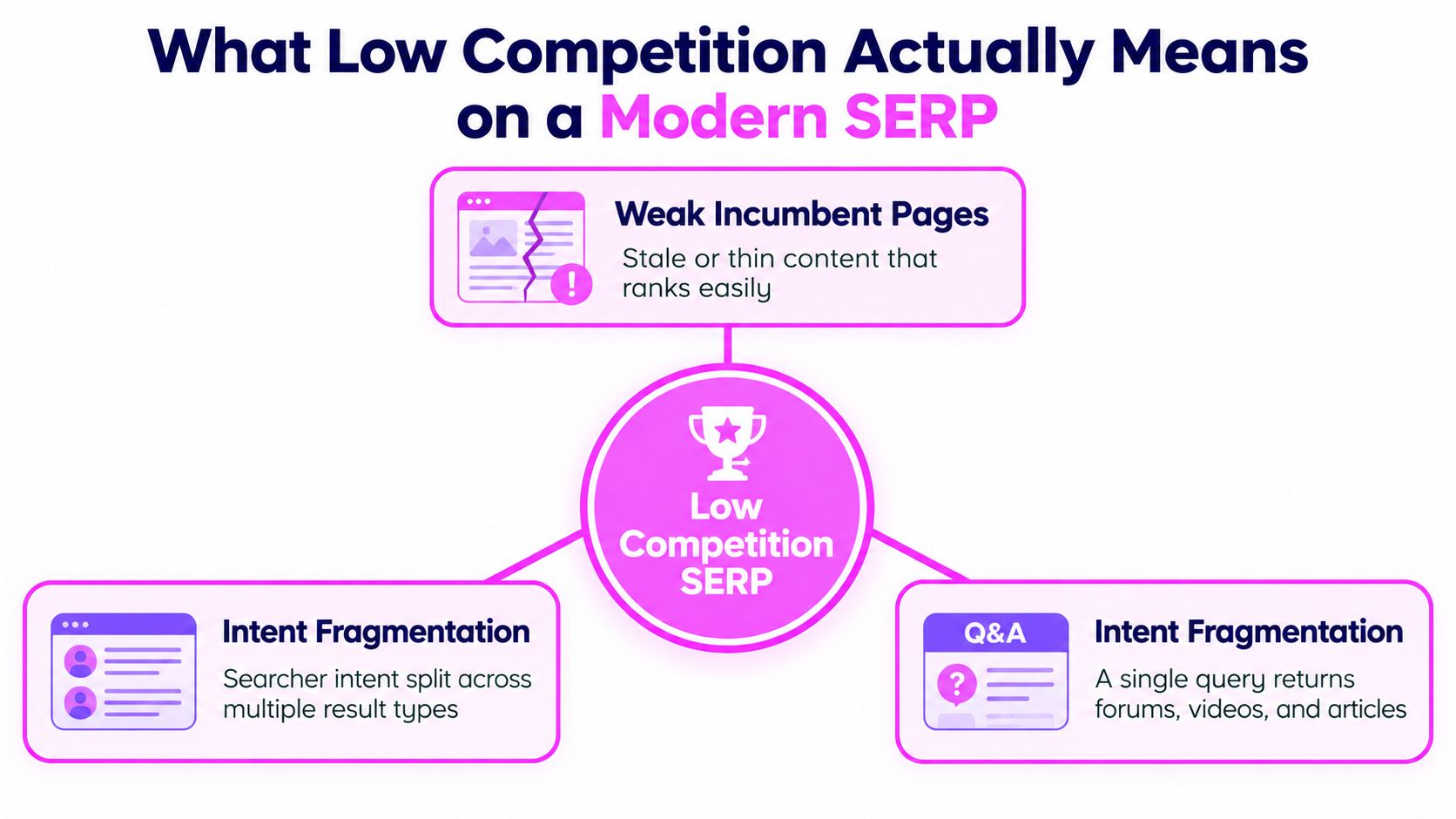
I define low competition as a property of the result page, not a number inside a keyword tool. A winnable SERP usually reveals weakness in at least one of three areas: the pages lack depth or freshness, the query has fragmented intent, or the ranking formats don't properly satisfy the searcher.
Weak incumbents create room
Open the ranking pages, not just the keyword report. I look for articles that answer the query superficially, pages that haven't kept up with the subject, and results that rank because the field is underdeveloped rather than because every competitor is excellent. Thin content isn't an automatic invitation to publish a longer article. It becomes an opportunity only when I can solve the same intent more clearly and completely.
Freshness matters differently by topic. A current recommendation query may need updated examples, while a stable definition may not. The useful question is whether the existing result still reflects what a searcher needs now.
Fragmented intent changes the competitive picture
A single query may return articles, forum discussions, videos, product pages, and question-and-answer results. That fragmentation can signal uncertainty about the ideal answer. It can also mean that one generic article won't win. I treat the mixed SERP as an instruction to choose a precise angle and format.
Long-tail keywords are generally specific phrases with three or more words, and they often face less competition than broad head terms. They can still attract high-intent visitors despite lower volume, but phrase length alone proves nothing. The long-tail keyword strategy guidance also supports clustering related variants so one topic doesn't become several competing pages.
Format mismatch is an overlooked opening
If searchers want a comparison and the SERP is filled with definitions, a focused comparison may have an opening. If they want a troubleshooting sequence and the results provide opinion pieces, a practical diagnostic page may fit better. Google isn't rewarding your keyword placement when the page type is wrong.
I inspect SERP features as part of the opportunity. People Also Ask, videos, local results, shopping modules, and AI-generated answers can reduce the organic clicks available even when ranking appears achievable. Low ranking difficulty doesn't automatically mean high traffic opportunity.
Mining Long-Tail and Question Keywords the Right Way
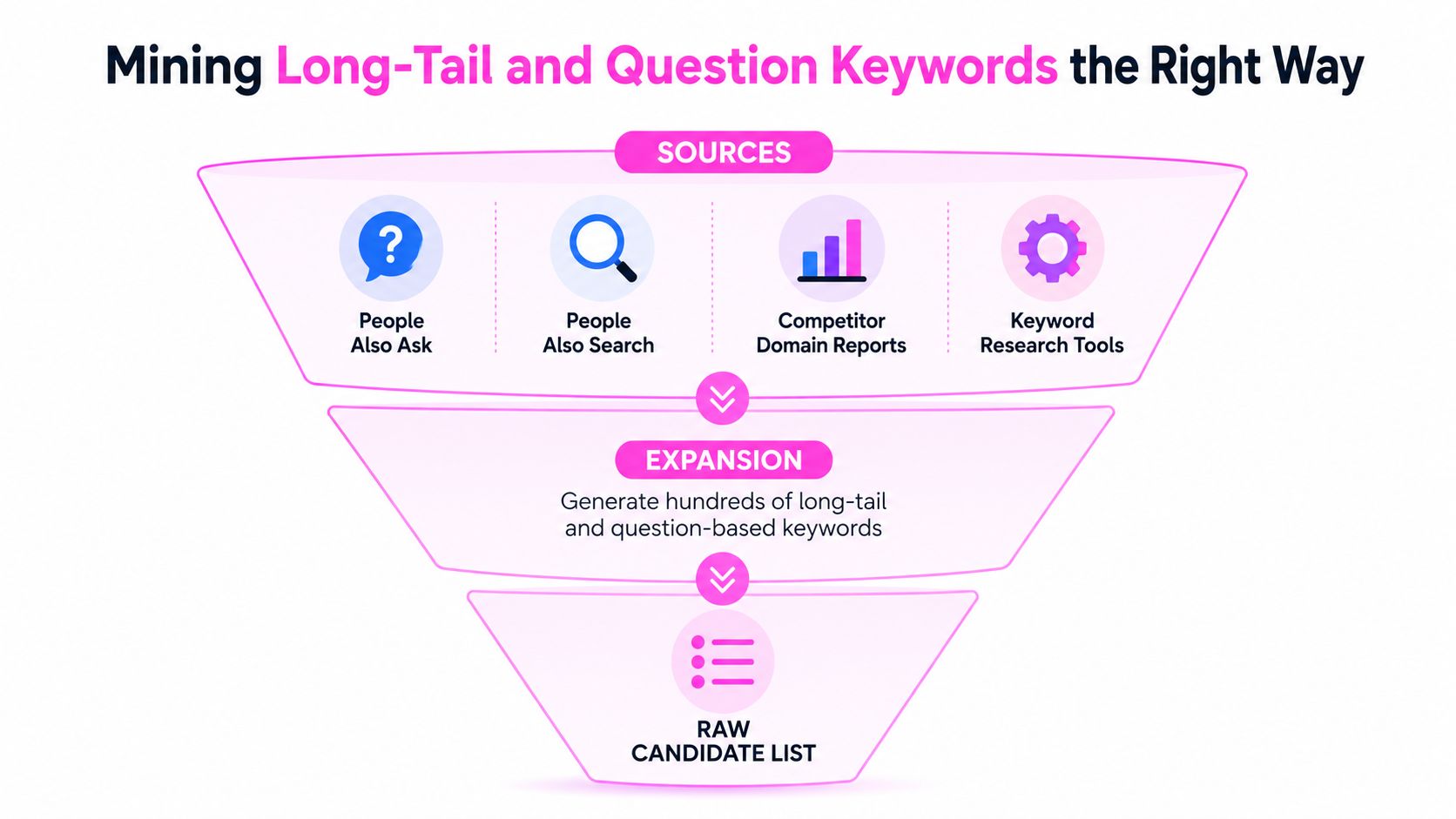
I start with a seed list, but I don't stop at the obvious phrases. The purpose of mining is to capture the language real searchers use, including awkward questions and specific constraints that standard keyword lists often flatten.
Start with a narrow seed
For a fictional project selling workflow software to small property managers, I might begin with seeds such as “property management workflow,” “tenant maintenance requests,” and “rental inspection process.” Those aren't targets yet. They're doors into the vocabulary of the market.
I expand each seed through four sources:
- People Also Ask: I record questions that reveal concerns, objections, and follow-up needs. I don't copy every question into the plan. I keep those that fit the site's expertise and audience.
- People Also Search: Related searches often expose modifiers that tools miss, such as templates, integrations, roles, or specific use cases.
- Competitor domain reports: I export the keywords driving relevant competitor URLs, then map each term to the exact ranking page. URL-level mapping shows whether the competitor wins with a guide, template, comparison, or product page.
- Keyword tools: I use seed expansion for spelling variants, question forms, and related entities. The tool accelerates discovery, but it doesn't decide intent.
Build the raw list before judging it
I keep the first pass deliberately permissive. I add the phrase, source, apparent intent, relevant competitor URL, and any obvious modifier. Then I normalize capitalization, remove duplicates, and group close wording variants.
The order matters. Filtering too early removes useful questions before I understand the topic. A competitor may rank for a phrase with little reported demand because the page captures related searches as well. Conversely, a term with attractive metrics may be irrelevant to the business.
Search-derived suggestions are not just extra keywords. They reveal how Google connects the main problem to adjacent questions.
By the end of mining, I want a raw candidate set that reflects the market's language, not a polished list of head terms. I then mark each candidate as informational, commercial, navigational, or transactional, and flag terms that clearly belong to another audience. That preparation makes the later SERP review faster and more accurate.
Filtering by Volume and Keyword Difficulty Without Fooling Yourself
Keyword difficulty helps me triage a list. It doesn't help me skip judgment. Major tools use a 1 to 100 difficulty scalecon 0 to 20 commonly treated as low competition, 20 to 50 as moderate, y 50 or higher as increasingly hard. One benchmark reports that terms in the 80 to 100 range have about a 1% chance of reaching the top 10, which illustrates why the score is useful for prioritization, not certainty. The benchmark is summarized in this keyword difficulty estimator guide.
Calibrate against your own site
The most useful KD range is the range your site has already demonstrated it can compete in. I export Search Console queries where my pages rank between positions 5 and 20, then compare those terms with their difficulty scores and intent types. That gives me an evidence-based starting band rather than borrowing a cutoff designed for another domain.
I also review whether those rankings came from pages with strong internal links, backlinks, or unusual topical relevance. A site may rank for a difficult term because the page is exceptionally well matched, not because every term at that score is attainable.
| Site Type | Realistic KD Range | Volume Floor | Sanity Check Before Committing |
|---|---|---|---|
| New domain | Under 20 | No fixed floor | Confirm weak incumbents and exact intent fit |
| Developing niche site | 0 to 30 | No fixed floor | Compare with your existing positions 5 to 20 |
| Established topical site | 20 to 50 | No fixed floor | Check page quality, authority, and SERP format |
| Strong authority site | 40 to 60 or above | No fixed floor | Confirm the opportunity is commercially worthwhile |
The “volume floor” stays open because reported volume isn't the same as achievable traffic. I prefer a term with clear intent and a realistic top-three path over a larger estimate that leaves the page buried.
For reporting workflows, an agency keyword research report can help organize the evidence clients need, but I still validate every important target manually. If you need a practical explanation of the metric itself, use this guide on cómo comprobar la dificultad de las palabras clave, then treat the resulting score as a screening input.
Reading the Live SERP Before You Trust Any Score
A keyword tool can tell me that a term appears easy. The SERP tells me whether that ease is real. I search the exact query, inspect the first page, and record what each result is trying to accomplish.
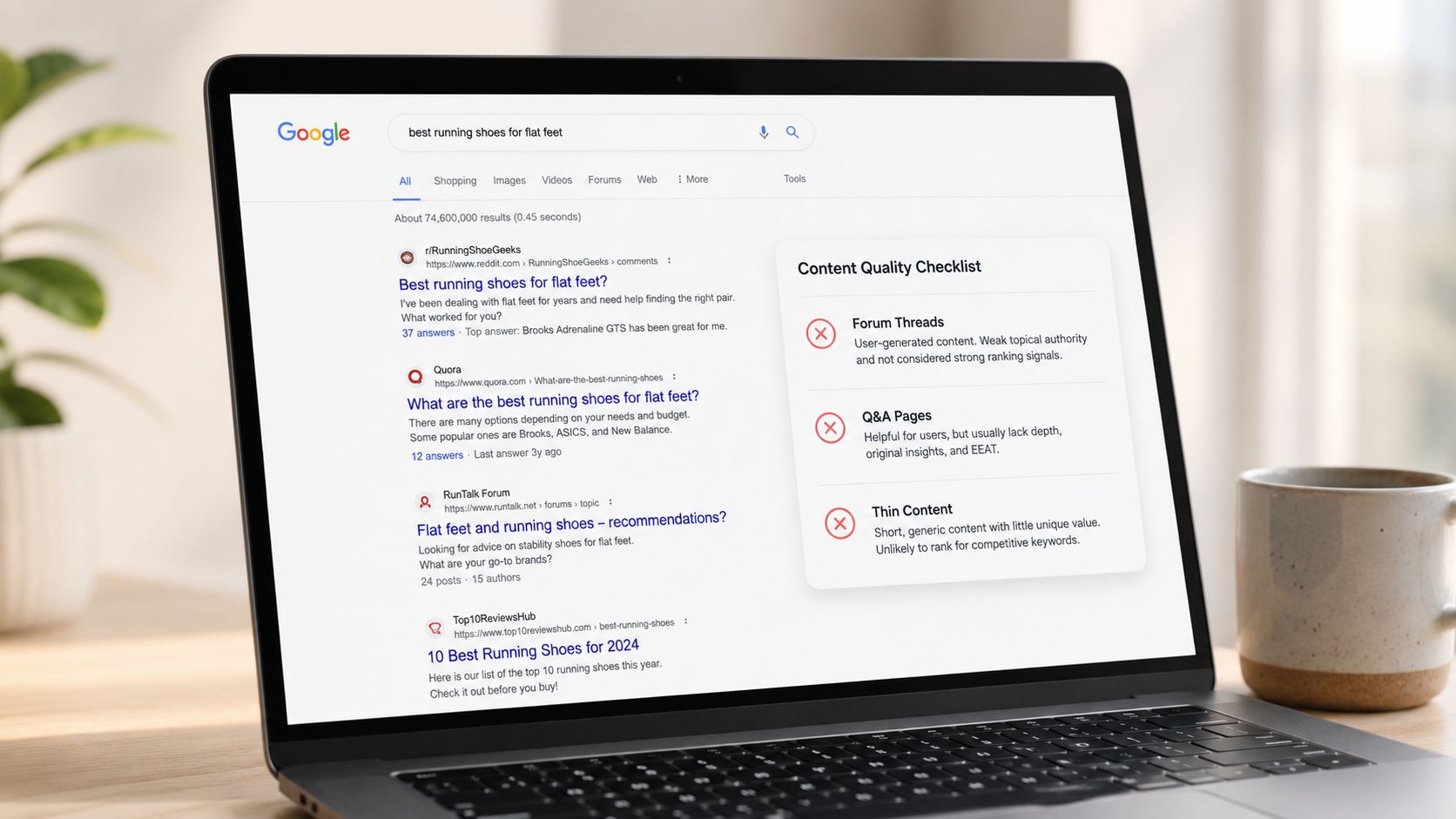
My SERP inspection checklist
I look at the result page in a consistent order:
- Intent alignment: Do the results answer the same question my page would answer? If most pages are templates and I plan a general essay, the target isn't aligned.
- Incumbent quality: Are the ranking pages thorough, current, and useful, or do they leave obvious subquestions unanswered?
- Site strength: Do weaker or less specialized sites rank? This isn't proof that I can outrank them, but it gives me a useful comparison.
- Format mix: Are forums, videos, product pages, local listings, or documents present? A mixed page may reveal an unmet format.
- Elementos de las SERP: Do answer boxes, People Also Ask, shopping results, or AI-generated responses reduce the organic space available?
- Frescura: Are the dates and recommendations current for the subject?
SERP analysis means examining the result page for features, competitor strength, and difficulty. A keyword may look easy in a tool but remain blocked by strong incumbents, intent mismatch, or features that reduce clickable organic demand, as described in this SERP analysis overview.
I use a simple judgment scale. “Target” means I can identify a specific weakness and a page format that addresses it. “Watch” means the opportunity looks plausible but the SERP is unstable or dominated by ambiguous intent. “Reject” means the result page is strong, irrelevant to my offer, or unlikely to produce meaningful clicks.
El guía del verificador de SERP en vivo is useful when I need a repeatable process for recording these observations rather than relying on one search session.
Historical SERP data adds context. I want to know whether the same page types have held positions over time or whether Google is rotating results aggressively. Data refreshed within the last 28 days is particularly useful for spotting new gaps and shifting competitor coverage, while older snapshots can hide a recently weakened incumbent. I don't treat volatility as automatically good or bad. A volatile SERP may offer an opening, but it also demands closer monitoring after publication.
Clustering Keywords Into Page-Level Topics
A raw list becomes useful only when I turn it into pages. Clustering prevents the common failure where five articles target nearly identical questions and divide relevance, links, and updates across URLs.
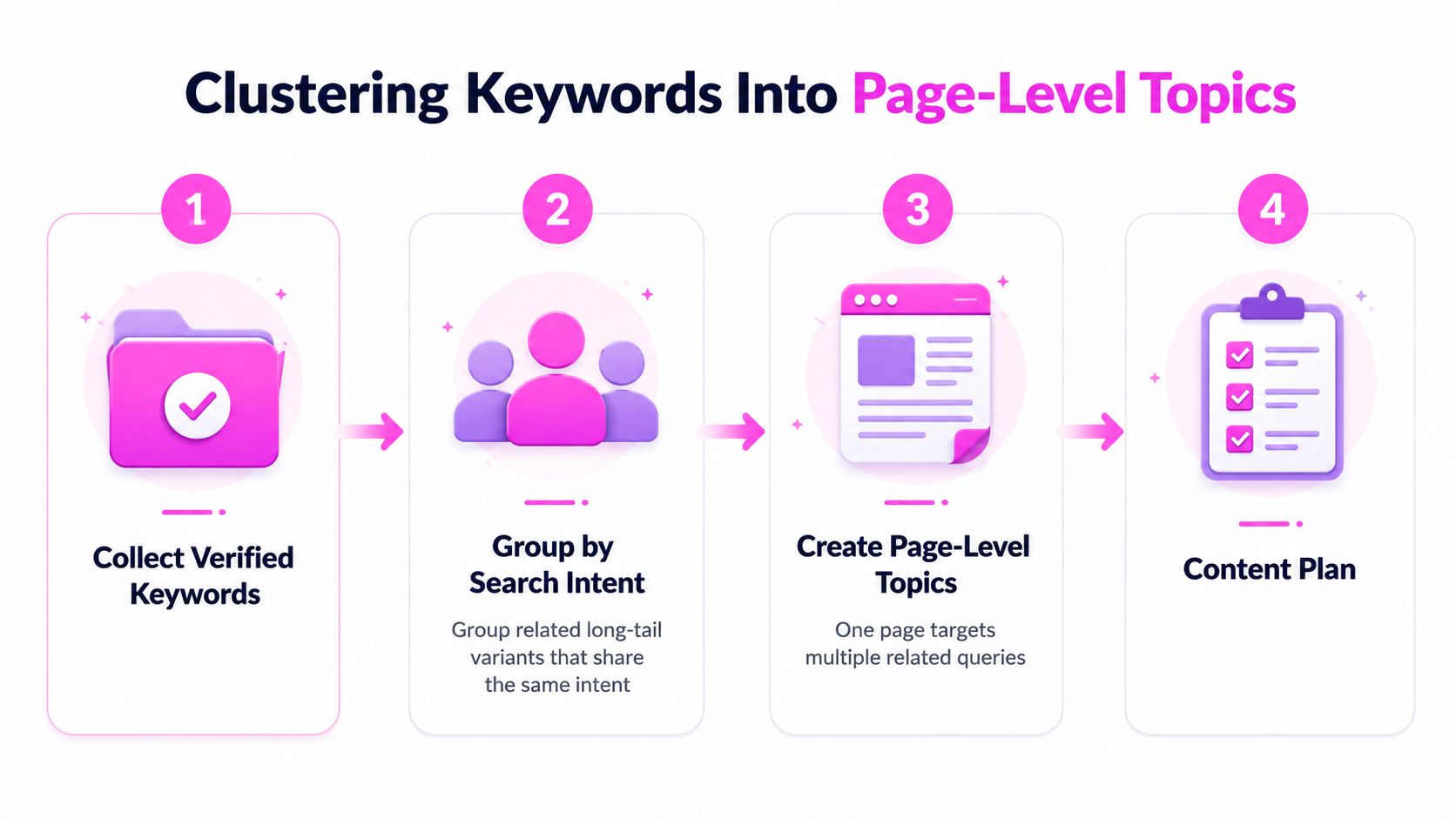
Use intent overlap first
I group variants when the searcher expects the same answer. “Tenant maintenance request workflow,” “rental maintenance process,” and “property maintenance request template” might belong together if the page can provide the process and the template without becoming unfocused.
SERP similarity provides the second test. I compare the ranking URLs for each candidate. If the same pages appear for multiple queries, Google likely sees them as close variants. If entirely different page types rank, I separate the topics even when the wording looks similar.
One page should have one primary job, but it can satisfy many closely related searches.
A long-tail query deserves its own page when it has a distinct intent, audience, conversion path, or format. A comparison query should not disappear inside a broad beginner guide just because both use the same noun. Conversely, a minor wording variation shouldn't receive a separate URL when the result pages and answer requirements overlap.
Turn clusters into briefs
For every cluster, I assign:
- Primary query: The phrase that best describes the page's central job.
- Supporting variants: Related questions and modifiers that belong naturally in the same answer.
- Required format: Guide, template, comparison, checklist, product page, or another suitable structure.
- SERP gap: The weakness I intend to improve.
- Internal links: Existing pages that should support or receive links from the new URL.
Recent guidance recommends collecting People Also Ask questions, related searches, and variants before publishing because page-level groups are more useful than isolated keyword lists and help prevent cannibalization. The keyword research clustering guidance reflects that shift toward topic planning.
I don't force every keyword into a cluster. Some terms should remain unassigned until the site has enough evidence to justify a dedicated page. That restraint keeps the content plan smaller, clearer, and easier to maintain.
Validating Targets and Avoiding the Mistakes I Made
Before a brief reaches a writer, I run one final check: What can this page realistically achieve, and will the visitor matter? I compare the estimated demand with the likely ranking range, then inspect whether the query supports the site's business or editorial purpose.
Position changes have a large effect on clicks. Google defines CTR as clicks divided by impressions, and Search Console reports position using the topmost ranking position averaged across queries in its documentation. One 2026 dataset reported average CTR of 29.1% for position 1, 13.6% for position 2, 9.0% for position 3, y 1.1% for position 10, as documented through Google Search Console guidance. The practical lesson is simple: a modest-volume term that reaches the top three can beat a larger term stranded near the bottom of page one.
The mistake I no longer repeat
I once chose a keyword because its volume looked attractive and its difficulty appeared manageable. I built a detailed brief, assigned the article, and expected the page to become a useful acquisition asset. The SERP was dominated by a different intent. Searchers wanted a direct tool or action, while my planned page offered education. The content was sound, but it competed in the wrong category.
Now I run this ten-minute gate for every serious candidate:
- Read the query aloud: Can I state exactly what the searcher wants?
- Check the current results: Do at least some pages show a weakness I can address?
- Confirm the format: Will my proposed page look like the results users engage with?
- Review the authority gap: Are the incumbents comparable, or am I relying on wishful thinking?
- Assign the cluster: Is this a new page, or does an existing URL already own the intent?
- Check business value: Would the visitor become a reader, lead, customer, or meaningful audience member?
- Set a measurement point: Will I track impressions, average position, clicks, and query expansion after publication?
The durable advantage comes from precision and coverage. I'd rather build a coherent set of pages around winnable, specific needs than spend months chasing a few broad terms where the SERP gives my site no credible opening.
SemDash combines keyword discovery, competitor domain and gap reports, long-tail and People Also Ask expansion, live SERP analysis, historical SERP checks, and keyword clustering for page-level planning. Visit SemDash to compare its research workflow with the way you currently validate low-competition targets.