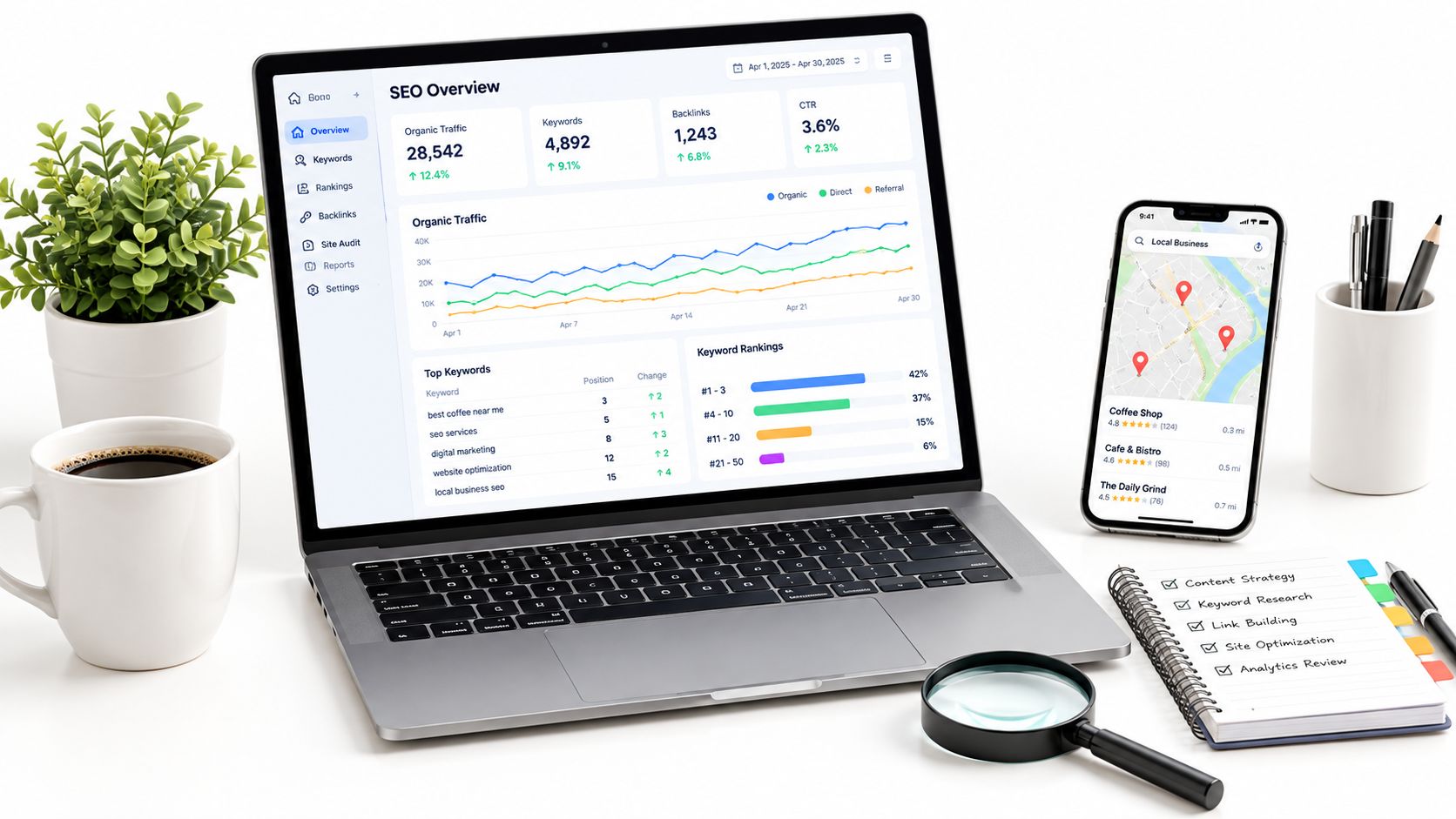
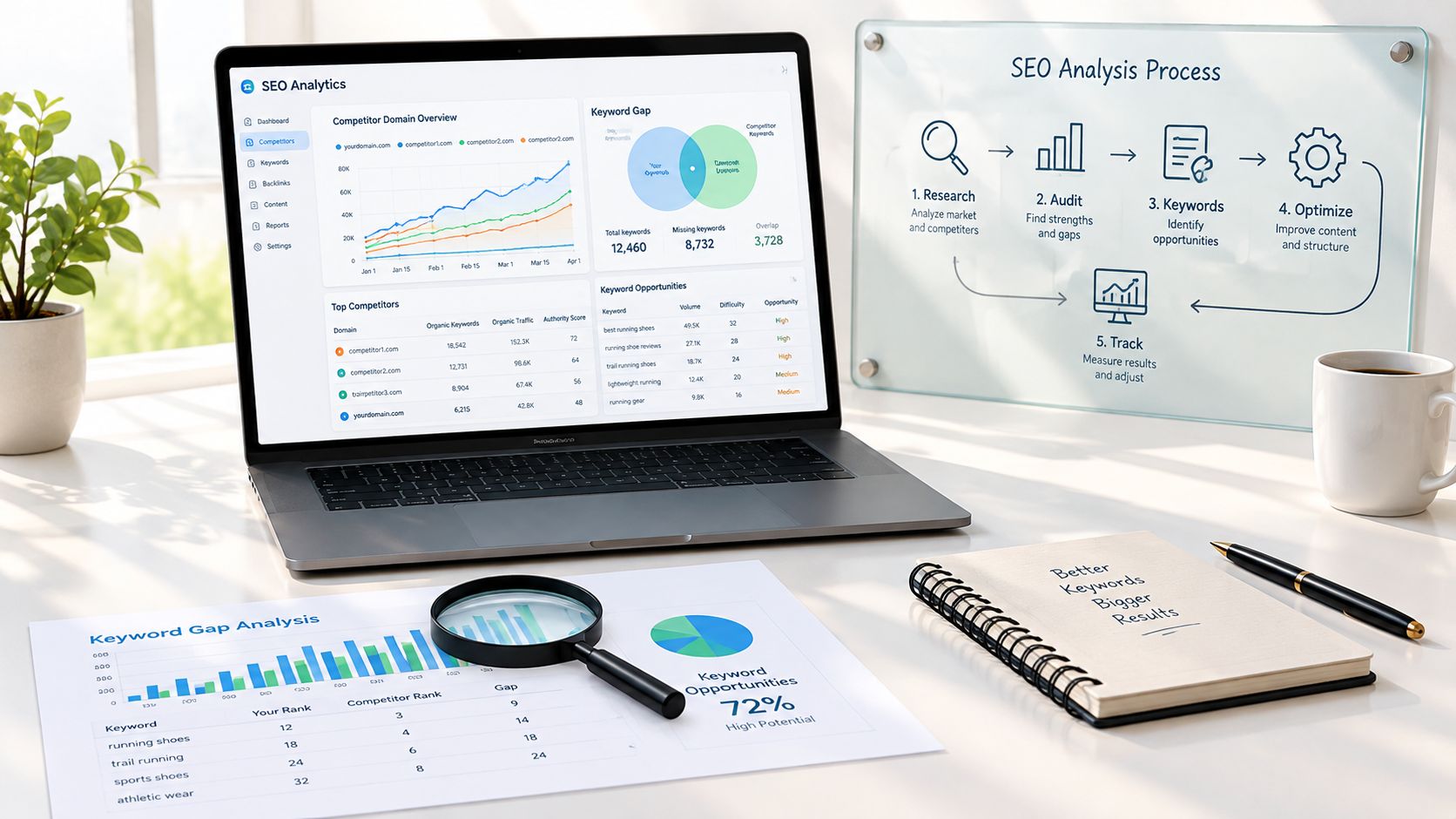
%20(1)-B86R08ZzwhPzS6UZbG3mSxRWPCwGwn.png)



The most popular advice about keyword clustering is also the most dangerous: export your keyword list, click cluster, and treat the result as your content plan. I've watched that shortcut produce oversized pages, mixed funnel stages, duplicate articles, and URL maps that looked tidy in a spreadsheet but failed against the actual search results.
A cluster isn't a decision. It's a hypothesis about which queries deserve the same page. A useful semantic keyword clustering tool helps me test that hypothesis against meaning, intent, ranking URLs, and changing SERP features. The output matters less than whether I can explain why those keywords belong together, where they should live, and when that decision needs revisiting.
Tabla de contenido
- Why Most Clustering Workflows Fail Before They Start
- What a Semantic Keyword Clustering Tool Actually Does
- Embeddings vs Intent vs Overlap Benchmarks
- How to Evaluate a Semantic Keyword Clustering Tool
- Three Real Ways a Cluster Goes Wrong
- Overlap Bands and the Two-Dimensional Cluster Model
- Building a Content Plan From SemDash Clusters
- When to Re-Cluster and What to Watch
Why Most Clustering Workflows Fail Before They Start
The first failure usually happens before any algorithm runs. Someone collects a large keyword export, sorts it by shared words, and assumes that phrases containing the same head term represent one search need. That assumption feels efficient, but searchers can use similar vocabulary for very different jobs.
“Keyword clustering tool” and “how keyword clustering works” may share language while requiring different page formats. One suggests a commercial evaluation. The other asks for an explanation. If I force both into one page, I'm asking a product-led landing page to teach fundamentals, or an educational guide to convert visitors who are comparing tools.
The broader information-retrieval principle behind clustering is sound. The Stanford information-retrieval text on the cluster hypothesis describes a process where a system identifies groups close to a query and then ranks documents within a smaller candidate set. Semantically related documents are more likely to appear together, and working with groups can be more efficient than evaluating every document independently. That principle explains why clustering is useful, but it doesn't turn a machine-generated group into a page assignment.
A cluster is a testable proposition
I treat every cluster as a statement:
These queries express a sufficiently similar information need, and Google currently expects a sufficiently similar result.
The first half comes from language and intent. The second comes from live SERPs. They often agree, but not always. A semantic model can recognize that “running shoes” and “how to clean running shoes” concern the same broad subject while missing the fact that one query is transactional and the other is instructional.
Academic evaluations reinforce the risk of treating the algorithm as neutral. One study found that retrieval-system performance varied by an average of 23% depending on the clustering method used, as reported in the Stanford reference above. The practical lesson is simple: similarity thresholds and algorithm choices change the page opportunities you see.
Success isn't “the tool grouped my keywords.” Success is a defensible map with one primary topic per page, supporting variants that belong there, separate targets for incompatible needs, and a process for detecting when the SERP has moved.
What a Semantic Keyword Clustering Tool Actually Does
A modern clustering pipeline usually combines four stages. Each stage solves a different problem, and none can safely replace the others.
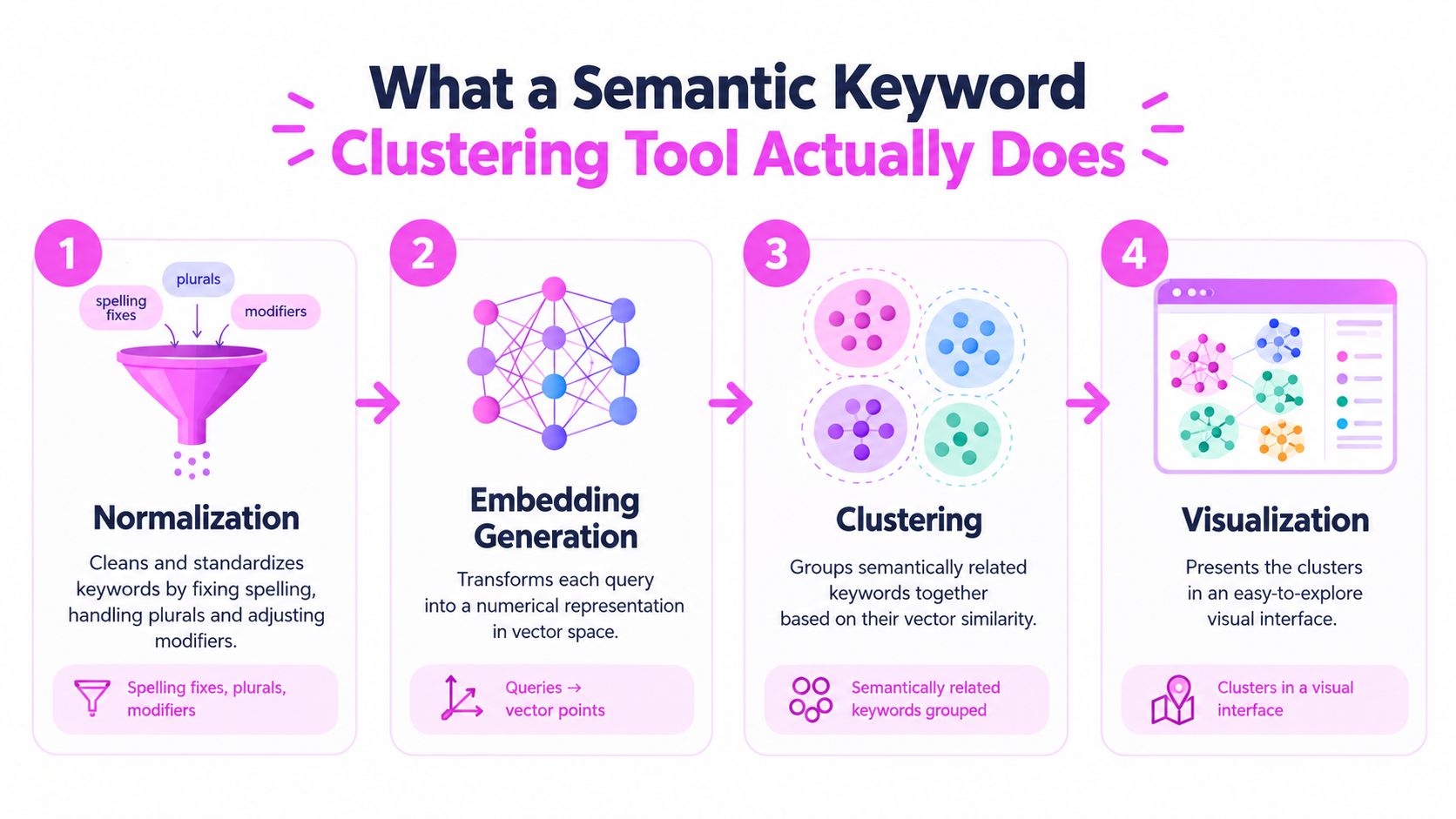
Normalization removes avoidable noise
The process starts by standardizing the input. The tool may correct spelling, handle singular and plural forms, normalize morphology, and separate or preserve modifiers such as “best,” “pricing,” “template,” and “how to.”
This stage prevents superficial differences from creating unnecessary fragments. It also protects against the opposite error, where modifiers that change the page type disappear into a generic topic. “CRM software” and “CRM software pricing” may be related, but the pricing modifier can alter both the commercial expectation and the SERP composition.
Embeddings measure meaning at scale
The tool then converts each query into a semantic vector. Queries with similar meanings sit closer together in that vector space, allowing the system to generate candidate groups without relying only on exact-word overlap.
Embeddings are excellent for reducing a large keyword list to manageable review sets. They're not a reliable final judge of page targeting because they measure language, not necessarily the page Google expects. A phrase can be semantically close to another while serving a different funnel stage, format, country, or freshness requirement.
Intent classification adds the missing “why”
Most practical workflows label queries as informational, commercial, transactional, or navigational. That label gives the cluster a job to perform.
Navigational queries deserve special caution. A brand name, product name, or login query may be topically adjacent to a content topic, but its SERP is dominated by a specific destination. I generally remove those terms from ordinary editorial clusters rather than allowing them to distort page recommendations.
SemDash combines its Base de datos de 6.600 millones de palabras clave, URL-level mapping, search-intent classification, and clustering in one workspace. That combination lets me move from query discovery to page-level review without treating the cluster name as a black box. For a broader look at how products differ, it can also help to browse clustering tool reviews before choosing a workflow.
SERP validation tests the hypothesis
The final stage compares the pages ranking for each query. If several terms repeatedly return the same URLs, that's evidence that Google sees a related information need. If their ranking pages diverge, I investigate whether the difference comes from intent, audience, location, freshness, or format.
I want the output to show more than a topic label. It should retain member keywords, intent labels, ranking URLs, overlap evidence, outliers, and a suggested page relationship. That turns clustering into an editorial and information-architecture decision rather than a decorative visualization.
Embeddings vs Intent vs Overlap Benchmarks
The three signals do different jobs, so I don't rank them as interchangeable alternatives. Embeddings generate candidates, intent labels block obvious mismerges, and SERP overlap provides the strongest page-level confirmation.
A practical starting point for embedding similarity is a cosine-similarity range of 0.75 to 0.85, based on the practitioner workflow described by HubSpot's keyword clustering guide. A lower threshold tends to merge loose relationships. A higher threshold can split obvious variants. I use that range to make a large list reviewable, not to decide the final URL map.
Intent classification catches errors that embeddings can't. “Best project management software” and “how project management software works” share a topic, but one is commercial and the other informational. A rule that blocks incompatible labels keeps the cluster from becoming an awkward compromise page.
SERP overlap tells me what Google is doing now. A Microsoft Research study on organizing search results found about 35% average overlap among the top five clusters, with approximately 65 distinct documents out of 100, while top-20 clusters overlapped by about 60%, leaving roughly 40 distinct documents out of 100. The figures show why clusters aren't automatically independent. Queries can share a topic and still produce overlapping, partially distinct result sets.
| Señal | Qué mide | Strength | Modo de fallo |
|---|---|---|---|
| Embeddings | Semantic closeness between query meanings | Fast candidate generation at scale | Merges similar language with different page intent |
| Intent labels | The user's likely task or funnel stage | Prevents obvious informational, commercial, transactional, and navigational mismerges | Labels can be too broad or wrong without SERP review |
| SERP overlap | Shared ranking URLs for two or more queries | Grounds page decisions in current search behavior | Can shift with location, device, freshness, and SERP features |
I calculate overlap using shared organic URLs, often with a Jaccard-style comparison. I ignore paid listings and treat non-organic features separately because an AI Overview, video pack, or product module can change the page format even when organic URLs overlap.
The quality question isn't “How many clusters did the tool create?” I look at cluster cohesion, overlap distribution, outlier volume, URL ownership, and post-launch cannibalization. The SemDash explanation of keyword grouping software is useful context for teams comparing grouping approaches with broader content-planning workflows.
How to Evaluate a Semantic Keyword Clustering Tool
I can usually grade a clustering product in a few minutes by checking whether it exposes the evidence behind its output. A polished interface doesn't compensate for an opaque method.
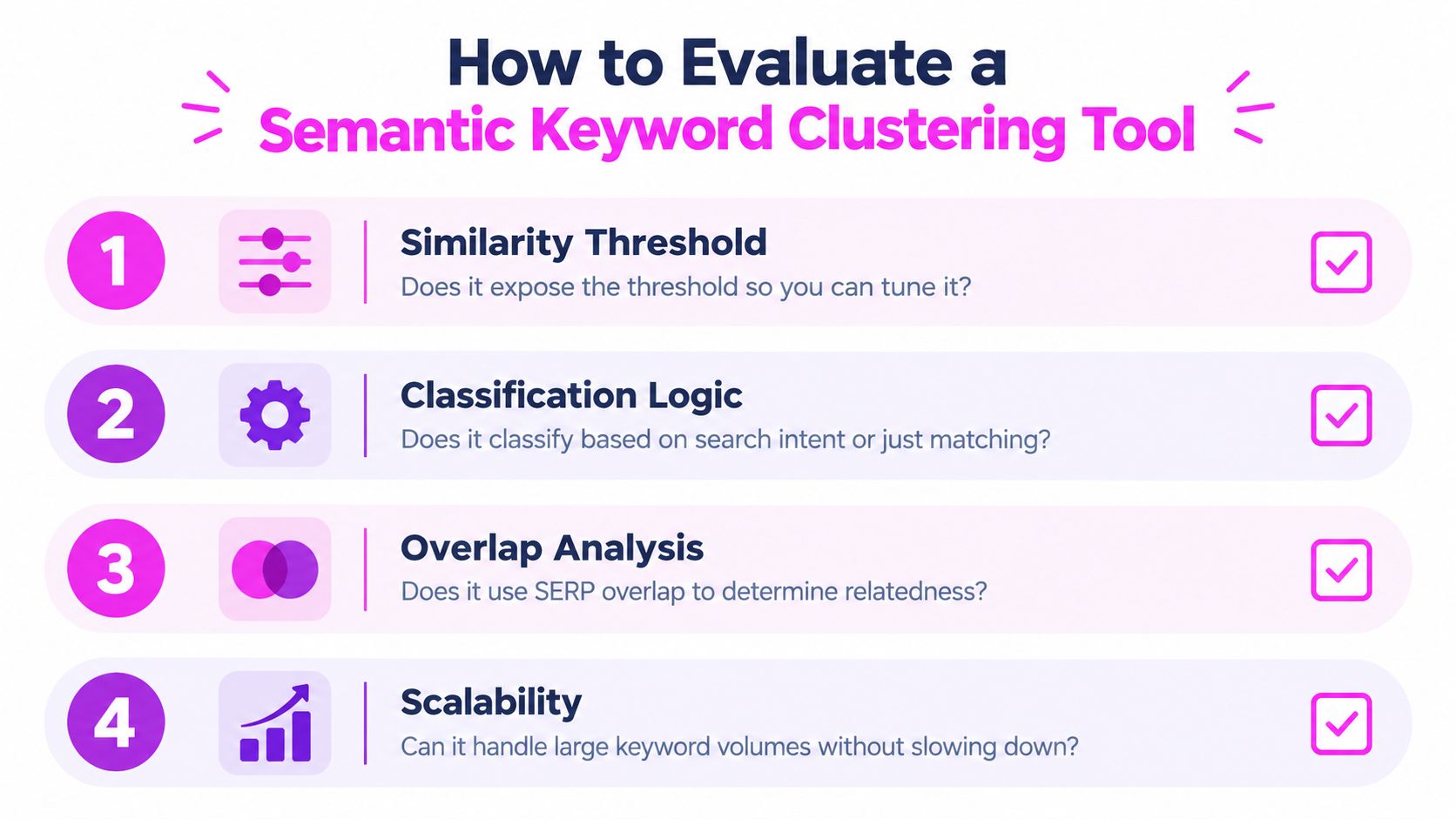
1. Similarity settings should be visible
Can I see and adjust the semantic threshold, minimum cluster size, or merge sensitivity? If the product hides every setting, I can't tell whether a giant cluster reflects a deliberate choice or a weak default.
I don't need unlimited controls. I do need enough visibility to test a stricter or looser grouping and understand what changed.
2. Intent must be query-specific
The tool should classify intent for each keyword, not assign one vague label to an entire group. A cluster containing “how,” “best,” “pricing,” and “login” terms needs inspection before it becomes a page recommendation.
If incompatible intent types merge without warning, the tool shifts cleanup work into the spreadsheet. That's where teams often miss errors because the output still looks organized.
3. Overlap should come from current SERPs
Embedding distance alone can't prove that two queries deserve one URL. I want the top-ranking organic URLs for each query, the shared results, and enough context to inspect divergent pages.
A useful tool makes it easy to answer, “Which exact pages caused these terms to merge?” Without that evidence, I'm trusting a score instead of validating a search result.
4. URL mapping must be visible
Each keyword should map to the page currently ranking for it, where ranking data exists. URL-level mapping exposes cannibalization, identifies an existing page that already owns a topic, and shows whether a proposed article would compete with an asset already performing.
I also check scale and export quality. A tool that handles a large list but produces no usable URL map may save processing time while creating more editorial work. For teams evaluating adjacent digital workflows, Operosus website building explained offers useful context on how a platform can turn planning inputs into practical site decisions, although clustering evidence still needs its own review.
Three Real Ways a Cluster Goes Wrong
The first failure is over-merging. I've seen a loose semantic threshold pull “SEO audit checklist,” “SEO audit service,” and “SEO audit software” into one group because the vocabulary is nearly identical. The resulting page tries to educate, sell a service, and position a product at once.
The fix isn't to ban semantic similarity. I tighten the candidate threshold, split by intent, and inspect the ranking pages. If the commercial and informational SERPs don't share meaningful URLs, they become separate targets with internal links between them.
Regla práctica: Use semantic similarity to find the neighborhood, then use ranking-page evidence to decide which houses belong on the same street.
The second failure is intent mixing. A familiar example is grouping “how keyword clustering works” with “buy keyword clustering tool.” Both include the same core concept, but the visitor's next action is different. The explanatory query needs definitions, process detail, and examples. The transactional query needs capabilities, proof, pricing context, and a clear path to evaluation.
I prevent this by assigning an intent label before calculating a page recommendation. If the group contains mixed modifiers such as “how,” “best,” “price,” or “template,” I send it to manual review rather than accepting the default merge.
The third failure is SERP drift. A cluster can be correct when I build it and wrong later. Rankings change, new formats enter the result page, and Google may reinterpret a query as commercial instead of informational. A page that once covered two terms may start ranking for one while a different page becomes dominant for the other.
A monthly SERP snapshot makes that visible. I compare ranking URLs, overlap, and SERP features over time. If the divergence persists, I split the cluster, redirect ownership, or create adjacent pages. Temporary movement shouldn't trigger a rewrite, but sustained separation should.
The same discipline helps paid search teams. Separating informational research terms from commercial queries can also cut wasted ad spend by giving negative-keyword decisions a clearer intent structure.
Overlap Bands and the Two-Dimensional Cluster Model
A single yes-or-no overlap threshold is too blunt for content architecture. I use overlap bands to decide whether terms should share a page, share a broader topic, or remain separate but connected.
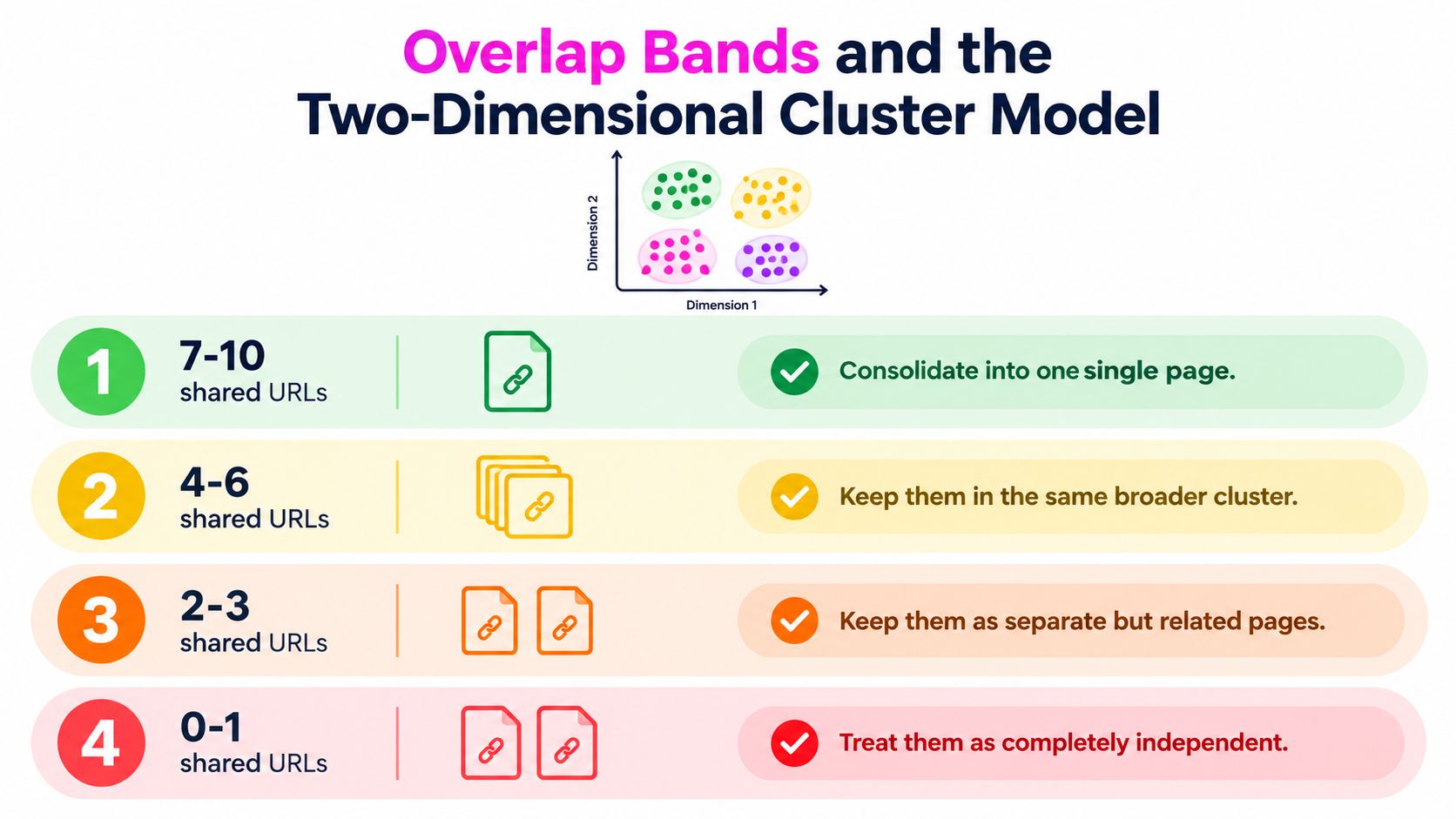
| Shared top-10 URLs | Page decision | What I do |
|---|---|---|
| 7 a 10 | One target page | Consolidate the terms around one primary keyword and use close variants naturally |
| 4 to 6 | Same broader cluster | Review format and audience, then decide whether one page or a hub-and-supporting-page structure fits |
| 2 to 3 | Adjacent clusters | Keep separate targets and connect them with deliberate internal links |
| 0 to 1 | Independent targets | Treat the queries as separate opportunities unless another strong signal changes the decision |
These bands aren't laws. A four-of-ten match can still hide a format conflict, while two shared URLs can matter if the remaining results are weak or unstable. I inspect the pages that don't overlap, not just the count.
Add answer-surface economics
Topical fit is only one prioritization dimension now. I also label each cluster by traditional-click opportunity, AI-citation opportunity, conversion potential, and zero-click risk.
AI Overviews appeared for 6.49% of U.S. desktop searches in January 2025, increased to 13.14% in March, and reached roughly 20% by May, según la MarTech report on AI Overview visibility. The mix also expanded beyond informational searches into commercial and transactional queries.
That means a cluster can be semantically coherent yet commercially weak if its result page answers the question directly and produces little traffic. It can still be valuable for discovery, authority, branded demand, or citation visibility, but I won't prioritize it using ranking potential alone.
For each cluster, I record two separate judgments:
- Topic relationship: Should these queries share a page, share a hub, cross-link, or remain independent?
- Business surface: Is the opportunity primarily clicks, citations, conversions, branded discovery, or a combination?
This prevents a common mistake, treating every AI-triggering cluster as either automatically valuable or automatically worthless. The right decision depends on the business outcome attached to the query.
Building a Content Plan From SemDash Clusters
I start with a seed topic, then expand it through SemDash's Base de datos de 6.600 millones de palabras clave, competitor keyword gaps, long-tail suggestions, People Also Ask, and People Also Search data. The purpose isn't to collect every possible phrase. It's to create a broad enough candidate set to reveal distinct intents and missing page types.
I then run the semantic clustering workflow and inspect the groups with three filters first: navigational terms, mixed intent, and unusually large clusters. Navigational queries often need exclusion. Mixed-intent groups usually need splitting. An oversized cluster can represent a real pillar topic, but it can also signal that the similarity threshold is too permissive.
For every accepted group, I assign one primary keyword, retain close variants as supporting terms, and map the group to either an existing URL, a refresh, a consolidation, or a new page. The URL-level view matters because an apparently new opportunity may already be owned by a page that needs better alignment rather than a duplicate article.
The content brief should reflect the dominant SERP format, audience, and intent. SemDash combines clustering with AI-assisted briefs and SERP history, so I can carry the cluster evidence into the editorial specification instead of copying a keyword list into a document. A practical ejemplo de brief de contenido SEO shows the kind of handoff that keeps the assigned page focused.
I connect the 2-to-3-overlap groups with contextual internal links rather than forcing them into one oversized page. Then I save the initial SERP snapshot and schedule a review. A cluster is useful only if the content plan preserves the reasoning behind the assignment.
Here's the workflow in motion:
When to Re-Cluster and What to Watch
I don't treat a cluster map as permanent because search intent is observable behavior, not a fixed property of a phrase. I re-check important groups monthly, with deeper reviews whenever one of three triggers appears.
Ranking URLs diverge over repeated snapshots
A single ranking change can be noise. Sustained divergence across monthly SERP snapshots is different. If two keywords that once shared most ranking pages begin returning different competitors, formats, or page types, I reconsider the page assignment.
The decision may be a split, a new supporting page, or a rewrite that better matches the dominant intent. I also check whether the old page still owns the original query before creating anything new.
SERP features change the job of the page
AI Overviews, People Also Ask, videos, shopping results, and other features can alter the answer format. The Pew Research Center study on AI summaries and clicks found that searches with AI-generated summaries produced clicks on conventional results less often than searches without them. A separate panel study cited in the same verified research reported that only about 1% of visits to AI Overviews clicked a cited source, while sessions were more likely to end after the summary.
That's why I separate visibility from value. I track qualified visits, assisted conversions, branded searches, citations, and revenue contribution where attribution supports it. A cluster can lose clicks while still helping discovery, or gain visibility without producing meaningful business outcomes.
Conversion behavior changes
If a page's conversion pattern shifts, I inspect its cluster even when rankings look stable. A query may retain its wording while the audience, offer, or funnel stage changes. The page assignment should follow the business and SERP evidence, not the historical spreadsheet.
Global teams should also compare countries, devices, and search engines rather than assuming one market represents all others. AI-generated result surfaces are not stable across contexts. A practical maintenance loop is to save the cluster, URL map, intent labels, SERP features, and business outcomes, then reclassify only where the evidence shows a durable change.
The best semantic keyword clustering tool is therefore not the one that creates the most groups. It's the one that helps me make a defensible page decision, see when that decision is becoming obsolete, and act before competing URLs turn a clean strategy into cannibalization.
SemDash combines keyword discovery, semantic clustering, URL-level mapping, SERP history, intent classification, AI Overview citation tracking, and content briefs in one SEO workspace. Use SemDash to test your keyword hypotheses against current search results and turn validated clusters into a maintainable content plan.