%20(1)-B86R08ZzwhPzS6UZbG3mSxRWPCwGwn.png)



Sending more emails is the most popular fix for weak link building outreach. It's also often the wrong one. If the people on your list don't publish for your audience, manage the relevant pages, or have a reason to include your resource, more volume just scales the mismatch.
I treat outreach as a qualification problem. A reply is useful feedback, but it isn't the finish line: the outcome is a relevant editorial link that gets published and stays live. That means starting with evidence about who already links to sites in your space, then researching each page before writing the pitch.
Tabla de contenido
- Why Most Outreach Campaigns Stall Before the First Reply
- Building a Qualified Prospect List With Backlink Gap
- Reading the Target Page Before You Write a Single Word
- Outreach Templates That Get a Reply Without Sounding Like a Template
- Follow-Up Cadence as a Funnel Diagnostic, Not a Persistence Play
- The Paid-versus-Earned Boundary You Cannot Afford to Ignore
- Tracking Replies, Placements, and What Your Numbers Actually Tell You
Why Most Outreach Campaigns Stall Before the First Reply
A large-scale analysis by Backlinko and Pitchbox examined approximately 12 million outreach emails and found that only 8.5% received a reply. That's roughly one response for every twelve messages, and replies are only an intermediate outcome, not confirmed link placements (study details). The practical lesson isn't to send twelve emails and expect a yes. It's that outreach is a low-conversion activity even before you account for editorial review, qualification, or whether a publisher adds the link.
The campaigns that stall usually have the same underlying problem: teams count activity instead of testing fit. They build broad lists, use mail-merge personalization that changes only the recipient's name, then judge their work against a single reply-rate benchmark. But a resource-page pitch, an expert-commentary pitch, and an unlinked-mention request have different audiences and different asks. Treating one reply rate as a universal target hides where the campaign fails.
I'd rather work a tightly qualified list of 200 prospects than send to 5,000 sites that happen to mention a loosely related keyword. That isn't a claim that a smaller list guarantees more links. It's a decision about where research time goes: toward publishers with topical fit, a suitable page, and signs they already cite comparable material.
The useful question isn't “How many emails can we send?” It's “Which publishers have already shown they might link to something like this?”
That's why I start with a backlink gap. Competitor referring domains give me evidence of editorial behavior, while the linking pages and anchors help me assess whether that behavior is relevant to my client's asset. A guest post outreach playbook can help shape a specific contributor pitch, but no template can rescue a prospect list that's unqualified.
Outreach rewards relevance, not effort. Reply benchmarks are diagnostic signals, not universal KPIs. The work begins before the email, with the sites and pages we choose to approach.
Building a Qualified Prospect List With Backlink Gap
A backlink-gap report surfaces websites that link to competitors but not to your site. I use that overlap as a starting point, not as a verdict: a publisher's link to a competitor shows that it has linked into the subject area, but it doesn't prove that your page belongs there.
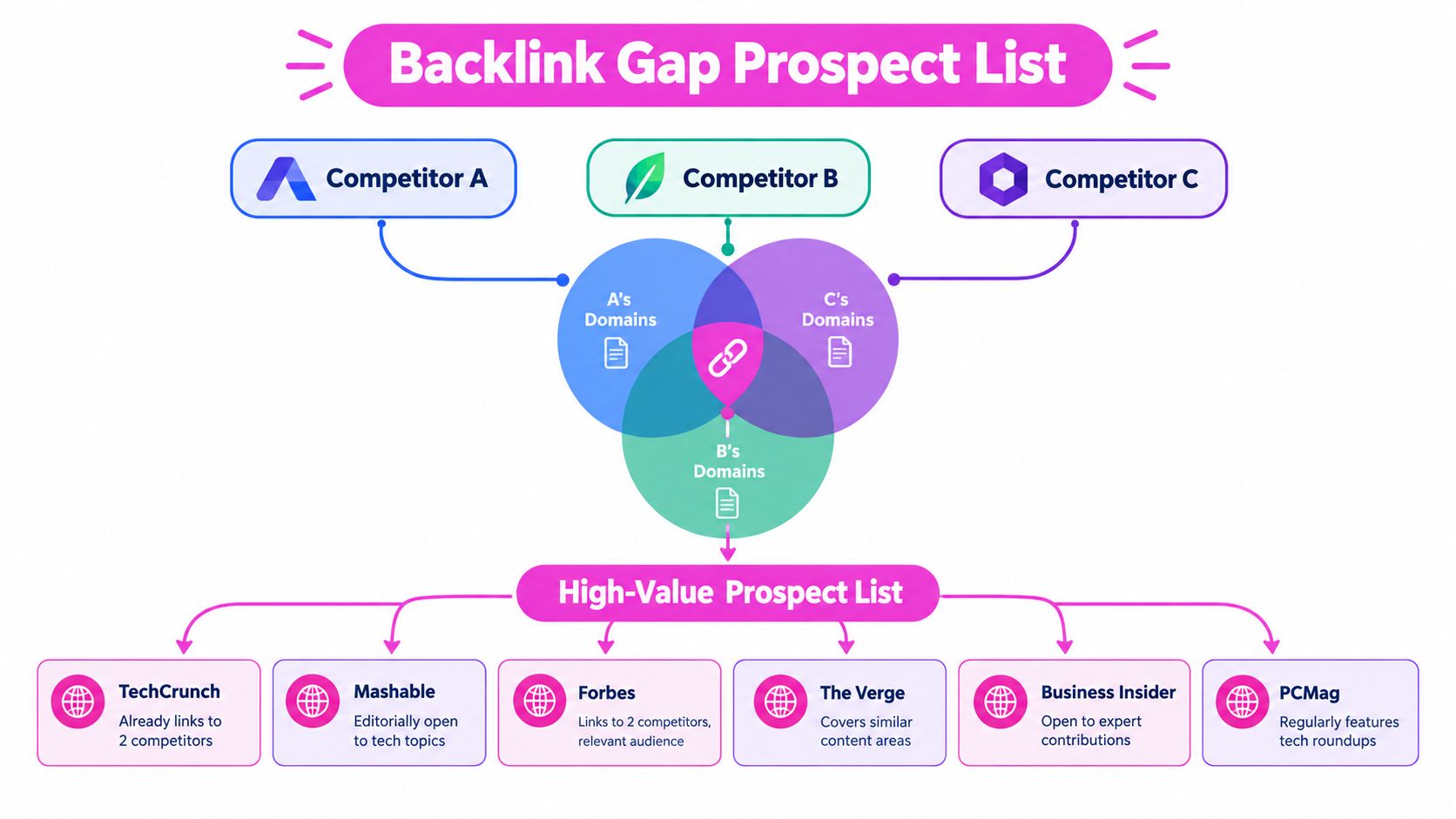
Here's the filtering sequence I use:
- Find overlap, then inspect the page. Compare your backlink profile with competitors that target the same audience. Look for domains linking to multiple competitors, then open the actual linking pages. A domain-level match can conceal an irrelevant article or a link that appears in an unrelated section.
- Check topical and editorial fit. Ask whether the destination page would help the publisher's readers in the context where it might appear. A SaaS guide citing product comparisons may be a better fit for a relevant tool resource than a general business blog with no matching topic.
- Assess the linking page, not just the domain. Review whether the page appears useful and maintained, whether it attracts a real audience, and whether its outgoing links make editorial sense. Metrics can inform the review, but they don't replace it.
- Read the anchor and surrounding context. The anchor text and nearby sentences show what kind of resource the editor considered worth citing. If the existing link supports a definition, a product page may not be an appropriate substitute.
- Exclude poor fits. Remove obvious link farms, unrelated niches, and pages with no credible reason to cite your asset. A large raw prospect count doesn't make a defensible outreach list.
SemDash Brecha de backlinks y Páginas por enlaces views can support this workflow by bringing competitor comparisons and page-level link context into one research process. I'd use them to move from a broad export to a short sheet of verified targets, rather than treating every returned domain as a contact to email. For a closer look at the analysis behind that process, see this guide to competitor backlink analysis.
A SaaS team might, for example, start with 1,400 raw referring domains and narrow them to a 220-domain outreach sheet after checking overlap, relevance, target pages, and editorial context. Those figures describe an illustrative workflow, not an observed campaign result or performance benchmark. The point is that every removed prospect makes the remaining list easier to justify and personalize.
A useful list comes from overlap, context, and editorial fit, not raw counts. If you can explain why each publisher is on the sheet and which page you're approaching, you're ready to write.
Reading the Target Page Before You Write a Single Word
Personalization starts with the page, not the greeting. Before I draft an email, I look at the article or resource page that might host the link and ask what the editor is doing for readers there. If I can't explain why my asset belongs in that context, I don't have a pitch yet.
I check the page's topic, how recently it appears to have been maintained, and the existing outbound links. I also read the paragraphs around comparable citations. Those details tell me whether the editor prefers research, practical tools, reference material, or a particular kind of expert source. They also help me avoid pitching the wrong destination page.

A generic opener such as “I love your great article” proves nothing. A useful opener points to something a recipient can recognize: a section that lists tools, a broken citation, or a mention of your brand that doesn't link. That research also changes the request. The same website can be a fit for different approaches, but I wouldn't use the same email for all of them.
Resource-page pitch: “Your resources page groups analytics guides separately from software, so I'm reaching out about the guide rather than asking you to add our product to the tools list.”
Broken-link pitch: “The reference in the section on email verification appears to lead to an unavailable page; I have a resource covering that same reader question if a replacement would help.”
Unlinked-mention pitch: “I saw your article name our brand in its comparison of outreach tools, but the mention doesn't point readers to the product page.”
These are research artifacts, not decorative compliments. Each opener refers to a page feature that can be checked and connects it to a specific reason for contacting the editor.
I also look for reasons not to pitch. If the page hasn't been maintained, its author may no longer own updates. If it already cites a more suitable source, asking for a replacement may add work without improving the page. If its outbound-link context is commercial while I'm pitching an informational asset, I need to rethink the angle.
Personalization doesn't mean writing a long custom email for every person. It means doing enough page research to make the relevance obvious. That's the difference between a personalized greeting and a pitch an editor can evaluate.
Outreach Templates That Get a Reply Without Sounding Like a Template
I use a consistent structure, but I don't send the same pitch with a different name pasted in. The subject line identifies the page or topic, the opening refers to something I verified, the value sentence explains why the resource fits, and the call to action asks for one small decision.
| Pitch Angle | Opening Hook | Value Exchange | Mejor para |
|---|---|---|---|
| Resource-page inclusion | “Your page separates practical guides from tools, and I'm reaching out about the guide section.” | Explain which reader need your resource addresses and offer details the editor can assess. | A maintained resources page with a clear topical category |
| Broken-link replacement | “The citation in your section on email verification appears to be unavailable.” | Offer a relevant alternative that addresses the same reader need. | A page where the broken reference and your resource genuinely match |
| Unlinked mention | “I saw your comparison mention our brand without a destination link.” | Make it easier for readers to find the referenced product or source. | A page that already names your brand or asset |
Keep the email focused on the editor's decision. “Would you consider adding this resource?” is a smaller, more direct request than asking someone to write a new post, review a product, or join a broad partnership before you've established relevance. A long narrative about your company doesn't make that decision easier. For cold outreach, two clear lines of substance can do more than several paragraphs of background.
A reply starts a conversation. The page context and the value exchange are what give that conversation a chance to become a placement.
A resource-page email might say: Subject: Resource for your [topic] page. “Your guide groups measurement resources by use case, and I noticed there isn't a reference for [specific reader need]. Our guide covers that question with [specific useful detail]. Would you be open to reviewing it for that section?”
For a broken-link replacement: Subject: Reference in your [article title]. “The citation in your section on [topic] appears to be unavailable. I have a resource that addresses the same question for readers. Would you like me to send it over?”
For an unlinked mention: Subject: Your mention of [brand]. “I saw your [article] mention [brand] in the section about [context]. Would you consider linking that mention to the relevant page so readers can find the reference?”
Before sending, I verify that the recipient address is usable; a deliverability checker for B2B outreach can be part of that check. Then I track the unlinked-mention opportunities separately from new editorial pitches, since the page already contains evidence of brand familiarity. This guide to unlinked brand mentions provides additional context for that reclamation angle.
Two mistakes make a positive reply harder to turn into a link. One is asking for placement before showing why the resource fits. The other is burying the actual ask under multiple paragraphs of company history. Make the next step easy to understand, and let the editor decide whether the page deserves an update.
Follow-Up Cadence as a Funnel Diagnostic, Not a Persistence Play
A follow-up should add context or make the decision easier. Sending the same nudge repeatedly doesn't tell me whether the list, message, or offer needs work. I use a four-touch sequence to observe how recipients respond, then adjust based on what I can learn.
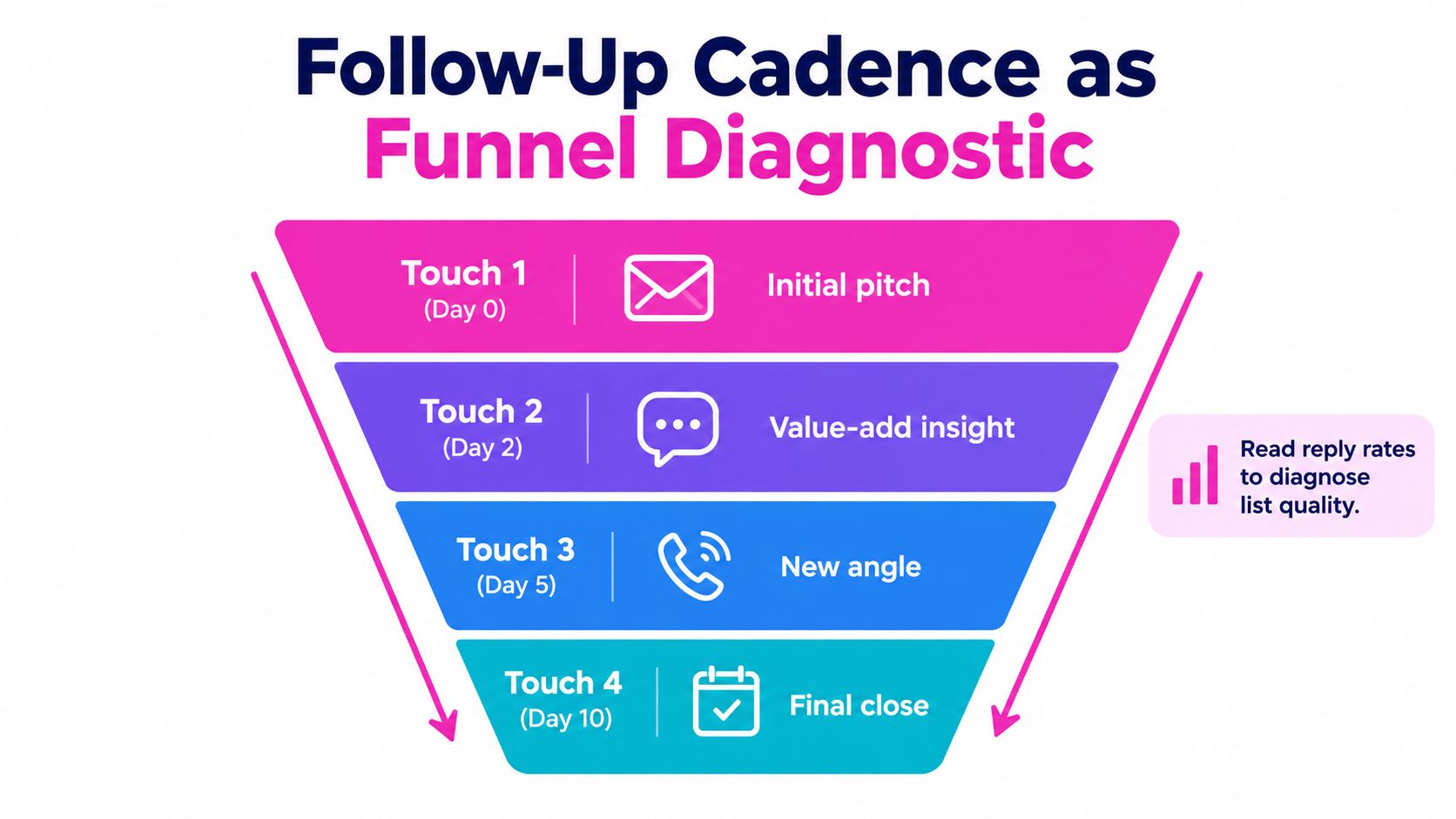
The cadence below is a working schedule, not a rule that overrides recipient signals:
- Touch one, Day 0: Send the researched pitch with one clear call to action.
- Touch two, Day 2: Add a useful detail or clarify why the resource fits the page.
- Touch three, Day 5: Try a different angle, such as a more relevant resource or an explanation of what the editor's audience can get from it.
- Touch four, Day 10: Close the loop politely and make it easy for the recipient to decline or point you to the right person.
If tracking indicates no opens, I don't assume the editor rejected the idea. I check deliverability, address accuracy, and whether the contact is still appropriate. Opens without a reply suggest the email reached someone, but they don't establish that the ask was clear or compelling. A short, interested reply that doesn't lead to a placement tells me to examine the value exchange and the follow-through, not to send more generic nudges.
Backlinko and Pitchbox's analysis reports an outreach reply rate of 8.5% across approximately 12 million emails. That's a reply benchmark, not a prediction that a campaign will place links. A separate workflow reference reports that one follow-up can raise replies by approximately 65.8% and that Hunter's dataset saw replies increase from 3.3% to 6.8% with three follow-ups (outreach workflow and benchmark details). Those reported increases don't establish that repeated follow-ups improve placement rates or protect sender reputation.
Stop when the signal says stop. If a recipient declines, asks not to be contacted, or says the page isn't a fit, suppress that contact rather than pushing through the sequence.
For example, if an editor opens the pitch and replies that the proposed resource doesn't match the page, I'd close the loop and revise the targeting criteria. If there's no response and the sequence adds no new information, I don't fire off five generic reminders. A library of cold email follow-up templates can help with wording, but each touch still needs a reason to exist.
The Paid-versus-Earned Boundary You Cannot Afford to Ignore
I separate editorial outreach from paid placement before contacting publishers. The distinction isn't just the publisher's reputation or whether the link looks natural. It's also whether money, goods, or services are part of the arrangement, whether the publisher retains editorial control, and how the link is qualified.
Google's spam policies identify buying or selling links for ranking purposes, exchanging goods or services for links, and automated link programs as link spam. For links associated with paid advertising or sponsorship, Google says publishers can use rel="sponsored" o rel="nofollow" so the link isn't presented as an organic endorsement (Google's link-spam policies). Sending a product for review while implying that a backlink is required creates the same problem: a material benefit has become part of the link exchange.
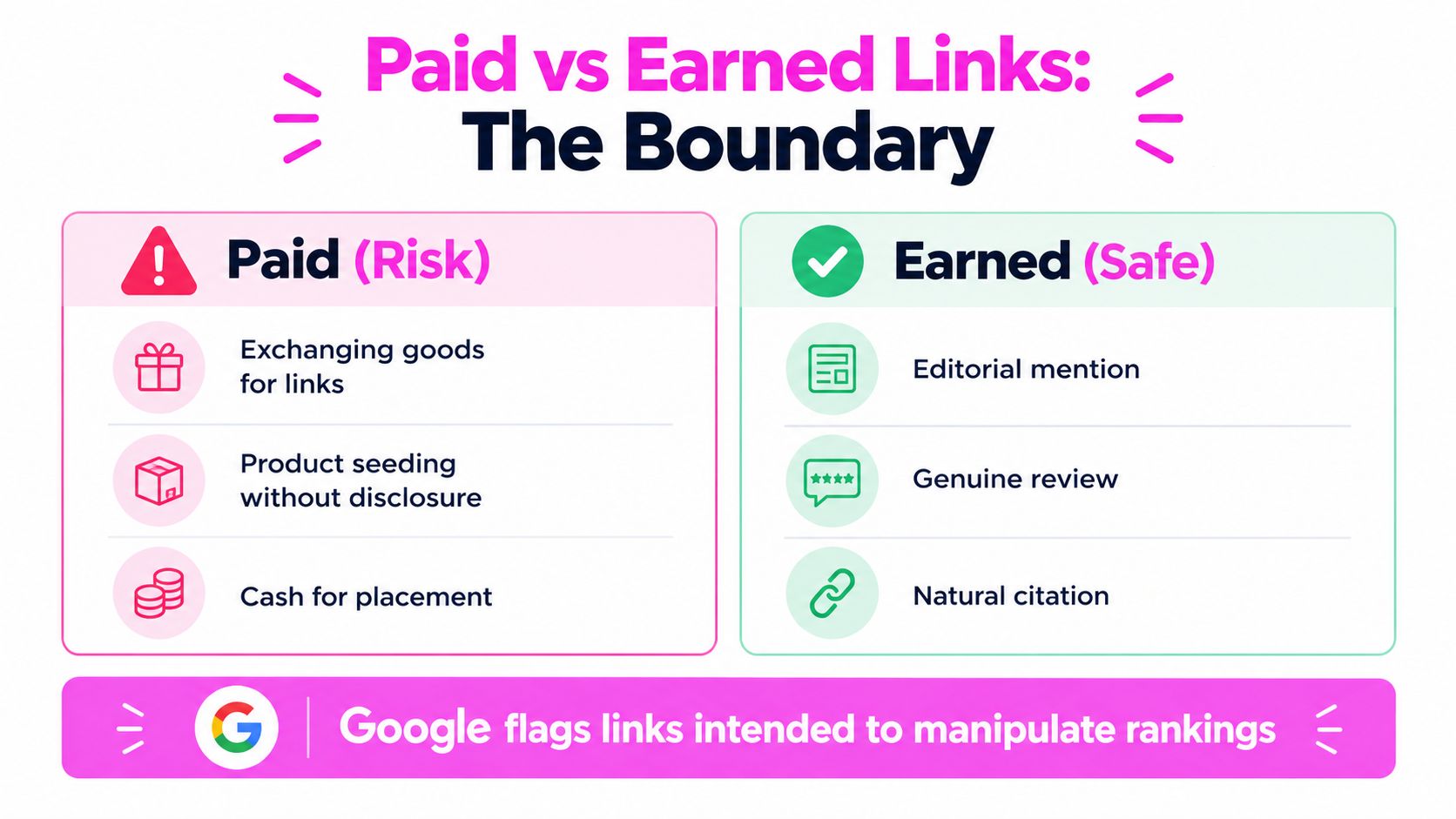
Before agreeing to a placement, I ask:
- Is there compensation or a material benefit? If money, a product, or a service is exchanged for the placement, treat it as commercial rather than earned editorial coverage.
- Does the publisher control editorial judgment? An editor who can reject or revise a pitch is different from a seller promising a fixed link.
- Is a link required as part of the exchange? A required backlink changes the nature of an offer, even if the publisher and topic are legitimate.
- Is the commercial relationship visibly disclosed, and is the link qualified? Ask how the publisher handles disclosure and whether the link will carry the appropriate
relattribute.
A campaign can include both types without conflating them. I can pitch an unpaid, useful resource for editorial consideration and separately discuss a clearly disclosed sponsored placement where the publisher retains control over its content and correctly qualifies the link. I don't describe the second as an earned endorsement.
Digital PR is another route to editorial consideration, but it needs to be planned around a real story or useful information, not just a request for a link. A 2025 survey found 48.6% of respondents rated digital PR the most effective link-building tactic, while 17.7% used it regularly (survey context and link-building analysis). That difference points to an opportunity for teams willing to develop newsworthy material and pitch it to relevant publishers, while keeping editorial independence intact.
The rule I use is straightforward: design for transparency before the placement happens. Don't wait until publication to decide whether the link was earned, sponsored, or part of an exchange.
Tracking Replies, Placements, and What Your Numbers Actually Tell You
A reply-rate report can make a campaign look healthy while no links appear. I track the whole path so I can find the stage that needs attention, from delivery to retention. The minimum tracker needs a status for delivered, opened, replied, positive reply, link placed, and link retained at thirty days, plus separate fields for the link's rel attribute and any disclosure status.
For comparison, a reported case study of 500 personalized emails producing 23 backlinks equates to a 4.6% email-to-link conversion rate (case-study details). That example is useful because it measures placements against sent emails, not just replies. It's still one case, not a universal forecast. The metric I want is the campaign's own delivered-email-to-live-link conversion, interpreted alongside relevance and retention.
Read the funnel to find the leak. If emails aren't delivered, review address quality and sender health. If they're delivered but don't get replies, revisit the prospect list, page fit, and pitch. If positive replies don't become placements, look at editorial approval, link eligibility, and follow-through. If a link later disappears or its qualification changes, the placement count alone won't tell you.
A practical first-week setup
- Pull a backlink-gap list in SemDash. Start with competitors that serve the same audience, then review the actual linking pages.
- Qualify a short prospect sheet. Record the page, its context, the reason for the pitch, and the right contact.
- Draft three distinct templates. Write separately for a resource page, broken-link replacement, and unlinked mention.
- Set the four-touch cadence. Add new information at each follow-up and stop when the recipient's response calls for it.
- Log placements in one tracker. Record the live URL, publication status, link attribute, disclosure, and retention check.
Don't optimize for the biggest send count or the most replies. Smaller, better-qualified lists give you a clearer view of what's working when you measure relevant, retained editorial links.
Use SemDash's backlink research and Backlink Gap analysis to identify publishers already linking to relevant competitors, then review page and anchor context before building your outreach list. Visit SemDash to explore those research tools and organize a more qualification-first link acquisition workflow.