%20(1)-B86R08ZzwhPzS6UZbG3mSxRWPCwGwn.png)


$50–$250: Precios de herramientas de SEO que relacionan dinero con flujos de trabajo

Most SEO subscriptions fall into three general pricing categories: a lower tier for basic tracking, a mid tier designed for multi-project agency use, and a higher tier catering to enterprise-scale access with API calls and unlimited seats. The right band isn’t about brand reputation. Match plan limits (tracked keywords, crawl volume, backlink lookups) to your actual monthly workload, then check whether billing runs on a flat subscription or a credit meter, because that detail alone can double your real cost.
TL;DR:
- Choosing an SEO plan requires matching workload levels and growth projections with plan limits, especially for keywords, crawls, and API calls.
- Cost overruns often occur from add-ons like extra seats, API overages, and report exports, which can quickly increase the initial subscription fee.
- Monthly billing offers flexibility for seasonal or testing workflows, while annual plans provide discounts but can lock in unused months.
- Credit-based plans, like Semdash, align costs with actual usage, making them ideal for solopreneurs and small agencies managing variable workloads.
- AI features are increasingly metered separately, and tracking real consumption during a trial helps predict true costs more accurately than advertised prices.
How does SEO software pricing actually work?
SEO tool pricing splits into four models, and confusing them is the fastest way to overpay or to underbuy.
Monthly vs. annual billing is the first fork. Annual plans typically shave a noticeable percentage off the monthly rate, a standard discount pattern across most SaaS pricing pages. The tradeoff is flexibility. If your workload is seasonal or you’re still testing a workflow, monthly billing costs more per month but lets you downgrade or cancel without eating a prepaid year.
Per-seat billing charges by user login. Some vendors pool seats across a team; others charge per named user regardless of activity. Pooled seats favor agencies with rotating contractors, while per-user pricing punishes teams that add seasonal help.
Credit or usage-based pricing ties cost to actions: a keyword lookup, a SERP check, a backlink crawl. A “credit” usually covers one data pull, and heavy exporters or agencies running frequent audits burn through credits fast. This model rewards light, targeted usage and penalizes anyone running bulk historical pulls without checking the meter first.
Common add-ons stack on top of any base plan:
- API access, often billed separately or capped by call volume
- Extra project or domain slots beyond the base allowance
- White-label reporting for agencies presenting to clients
- Additional tracked keywords beyond the included limit
A SaaS SEO platform that clearly separates these charges makes budgeting far easier than one that bundles everything into a vague “professional” tier.
What do you get at $50, $150, and $250 a month?
Price and capability track together in SEO software, but not in a straight line. The jump from entry-level to mid-tier buys real functionality; the jump from mid-tier to enterprise mostly buys scale and support.
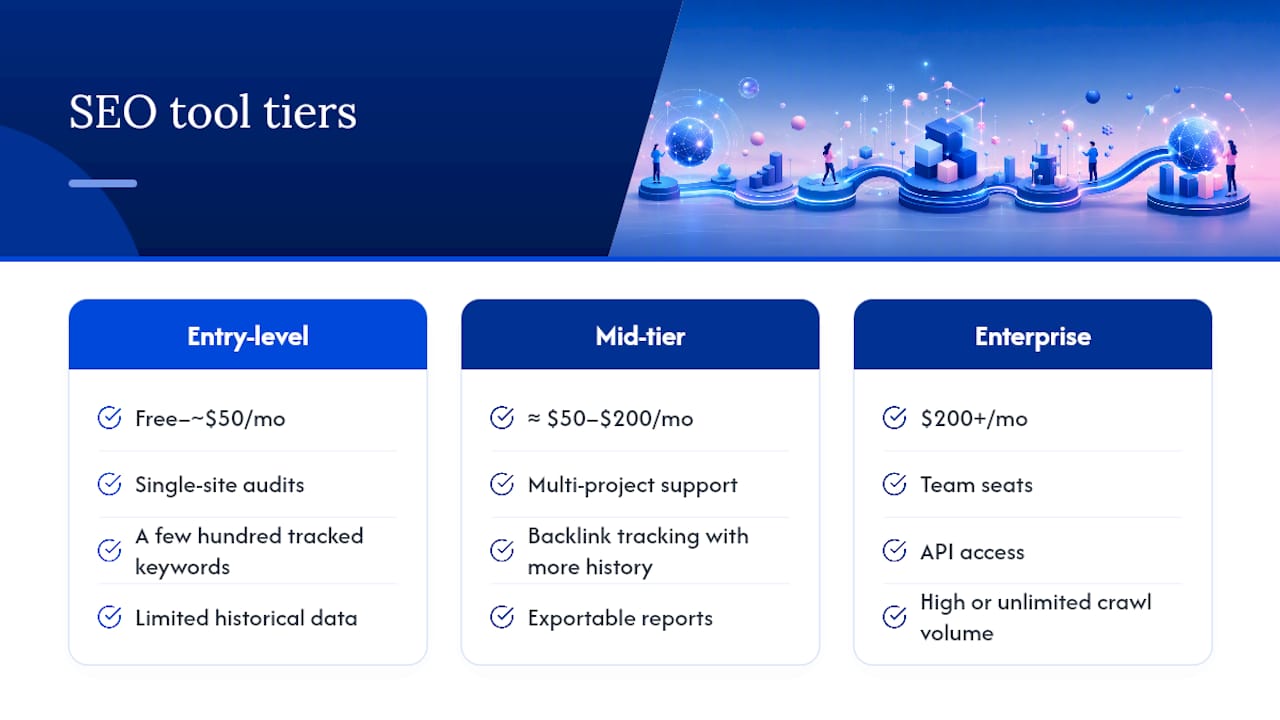
Entry-level (free to roughly $50/month). Expect single-site audits, a few hundred tracked keywords, and limited historical data. Free tiers exist, but they usually cap lookups so tightly that anyone doing regular content or link work will hit the ceiling within a week. Solopreneurs and bloggers doing occasional audits fit comfortably here.
Mid-tier (roughly $50 to $200/month). This band typically unlocks multi-project support, backlink tracking with more history, exportable reports, and higher keyword-tracking caps. Small agencies managing three to ten client sites usually live in this range, since it’s the first tier that supports parallel projects without constant limit warnings.
Agency/enterprise ($200-plus/month). Team seats, API access, high or unlimited crawl volume, white-labeling, and dedicated support show up here. In-house teams at larger companies and agencies juggling dozens of clients need this tier mainly for the seat count and API throughput, not for basic feature access.
Consejo pro: Before comparing sticker prices across tiers, list what pushes your bill above the base rate. Extra seats, API overages, and report exports are the three line items that most often turn a $99 plan into a $180 invoice.
SEO work itself spans technical audits, content research, link building, and local optimization, and no single tier covers every workflow equally well. Buying based on which workflows you actually run each month beats buying based on the highest tier available.
How do you pick the right plan for your workload?
Choosing a plan comes down to matching numbers, not chasing feature lists. Run through this before you commit to a subscription:
- Count your monthly actions. Tally keyword checks, site crawls, tracked keywords, and backlink lookups from the last 30 days of actual work, not a guess.
- Project team growth. If you’re likely to add a second SEO or a contractor within six to twelve months, price the plan at that future seat count now, since some vendors charge a premium for mid-cycle upgrades.
- Estimate API and export needs. If you automate reporting or pull data into another system, get the API rate card before you sign, not after your first overage bill.
- Ask sales four specific questions: What’s the overage rate once I exceed my limit? Is billing monthly, annual, or both? How long is historical data retained? What support level is actually included, and is there an SLA?
Consejo pro: Ask for a usage report template during your sales call. A vendor that can’t show you what “1,000 credits” looks like in real tasks is a vendor whose invoice will surprise you in month two.
Freelancers and small businesses often overbuy seats out of caution. A best SEO software for small business comparison helps confirm whether a lower tier genuinely covers your workload before you pay for headroom you won’t use.
Where do hidden SEO tool costs come from?
The advertised monthly price rarely matches the invoice three months in. Line items accumulate quietly, and the biggest offenders are predictable once you know to look for them.
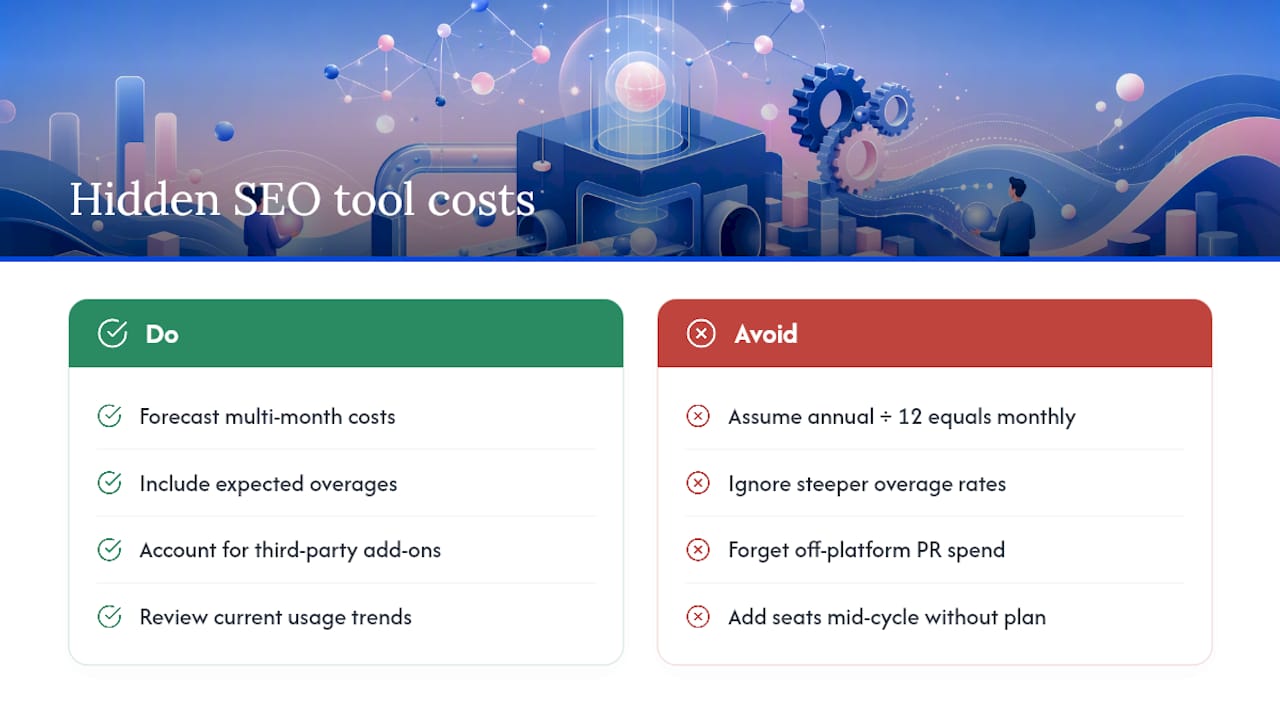
Comparing monthly against annual pricing takes more than dividing the annual total by twelve. Factor in whether you’ll actually use the plan for the full term, since a discounted annual rate locks you into paying for months you might not need. Overages are the other quiet cost driver: API calls beyond your cap, seats added mid-cycle, and credit consumption past your monthly allotment often bill at a steeper per-unit rate than your base plan implies.
Third-party add-ons compound this. Press release distribution, for instance, sits entirely outside your SEO subscription but frequently gets budgeted alongside it. eReleases offers pricing packages generally in the mid to upper hundreds of dollars range, mientras que PRWeb’s tiers run from $120 to $480 per release. Neither shows up on your SEO tool invoice, but both are common line items in a marketing budget built around link-building and PR outreach.
Before your first billing cycle, build a simple multi-month forecast including your base subscription costs, expected overage charges based on current usage trends, and any known add-on services such as PR distribution, extra seats, or API tier upgrades.
When should you downgrade, upgrade, or negotiate?
Annual billing and multi-year commitments generally offer the deepest discounts, but only pay off if your usage is stable. Monthly billing costs more per month yet keeps you free to downgrade the moment a project ends.
Seat pooling, bulk credit purchases, and bundling multiple products from one vendor are the three most reliable discount levers, and bulk purchasing patterns from press-distribution vendors show the same logic: buying in volume consistently lowers your per-unit cost. Use a trial period deliberately. Run your actual weekly workload through it and track how fast you burn through credits or hit seat limits, rather than testing the interface and assuming usage will scale linearly.
Consejo pro: Two unused seats and a repeat overage charge in the same month are the clearest signal you’re on the wrong tier. Downgrade the seats, then negotiate the overage into a higher credit allotment instead of just eating the fee again.
Watch for these red flags: seats nobody has logged into in 30 days, overage charges appearing three months running, or a support ticket queue that never gets a response within your supposed SLA. For more budget-conscious options, this breakdown of budget SEO tools under $99 a month is worth a look before you settle on a tier.
Get more from a credit-based plan with Semdash
Semdash prices around what you’ll actually use instead of forcing you into a flat tier padded with features you’ll never touch. The credit-based model means a solopreneur running weekly audits pays for weekly audits, not for an enterprise crawl allowance sitting idle.
That structure fits a range of buyers differently. Bloggers and solopreneurs get keyword research and SERP tracking without committing to an agency-scale seat count. Small agencies managing several client sites can pool credits across projects instead of buying a separate subscription per client. In-house teams get análisis de la competencia y investigación de backlinks without the API markup that enterprise tiers on legacy platforms often charge separately.
During a trial, track three numbers: how many credits a full keyword research session consumes, how API calls factor into your reporting workflow, and whether your project limit covers every site you manage. Those three data points tell you more about real cost than any pricing page comparison. Start with Semdash’s keyword research tool and measure your actual usage before you commit to a tier.
The pricing trend nobody’s budgeting for yet
AI-driven features are quietly changing what a “credit” costs you. Automated content scoring, AI Overview tracking, and semantic clustering all consume compute, and vendors increasingly meter that usage separately from basic lookups. Two mistakes show up constantly: buying seats for a team that hasn’t grown yet, and ignoring API or credit consumption until the first overage invoice arrives.
My recommendation is blunt: run a two-week trial and measure exactly three things. Keyword checks per session, crawl runs per project, and tracked keywords against your cap. Those three numbers predict your real bill better than any sales conversation will.
— Leonid
Fuentes
Preguntas más frecuentes
How much does an SEO tool cost per month?
Most SEO software runs free to roughly $50 for entry-level access, roughly $50 to $200 for mid-tier multi-project plans, and $200-plus for agency or enterprise tiers with API access and higher seat counts.
Is SEO still worth paying for in 2026?
Yes. Search remains a primary discovery channel for most businesses, and paid tools cut the time spent on keyword research, technical audits, and competitor tracking compared to manual methods.
Can ChatGPT replace an SEO tool?
No. ChatGPT can help draft content or brainstorm keyword ideas, but it can’t crawl live sites, pull real backlink data, or track actual SERP rankings the way a dedicated platform like Semdash does.
What’s a realistic budget for SEO software as a small business?
Most small businesses land comfortably in the $50 to $200 monthly range, which covers multi-project support, backlink tracking, and enough tracked keywords for a handful of client or company sites.
Do annual SEO tool plans really save money?
Annual billing typically discounts the monthly rate, but only makes sense if your usage is steady. If your needs might shrink or change within the year, monthly billing costs more but avoids a prepaid commitment you can’t use fully.