

Forty posts about email marketing and none of them rank. You've written about segmentation, automation, deliverability, subject lines, compliance, and every one of those posts targets its own keyword. Taken together, they should add up to something. Instead they cannibalize each other, and Google treats them as forty unrelated articles that happen to share a vocabulary.
That's what a topic cluster is built to prevent. It's an information-architecture model that organizes a site around one broad subject instead of treating every keyword as an isolated publishing target. HubSpot's research traces the methodology to experiments launched in 2016, with the framework first detailed in 2017, and describes it as a shift from keyword-by-keyword production toward semantic coverage: one page establishes the main subject, related pages demonstrate breadth and depth (HubSpot's topic cluster guide).
Tabla de contenido
- A Topic Cluster in Three Parts
- How Pillar and Cluster Pages Link Together
- How to Build a Cluster Step by Step
- Mapping One Intent to One Page
- Designing Clusters for AI Answers
- Decide Whether to Build and Publish
A Topic Cluster in Three Parts
The structure is simple, and that's exactly why people skip past it too fast. A cluster has a pillar page, several cluster pages, y contextual internal links joining them. Everything else is implementation detail.
Say a client sells email marketing software. The pillar is a thorough guide to email marketing: what the discipline is, why teams use it, which sub-disciplines matter, what success looks like. It covers the whole territory at overview depth and routes readers outward. The cluster pages each take one narrow slice and go deep: segmentation for small lists, welcome sequences, deliverability troubleshooting, GDPR compliance. The links connect general to specific, guiding readers and helping crawlers interpret how the pages relate.
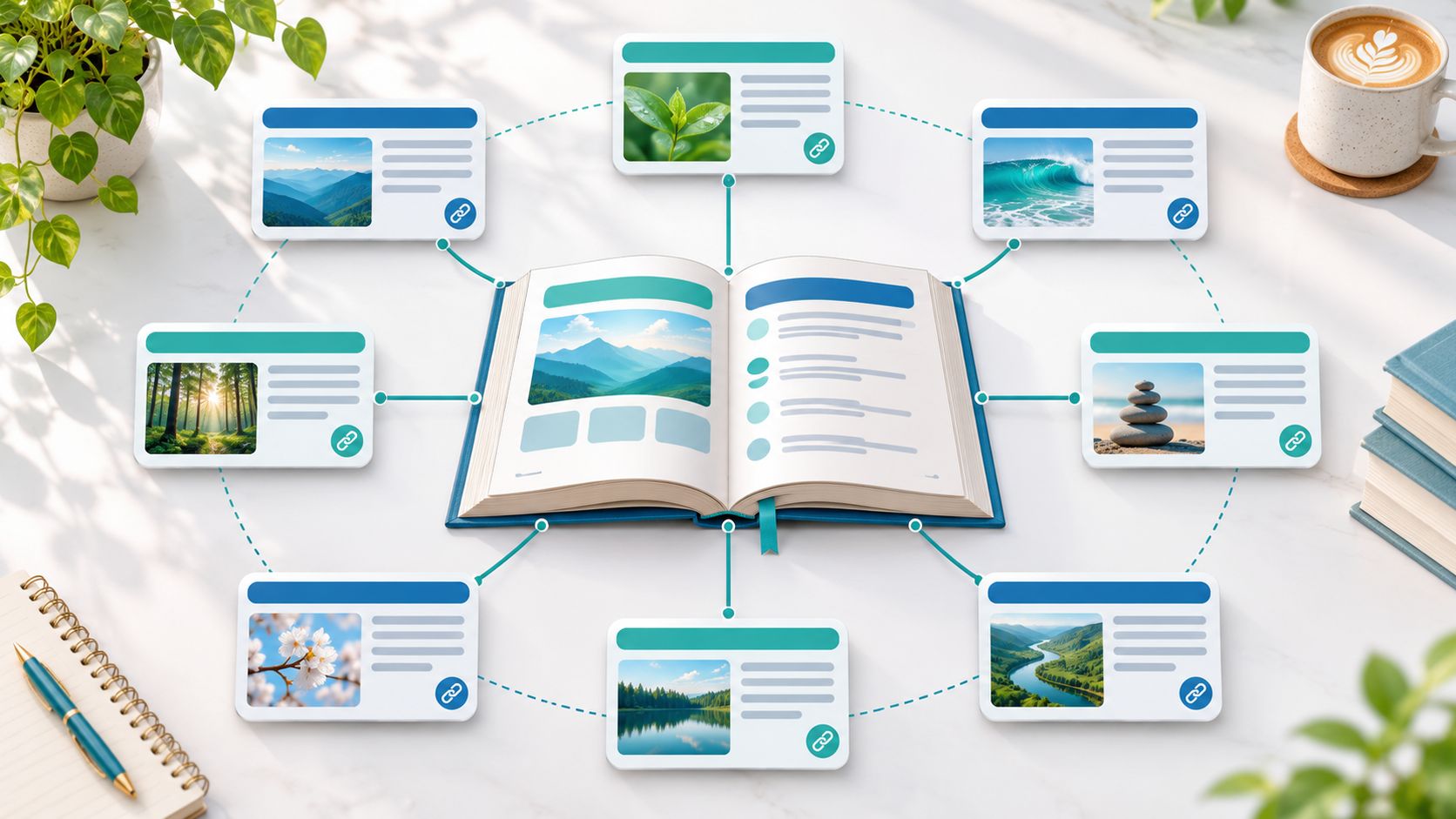
I picture it as a wheel. The pillar is the hub, cluster pages are the spokes, internal links are the rim. Without the rim, the spokes fall flat. Without the hub, you have loose spokes lying on the floor, which is the state of most "content libraries" I audit.
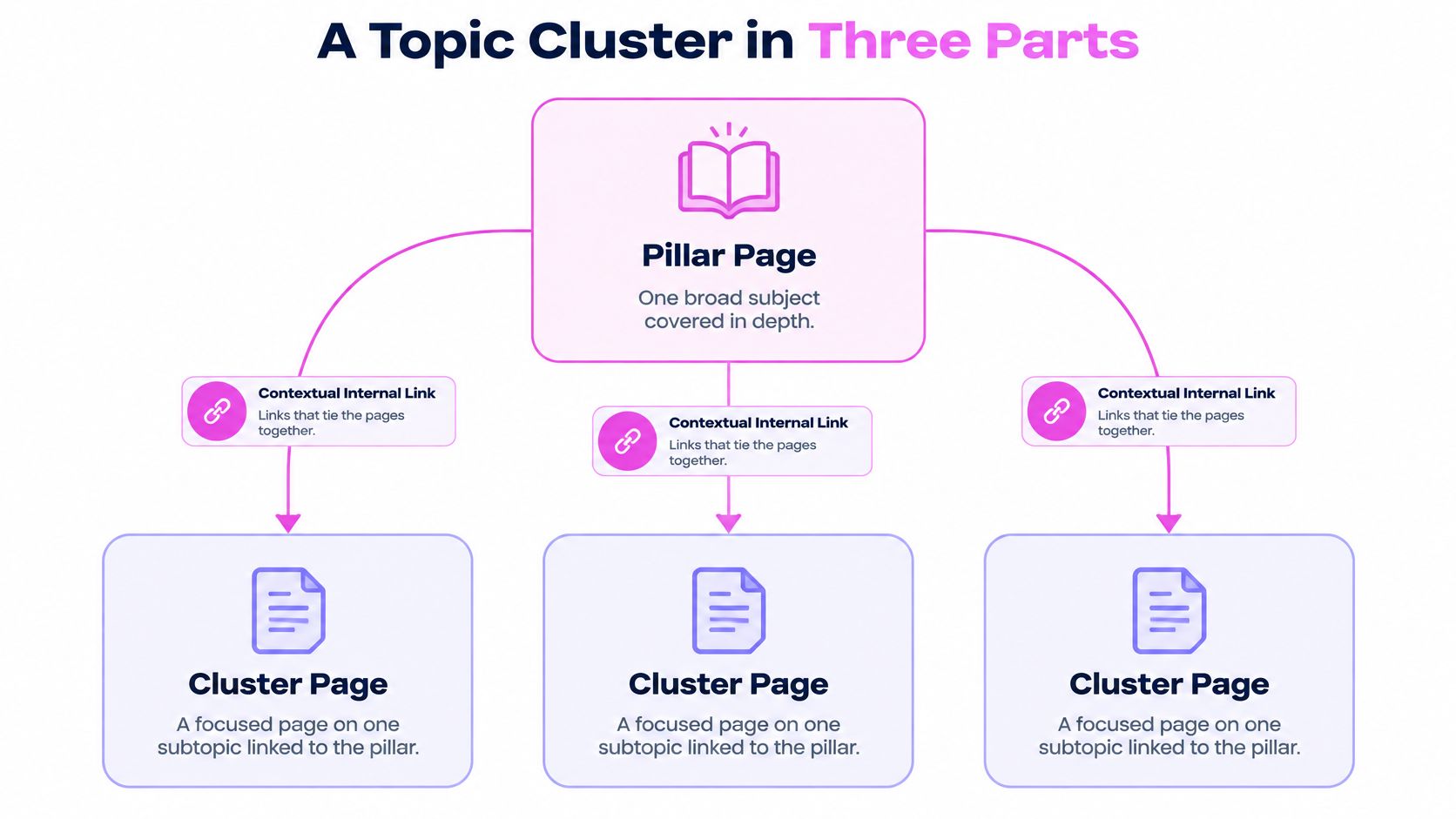
The practical payoff is risk reduction. A cluster maps one page to a broad query and other pages to distinct long-tail or intent-specific queries, which lowers the chance that several URLs fight over the same search demand. That's the entire game. Rankings follow when one URL owns one intent.
What a cluster is no: a pile of articles with similar words. It needs one defined topic, one search intent per page, and an explicit site hierarchy. It's an organizing discipline, not a ranking signal, and I'd walk away from anyone selling it as the latter.
Self-check: Find your pillar. Count the cluster pages that link back to it with descriptive anchors. Then check whether each one serves a single intent. If three pages chase the same query, you don't have a cluster. You have competition you created yourself.
How Pillar and Cluster Pages Link Together
A cluster is defined by its internal link graph, not by semantic similarity between keywords. The technical property that separates a real cluster from a themed archive is an explicit link structure that converts isolated documents into a crawlable topical network. Google's guidance is direct: every important page should be linked from at least one other page on the site, and links should point to resources that help users understand the destination (Google Search Central on crawlable links).
I build the link map from three rules, in this order.
The pillar links out to every important cluster page, placed in the section of the pillar where that subtopic appears. The anchor names the subtopic. "Click here" tells a crawler nothing and tells a reader less.
Each cluster page links back to the pillar wherever the reader benefits from seeing the bigger picture. In practice that's usually the introduction and one contextual mention further down. A single well-placed link beats a forced one.
Sibling pages link to each other only when the next step is relevant. A page on email segmentation can link to email automation because readers who finished segmentation have a natural next question. A forced web where every article links to every other article adds noise and flattens the hierarchy you just built.
What breaks
The failure modes are predictable. A pillar that's really a thin directory of links with no substance of its own. Anchors like "read more." Cluster pages that exist in the CMS but are never linked from the pillar, so the only path in is the sitemap. Links pointing at duplicate or parameterized URLs instead of the canonical address, which happens after migrations, faceted navigation changes, and CMS template updates.
Your page architecture carries this weight whether you plan it or not, which is why I'd rather design the graph deliberately than retrofit it. The URL layer underneath the links is where that decision gets made, and this guide to web page architecture covers how to structure it.
The afternoon audit
- Export every URL in the topic from your sitemap and analytics, one row per page.
- Crawl for internal inlinks and sort by count ascending. Zero means an orphan.
- Check each cluster page for a link to the pillar with a descriptive anchor.
- Confirm the destination is the canonical URL, not a duplicate.
Fix the orphans first. A 30-page cluster takes two or three hours with a crawler, and there's no excuse for leaving pages stranded.
How to Build a Cluster Step by Step
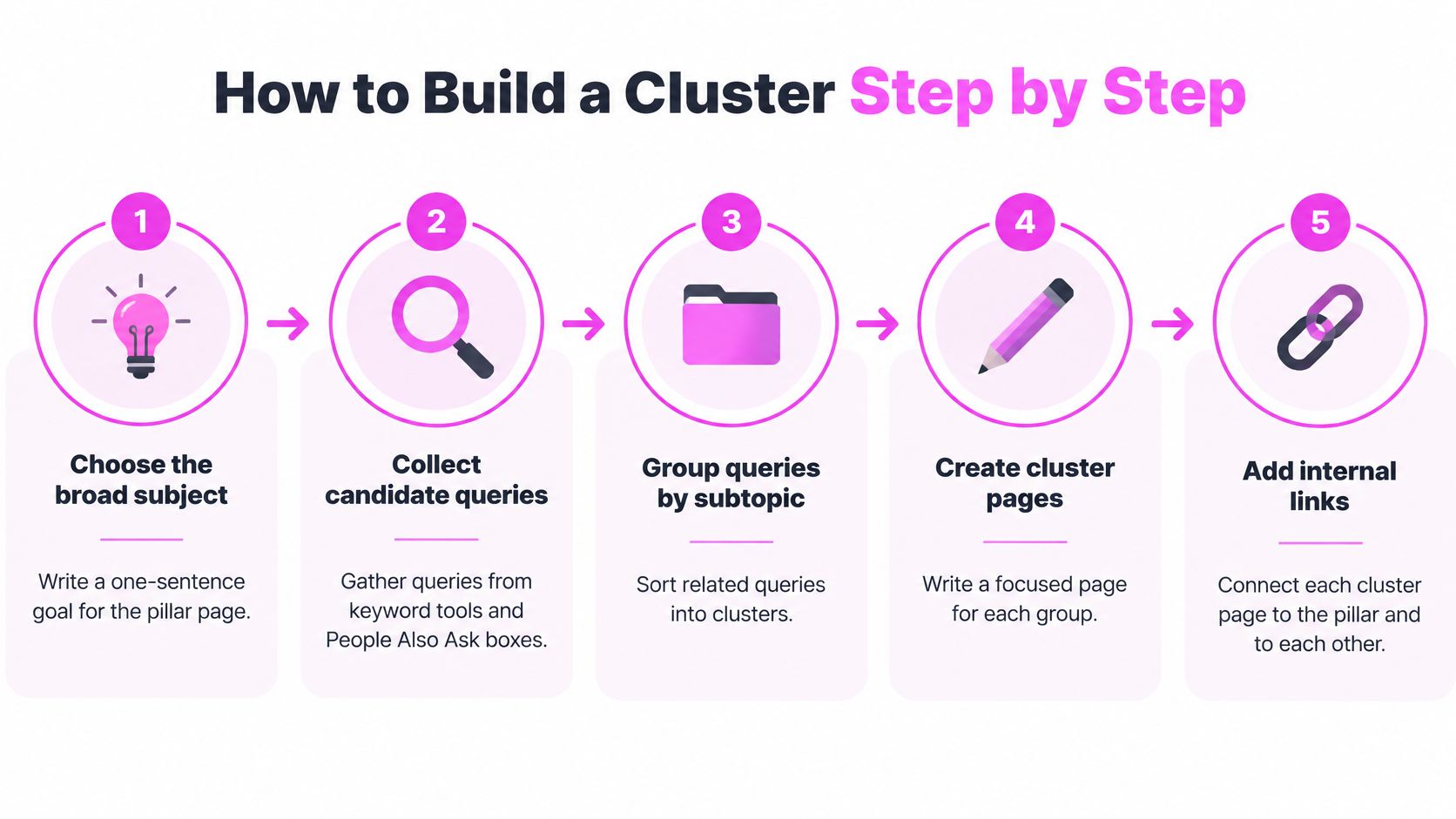
Six steps, in this order. Skipping step four is the most expensive mistake in the process.
1. Choose the broad subject and write the pillar goal in one sentence. Not "rank for project management software" but "help a first-time buyer understand what the software does and how to evaluate it." The sentence gives you a standard to test every candidate subtopic against. While you're here, read Google's position on automation: it provides no special ranking advantage, and content has to be useful and original rather than generated at scale.
2. Collect candidate queries from Search Console, keyword tools, and the People Also Ask boxes on the seed term. People Also Ask is the richest source because Google has already grouped those questions with your topic. SemDash's own PAA tool surfaces the sub-questions under a keyword, which saves an afternoon of manual SERP scrolling.
3. Group by intent, not by wording. Informational, comparative, transactional, troubleshooting. The slip here is clustering on shared tokens: "email automation setup" and "email automation software" share two words and belong on different pages, one procedural and one commercial.
4. Validate each group against live SERP overlap. Compare the top ten results. If the same URLs keep appearing across a group of queries, search engines are already treating those queries as one intent, and one well-targeted page can compete for all of them. If the results diverge, split the group. A clustering tool gives you a first pass, but I check every group against live results before it becomes a URL.
5. Assign each group a URL and mark which one owns the broad query. That's your pillar. The rest are cluster pages, each with one primary intent and a format that matches it: a checklist for action queries, a comparison table for evaluation queries, a walkthrough for procedural ones.
6. Write the link plan before drafting. Every page gets a parent and a link back. Drafting first and linking later is how clusters end up as archives.
A practical test I apply before writing: define the deliverable for each page. A page on "employee onboarding checklist" should give the reader a usable checklist. A page on "employee onboarding process" explains sequence, ownership, and timing. If two briefs produce nearly identical outlines, one of them doesn't need to exist.
Google's own starter guide notes that keyword density isn't a meaningful ranking requirement and that being explicit matters more than mentioning every lexical variation (Google SEO starter guide). I compare titles, intros, headings, examples, and calls to action across proposed pages, not keyword lists.
The cluster is complete when every subtopic has a page that answers it and the pillar gives readers a coherent route through those answers. Not when you've hit a page count.
Mapping One Intent to One Page
The most common failure isn't a missing page. It's three pages fighting over one query because keyword research surfaced three modifiers. The test I apply to every proposed URL: does this page change the user's task, the comparison criteria, or the evidence they need? If the answer is no on all three, I consolidate instead of publishing.
Here's how that plays out on a project management cluster.
| Query | Intent | Page to target | Decisión |
|---|---|---|---|
| project management software | Broad commercial research | Pillar page | Own it on the pillar |
| project management software for small teams | Narrower buyer segment | Dedicated cluster page | Separate page, because the criteria differ |
| how to choose project management software | Decision guide | Criteria checklist cluster page | Separate page, because the task differs |
| best project management software 2026 | Comparison list | Pillar or consolidated comparison | Merge with the pillar when live results show the same listing type |
| project management software free | Price-led search | Pillar page, pricing section | Merge into the pricing section, no new URL |
Read the rows as a set and the logic shows. The broad query belongs to the pillar because that page has to satisfy the head term first. The small-team variant earns its own URL because a five-person team weighs onboarding speed and per-seat cost differently from an enterprise buyer, so the evidence changes. The how-to-choose query is a different task entirely, a decision framework rather than a product overview.
The last two rows are where discipline matters. "Best project management software 2026" only deserves a separate URL if the live results show a different content type from the pillar, a genuine comparison list rather than vendor landing pages. If they don't, the pillar absorbs it. And "free" is a pricing question, not a page. A thin free-plan article on a site that already covers pricing gives you a second URL competing for a variant of the same demand.
Consolidation mirrors what happens in paid media when two campaigns chase one audience. If you've ever rebuilt a paid search account, the logic of merging overlapping ad groups before adding new ones will be familiar, and the same planning approach behind content planning for UK trades applies to organic clusters.
The canonical rule
When two URLs should no longer coexist, redirect one to the other. When alternate access paths have to stay live, for tracking parameters or legacy paths, a canonical tag identifies the preferred version and internal links should point to that preferred URL rather than the duplicate. Google describes canonicalization as selecting one representative URL among pages with duplicate or highly similar primary content (Google on canonicalization).
When two rows in that table map to the same URL and your ranking data agrees, that's confirmation, not a coincidence. Merge them and put the effort into the stronger page.
Designing Clusters for AI Answers
The click economics changed, and cluster plans mostly haven't caught up. Pew Research Center analyzed browsing activity from 900 U.S. adults and found that traditional-result clicks occurred in only 8% of visits when an AI summary appeared, compared with 15% without one. Clicks on links inside the AI summary happened in just 1% of visits (Pew Research Center).

Read that as a prioritization rule rather than a reason to stop publishing. If a summary answers the query, adding a twelfth supporting article on the same subtopic earns almost nothing. What earns citations is distinctive material: original data, clear entities, tight answer passages, and pages that cover different intents in a meaningful way, such as definition, comparison, implementation, troubleshooting, and firsthand evaluation.
If you want the mechanics of earning those citations, the workflow in this guide to AI Overview optimization is worth the read.
Measuring a cluster nobody clicks
Sessions and average position understate what's happening. Track cited URLs in AI answers, branded search volume, assisted conversions, direct traffic, and coverage of the high-value claims you want associated with your brand. A page that gets cited and never clicked still moves revenue, and a cluster report that ignores that will get the work cancelled.
My working routine: map each cluster keyword to the URL that ranks for it, flag the queries that trigger an AI Overview, and grade each page on whether it's citation-worthy or redundant support. The redundant ones get merged or cut.
Decide Whether to Build and Publish
Clustering isn't automatically worth doing, and the standard advice glosses over that. Google warns that generating many pages without adding user value can violate its policy on scaled content abuse, and states that automation provides no special ranking advantage: content has to be useful, original, and demonstrate experience, expertise, authoritativeness, and trustworthiness (Google on gen-AI content and scaled abuse).
So before I publish a cluster page, I score it on five factors and write the scores down. The writing-down part matters. It forces the weak candidates into daylight where a spreadsheet can kill them instead of three weeks of drafting.
| Factor | What I check | Decision rule |
|---|---|---|
| Intent separation | Whether the query changes the task, criteria or evidence | Separate page only if it does |
| SERP overlap | Whether the top ten URLs match the pillar's results | High overlap means merge |
| Business value | Whether the page supports a conversion or a key claim | Low value with high cost means skip |
| Content cost | Hours of original research and writing needed | Thin content with no unique data means skip |
| Cannibalization risk | Whether two URLs would compete for the same query | Competing pages get consolidated |
A page has to pass all five. Failing one is enough to keep it out of the build queue.
Where this matters most
Small sites and publishers with limited authority get more from consolidation than from expansion. A site with sixty linking domains should not be spreading itself across thirty long-tail pages on one subject. It should own four or five pages that answer the questions buyers ask, link them properly, and let the authority concentrate.
This is also where competitor coverage earns its keep. SemDash's content gap reporting shows the topics competitors cover that your site doesn't, presented as a prioritized list of ideas, which turns the scorecard from a blank page into a ranked queue.
Distinguishing a genuine cluster from keyword fragmentation comes down to evidence: distinct search intents, materially different results, separate audiences or decision stages, and enough unique information to fill each page. Absent that, you're building doorway pages with better manners.
For the first cluster, pick a subject where a page already has some traction. Write the pillar goal in one sentence. List one cluster page per distinct intent with its target query. Score every row, merge any two that would produce near-identical outlines, and confirm the link plan before a single draft begins. Publish only when every page solves a different problem and the pillar gives readers a coherent route through them.
SemDash was built for the messy part before drafting: its keyword clustering groups queries by intent and ranking-URL overlap, so you can see which terms deserve one page and which need their own before you commit to a URL. The competitor gap view adds the prioritization layer, showing the topics rivals cover that you don't, ranked as content ideas. Start with one subject you already half-own and see what a mapped cluster looks like before you write another standalone post.