
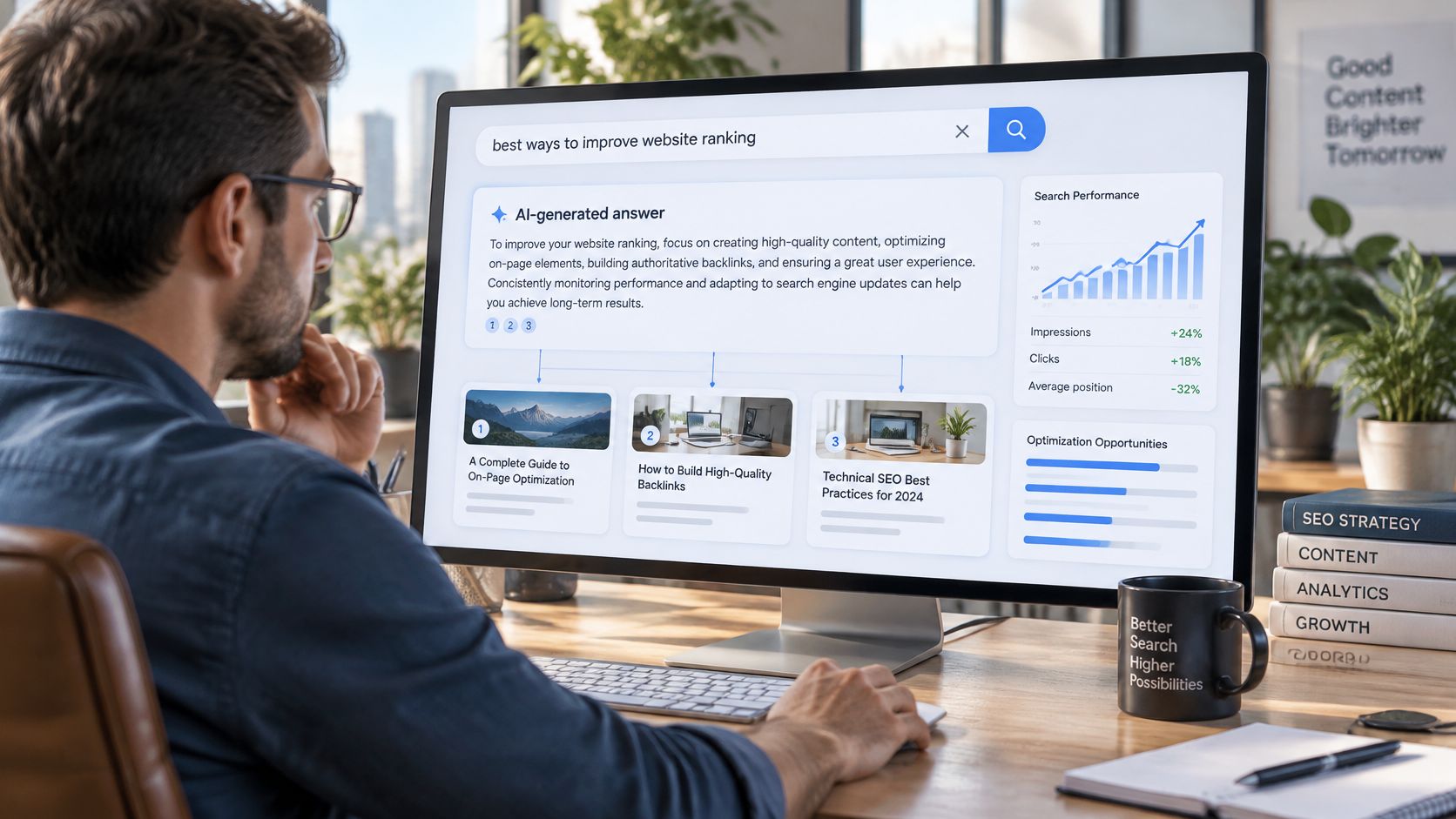
“Rank well, add FAQs, and the citations will follow” is a weak strategy for AI Overview optimization. I wouldn't treat a citation as proof of success, either. You can earn visibility inside an answer while giving the searcher less reason to visit your site.
My approach starts with a harder question: Which queries justify the effort of becoming a cited source? I separate citation eligibility from citation value, keep a repeatable record of what Google shows, and change pages only when I can explain what business outcome I'm testing.
Tabla de contenido
- Why Ranking First Does Not Guarantee an AI Overview Citation
- Finding the Queries That Trigger AI Overviews
- Building a Citation Log You Can Trust
- Structuring Pages for Citable Passages
- Deciding Which Citations Are Worth Chasing
- Choosing a Tracking Setup and Where SemDash Fits
- Your First Week of AI Overview Tracking
Why Ranking First Does Not Guarantee an AI Overview Citation
I treat organic position and AI Overview inclusion as related but separate outcomes. With a conventional ranking, I'm measuring where a page appears among organic results. With an Overview citation, I'm measuring whether Google references a particular URL inside a synthesized answer. I can't substitute one measurement for the other.
Google introduced AI Overviews in the United States in May 2024 and expanded to more than 200 countries and territories and over 40 languages by May 2025, según Google's account of its AI search rollout. I therefore wouldn't interpret a visibility report without knowing which audience and search environment it represents.
Separate the page from the question
When I assess a well-ranking page that's missing from an Overview, I don't immediately conclude that it needs more authority or a longer introduction. I first distinguish the broad query from the narrower questions answered inside the panel.
For example, when targeting a hypothetical Shopify shipping query, I'd examine whether the Overview discusses configuration, delivery expectations, or troubleshooting. I might have a detailed shipping guide without a clearly supported answer to the specific issue being summarized. That's a different problem from poor keyword targeting.
For store-specific context, I'd pair that assessment with Yassine Malti's resource on how to improve Shopify SEO for AI search. I'd use it as an implementation reference, not as evidence that a particular change guarantees inclusion.
Working distinction: I use rankings to assess organic visibility and citations to assess source selection. Neither tells me whether the resulting exposure produces qualified demand.
Don't flatten international visibility
I also keep the search interface in view. Google has changed citation presentation, including prominent site links and tests of links within Overview text, as described in its AI Overviews expansion update. I wouldn't assume that identical cited URLs receive identical attention across layouts.
My reporting separates:
- Citation presence: Whether my domain appears as a source, rather than merely somewhere in the answer.
- Page identity: Which exact URL receives the reference.
- Contexto de búsqueda: Which market, language, device, and observation date produced that result.
Without those distinctions, I could report progress while optimizing the wrong page for the wrong audience.
Finding the Queries That Trigger AI Overviews
I build the monitoring set from queries that already matter to the business. Google Search Console exports give me existing search exposure; keyword research adds relevant gaps and competitor topics. I don't start with a large collection of questions merely because they're easy to check.
Here's the kind of query-level review I'd use before committing pages to a test.
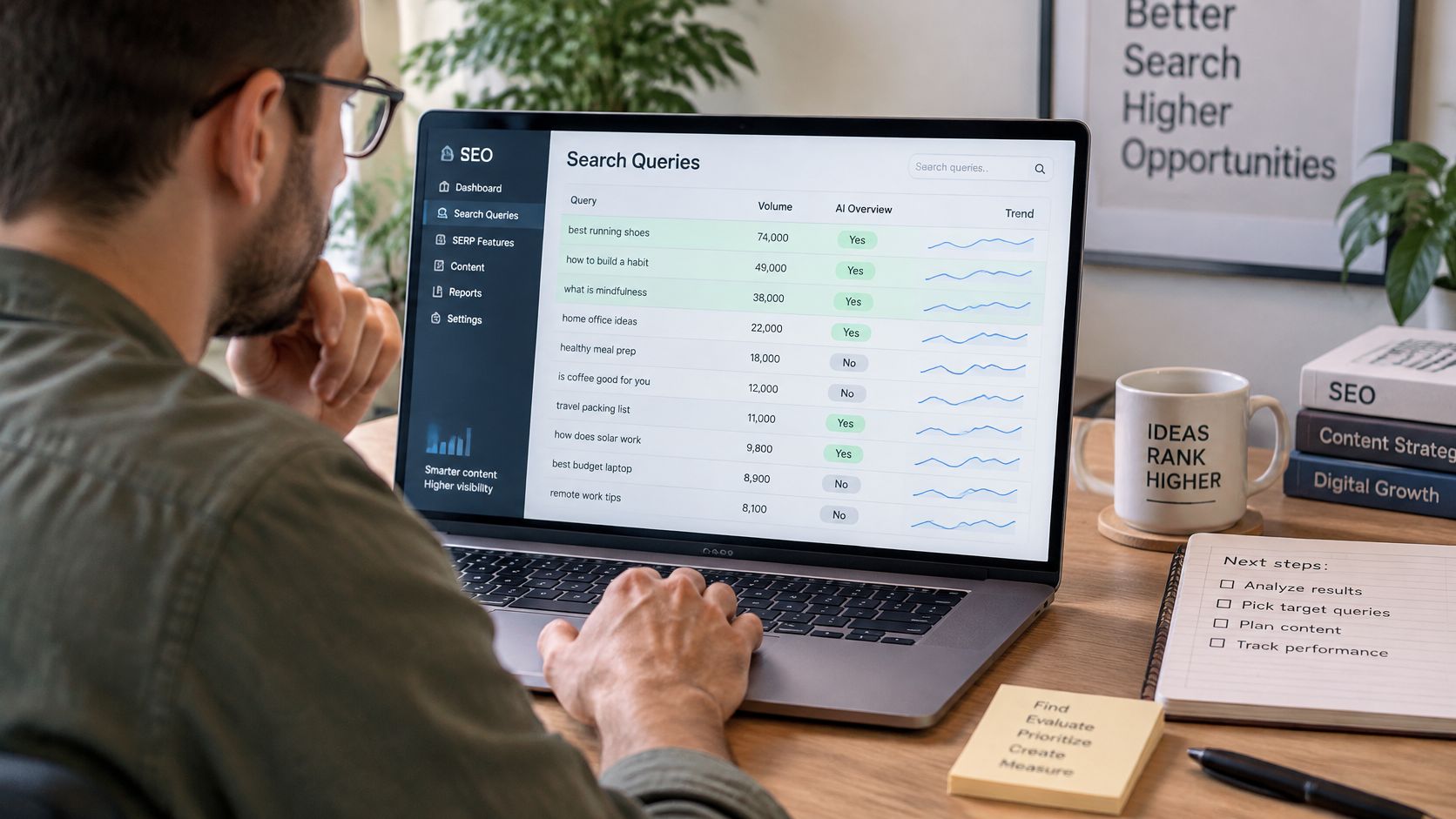
Choose queries by business relevance
I label each candidate informational, commercial, transactional, or navigational. Then I assign the intended country, language, and device. That gives me a defined observation rather than an ambiguous keyword.
I use these filters to keep the set useful:
- Existing exposure: Include queries associated with pages I can improve and measure.
- Customer relevance: Keep questions that connect to a genuine problem my product or service addresses.
- Observable competition: Include searches where an Overview appears but my domain isn't cited.
- Distinct intent: Retain meaningful variations without filling the set with near-duplicates.
For example, I'd keep a shipping-policy question separate from a shipping-app comparison. I might place them in the same topical cluster, but I wouldn't judge their commercial value by the same standard.
Inspect before expanding
I use a flujo de trabajo de comprobación de SERP en vivo to inspect the current results rather than relying exclusively on a keyword label. I record Overview presence, absence, or an inconclusive observation. I don't convert a failed check into “no Overview.”
The reason to inspect is commercial, not just technical. A 2025 Pew Research analysis of 68,879 unique Google queries, including 12,593 that triggered an AI summary, reported that users encountering a summary clicked a link only 8% of the time, as covered in Search Engine Journal's reporting on Pew's analysis. I read that as a reason to qualify opportunities, not chase every panel.
I then annotate the subquestions represented in each answer. For a hypothetical subscription-software comparison, those might concern migration, integrations, and cancellation terms. I keep the observed subquestions distinct from my guesses about Google's retrieval process.
Finally, I freeze the initial set. I can maintain a separate discovery list, but changing the benchmark during a content test would make the comparison less useful.
Building a Citation Log You Can Trust
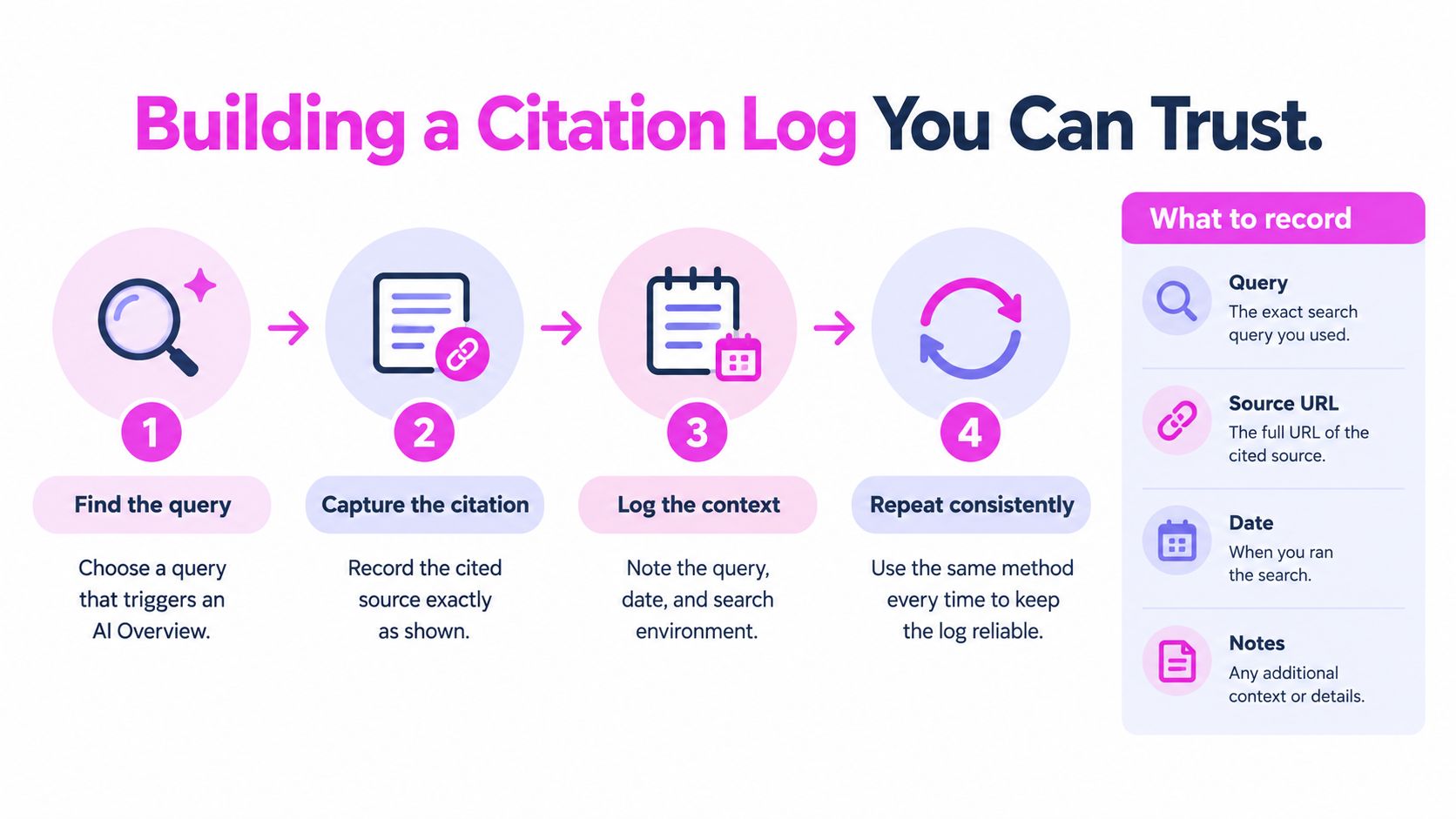
My citation log needs to preserve enough evidence that I can challenge my own interpretation later. A domain name and a visibility score aren't sufficient. I want to know what appeared, what was referenced, and whether I can reproduce the observation under comparable conditions.
I use this capture sequence as the backbone of the process.
Keep observations separate from interpretations
I create an observation record for each scheduled query check, then attach citation records when an Overview appears. That avoids squeezing several sources into an unreadable cell or overwriting yesterday's evidence with today's result.
| Campo | What I record | Why I retain it |
|---|---|---|
| Query and environment | Exact wording, country, language, device, date, and search settings | To compare like with like |
| Overview status | Present, absent, or inconclusive | To distinguish absence from a failed check |
| Citation evidence | Every cited URL, associated answer text, and source passage where identifiable | To verify the relationship |
| Organic visibility | Position of the same cited URL | To compare citation and ranking outcomes |
| Presentation | Saved panel capture and citation layout | To preserve the observed experience |
| Change notes | Page edits and implementation dates | To connect later observations to a test |
I don't label a passage as an exact extraction unless I've verified that relationship. If Google paraphrases a claim or combines sources, I record that uncertainty instead of manufacturing a neat quotation.
Check eligibility before rewriting
Before proposing content changes, I check the technical gates. Google's guidance for AI features says pages must be indexed and eligible to appear with a normal search snippetcon no additional AI-specific technical requirements or special schema requirements.
That changes my troubleshooting order:
- Confirm eligibility: Check indexing and snippet restrictions before treating the issue as an editorial failure.
- Inspect accessible content: Verify that the relevant answer exists in crawlable HTML.
- Validate the claim: Follow supporting evidence back to its origin.
- Record uncertainty: Distinguish missing evidence from a passage I couldn't match.
When using an assistant to organize claims, I'd apply the principles of using AI fact-checking tools responsibly from Zemith. I still verify the original evidence myself; an automated confidence judgment isn't a source.
For my operational KPI, I calculate citation rate across the fixed monitoring set. I also retain the subset of observations where an Overview appeared, so I can distinguish changes in feature availability from changes in source selection.
I preserve exact URLs throughout. Otherwise, I could mistake a citation moving from a product page to a support article for unchanged performance.
Structuring Pages for Citable Passages
I wouldn't rewrite an entire ranking page because it lacks a citation. I'd compare the page with the specific questions represented in the Overview and identify the smallest defensible change. My priority is a clearer, better-supported answer, not a page that merely looks easier to extract.
The ranking overlap evidence supports that restraint. Analyses report that approximately 37.9% to 60% of cited URLs also rank in Google's top 10, with differences in datasets and parsing affecting the results, as summarized in Qwairy's analysis of AI Overview ranking factors. I use that range directionally, not as a citation probability for my own pages.
Make the answer independently understandable
I start with pages that already have relevant organic visibility because I can map a known query to an existing URL. Then I compare the page's answer with the question being addressed.
For a hypothetical data-migration guide, I wouldn't settle for a paragraph saying that preparation makes migration easier. I'd explain what to export, which dependencies to verify, and when the procedure doesn't apply. If the instructions depend on a product version or account setting, I'd state that condition beside the answer.
My editing checks are specific:
- Name the subject: Replace ambiguous references such as “this setting” with the actual setting or feature.
- Keep conditions nearby: Put exceptions, prerequisites, and limitations beside the claim they qualify.
- Support factual statements: Cite primary documentation or authoritative evidence where available.
- Connect related material: Add internal links to relevant implementation detail rather than repeating it.
I keep the explanation useful after the concise answer. A passage can stand alone without forcing the entire page into disconnected fragments.
Don't confuse formatting with evidence
I wouldn't add a stack of headings, unsupported statistics, or a detached FAQ block just to create more extractable text. Those changes don't resolve an inaccurate claim or an unanswered question.
I also separate markup maintenance from citation testing. I'd use a structured data for SEO reference to check appropriate implementation, but I wouldn't describe schema as an AI Overview admission ticket.
I want the passage to deserve quotation before I make it easier to quote.
For external trust work, I prioritize verifiable documentation, accurate product descriptions, and relevant editorial references. I don't treat manufactured mentions as a substitute for evidence.
Finally, I retain an unchanged control set of comparable pages. I log what I edited and avoid bundling unrelated changes into the same test. If both edited and untouched pages move together, I won't confidently attribute the change to my rewrite.
Deciding Which Citations Are Worth Chasing
I don't classify every missing citation as a content gap worth closing. For some queries, I'd accept exposure without a visit. For others, I'd protect the page's ability to help someone evaluate, buy, or request a consultation.
Across 53 brands and 2.43 billion impressions from January 2025 through February 2026, average organic CTR was about 0.61% when an AI Overview appeared versus 1.62% when it didn't; cited pages averaged approximately 2.1%, compared with approximately 3.3% for the comparison searches without an Overview, while uncited pages averaged about 0.9%, según la AI Overview click-through analysis published by Relevant Audience.
Organic CTR With and Without AI Overviews
| Result type | Average organic CTR |
|---|---|
| Overall results with an AI Overview | About 0.61% |
| Overall results without an AI Overview | About 1.62% |
| Cited pages in AI Overview results | About 2.1% |
| Uncited pages in AI Overview results | About 0.9% |
| Searches without an Overview in the cited-page comparison | Approximately 3.3% |
I keep the overall and cited-page comparisons separate. I wouldn't mix their baselines into an uplift calculation or assume these observational averages predict my site's outcome.
Apply a business-value rule
For informational queries, I pursue citations when the question reaches a relevant audience and the answer gives my brand a meaningful role. For commercial and transactional queries, I pursue citations only when the test preserves or improves qualified demand.
In practice, that means:
- Pursue: A relevant educational question where source visibility supports a credible route toward product consideration.
- Test cautiously: A comparison query where a concise answer can coexist with useful demonstrations, limitations, and decision support.
- Leave alone: A low-relevance definition with no plausible connection to demand, or a page where further citation-focused editing would weaken purchase information.
Leaving a query alone doesn't mean I can prevent Google from summarizing it. It means I won't allocate additional work to citation acquisition.
Measure the visit and the outcome
I compare cited and uncited URLs separately, then inspect qualified visits, conversions, assisted conversions where measurable, and revenue per impression where applicable. I also watch branded search demand, but I don't automatically credit a change to Overview exposure.
Decision rule: If I can't explain what a citation should contribute beyond appearing in a report, I don't prioritize it.
I can accept reduced traffic if the remaining visits become more valuable. I can't call increased citation frequency a commercial win while ignoring deteriorating business results.
Choosing a Tracking Setup and Where SemDash Fits
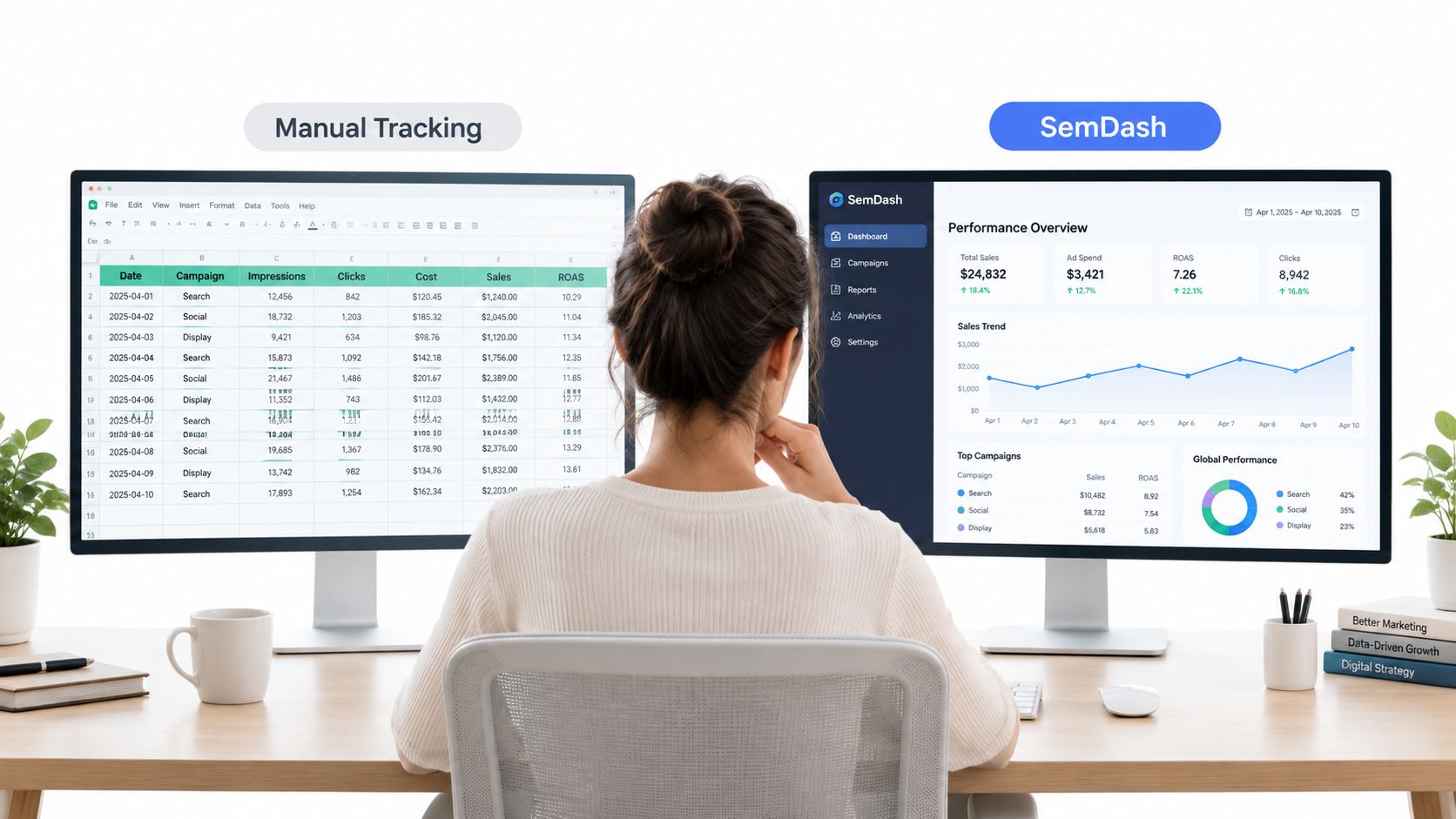
I choose tooling around the evidence I need to retain, not the attractiveness of the dashboard. For a small, single-market site, I'd start with a spreadsheet and saved result captures. I'd move to a dedicated platform when maintaining comparable observations becomes difficult.
This is the practical comparison I make before choosing either approach.
Compare evidence retention
| Criterio | Manual spreadsheet | Dedicated platform |
|---|---|---|
| Query coverage | I limit the set to what I can revisit reliably | I check supported market and query coverage |
| Page-level citations | I capture and verify each URL | I require exact URLs, not domain mentions alone |
| Historical evidence | I maintain captures and dated records | I inspect snapshot retention and export options |
| Ranking comparison | I join observations manually | I look for compatible SERP history and URL mapping |
| Business outcomes | I combine analytics separately | I still verify how conversion data can be connected |
I wouldn't abandon a working spreadsheet just because a platform offers a composite score. I'd first ask whether I can inspect the underlying query, observation date, cited page, and environment.
SemDash is one option: its la visibilidad en los Resúmenes de IA feature lists keywords that trigger domain mentions and the exact URLs cited. I can combine that research with SERP Checker history, keyword clustering, and competitor top-page analysis to investigate which pages and topic groups deserve attention. I would still preserve my test notes and connect business-performance data rather than expect citation tracking to establish causation.
For a visual reference alongside that evaluation, I can use the accompanying video.
Verify scope before buying
When comparing a broader AI-monitoring workflow, I'd also review The AI CMO's documentation on how to use AI Tracker. I wouldn't assume that monitoring conversational answers and monitoring Google AI Overviews produce interchangeable evidence.
My buying criterion is straightforward: Can I use the setup to repeat a defensible test? If I can't recover the cited URL or understand the score's denominator, I'd keep looking.
Your First Week of AI Overview Tracking
I'd spend the first week establishing a baseline, not rewriting the whole site. Choose a manageable query set for a single market, keep the discovery backlog separate, and define what would justify continued investment.
Establish the baseline
Start with Search Console queries tied to relevant landing pages. Assign intent, language, and device, then run the platform's AI Overviews visibility check for your domain.
Use the results to begin the citation log:
- Capture the evidence: Save the Overview, cited URLs, associated passages, and observation context.
- Map the pages: Record the organic position of each relevant URL, including whether the ranking and cited pages differ.
- Assign a decision: Mark each opportunity as pursue, test cautiously, or leave alone.
- Choose the outcome: Specify whether you're testing source visibility, qualified visits, or commercial performance.
Don't treat a missing citation as permission to edit immediately. Complete the eligibility checks and inspect the evidence gap first.
Make a bounded content test
Pick two or three pages from the top-10 overlap as your initial test scope, not as a universal sample-size recommendation. Rewrite the passages that fail to answer the observed subquestions, add support where needed, and leave comparable pages unchanged.
Record implementation dates and repeat the same citation measurement on a fixed schedule. After two weeks, compare citation presence, exact cited URLs, organic position, and available conversion signals against the baseline and control pages. Treat that checkpoint as an early diagnostic, not proof of a lasting effect.
Start with the query you can evaluate most clearly. A modest test with preserved evidence is more useful than a broad visibility claim you can't explain.
SemDash offers AI Overview citation tracking alongside keyword research, page-level URL mapping, and SERP history. Visit SemDash to identify the queries mentioning your domain, inspect the cited pages, and build a focused test around citations that could support qualified demand.