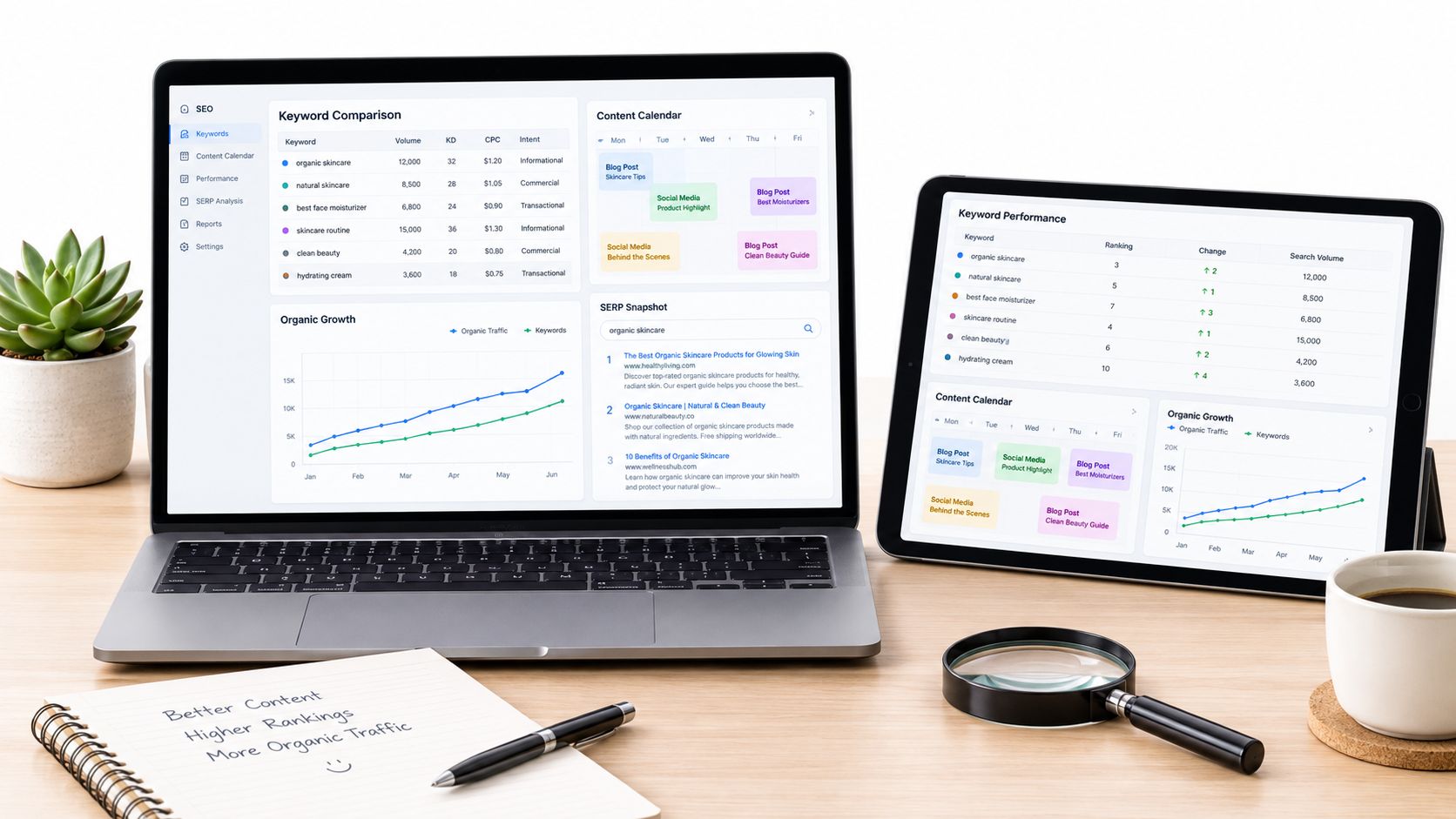


Most ecommerce keyword lists fail before the first page is optimized. They begin with a tool export, sort by search volume, and hand writers a spreadsheet that has no relationship to the catalog, the SERP, or the margin behind each product. I've seen teams collect thousands of terms and still miss the queries that describe the exact size, material, compatibility, budget, or use case that makes a shopper ready to buy.
Ecommerce keyword research is a revenue-mapping exercise, not a volume exercise. I start with the page a query deserves, then use volume, difficulty, CPC, and existing performance to decide whether that page is worth improving. A keyword belongs to a product page, category page, comparison, or guide because of the results Google already shows, not because a tool labels it “easy.”
Search remains a major product-discovery channel. A 2024 survey of 10,147 U.S. consumers found that 52% use search engines to research products before buying, while industry summaries report that 75% of shoppers begin with a Google search and 43% of ecommerce traffic comes from organic Google searches. Those figures are reported in online shopping statistics from Fit Small Business. The practical lesson is simple: your research must cover early discovery queries as well as terms close to checkout.
A useful keyword list for ecommerce sales can help organize the raw material, but the list isn't the strategy. The strategy is the relationship between a query, the SERP pattern, your inventory, and the URL that can satisfy the shopper better than the alternatives.
Tabla de contenido
- Introduction Why Most Ecommerce Keyword Lists Never Convert
- How Search Intent Maps to Product Category and Content Pages
- Finding Long Tail and Marketplace Keywords That Actually Sell
- My Hands On Workflow for Research Clustering and Cannibalization Control
- Using Competitor Top Pages and Keyword Gaps to Prioritize Targets
- Preparing Your Keyword Strategy for AI Overviews and International Search
- Conclusion Your Next 30 Days of Ecommerce Keyword Research
Introduction Why Most Ecommerce Keyword Lists Never Convert
The most popular advice says to find high-volume keywords, assess difficulty, and create content around the winners. That workflow produces tidy spreadsheets. It also creates three recurring problems: category pages target informational queries, product pages chase broad category terms, and several URLs compete for the same cluster without a clear canonical target.
I used to treat keyword exports as the starting point. The better starting point is the catalog. List the products, collections, attributes, customer problems, and commercial distinctions your store can satisfy. Then inspect the SERP for each query family. If the results are dominated by product grids, a long guide won't solve the intent mismatch. If comparison pages and buyer guides dominate, adding another product description won't make the page competitive.
Regla práctica: Search volume tells me how much visible demand a phrase may represent. The SERP tells me what kind of page can earn that demand.
This distinction matters because a generic term such as “office chair” can represent research, browsing, or purchase intent. A phrase such as “ergonomic office chair with headrest for tall users” carries more information about the shopper and the product required. The second query may attract less traffic, but it gives merchandising and content teams clearer decisions.
My research output isn't a keyword list. It's a page plan with one primary cluster per URL, supporting variants, a defined intent class, a SERP pattern, and a reason the page can create commercial value. That plan can include existing pages that need rewriting, pages that should be consolidated, and genuine catalog gaps where a new category or comparison asset is justified.
How Search Intent Maps to Product Category and Content Pages
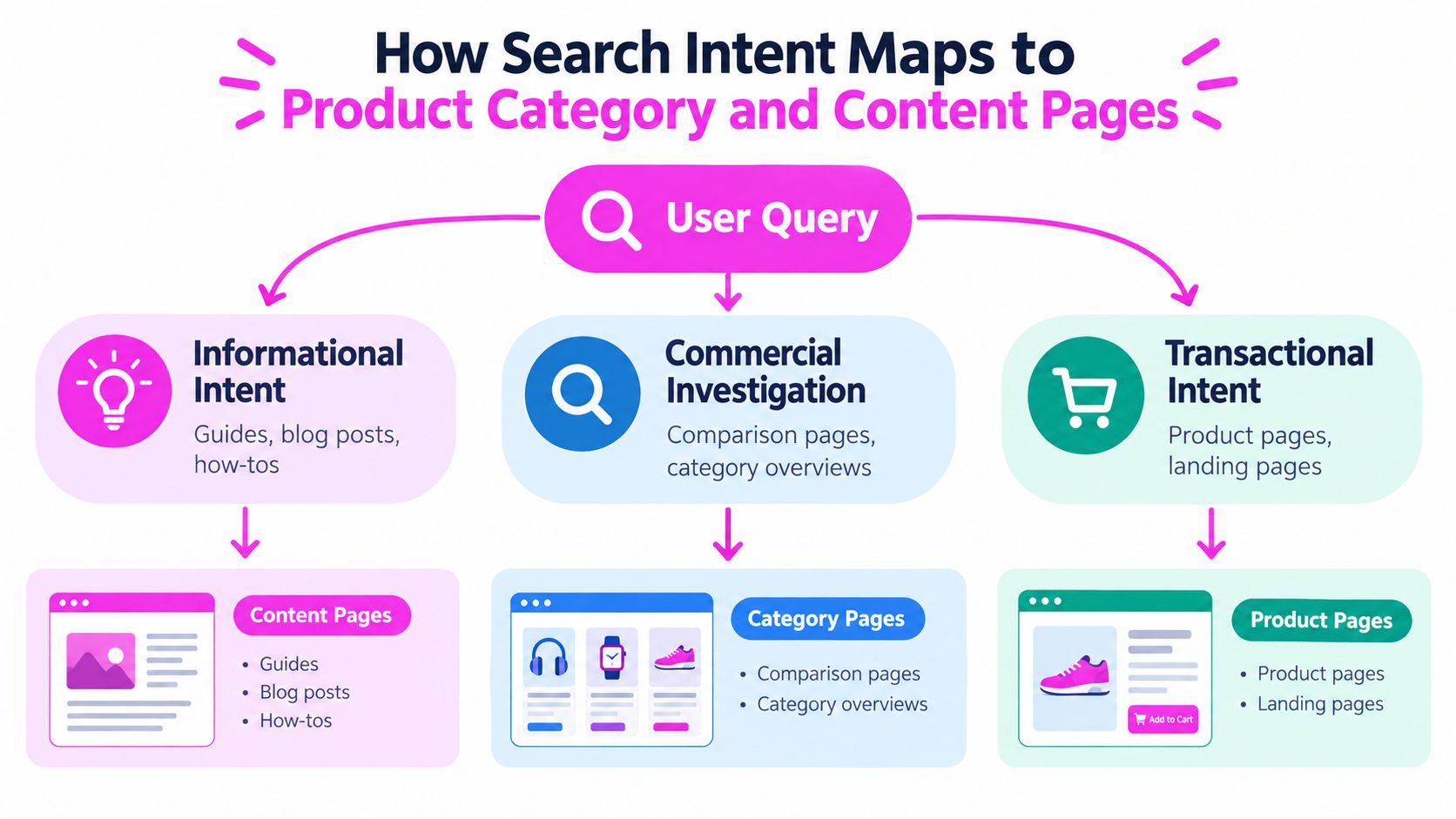
Intent mapping starts by asking what the shopper expects to see after submitting the query. I classify ecommerce terms into transactional, commercial investigation, and informational groups, then verify the classification against the live results. The words in the query provide clues, but the ranking templates provide stronger evidence.
Transactional queries belong on conversion pages
Queries containing a product name, model, SKU, “buy,” “price,” or a tightly defined specification usually need a product detail page or a focused landing page. The shopper expects availability, variants, delivery information, proof, and a direct route to purchase. A blog post can mention the product, but it shouldn't be the primary URL for a query where the user is already selecting an item.
Branded queries need a closer look. “Braun Series 3 3040s” points toward a product page if that exact model exists. “Braun Series 3 replacement heads” may belong to a replacement-parts category or product page, depending on how the catalog is structured. The page type follows the purchase object, not the presence of a brand name.
Commercial investigation needs choice architecture
Terms such as “best waterproof hiking boots,” “running shoes for trail use,” or “standing desk under a budget” signal comparison. The shopper hasn't necessarily chosen a product, so a category overview, collection page, or comparison page should make differences easy to understand.
A category page works when the shopper needs a browsable set of products with useful filters. A comparison page works when the query names alternatives, trade-offs, or a decision criteria. I don't force every commercial phrase onto a category template. If the SERP consistently shows editorial comparisons, a faceted product grid may lack the explanatory structure users expect.
Informational queries earn attention before the product decision
“How does noise cancellation work?” or “what material is best for summer bedding?” belongs on a guide, glossary, or how-to page. These pages should answer the question directly, then connect the answer to relevant products without pretending the visitor is already ready to buy.
The practical classification method is to inspect the top results and record their page types, content depth, product presence, and SERP features. Shopify's keyword research guide describes the same core principle, classify terms into informational, commercial, and transactional buckets, then map them to content pages, category pages, or product detail pages.
A mismatch creates friction on both sides. Search engines see a page competing in the wrong result class, while shoppers must work to find the information or products they expected. For implementation details after the mapping decision, I use resources such as these actionable product page optimization steps, particularly when a transactional cluster already has the right URL but weak relevance or incomplete buying information.
Finding Long Tail and Marketplace Keywords That Actually Sell
Broad keywords describe departments. Long-tail queries describe decisions. That difference is where much of the useful ecommerce language appears.
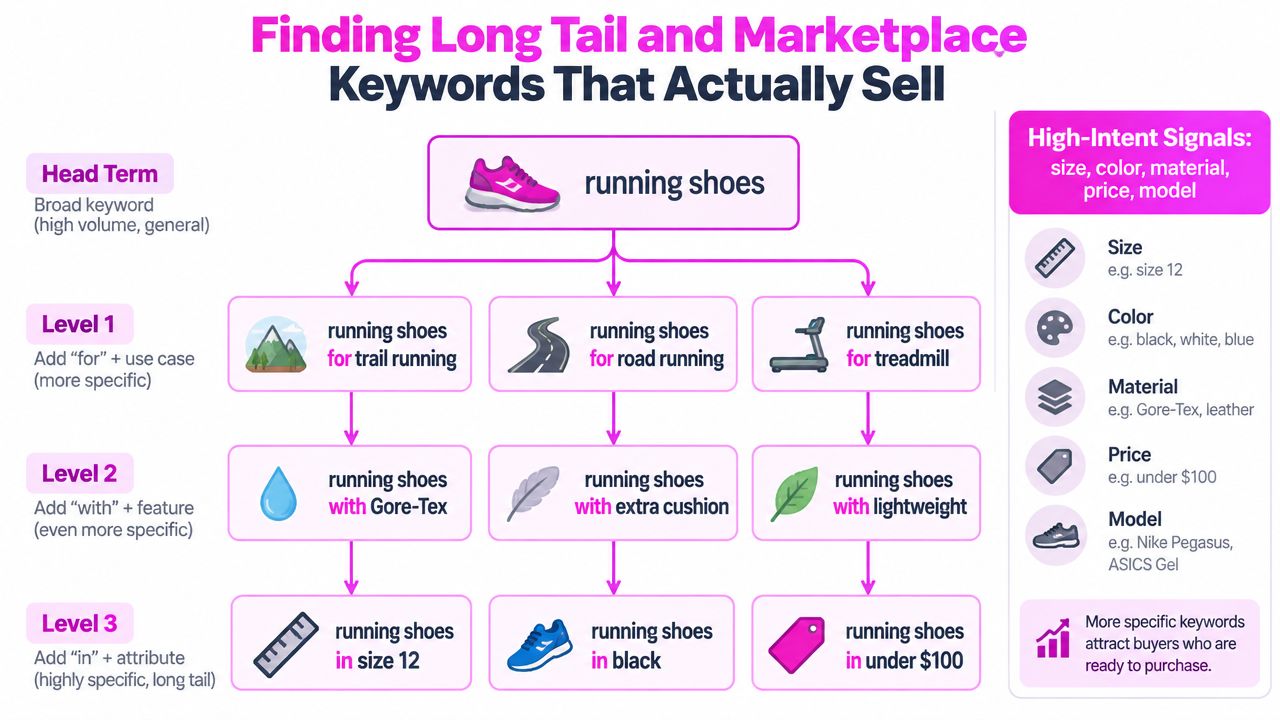
A long-tail phrase usually contains three or more words and often adds a meaningful constraint, such as size, color, material, compatibility, price, model, or use case. One industry source reports that these phrases generally have lower individual volume but 2.5x to 5x higher conversion rates than broad traffic, because the extra words express a tighter product need. See the supporting analysis of product-specific long-tail queries.
Consider the difference between these clusters:
- “Running shoes” describes a department.
- “Running shoes for trail running” adds a use case.
- “Trail running shoes with Gore-Tex” adds a material or feature.
- “Gore-Tex trail running shoes in size 12” describes a purchase constraint.
The final phrase may not deserve a standalone URL. It may belong to a filterable category page, provided that the combination exists in stock and the filtered state can be crawled and indexed intentionally. If the catalog can't support the attribute, don't create a thin page just because a tool surfaced the phrase.
Mine language where shoppers actually speak
Google tools are useful, but they aren't the only source. I review internal search logs, marketplace autocomplete, customer support tickets, product reviews, chat transcripts, and zero-result searches. A shopper may search your store for “gift for someone with sensitive skin” or “charger that works with a Braun Series 3,” while a conventional database organizes the same demand around product taxonomy terms.
Site search exposes vocabulary gaps. If customers repeatedly use “trainers” while your filters say “sneakers,” add a synonym or adjust the visible merchandising language. If shoppers search by a use case your category structure ignores, that pattern may justify a guide, collection, filter, or better cross-linking.
Long-tail research also benefits from existing performance. I sort Google Search Console queries by clicks, then inspect terms where a relevant page already appears around the middle of the results. Queries in positions 5 to 20 are useful refinement candidates because the page has some relevance but may need a better title, clearer attribute coverage, stronger internal links, or a more precise page target.
For a broader view of modern keyword research methods, I compare tool suggestions with customer language rather than accepting every generated variation. The distinction keeps the strategy grounded in products you sell and problems you can solve. A concise explanation of the same query pattern is available in what a long-tail keyword is.
A short visual guide can help teams understand how modifiers build intent, while the actual decisions still require inventory and SERP validation.
My Hands On Workflow for Research Clustering and Cannibalization Control
I don't begin by asking which keywords to publish. I ask which URLs already receive evidence of demand, which pages are competing, and where a new page would add something the catalog currently lacks.
Start with first-party queries
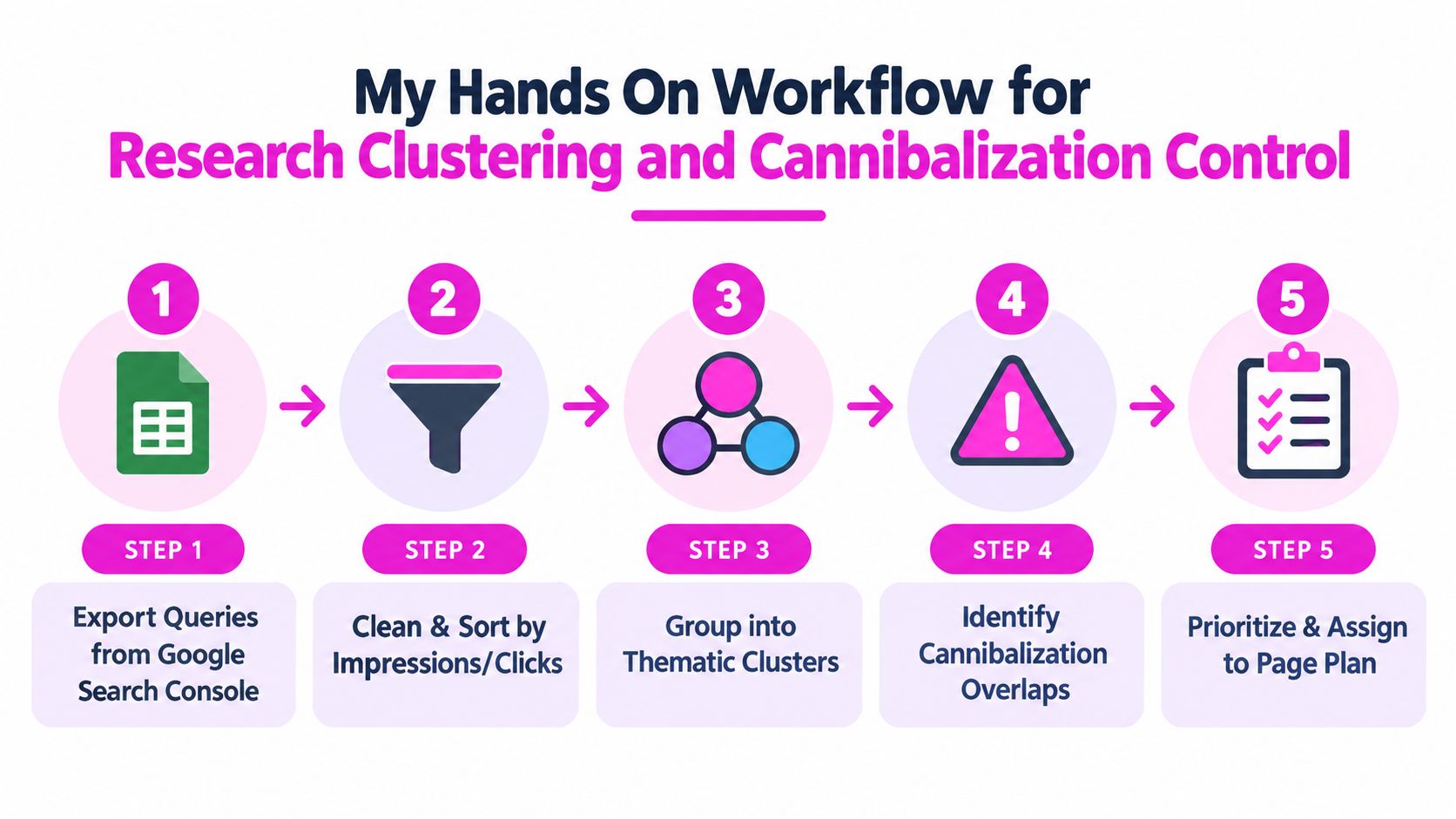
Export Google Search Console query data for the relevant property and sort by clicks. I keep the query, clicks, impressions, average position, landing page, and date range together. Real queries associated with the site reveal language that a seed list misses, particularly for variants, materials, use cases, and specific product combinations. This starting point follows the workflow described in an ecommerce long-tail research process using Search Console.
I then clean obvious noise, separate branded and non-branded terms, and identify queries that point to the wrong URL. A product query landing on a blog post is a mapping issue. A category query split between several product pages may indicate weak architecture or insufficient category relevance.
Cross-check metrics, then inspect the SERP
After cleaning, I use a keyword platform to add search volume and Keyword Difficulty, but I don't treat either metric as a verdict. Google Keyword Planner estimates are based on exact keyword matches, so I switch to Exact match when I need a tighter comparison, following the guidance on improving Google Keyword Planner accuracy.
SemDash can be used here as one option for combining keyword discovery, URL-level ranking data, clustering, and SERP analysis. Its dataset includes search volume, traffic estimates, Keyword Difficulty, related suggestions, and historical SERP information. I use those fields to prioritize investigation, not to replace judgment.
For each meaningful cluster, I search the live result and record:
- Dominant template: product, category, comparison, guide, marketplace, or mixed.
- Commercial signals: prices, product grids, review pages, availability, and shopping elements.
- Content requirements: specifications, use cases, comparisons, FAQs, or compatibility information.
- Current ownership: which URL on my site ranks, if any.
Cluster by page purpose
Clustering isn't just grouping synonyms. It means deciding which queries can be satisfied by the same page without weakening the experience. “Women's waterproof hiking boots” and “women's waterproof hiking boots for winter” may belong to one category if the inventory and copy cover both. “How to waterproof hiking boots” belongs elsewhere because the user needs instructions rather than a collection.
I assign one canonical URL to each cluster. Supporting variants go into the same page brief, while different intents become separate targets. Before creating anything new, I check whether another page already ranks for the same family. If two URLs alternate for closely related queries, I decide whether to consolidate, differentiate, redirect, or strengthen internal links.
The final sheet should answer four operational questions: which query family matters, which URL owns it, what change is required, and why the change could affect revenue. If those answers aren't clear, the research isn't ready for production.
Using Competitor Top Pages and Keyword Gaps to Prioritize Targets
Competitor research works best when I study pages, not just domains. A rival may rank broadly because of one powerful category page, a useful comparison hub, or a set of product pages with strong internal linking. Copying the competitor's keyword list without identifying the ranking URL produces the wrong kind of work.
I start with competitor domains and inspect top pages, traffic share, ranking URLs, and page templates. The question is not “What keywords does this retailer have?” It's “Which page types appear to capture demand that my catalog could also satisfy?” A gap attached to a product URL needs a different response from a gap attached to a category or comparison page.
A page-level decision matrix
| Keyword Cluster Example | Señal de Intención | Best Page Type | Priority Signal |
|---|---|---|---|
| “Braun Series 3 3040s replacement” | Specific model and purchase need | Product or replacement-parts page | Product availability and margin |
| “Women's waterproof hiking boots” | Browsing a defined product group | Filterable category page | Catalog depth and seasonal relevance |
| “Best trail shoes for wet weather” | Evaluation and comparison | Buyer guide or comparison page | Ability to compare products credibly |
| “How to clean suede hiking boots” | Instructional question | How-to guide | Opportunity to support product discovery |
I score each candidate on revenue potential, current page strength, technical cost, and seasonality, rather than relying on volume and difficulty alone. This scoring approach is supported by the ecommerce prioritization discussion in OuterBox's ecommerce SEO keyword research guide.
Page strength includes existing rankings, relevant backlinks, internal links, content quality, and whether the URL already satisfies the catalog need. Technical cost includes indexation, faceting, template changes, stock handling, and development dependencies. A low-volume phrase tied to a high-margin product and an existing relevant URL may outrank a broad term in the backlog.
Separate a true gap from a page problem
A competitor gap isn't automatically a new-content opportunity. Sometimes your store already has the right category, but its title, copy, filters, internal links, or product coverage are weaker. Sometimes the competitor ranks with a guide because the category page would not satisfy the comparison intent.
I also check whether the competitor's page is commercially relevant to my business. A rival may rank for an accessory or use case I don't stock. That's useful market intelligence, but it isn't a target until merchandising confirms that the store can fulfill it.
The final priority list should be small enough for teams to act on. Each row needs a target URL, page type, primary cluster, supporting terms, SERP evidence, commercial rationale, and implementation owner. That turns competitor research into a controlled backlog instead of an endless list of tempting phrases.
Preparing Your Keyword Strategy for AI Overviews and International Search
Blue-link rankings no longer describe the entire shopping journey. Some queries are answered directly in the SERP, while others still require a click to compare products, verify specifications, check availability, or complete a purchase.
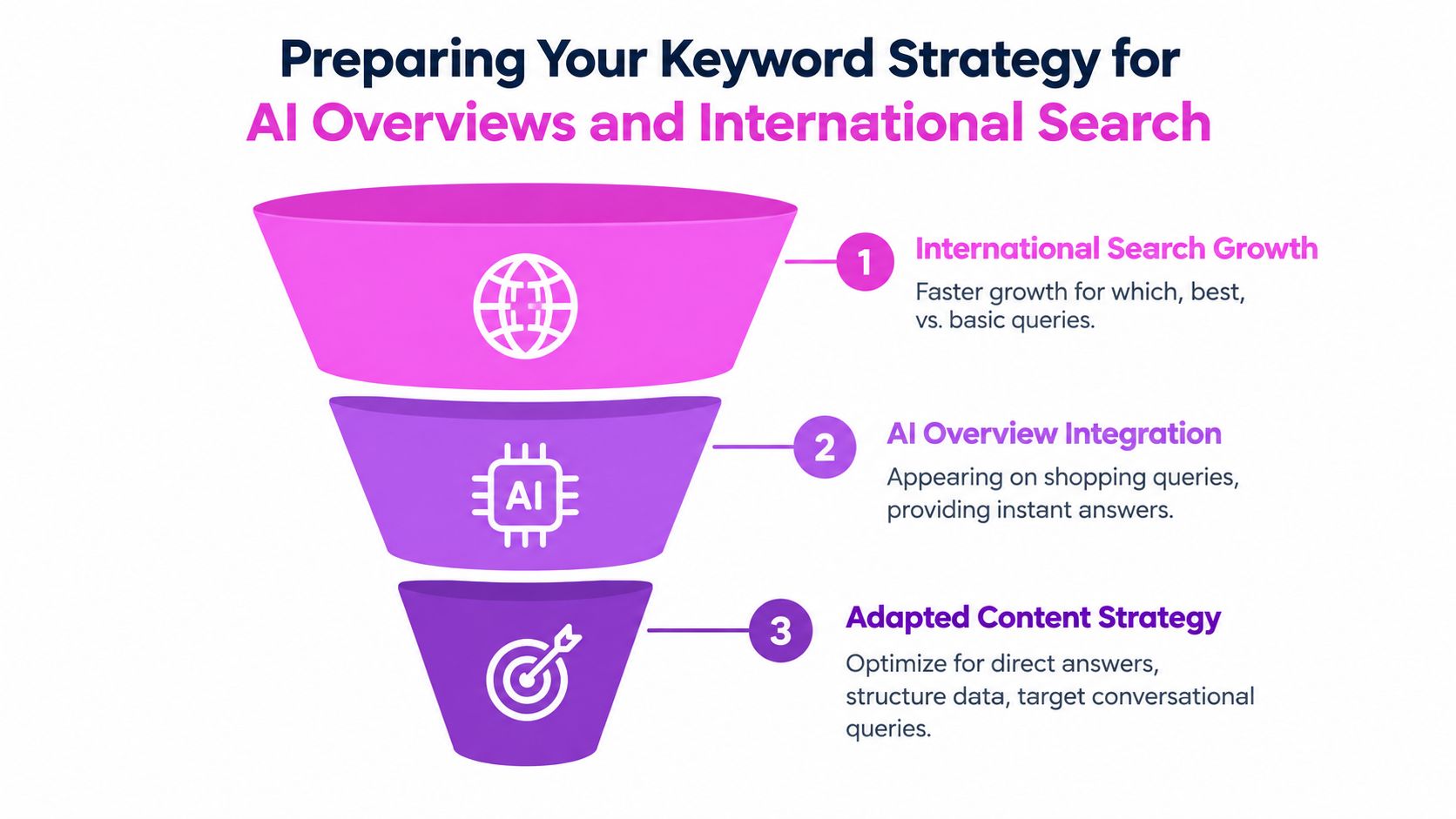
Recent coverage reports that AI Overviews appear on 14% of shopping queries, meaning retailers need to track visibility beyond traditional ranking positions. The same coverage explains that shoppers can encounter answers before reaching a retailer's site, as discussed in ecommerce keyword research and AI-mediated discovery.
Separate answer potential from click potential
I divide query families into two practical groups. The first includes questions that an AI summary can answer quickly, such as basic definitions, feature explanations, and broad “which” comparisons. The second includes queries where the shopper needs a retailer page for product selection, price, stock, delivery, compatibility, or detailed comparison.
That doesn't mean ignoring answer-oriented terms. A guide that gives a clear, structured answer can earn visibility and introduce the brand earlier. But I don't judge it only by sessions. I track whether the page is cited, whether the query still generates clicks, and whether the guide moves users toward a relevant category or product page.
For a practical implementation reference, see how to optimize for AI Overviews. I focus on concise answers, explicit product attributes, comparison tables where appropriate, descriptive headings, and consistent internal links. The content must remain useful if the summary never sends a visitor.
Localize the cluster, not just the copy
International expansion creates another false shortcut. Translating an English keyword list rarely captures local product vocabulary, marketplace behavior, or the way shoppers express dimensions and use cases. I rebuild the query set by market, validate the local SERP, and map each cluster to the appropriate regional URL.
The same discipline can scale across SemDash interfaces in English, German, Polish, and Spanish, but the research decisions still require native-language review. A translated product term may be grammatically correct yet commercially unnatural, or it may describe a different product category in the target market.
For each market, I record local modifiers, brand conventions, unit preferences, marketplace results, and seasonal language. Then I compare whether the same page type wins. A category page in one market may need a buyer guide in another because the SERP and shopping behavior differ.
Conclusion Your Next 30 Days of Ecommerce Keyword Research
My early mistake was building semantic cores in isolation from the catalog. The lists looked thorough, but they didn't tell merchandising which collection to expand, content which comparison to write, or developers which faceted pages deserved controlled indexation. I now treat keyword research as an ongoing map between customer language and commercial URLs.
Use the next 30 days to make that map operational:
- Audit existing URLs: Export Search Console queries, sort by clicks, and find pages ranking for the wrong intent or the wrong product family.
- Map the SERP: Classify priority clusters as transactional, commercial, or informational, then record the dominant result template.
- Mine specificity: Add internal search, marketplace autocomplete, reviews, support language, and attribute modifiers to the research set.
- Cluster by URL: Give every cluster one canonical owner and identify cannibalization before publishing another page.
- Prioritize commercially: Score revenue potential, page strength, technical cost, and seasonality alongside volume and difficulty.
- Prepare for AI discovery: Separate answer-led queries from click-dependent shopping queries, then monitor citations and SERP changes.
- Review by market: Revalidate language, modifiers, and page types for every international version instead of copying the original list.
Measure progress through transactional cluster coverage, cleaner URL ownership, fewer cannibalization conflicts, stronger category and product visibility, and presence in relevant AI-generated results. The work doesn't end when the spreadsheet is complete. Search Console, internal search logs, stock changes, merchandising decisions, and SERP shifts should keep updating the map.
SemDash brings keyword discovery, competitor gap analysis, URL-level mapping, clustering, SERP history, and AI Overviews citation tracking into one research workflow. Use SemDash to turn your ecommerce keyword research into a prioritized page plan, then visit the platform to start auditing the URLs that should drive your next sales opportunities.