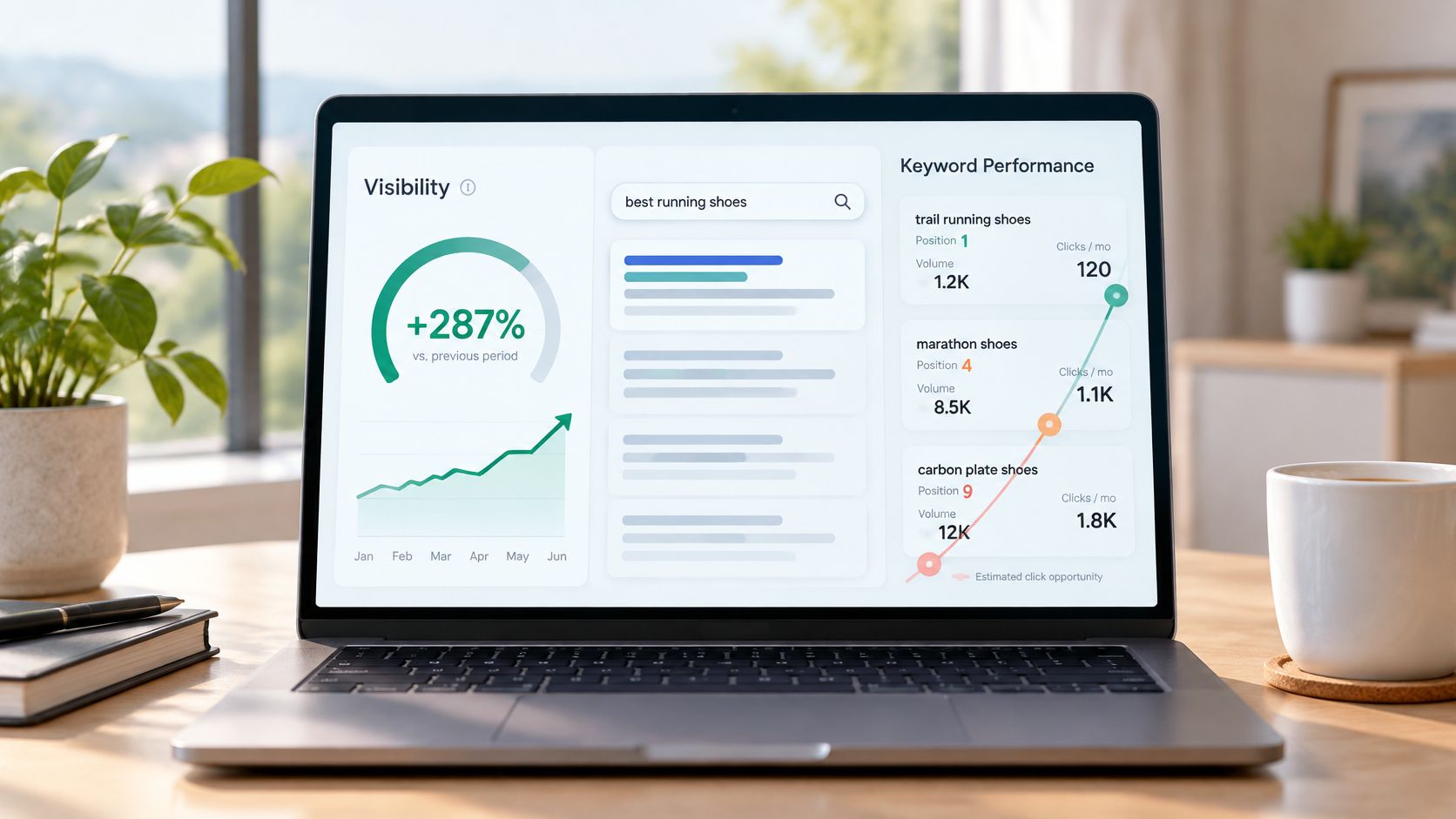


The most popular advice on how to fix keyword cannibalization is also the advice I trust least. Find two URLs ranking for one query, merge them, add a redirect, move on. I don't do that anymore, because that shortcut treats a symptom in Search Console as a diagnosis. Two URLs can share impressions for a week after an update, split work across a guide and a product page, or cover different stages of the same buying decision without harming each other.
I start from the opposite assumption. Overlap is innocent until the data shows sustained competition for the same intent, with no clear winner and weaker combined performance than one strong page would likely earn. That triage saves pages that are pulling real long-tail clicks and focuses your effort on the small set of clusters where consolidation will help.
Tabla de contenido
- Is It Real Cannibalization or Normal Overlap?
- How to Build a Query-to-URL Map
- Pick the One URL That Should Win Each Intent
- Choosing the Fix
- Clean Up Links, Canonicals and Redirect Chains
- Measure the Result and Decide Your Next Fix
Is It Real Cannibalization or Normal Overlap?
Two URLs appearing for one query is a reason to investigate, not an automatic case for consolidation. Different pages can serve different versions of the same search, and combining them may remove useful coverage.
Treat overlap as cannibalization when URLs repeatedly compete for the same intent, neither becomes the clear winner, and the switching coincides with weaker performance. In that situation, clicks and conversions may be split between pages, and visitors may land on the less effective one.
How I read the signals
Assess several signals together. A brief change in which URL ranks after an update is weaker evidence than persistent switching alongside poor clicks and conversions.
Signals to weigh
| Señal | Evidence of a problem | Evidence of normal overlap | Acción |
|---|---|---|---|
| Query alternation | Two URLs keep swapping for the same query | One URL takes over briefly after an update | Recheck the pattern over time before acting |
| Intent match | Both URLs answer the same need | Pages serve different intents, such as a guide and a product page | Consolidate if intent matches; differentiate if it does not |
| Combined clicks | Combined clicks fall below what the stronger URL earned alone | Combined clicks match or exceed the stronger URL's performance | Leave the pages alone if performance is healthy |
| Conversions | Visitors land on the page that converts less effectively | Traffic serves different stages of the funnel | Keep the page that best serves the converting intent |
| Vínculos de retroceso | Links are split between URLs covering the same topic | Each URL earns links for a distinct angle | Redirect only if the merged page preserves relevant value |
| Citas de la Descripción General de IA | Neither URL is cited for the query | One URL supplies a passage the other lacks | Preserve the page with distinct, useful content |
For example, two URLs may swap for a query over time without either gaining a lead in clicks. If they also serve the same intent and split links on the same topic, there is a case for a fix. By contrast, a buying guide and a product page can both appear for a headline query while serving different needs. If their combined clicks are healthy and the product page converts, the overlap may be working as intended.
Decision rule: If fewer than two signals point to a problem, record the overlap, check internal links, and move on.
Consolidating too quickly can erase long-tail coverage from the weaker page, discard useful backlink anchor diversity, or force informational and transactional searchers onto one page that serves neither well. When one URL has historically led and another appears briefly, give the pattern time to settle. Persistent switching with weaker combined results is a stronger reason to consider a fix.
How to Build a Query-to-URL Map
Two URLs appearing for one query do not, by themselves, prove cannibalization. A hand review of 80 multiple-ranking keywords found that only one required a fix, a useful reminder to map the evidence before changing pages.
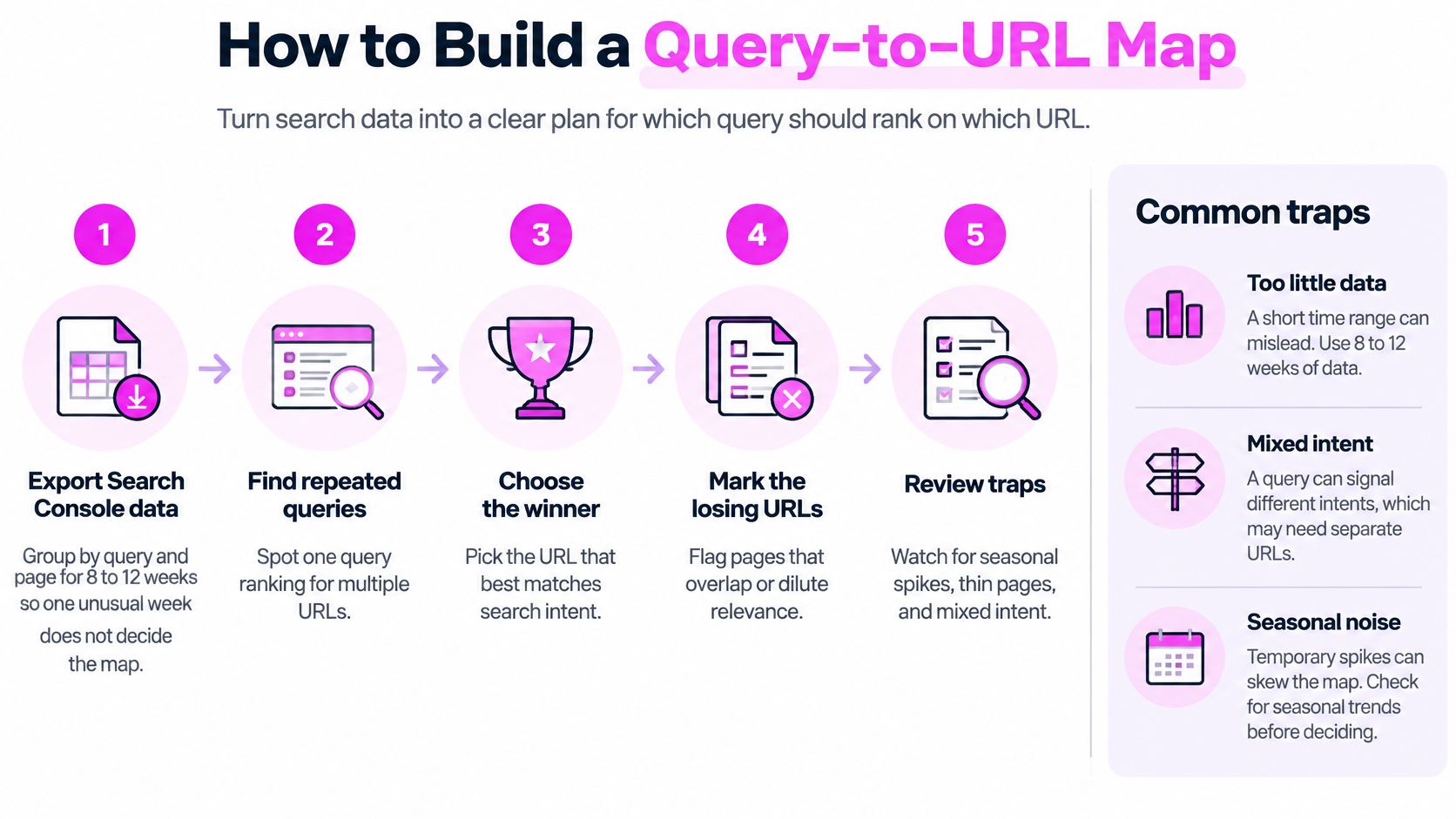
Start with a spreadsheet, not a screenshot. Put the queries, ranking URLs, performance signals, and proposed action side by side. Google's Search Console performance reporting guidance covers analysis by query, page, country, device, and date. Use a consistent 8 to 12-week period to make comparisons meaningful.
The routine
- Export query and page together. Pull Search Console data grouped by query and page for 8 to 12 weeks. A short window can make a temporary fluctuation look like a persistent issue.
- Filter for overlap. Keep queries where at least two of your URLs receive impressions. Sort by impressions so you review meaningful opportunities before low-impact queries.
- Group related queries. Put pages serving the same query or closely related intent in one cluster row. Agrupamiento de palabras clave can help group near-duplicate phrasings around page-level topics.
- Add decision columns. Include impressions, clicks, average position, CTR, page purpose, backlinks, internal links, and conversion value. Rank alone cannot show whether a URL is displacing another or serving a different need.
- Check for missing data. Search Console data is privacy-filtered and limited to top rows, so supplement it with rank tracking or server logs when low-volume queries may be missing.
- Record URL changes over time. Flag clusters where different URLs take turns ranking, and save the view as a baseline for later comparison.
A common spreadsheet mistake is exporting only top queries. That can hide overlap in the long tail and make a site look cleaner than it is.
Query-level analysis also reveals substitution that site totals conceal. Overall clicks can remain flat while one URL loses traffic to another, even if the replacement page converts less effectively. For SaaS teams building a research process, SubmitMySaas on SaaS keyword research offers related context on matching queries to product pages.
What a finished map looks like
A useful map is not a list of every shared keyword. It has one row per cluster, a candidate winner when the evidence supports one, a possible method, and a status that makes unresolved decisions visible.
Finished query-to-URL cluster map
| Cluster | Queries | Candidate winner | Method | Status |
|---|---|---|---|---|
| Cluster 1 | running shoes for flat feet, flat feet shoe guide | /guide-flat-feet | Redirección 301 from /blog/flat-feet-tips | Resolved |
| Cluster 2 | trail shoes for flat feet, flat feet trail running | /trail-shoes-flat-feet | rel=canonical | Unresolved |
| Cluster 3 | best shoes for flat feet, buy flat feet shoes | /guide-flat-feet for guide intent, /shoes/flat-feet for buying intent | Differentiate titles and links | Unresolved |
The unresolved rows are deliberate. Cluster 2 needs a decision about whether both URLs should remain live before a canonical target makes sense. Cluster 3 needs confirmation that the queries represent different intents before the pages are differentiated.
Pick the One URL That Should Win Each Intent
The mistake I correct most often is picking the URL with the most traffic. Traffic tells you which page Google currently favors or which title attracts curiosity. It doesn't tell you which page satisfies the searcher, converts qualified visitors, or deserves to carry the cluster for the next year.
I start from intent, using the same discipline behind our approach to search intent classification. For each cluster, I ask which URL best satisfies the query as the searcher phrases it. That page should carry the signals, even if it's currently second.
Six checks I score
- Intent fit. Does the page answer the query in the format the searcher expects, such as a guide, comparison, product listing, or tool?
- Historical clicks. Which URL earned clicks consistently across the same 8 to 12-week window, not just during a one-week spike?
- Qualified conversions. I weight demo requests, add-to-cart actions, and qualified leads over raw visits, because a busy page that never converts is a weak winner.
- Content completeness. Is this the most thorough version, or would I need to move major sections before it can own the topic?
- Backlinks. Which URL already holds relevant referring domains I can preserve without clumsy redirects?
- Indexability. Does it return a 200 status and sit outside noindex directives or blocked paths?
For example, say Page A is a 3,000-word guide with 40 referring domains and steady clicks, and Page B is a thin 400-word post with a few links covering the same questions. Page A wins, and Page B becomes a merge candidate after I lift anything unique from it. Reverse the conversion picture, though, and I slow down. A quieter product page that closes sales can outrank a popular guide as my winner for a transactional phrasing, while the guide keeps the informational version.
That choice matters because of how Google handles similarity. According to Google's canonicalization documentation, when pages are identical or highly similar, Google clusters them and selects one representative URL as the canonical page. That canonical page is crawled more regularly, while duplicates are crawled less frequently, and Google primarily evaluates content and quality through the canonical URL.
Your job isn't to repeat a keyword on fewer pages. It's to make Google's representative choice yourself, before the cluster logic picks a URL you wouldn't have chosen.
I write the outcome as a strict rule on the map. One winner per intent, and no more than one. If I can't name the winner in one sentence, the cluster isn't ready for a redirect or canonical, and I send it back for intent work.
Choosing the Fix
I choose the fix per cluster, not per site. Some clusters need a hard consolidation, some need clearer positioning, and some need me to leave them alone.
Here's the comparison I work from before I touch anything.
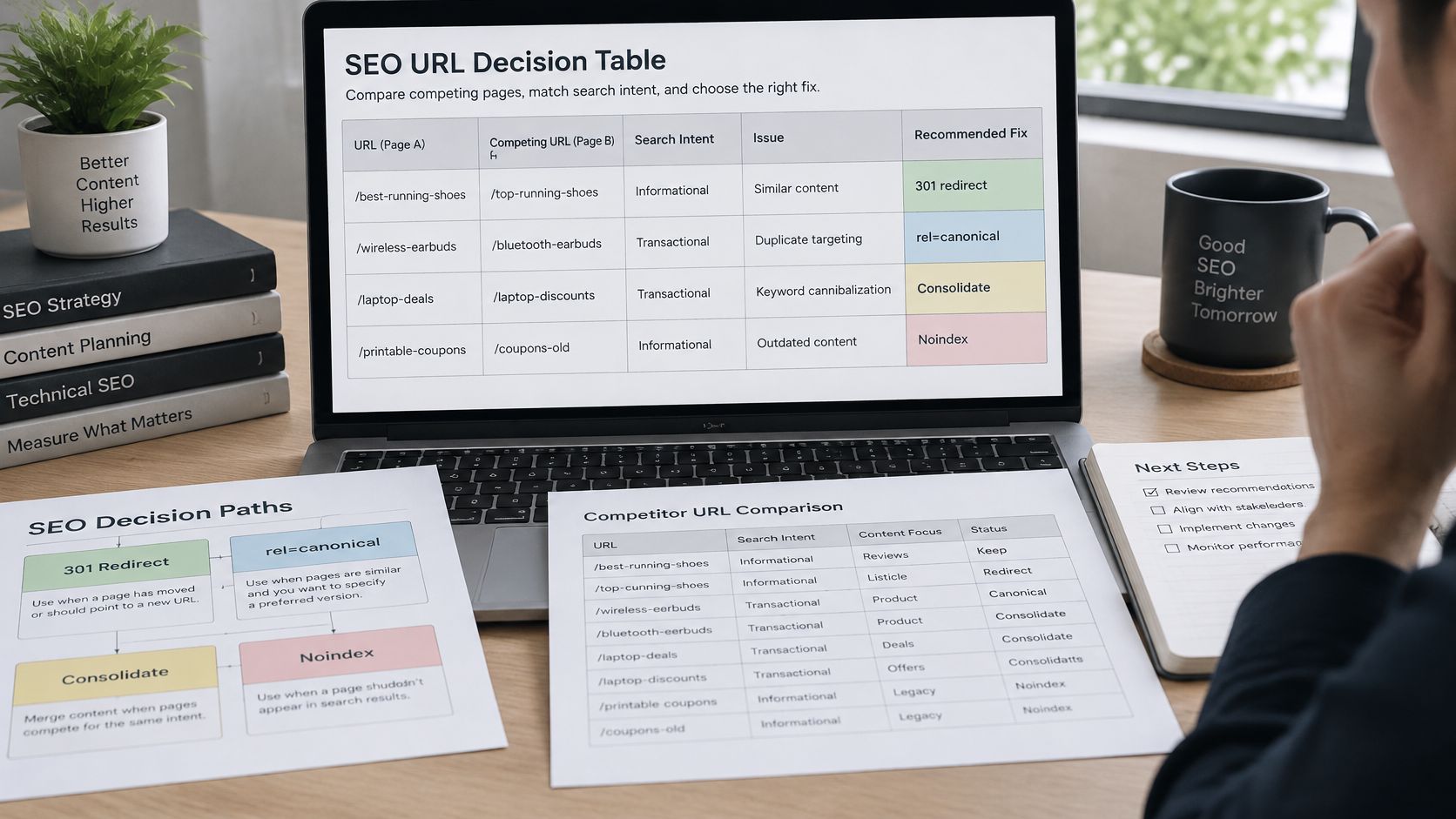
Fix methods and when each one fits
| Method | Use when | Signal strength | Watch for |
|---|---|---|---|
| Redirección 301 | Losing URL serves the same intent and the winner can absorb it | Strongest | Redirect chains and lost query-specific sections |
| rel=canonical | Both URLs must stay live, such as filtered or print versions | Strong, but a hint | Canonical pointing to a page that does not satisfy the query |
| Sitemap inclusion | Supporting signal only | Weakest | Relying on it alone |
| Differentiate titles, headings and links | Intents differ and both pages earn traffic | No canonical signal; intent does the work | Forcing a merge that removes useful coverage |
| No action | Combined clicks and conversions are healthy | Ninguno | Overlap that you can keep without a fix |
The cost of getting this wrong isn't a penalty. The Google Search Central SEO Starter Guide makes clear that duplicate content is not, by itself, a violation of spam policies, and its guidance traces back to Google's 2009 announcement introducing the canonical link element. The costs are operational. Search engines waste crawling resources on URLs you don't care about, users meet repetitive pages, and your relevance stays fragmented.
Two cases that surprise people
First, merging an informational guide into a product page often deletes coverage that was earning long-tail clicks. The product page can't naturally hold definitions, troubleshooting passages, and early-stage comparisons without hurting its buying flow. I keep both pages there, sharpen the guide's title and headings around learning intent, sharpen the product page around buying intent, and make the internal link from guide to product explicit.
Second, a cluster can look messy and still outperform its best single URL. If two pages divide clicks by device, region, or funnel stage and their combined conversions are healthy, consolidation gives you cleaner reporting at the price of worse results. I'll take messy and profitable over tidy and weaker every time.
The short walkthrough below is useful if you want to see the redirect and canonical decision framed visually before you commit to a method.
Whatever I choose, I pick one method per cluster and write it next to the cluster row. If the replacement page is equivalent, I redirect the non-preferred URL. If a redirect isn't possible, I use rel=canonical. I never rely on the sitemap to settle the question on its own.
Clean Up Links, Canonicals and Redirect Chains
Technical cleanup comes after the editorial decision, never before it. If I clean up signals around the wrong winner, I've just made the wrong choice more durable. Google's guidance on consolidating duplicate URLs describes redirects as the strongest canonicalization signal, while a sitemap entry is only a weak signal.
My cleanup checklist
- Point internal links at the winner. I replace links to the retired URL with direct links to the preferred URL, because every link left pointing through a redirect adds a hop and leaves the old address in your architecture.
- Rewrite the anchors. I change anchor text in content and navigation so it describes the preferred page's topic, rather than preserving the retired page's old title language.
- Fix the sitemap. I remove retired URLs from the XML sitemap and confirm the preferred URL is present, as a supporting signal rather than the main event.
- Set canonicals deliberately. I add a self-referencing canonical to the preferred page, and I put a rel=canonical on any duplicate that must remain accessible.
- Check intent before the redirect. If the retired URL holds a query-specific section with no equivalent on the winner, I move that section first, because redirecting before the move deletes coverage that was earning clicks.
- Make each redirect one hop. I point each 301 straight to the final URL, confirm that target returns a 200 status, then crawl the cluster for chains, loops, and targets that don't match the query.
A technically correct consolidation still fails when the old URL redirects through two intermediate addresses, or the canonical points to a page that doesn't satisfy the searcher.
I pay extra attention on large estates, where old campaign URLs and regional variants accumulate. For teams dealing with that scale, the thinking behind AI-search visibility for enterprise web estates is a useful companion when you're deciding which legacy pages still earn their keep. The principle is identical at small scale. Don't redirect pages with materially different intent into each other just to make the spreadsheet look finished.
Finally, I log every change with the date, the URLs involved, and the method I used. Six months later, that log is the difference between tracing a traffic shift in ten minutes and guessing. I also note which sections I moved, so if long-tail impressions dip, I know exactly what content I displaced.
Measure the Result and Decide Your Next Fix
I measure at three points, and I don't improvise the timing. I take a baseline before any change, a check at 8 weeks, and a final read at 12 weeks, after Google has had time to recrawl the redirects and settle the cluster.
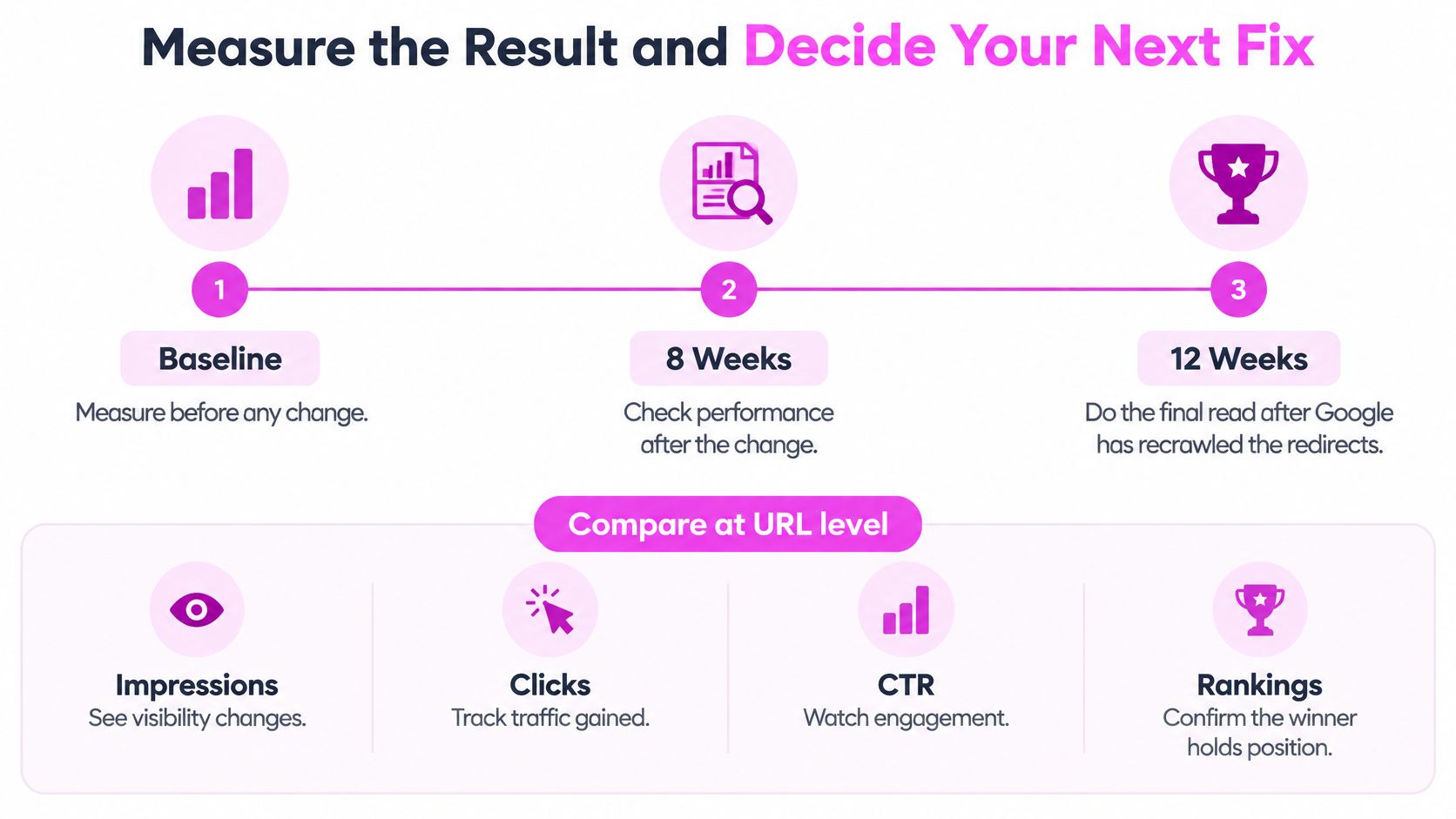
I compare URL-level impressions, clicks, CTR, and average position for each cluster, never site totals alone. I also track index coverage for retired URLs and whether the winner absorbed their visibility. To fix keyword cannibalization properly in 2026, though, I add a third outcome beyond rank and clicks, because answer engines don't reward the same pages blue links do. Recent reporting citing Ahrefs data descubrió que 36.7% of URLs cited in Google AI Overviews did not rank in the traditional top 100 for the query.
That figure changed my consolidation threshold. A page can lose the classic ranking fight and still supply the extractable definition or comparison that an AI answer cites. Before I retire a URL now, I log which URLs are cited for each cluster query, and I ask whether the losing page contributes a factual passage the winner lacks.
Outcome checks after a consolidation
| Métrica | Baseline | Check at 8 weeks | Decision rule |
|---|---|---|---|
| Combined clicks | Sum of cluster URLs before the change | Clicks on the winner plus any merged URLs | Equal or higher, keep. Lower, differentiate or revert |
| Posición media | Best URL position before the change | Winner position for the cluster query | Stable or better, keep. Worse by 3+ places, review intent fit |
| Index coverage | Count of indexed URLs in the cluster | Retired URLs dropped from the index | Retired URLs still indexed, check the redirect |
| Conversions | Cluster conversions before the change | Conversions on the winner | Lower conversions, confirm the winner matches intent |
| Citas de la Descripción General de IA | Citations for the cluster before the change | Citations to the winner and any complementary page | Losing citations, keep the complementary page |
I read that table row by row rather than chasing one metric. If combined clicks and conversions rose, I keep the fix even if average position wobbles briefly. If clicks fell while the winner's position held, I check intent and title fit before blaming the redirect, because the page may rank for the query without matching what searchers wanted to click.
I keep the baseline and follow-up exports in the same format, with the same date logic and columns, so the comparison stays like for like. In my own workflow, SemDash supports that read by showing the specific page Google sends traffic to for every keyword, letting me view the SERP over 12 meses for any keyword, and showing which keywords trigger Google's AI to mention a site, including competitors' sites, with the precise URLs Google cites in its AI-generated answers. That gives me rank ownership, history, and citations in one pass.
Don't end the audit with a dashboard. Take the next unresolved cluster from your map, rerun the query export, score the six signals, name one winner, and apply one method. Steady, cluster-by-cluster work beats a dramatic sitewide purge you'll spend the next quarter unpicking.
If you want that cluster work to run faster, SemDash shows you the exact page Google ranks for every keyword, tracks 12 months of SERP history so you can spot URL alternation early, and surfaces the precise URLs cited in AI Overviews before you consolidate them away. Build your next query-to-URL map there, work through one unresolved cluster this week, and you'll fix real cannibalization without deleting pages that were earning their traffic.