



Most guest blogging SEO advice starts with the same tired formula: pull a list of blogs with high Domain Rating, pitch generic topics at volume, and collect followed links until rankings move. That playbook breaks down fast once you audit what those placements produce. High-DR blogs that accept anyone rarely have engaged readers, and their outbound link profiles look like paid directories to search engines.
If I had to pick one shift that separates durable guest campaigns from wasted outreach budgets, it's judging every placement by audience fit, referral traffic, and sustained search visibility instead of raw link count. A link you have to hide from an editor or defend in a manual-action review isn't an asset. Even worse, treating every placement as a ranking shortcut hides the technical work of qualifying commercial links properly in the HTML and auditing whether the host page ever gets read.
I don't treat guest posting as a scalable backlink factory. I treat it as a targeted editorial channel with strict pass/fail thresholds, documented link attributes, and a 90-day performance check before anyone spends another hour pitching.
Tabla de contenido
- What Guest Blogging Actually Returns for SEO
- Prospecting Publishers Before You Score Them
- Publisher Scorecard for Passing, Flagging or Rejecting Sites
- Where Google Draws the Line on Guest Post Footprints
- How to Pitch and Write a Contribution Editors Accept
- How to Qualify Guest Post Links in the HTML
- Scoring Placements by Audience and Visibility
- Confirm Your First Three Placements Before Scaling
What Guest Blogging Actually Returns for SEO
A published backlink is an output, not a return. Guest blogging earns its place in an SEO budget when the host reaches relevant readers and the contribution remains useful and discoverable after publication.
Sure Oak's link-building statistics roundup describes research involving more than 500 bloggerscon 239 guest articles averaging roughly 50 visits per article, and reports that 47% of surveyed SEO professionals use guest posting for link building. These figures describe different samples, not a causal relationship. The referral average also isn't a forecast for your next placement or a measure of visitor quality.
The practical lesson is to separate backlink acquisition from audience acquisition. A followed link can sit on an indexed page without sending a qualified visitor. Equally, modest referral traffic can be worthwhile if those readers have a clear reason to explore your product or supporting resources. Judge the destination and the reader's intent together.
For example, a contribution pointing to revenue verification how-tos needs an audience interested in evaluating business revenue. A publisher's willingness to accept that link says nothing about whether its readers need the resource. Apply the same test to your own landing page: does it answer the question that would make someone click?
A useful placement can return value through three channels, each with a different measurement limit:
- Relevant referral visits: Readers click through to a supporting guide, tool, or benchmark. Assess whether those visits lead to useful engagement or conversion, rather than treating every click as equally valuable.
- Brand mentions and recall: Readers encounter your company in a relevant context, even without clicking. Referral reports alone cannot capture that exposure, so don't equate absent clicks with absent visibility.
- Author and entity association: A named practitioner contribution places your expertise alongside a specific topic. Treat that association as editorial context, not a guaranteed ranking benefit.
The baseline rule: Only pitch a publication where you'd still want target readers to discover your work even if the outbound link passed zero ranking credit.
Accept limited traffic when the audience fit is strong. Reject link volume as proof of success.
Prospecting Publishers Before You Score Them
Good prospecting starts with individual pages, not pre-built vendor lists or scraped site spreadsheets. Buying a list of "guest post sites" hands you the exact inventory every spammer already burned through. Instead, I build a candidate pool in three deliberate passes so every domain enters my review sheet with clear editorial context.
Running the Three-Pass Discovery Workflow
- Search for pages citing comparable resources. Combine your core topic with phrases like
"write for us"o"contributor guidelines", then inspect the articles those sites publish. Keep publications running practitioner breakdowns, case analyses, and technical walkthroughs, and cut sites filled with press releases or thin link roundups. - Pull a competitor backlink gap. Export the referring domains linking to two or three strong informational assets from direct competitors. Filter the raw export down to editorial articles and guest contributions, stripping out directories, scraper pages, and sponsored-listicles.
- Check organic traffic and referring domains before reading guidelines. Pull domain-level traffic estimates and referring-domain counts for every remaining candidate right away. This single check removes the majority of dead or inflated sites before you waste time reading submission rules or brainstorming headlines.
Tight pre-qualification saves hours downstream. That same filtering discipline shows up in Molted Email's AI prospecting guide for sales teams, where narrowing a target list by real fit beats blasting automated emails at cold contacts.
What to Log in Your Prospecting Sheet
Before moving any site into formal scoring, I log six concrete fields on one row:
- Target site and triggering URL: The exact page that proved the publication covers your subject and cites external resources.
- Topic overlap note: A short phrase defining where the host's readership intersects with your product or expertise.
- Estimated monthly organic visits: A quick baseline confirming search engines send real people to the domain.
- Author visibility: Whether articles carry named practitioners with bios rather than anonymous "Admin" or "Editorial Staff" tags.
- Link qualification policy: Any stated rule on
nofollow,sponsored, or editorial links found on contributor pages or recent guest posts.
A candidate stays on the active list only when it shows a clear reader audience, a visible editorial section, and a named editor or real contact address. Any site missing one of those three elements goes straight to a parked tab rather than the pitch queue.
Publisher Scorecard for Passing, Flagging or Rejecting Sites
Once a site survives initial prospecting, I run it through a six-point scorecard before writing a single pitch. Every candidate gets graded as Pass, Flag, or Reject across all six criteria, and the scoring rule is unforgiving.
| Criterio | Pass | Flag | Reject |
|---|---|---|---|
| Topical fit | Covers your topic and cites comparable resources | Adjacent niche with weak overlap | Unrelated or general news dump |
| Organic visibility | Independent organic keywords, stable rankings over 12 months | Traffic falling or spiking | No organic keywords |
| Audience size | 10,000+ monthly visits from your target market | 1,000-10,000 monthly visits | Under 1,000 visits or unknown audience |
| Domain authority | DR 40+ with a strong audience | DR 20-39 in a tight, relevant niche | Below DR 20 with thin content |
| Outbound link pattern | Few links, varied anchors, editorial citations | Many outbound links in every post | Sitewide paid links or link lists |
| Editorial standard | Named authors, real edits, rejects weak drafts | Accepts almost any submission | Pay-to-publish with no review |
Why Domain Metrics Alone Mislead
Filtering purely by Domain Rating or Domain Authority is the fastest way to fill a campaign with hollowed-out blogs. According to Backlynk's guest posting analysis, roughly 86% of marketplace opportunities fall below DR 40 y 10,000 monthly visits, while about 19% pull 100 or fewer monthly visitors. Plenty of sellers inflate DR through recycled expired domains or reciprocal link schemes that rank for nothing meaningful.
That's why I check organic visibility y audience size right beside authority. A site with independent non-branded keywords and steady rankings over a full 12-month window proves search engines trust its pages enough to keep showing them to users. Sudden traffic cliffs often point to core-update demotions or spam enforcement, while sharp, unexplained spikes usually trace back to one viral fluff post that brings zero buyers.
Running a structured backlink quality analysis on prospective hosts also reveals whether a domain earned its authority naturally or propped up its score with junk redirects. Check the top pages driving its organic traffic. If the top URLs are unrelated celebrity trivia or off-topic coupon posts on a supposed B2B marketing blog, walk away.
Applying the Single Reject Rule
Here's where teams get soft and compromise their own standards: a site scores high on DR, so they excuse weak editorial review or suspicious outbound links. I don't average scores across the table. Any single Reject kills the candidate immediately, even if the other five rows look spotless.
Look at why each Reject threshold carries veto power:
- Unrelated topics or general news dumps: Publishing a specialized SaaS workflow guide on a multi-topic lifestyle magazine signals link placement rather than expertise, and the readers have no reason to click.
- Zero organic keywords or under 1,000 monthly visits: If Google won't send readers to the host domain, your article won't earn meaningful discovery or sustained visibility there either.
- Sitewide paid links or link lists: Openly commercial outbound patterns put the host in the crosshairs of spam algorithms, dragging down the value of every outbound anchor on the domain.
- Pay-to-publish with no editorial review: When anyone with a credit card gets live within 24 hours, the site isn't a publication. It's a link broker dressed up as a blog.
Flags work differently. A site sitting at DR 20-39 with 1,000-10,000 monthly visits can still earn a green light if it serves a tight B2B niche where every reader fits your buyer profile and the editor pushes back on weak drafts. Two or more Flags, however, usually mean you're spending senior writing time on a marginal return.
Where Google Draws the Line on Guest Post Footprints
Every few months, someone still repeats the myth that Google banned guest blogging outright over a decade ago. That misreads what happened and leads teams into one of two bad extremes: abandoning legitimate editorial contributions altogether or assuming modern Google ignores guest-post patterns as long as the copy passes a grammar check.
Here's the actual policy timeline. On July 9, 2013, Google advised publishers to apply the nofollow attribute to links in guest posts that weren't editorially earned. Then in January 2014, Matt Cutts, head of Google's webspam team at the time, warned that guest blogging primarily for links had turned excessively spammy, before clarifying in Search Engine Journal's coverage of Matt Cutts's update that the warning targeted large-scale, low-quality link manipulation rather than legitimate expert contributions or reputable multi-author publications.

Google's current enforcement follows the exact same line. Under Google's Search spam policies, large-scale guest-post campaigns built mainly for link acquisition qualify as link schemes, especially when they rely on keyword-rich anchor text, duplicated or lightly spun articles, or paid placements intended to pass ranking credit.
Footprints That Trigger Risk
Intent and scale determine your exposure, not the mere presence of an author link. When I audit an existing guest campaign for risk, I look for five footprints that separate manufactured link networks from real editorial work:
- Repeated commercial anchor text: Pointing exact-match money keywords at the same product landing page across ten different domains screams engineered manipulation.
- Templated or recycled copy: Swapping a few intros and examples on the same core article to pitch multiple blogs leaves an obvious content pattern.
- Paid placements left unqualified: Compensating publishers for followed links designed to move rankings directly violates policy.
- Shared-ownership networks: Publishing across clusters of sites sharing the same WordPress themes, contributor rosters, or hosting footprints exposes an entire link profile at once.
- Unnatural publishing bursts: Dropping fifteen near-identical guest posts inside two weeks creates a clear campaign signature even when individual articles read decently.
Google reinforces this in its guidance on link tagging and link spam updates, warning that sites publishing or acquiring excessive sponsored or guest-post links without proper qualification risk algorithmic nullification or manual actions. If a partner site syndicates an article you originally published elsewhere, that same guidance advises pointing a canonical link back to the original page and adding nofollow to any questionable links inside the syndicated copy.
Documenting Editorial Selection and the Intent Test
If I stripped every link out of this draft, would the host's readers still gain something concrete from reading it on that exact site?
That single question cuts through rationalization faster than any checklist. Whenever a team hesitates on the answer, the placement exists only to manufacture a backlink.
To keep campaigns defensible over time, I keep a short editorial record alongside every live URL: who reads the publication, why the specific angle fits their current coverage, and what original framework, data point, or worked example the article adds. Five differentiated contributions written for distinct audiences build lasting authority. A spreadsheet of fifty interchangeable posts whose sole purpose is pushing anchor text builds the exact footprint search engines discount.
How to Pitch and Write a Contribution Editors Accept
Editors at real publications delete dozens of generic pitches every week. Most outreach fails before the editor finishes the first sentence because the sender clearly never read the site, pitched a broad textbook topic, or disguised a product pitch as an article.
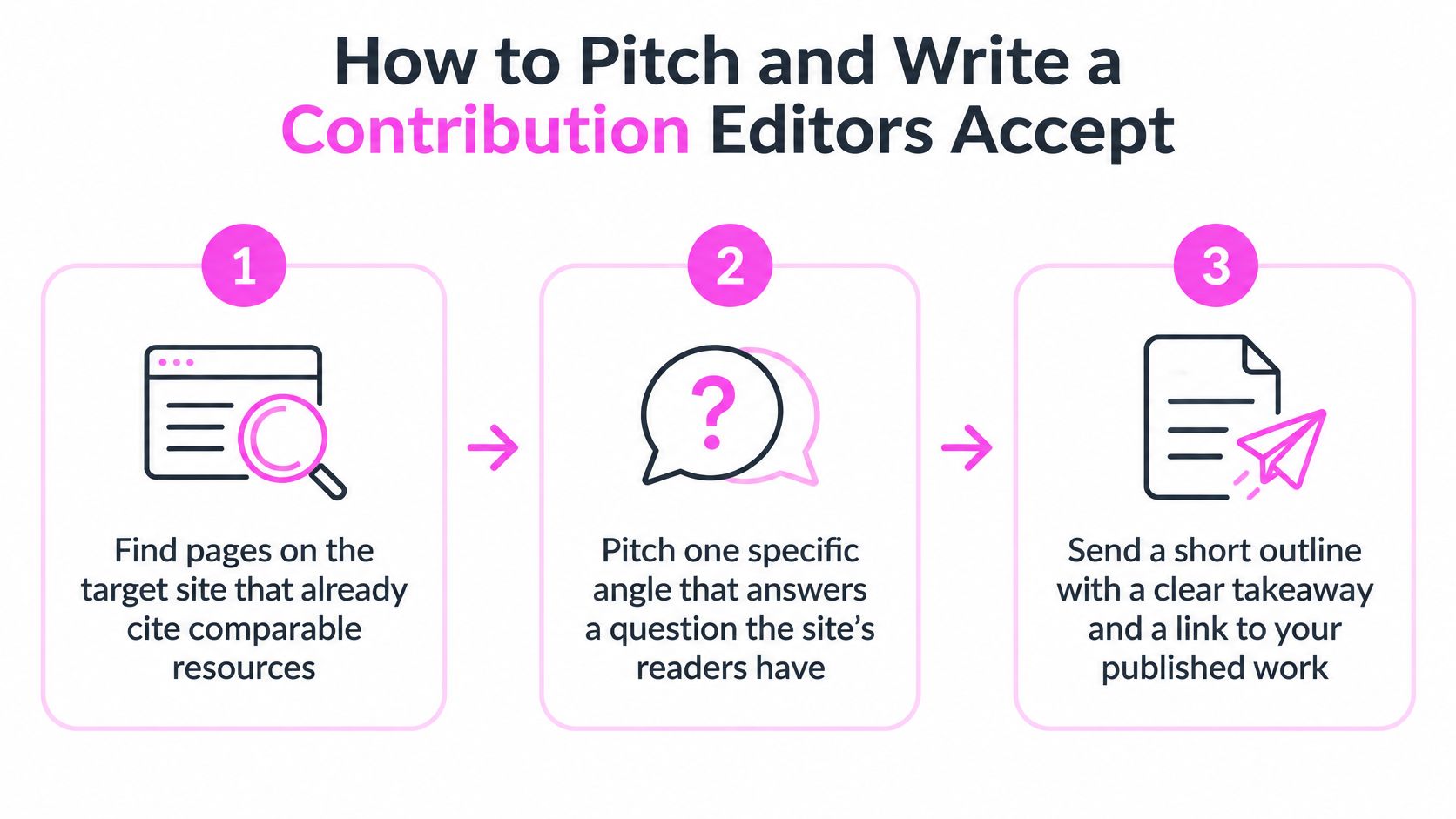
Before writing a single email, map out your pitch around what the host's audience needs, as illustrated below.
The Seven-Step Pitch and Production Workflow
- Locate pages on the target site that already cite comparable resources. Read at least five recent articles in the same category so you understand the technical depth, tone, and formatting style. Skipping this step leads to the most common pitch failure: suggesting a basic beginner topic the site already covered twice last year.
- Pitch one narrow angle that solves a specific reader problem. Frame the idea around a friction point the audience deals with weekly, and pitch under a named author who has hands-on experience solving it. Broad titles like "The Ultimate Guide to Email Marketing" get archived immediately because editors want specialized perspective, not encyclopedia summaries.
- Send a tight outline alongside one sample paragraph. Give the editor four or five clear H2 bullets plus a 60-word opening paragraph showing your voice and precision. Editors say yes faster when they can see you write cleanly and won't dump an unedited draft into their queue.
- Draft an original piece with concrete proof the host lacks. Build the article around a worked example, a real teardown, a clear decision rubric, or first-hand process numbers. Rewriting top-ranking search results adds zero value to the publication, and seasoned editors reject repurposed templates on sight.
If you want to refine how you structure outreach emails and follow-ups so busy editors reply, review our breakdown of link building outreach before launching your next batch of pitches.
The walkthrough video below breaks down practical ways to position guest contributions so editors view them as editorial upgrades rather than link requests.
Shipping the Draft Without Losing the Editor
- Insert one contextual link to your most helpful supporting page. Point readers to a relevant template, technical guide, or benchmark study rather than forcing a link to a high-intent commercial sales page. Turning a contributed article into a disguised landing page is the quickest way to get your draft rejected or stripped of links during editing.
- Confirm the link qualification treatment in writing before publication. Ask upfront whether the publication treats contributor links as editorial,
nofollow, osponsoredwhen commercial arrangements apply. Clearing this up before you deliver the draft prevents awkward post-publish disputes and keeps your measurement expectations honest. - Inspect the live page and log the final placement. Once the post goes live, verify the exact URL, the live anchor text, the rendered
relattribute, and the indexability of the page in your campaign tracker. Editors occasionally trim links or alter anchors during copyediting, and catching changes on day one beats discovering broken assumptions three months later.
How to Qualify Guest Post Links in the HTML
Qualifying links correctly isn't a technical afterthought. It determines how search engines interpret the relationship between the host domain and your site, and how accurately you forecast SEO impact.
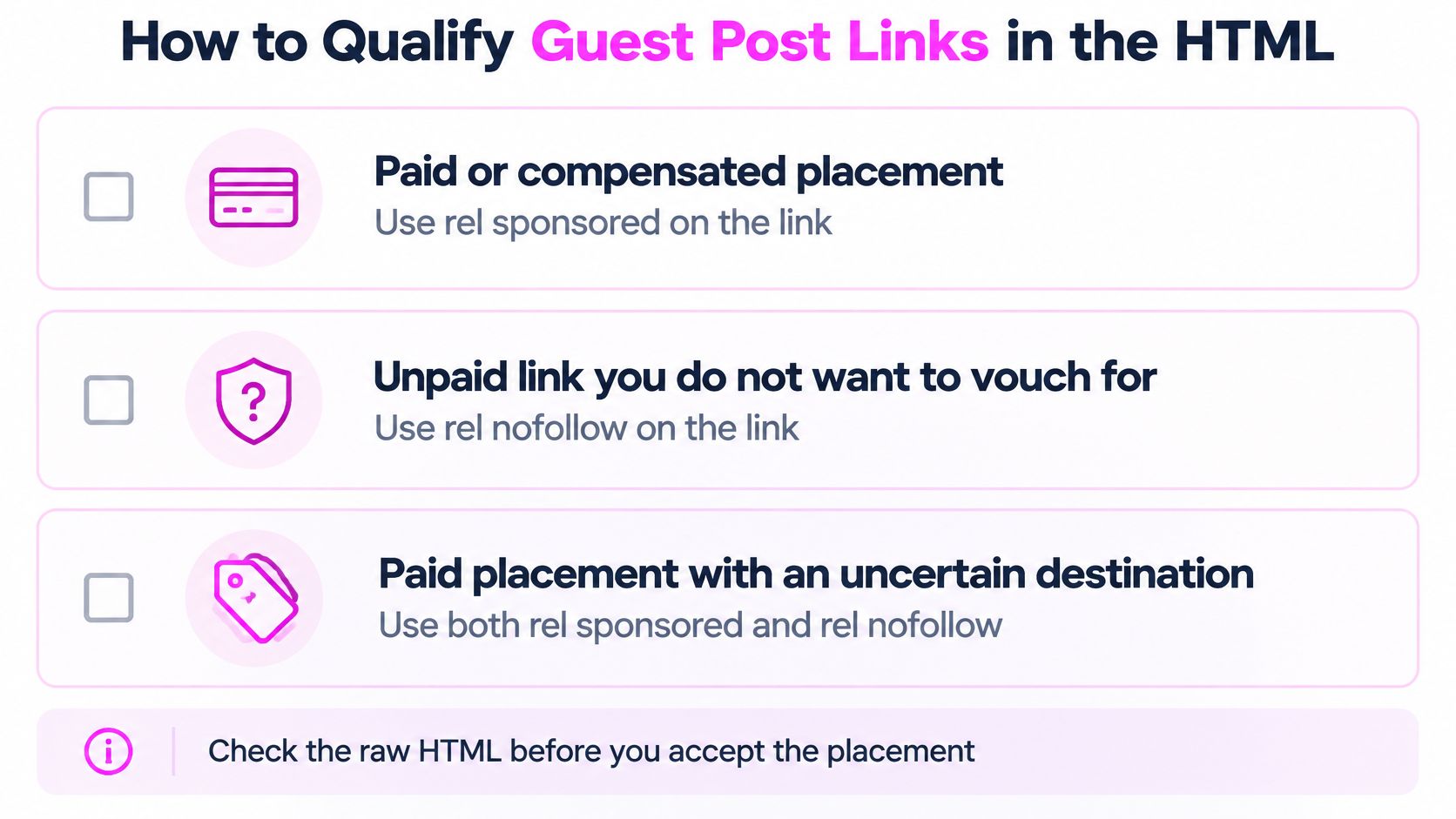
| Atributo | Use when | What it signals |
|---|---|---|
rel="sponsored" |
Paid or compensated guest post | Compensated placement, should not affect ranking |
rel="nofollow" |
Unpaid link you do not want to vouch for | No endorsement implied |
rel="sponsored nofollow" |
Paid placement with an uncertain destination | Both signals combined |
No rel attribute |
Editorial link you would stand behind | Ordinary followed editorial link |
Per Google's documentation on crawlable links, publishers should use rel="sponsored" for paid placements and rel="nofollow" when they don't want to imply endorsement or associate their site with the destination, combining both as rel="sponsored nofollow" when needed. Google explicitly states that paid guest-post links shouldn't affect search results and notes that links carrying these qualifying attributes are generally not followed.
That technical reality changes how you evaluate the placement. A qualified link delivers discovery, referral sessions, and brand reputation, not direct PageRank transfer. Always separate qualified links from earned followed links inside your backlink inventory so nobody inflates organic ranking forecasts based on placements that won't pass equity.
The quick-reference checklist below summarizes which attribute belongs on each placement type before you sign off on a live URL.
Verifying Attributes in Rendered HTML
The attribute must sit directly on the outbound anchor tag, like <a href="https://example.com/resource" rel="sponsored nofollow">resource</a>. Never trust a seller's email, a media kit disclaimer, or a toggle screenshot inside a CMS as proof of compliance. As detailed in Google's guide to qualifying outbound links, proper tagging needs to hold across the actual rendered markup and cover every compensated link tied to the placement.
Follow these four steps every time a guest post publishes:
- Open the live article in a clean browser tab. Don't check staging previews, since publishing templates frequently alter link markup on push.
- Inspect the rendered HTML directly. Right-click the anchor, open DevTools (or view the rendered DOM), and confirm the exact
relstring sits inside the<a>element. - Audit every compensated link on the page. Check secondary links in the body copy, links inside the author bio box, linked images, and any recurring sitewide callouts. A common slip is tagging one main link while leaving a secondary keyword-rich anchor followed, which undermines the entire qualification.
- Log the verified attribute and recheck after updates. Record the exact
relvalue in your backlink inventory alongside the publish date, then spot-check key placements quarterly. CMS plugin updates, theme migrations, and editorial refreshes can strip link attributes weeks after launch.
Scoring Placements by Audience and Visibility
Counting acquired backlinks tells you how busy your outreach team was, not whether the campaign moved the business. Search visibility has shifted well past ten blue links. According to Yotpo's analysis of guest posting and AI Overviews, transactional queries triggering Google AI Overviews reached 13.94% in late 2025, y 80.9% of surveyed SEO professionals believe unlinked brand mentions may influence rankings. The same report notes that marketplace data suggests only 4.6% of listed guest-post opportunities meet both high-authority and substantial-traffic thresholds.
That's why I score every completed placement across four weighted outcomes instead of celebrating a raw link count:
- Audience fit (40%): Do the readers arriving from the host page match your actual buyer profile and search intent?
- Referral quality (30%): How many engaged referral sessions, newsletter signups, or assisted conversions did the placement drive in GA4 over 60 to 90 days?
- Brand and entity signals (20%): Did branded search volume, direct mentions, or unlinked brand citations tick upward after the article circulated?
- Visibility durability (10%): Does the host article hold independent organic rankings, get crawled cleanly, or appear as a cited URL inside AI-generated answers?
A
nofollowlink or even an unlinked mention inside an influential industry publication often outperforms a followed link buried on a low-traffic general blog.
A Worked Comparison of Two Real-World Scenarios
To see how the 40/30/20/10 weighting flips conventional link-building instincts, imagine comparing two hypothetical placements 90 days after publication.
Site A is a DR 58 general marketing blog pulling 4,000 monthly visits across broad topics. You land a followed link in the body copy, yet barely anyone in its readership buys your niche software. Over 90 days, the article drives almost no qualified referrals and little brand recall, though the host page ranks on page two for a broad secondary term. On a 0-to-100 scale, Site A scores 25 for audience fit, 15 for referral quality, 30 for brand signals, y 70 for visibility. Applying the 40/30/20/10 weighting brings Site A to a final score of 27.5.
Site B is a DR 34 niche industry publication generating 38,000 monthly visits from your exact target market. Its editorial policy applies rel="nofollow" to every external contributor link. Over the same 90-day window, the article sends 310 qualified referral sessions and sparks two direct branded searches tied to the topic you covered, while the host page holds steady mid-page-one visibility for a core niche query. Site B scores 90 for audience fit, 80 for referral quality, 60 for brand signals, y 50 for visibility. Applying the same 40/30/20/10 weighting brings Site B to 77.
| Ubicación | Audience (40%) | Referral (30%) | Brand (20%) | Visibility (10%) | Final 90-Day Score |
|---|---|---|---|---|---|
| Site A (DR 58, followed) | 25 | 15 | 30 | 70 | 27.5 |
| Site B (DR 34, nofollow) | 90 | 80 | 60 | 50 | 77 |
The followed link on the higher-DR blog loses decisively because the wrong people saw it. Revisit every placement score at the 90-day mark so you put future writing hours into publishers that compound brand demand and referral pipeline.
Confirm Your First Three Placements Before Scaling
Don't sign a six-month guest posting retainer or build a 100-site outreach queue until you prove the workflow works in your niche. Pick three target publishers that pass every single criterion on your scorecard with zero Rejects. Write one original contribution for each site, confirm and qualify every compensated link in writing before launch, and verify the live HTML on publish day.
Put a calendar reminder at 90 días and audit five concrete signals across those three URLs:
- Qualified referral sessions and assisted conversions tracked by host domain in GA4.
- Branded search queries in Google Search Console following publication and social distribution.
- Unlinked brand mentions appearing on other blogs or forums referencing your contributed research or framework.
- Host-page organic visibility, confirming the guest article ranks and stays indexed.
- Citas de la Descripción General de IA, checking whether Google's AI-generated answers cite either the host article or your supporting page.
Scale your guest campaign only when at least two of your first three placements deliver measurable audience-level results within 90 days.
If none of the three bring engaged readers, brand queries, or lasting visibility, tighten your publisher scorecard before pitching a fourth site. When you want structured walkthroughs on evaluating competitor links and SERP visibility, SemDash's SEO Academy offers video tutorials on SEO strategies and how to use SemDash tools. If you'd rather get a second set of eyes on your publisher scorecard before committing writing budget, SemDash also offers free live calls where you can speak to an SEO specialist.
SemDash brings Backlink Gap, Referring Domains, 12-month Historical SERP tracking, unlinked brand-mention detection, and AI Overviews citation tracking into one workspace so you can vet host sites by real audience visibility instead of guessing from surface metrics. Run your first three guest-post candidates through real organic traffic and link-profile data before you send a single pitch, and get started for free at SemDash.