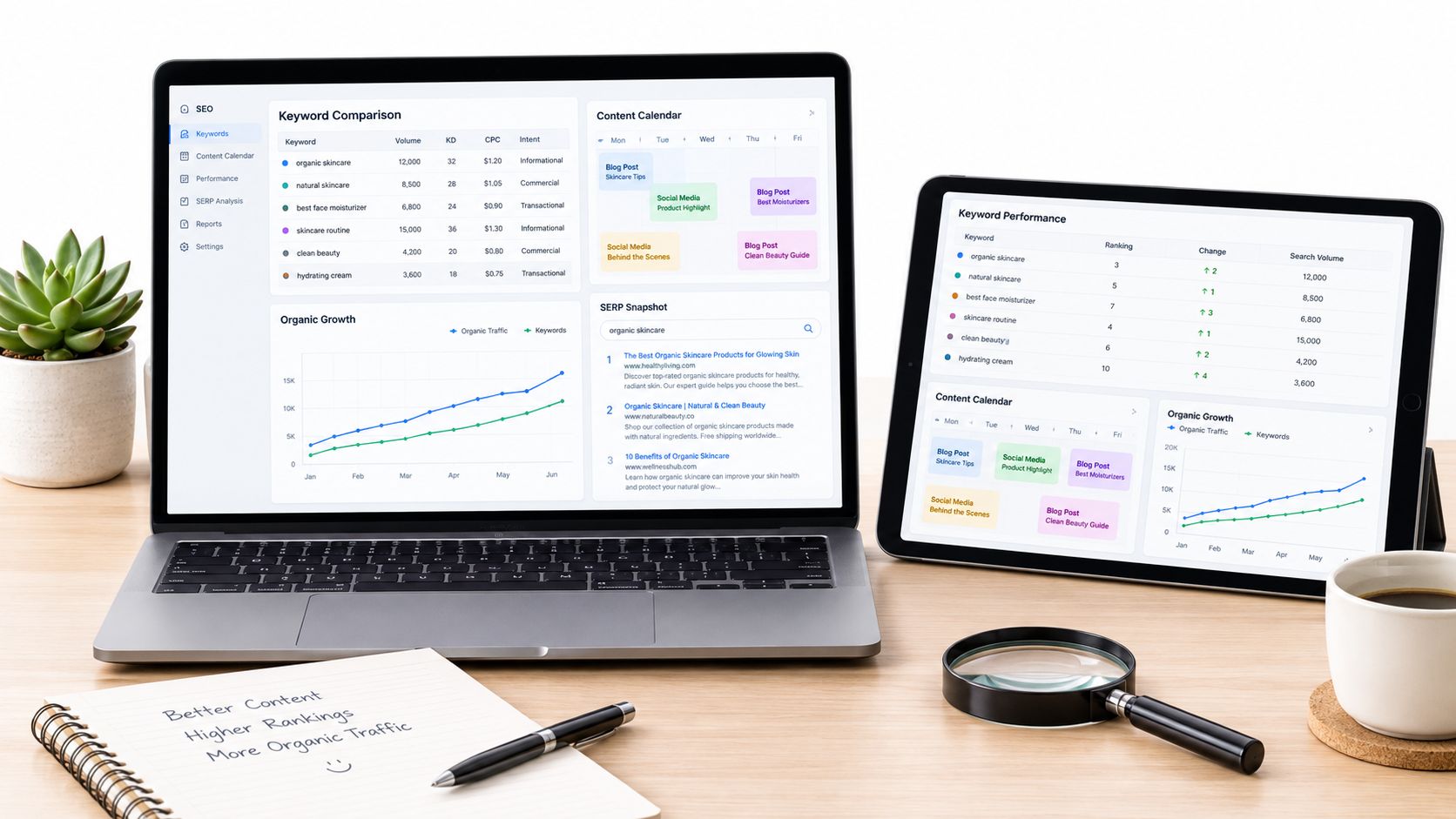


The popular advice on how to get backlinks usually starts with a list: publish a guest post, design an infographic, answer journalist requests, repeat. That format makes link building look easier than it is. The actual bottleneck usually isn't a shortage of tactics. It's deciding which sites deserve attention, which pages need links, and what reason an editor has to say yes.
I've seen campaigns fail after the first batch of outreach because the team chose prospects from a generic list instead of from competitor evidence. A high-authority publication may be impressive, but a relevant referring domain that already links to comparable businesses can be a more practical target. Google's original PageRank system, introduced in 1998, made links a core ranking signal by treating them as votes of confidence and weighting those votes by the authority of the linking page. That history still explains why relevance and referring-domain quality matter more than raw backlink volume. The historical link-building benchmark and PageRank context also reports that the number-one Google result has about 3.8 times more backlinks than results in positions 2–10.
Tabla de contenido
- Why Most Backlink Tactics Stall Before They Start
- Building a Target List From SemDash Backlink Data
- Outreach That Earns Replies Instead of Ignores
- Asset-Led Link Building for Digital PR and Original Research
- Broken Links and Unlinked Mentions as Warm Opportunities
- Earning Links to Commercial and Product Pages
- Measuring, Vetting, and Following Up on Acquired Links
Why Most Backlink Tactics Stall Before They Start
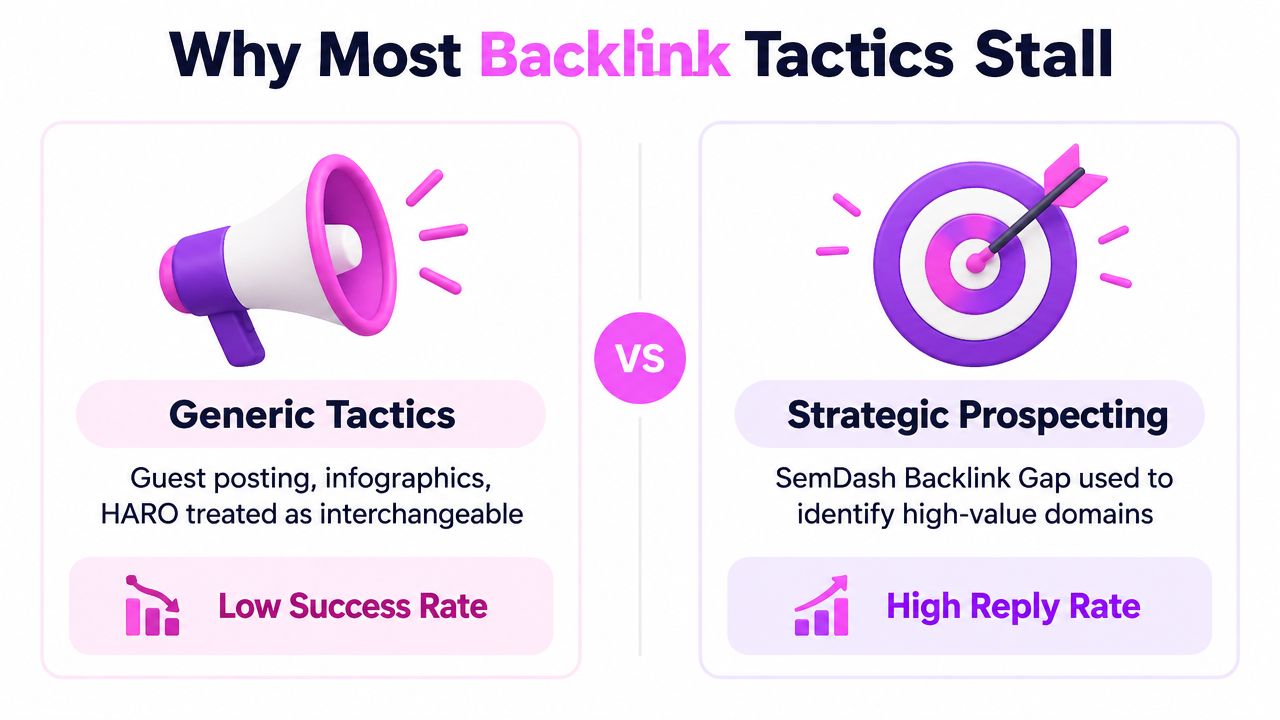
A list of ten tactics treats guest posting, digital PR, resource pages, broken links, and journalist outreach as interchangeable. They aren't. Each depends on a different editorial trigger, a different asset, and a different type of prospect. Guest posting needs a publication with a contributor model. Broken-link outreach needs a page with a genuine dead resource and a close replacement. Digital PR needs something timely enough for a journalist to use.
That distinction changes the starting point. I don't begin by drafting outreach templates. I begin by sorting the market into link gaps, page gaps, and plausible editorial opportunities. If three competitors earn links from the same industry publication and my site doesn't, that domain deserves investigation. If a competitor's category page attracts links from comparison sites, I need to understand the page's evidence and positioning before deciding whether my own commercial page can compete.
The sorting problem behind outreach
Campaigns built around a tactic list often stall after the first 20 sends, not because outreach never works, but because the list contains weak-fit domains. The sender then blames the subject line, changes the template, and sends to another unqualified batch. That creates activity without improving the underlying selection.
A better workflow ranks prospects by:
- Topical relevance: Does the site cover the problem, industry, or audience connected to my page?
- Link-type gap: Is it a review, resource mention, integration page, editorial citation, or commercial comparison link that competitors have and I lack?
- Conversion likelihood: Has the publisher linked to similar companies, updated the page recently, or already mentioned my brand?
- Page usefulness: Can I offer a materially better destination, rather than asking an editor to add a link out of courtesy?
Regla práctica: If I can't explain why a specific page would benefit its readers from my URL, I don't add that prospect to the sequence.
A durable link building strategy helps as a companion resource. The durable part isn't collecting every possible tactic. It's building a repeatable system where research determines the target, the asset, and the pitch.
The contrarian promise is simple: data first, pitch second. Use SemDash Backlink Gap and Referring Domains data to identify the opportunity, then choose the tactic that fits the gap instead of forcing every prospect into the same outreach playbook.
Building a Target List From SemDash Backlink Data
I build a prospecting sheet from competitor link profiles before I write a single email. The purpose isn't to copy every link a rival has. It's to find domains that already understand the category and have demonstrated a willingness to cite or recommend comparable businesses.
Start with the gap, not the domain list
Enter your site and three to five ranking competitors in Backlink Gap. The report surfaces domains linking to those competitors but not to your site. I export that list, then retain the source-page URL, linked competitor, destination page, anchor text, link attribute, and the date information available in the report.
The export is only raw material. A domain that links to a competitor from a profile footer isn't equivalent to a domain that cites the competitor inside an updated buying guide. I inspect the actual page because the placement explains the opportunity better than the domain metric alone.
For a broader process, I use this competitor backlink analysis workflow to keep competitor selection, source-page review, and prioritization connected.
Validate the referring domain
Next, I open each meaningful prospect in the Referring Domains report. I check whether the domain has a coherent editorial footprint, whether links appear across relevant pages, and whether the source resembles a real publication, specialist community, partner directory, or maintained resource hub.
Then I review Anchors. Anchor diversity helps reveal whether the competitor earned natural editorial references or a cluster of repetitive placements. I also compare follow and nofollow patterns, not because nofollow links are worthless, but because the attribute helps explain how the publisher normally links out.
The final checks are practical:
- Remove dead hosts: Exclude domains with inactive pages, broken navigation, or no recent signs of maintenance.
- Check topical fit: A site can have strong authority and still be irrelevant to the page I'm promoting.
- Review placement type: Prioritize body-copy references and genuine resource inclusions over sitewide footers.
- Bucket by intent: Separate review sites, category publications, partner ecosystems, resource pages, and data-driven editorial targets.
- Assign a next action: Every row should say whether it needs a replacement asset, a partnership angle, a mention reclamation request, or a straightforward editorial pitch.
The result is a target list scored on evidence rather than guesses. Keep the strongest domains for a carefully researched sequence, and use lower-priority but relevant prospects to test angles without exhausting the best opportunities.
The video below provides additional visual context for working with backlink gap data.
Outreach That Earns Replies Instead of Ignores
A SaaS content team I worked with had a familiar problem: the export contained plenty of domains, but one generic pitch produced almost no useful conversation. We split the list into three segments: sites that had recently linked to a competitor, publications reviewing similar tools, and category sites that covered the broader problem without mentioning the company.
The message changed with the segment. A recent competitor linker received a replacement or additional-resource angle. A reviewer received a product-fit note only when the product genuinely matched the article. A category publication received a data asset or explanatory guide, not a request to insert a commercial link into an unrelated paragraph.
A short email with a reason to exist
For a publication covering reporting tools, the opening might look like this:
Subject: A data source for your reporting tools guide
Hi [Name],
I noticed your recent section on reporting workflows focuses on dashboard setup, but doesn't cover how teams validate the underlying data. We've published a practical guide on that specific problem, with examples that could give readers a useful next step after the dashboard recommendations. Would it be worth considering as an additional reference?
Best,
[Name]
The structure is deliberate:
- Subject: References their article and the relevant angle.
- Proof of reading: Identifies a real omission or editorial detail.
- Asset match: Connects one URL to one reader need.
- Soft ask: Leaves the editor room to judge the fit.
- Short signoff: Avoids turning a simple request into a biography.
Cold outreach is a low-yield channel overall. Benchmarks report an average response rate of about 8.5%, while conversion from outreach email to an actual backlink is typically 1–5%. The cited outreach benchmarks also report personalized emails reaching 15–25% response rates, compared with under 5% for generic templates.
Follow up with new value
On day 3, I don't send “just bumping this.” I add a specific reason the resource fits, such as a missing subsection, a relevant chart, or a cleaner replacement for an outdated reference. On day 7, I make one final, low-pressure attempt and close the record if there's no response.
Every prospect gets CRM tags for segment, asset offered, contact status, response, placement, and destination URL. That makes later measurement possible. Without those tags, teams remember that outreach happened but can't tell whether the segment, asset, or publisher type produced the result.
Asset-Led Link Building for Digital PR and Original Research
A linkable asset gives an editor something worth citing. It isn't a long article with a designed header. I use the term for proprietary survey data, original benchmark studies, free interactive tools, visual explainers, and data-backed infographics that add evidence or utility to another publisher's work.
The right format depends on the business and the audience:
- B2B SaaS: A benchmark study or proprietary survey can support trade coverage, analyst commentary, and specialist blogs. The production burden is higher because the methodology must be clear.
- Ecommerce: A calculator, buying tool, or visual dataset can earn references from consumer publications and product communities. The tool has to solve a narrow task quickly.
- Local services: A regional data story or practical visual guide can work better than a national survey because local publishers need a relevant angle.
I don't promise a fixed hit rate. Journalists and bloggers choose assets based on timing, relevance, originality, and how easily they can verify the claim. A polished infographic with no new information usually performs worse than a plain table containing data nobody else has assembled.
Build the pitch around the evidence
I use SemDash Anchors and referring-domain overlap to identify publications already covering the topic or citing similar studies. The first line leads with the asset, not the company:
We surveyed [audience] about [specific problem] and found a clear pattern in [relevant behavior]. The full dataset, methodology, and charts are available here: [URL].
Then I explain why that publication's readers would care, offer a short summary of the finding, and provide a clean image or embed code. Embed code matters because it reduces production work. A writer can place the visual without recreating it, while the linked source remains clear.
For potentially newsworthy research, I offer one publication a short early look when exclusivity is genuinely useful. I don't promise exclusives to several outlets at once. After publication, I follow up once with the relevant chart or finding, then give the newsroom space to decide whether it fits its calendar.
The strongest assets also support non-link outcomes. A journalist may cite the data without linking, while a blogger may use the chart with a direct reference. Both can strengthen brand association, but the link request should remain accurate and useful rather than overstated.
Broken Links and Unlinked Mentions as Warm Opportunities
Broken-link building and unlinked-mention reclamation look similar in a spreadsheet, but the editorial mechanics differ. Broken-link outreach solves a publisher's maintenance problem. Mention reclamation asks a publisher to improve an existing reference to a known brand.
I find broken opportunities through relevant source pages and referring-domain reports, then inspect the outbound destination and confirm the page is unavailable or no longer appropriate. The replacement must match the original intent. A general homepage rarely replaces a detailed guide, and a product page shouldn't replace a neutral research source unless the page serves that purpose.
Unlinked mentions need faster handling. I search alerts and SemDash Anchors for branded terms, remove my own domain and obvious noise, then check whether the mention is editorial, accurate, and connected to a page worth sending readers to. The best request is usually simple: thank the author, identify the exact mention, and suggest the most relevant URL.
Reported practitioner ranges put well-executed broken-link outreach at about 5–8%, with highly personalized campaigns reaching 12–15% conversion and some summaries citing up to 22% when the replacement is tightly relevant. Warm unlinked-mention reclamation is often reported at 15–40%, because the editor already knows the brand. These figures come from the broken-link building evidence and comparison, and they should be treated as directional benchmarks, not guarantees.
| Factor | Broken Link Building | Unlinked Mention Reclamation |
|---|---|---|
| Relevance | Must closely replace the dead destination | Must match the existing brand reference |
| Potencial de tráfico | Strong when the source page is maintained and read | Strong when the mention sits in a useful editorial page |
| Ease | Requires crawling, verification, and replacement review | Requires finding the mention and checking link status |
| Conversion rate | Acerca de 5–8% in reported well-executed campaigns, with higher ranges for tight matches | Often reported at 15–40% for warm mentions |
| Mejor uso | When I have a genuinely equivalent replacement | When the publisher already trusts or recognizes the brand |
I choose mention reclamation first when speed matters. I choose broken links when the source is highly relevant and I can offer a replacement that improves the page for readers, not merely my backlink profile.
Earning Links to Commercial and Product Pages
Most backlink guides steer all authority toward blog posts. That makes outreach easier, but it leaves the pages that convert under-supported. A product page, category page, comparison page, or integration page often needs links precisely because it sits close to a buying decision.
The difficulty is obvious. An editor doesn't want to add a commercial URL just because a vendor asks. The page needs an editorial role.
Match the workflow to the funnel
Comparison and best-of pages work when the product genuinely belongs in the selection. I inspect competitor anchors to learn whether reviewers link with a product name, a category phrase, or a feature description, then improve the commercial page so the wording is accurate and useful. The destination should support the reviewer's claim with clear functionality, limitations, and evidence.
Partner and integration links create a stronger reason to link. Integration directories, co-marketed webinars, partner pages, and case-study co-publication all give both organizations an editorial reason to reference the other. The link can point to an integration page or a joint resource, rather than forcing a blog URL into the relationship.
Customer stories can support product-page authority when they include original operational detail, approved quotations, and useful data. I distribute the story to relevant trade publications and niche communities, then link to the customer outcome or solution page only where it clarifies the story.
A simple mapping keeps the campaign honest:
| Funnel stage | Linkable destination | Editorial reason |
|---|---|---|
| Descubrimiento | Research or category page | Defines the problem with evidence |
| Evaluation | Comparison or integration page | Helps readers assess alternatives |
| Decisión | Product or customer story page | Explains fit, implementation, or outcome |
I don't assign a guaranteed monthly link pace to these workflows. The achievable pace depends on partner access, editorial demand, asset quality, and whether the commercial page deserves inclusion. That uncertainty is useful. It prevents teams from manufacturing placements to hit an arbitrary quota.
A 2025 survey found that 68% of link builders prioritize blog content, while only 41% prioritize product or commercial pages. The survey on link-building priorities highlights the gap. My practical response is to reserve part of every campaign for commercially relevant URLs, then build the supporting evidence those pages need before outreach begins.
Measuring, Vetting, and Following Up on Acquired Links
Acquisition isn't the finish line. A link can disappear, point to the wrong URL, move into a footer, or remain live on a page that no longer has meaningful relevance. I schedule verification as part of the campaign rather than treating the placement as permanent the moment an editor says yes.
Verify the placement
I review new links in the Referring Domains and Backlinks reports and record the source page, destination URL, anchor text, link attribute, first-seen information, and last-seen information where available. I also open the page manually. Reports identify patterns efficiently, but a browser check confirms whether the link appears in readable editorial context.
My vetting checklist covers:
- Domain quality: The site has a coherent purpose, maintained pages, and identifiable editorial or organizational ownership.
- Topic alignment: The source page addresses the same audience or problem as the destination.
- Contextual placement: The link helps readers understand or verify a claim.
- Anchor naturalness: The wording describes the destination without forcing exact-match language.
- Referral potential: The page appears capable of sending relevant visitors, even when ranking value is uncertain.
- Persistence: The page remains live, accessible, and connected to the site's current information architecture.
For a deeper review of these checks, use this backlink quality analysis guide as a reference point, then apply your own business and topical judgment.
Use a small monthly routine
Once a month, I export newly discovered referring domains and compare them with the campaign CRM. I flag unrecognized links for review, confirm newly acquired placements, and create reclamation tasks for lost links. If a source removed the link because the page changed, I first ask whether a better current URL or updated citation can restore the reader value.
I keep disavow work conservative. Google defines link spam as creating links to or from a site primarily to manipulate rankings, including buying or selling links for ranking purposes, exchanging goods or services for links, excessive link exchanges, automated link creation, and required links in contractual or product-review arrangements. Google's spam policies should guide the decision, not a third-party toxicity score alone.
I also don't panic over every strange backlink. A public Google support response about spam backlinks states that Google's systems automatically detect and filter spam patterns at scale, and that third parties don't need to report spam backlinks pointing to another site.
Finally, connect each campaign to referral sessions, organic visibility, ranking changes for the destination page, and conversions. I look for trends across a group of links rather than claiming that one placement caused every improvement. That evidence tells me whether digital PR, partner links, reclamation, or commercial-page outreach deserves more investment.
SemDash brings Backlink Gap, Referring Domains, Anchors, and competitor link research into one workspace, so you can prioritize evidence-backed prospects before writing outreach. Build your next target list around the pages and domains your competitors already earn links from, then visit SemDash to research the gaps and turn them into a measurable campaign.