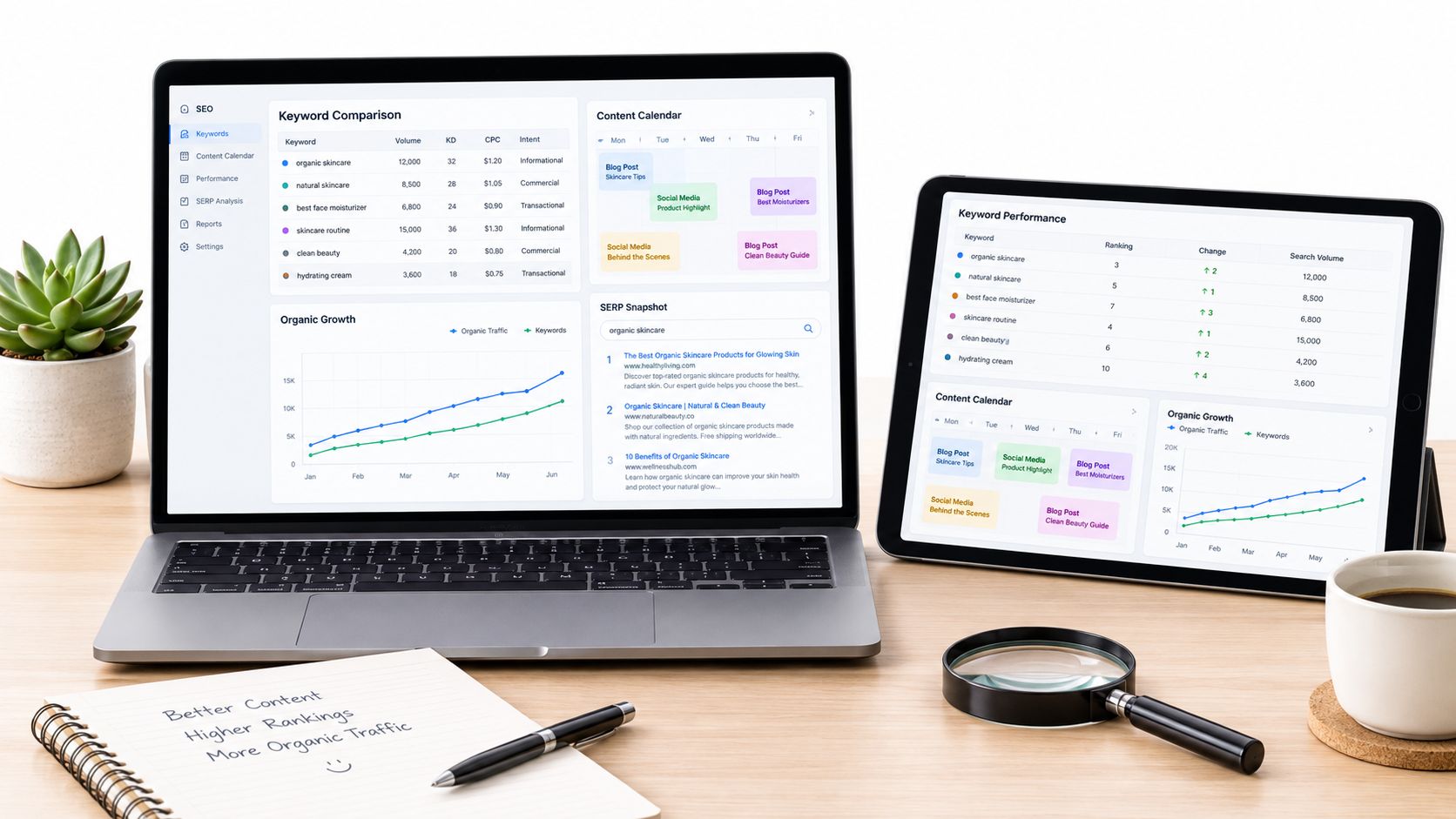

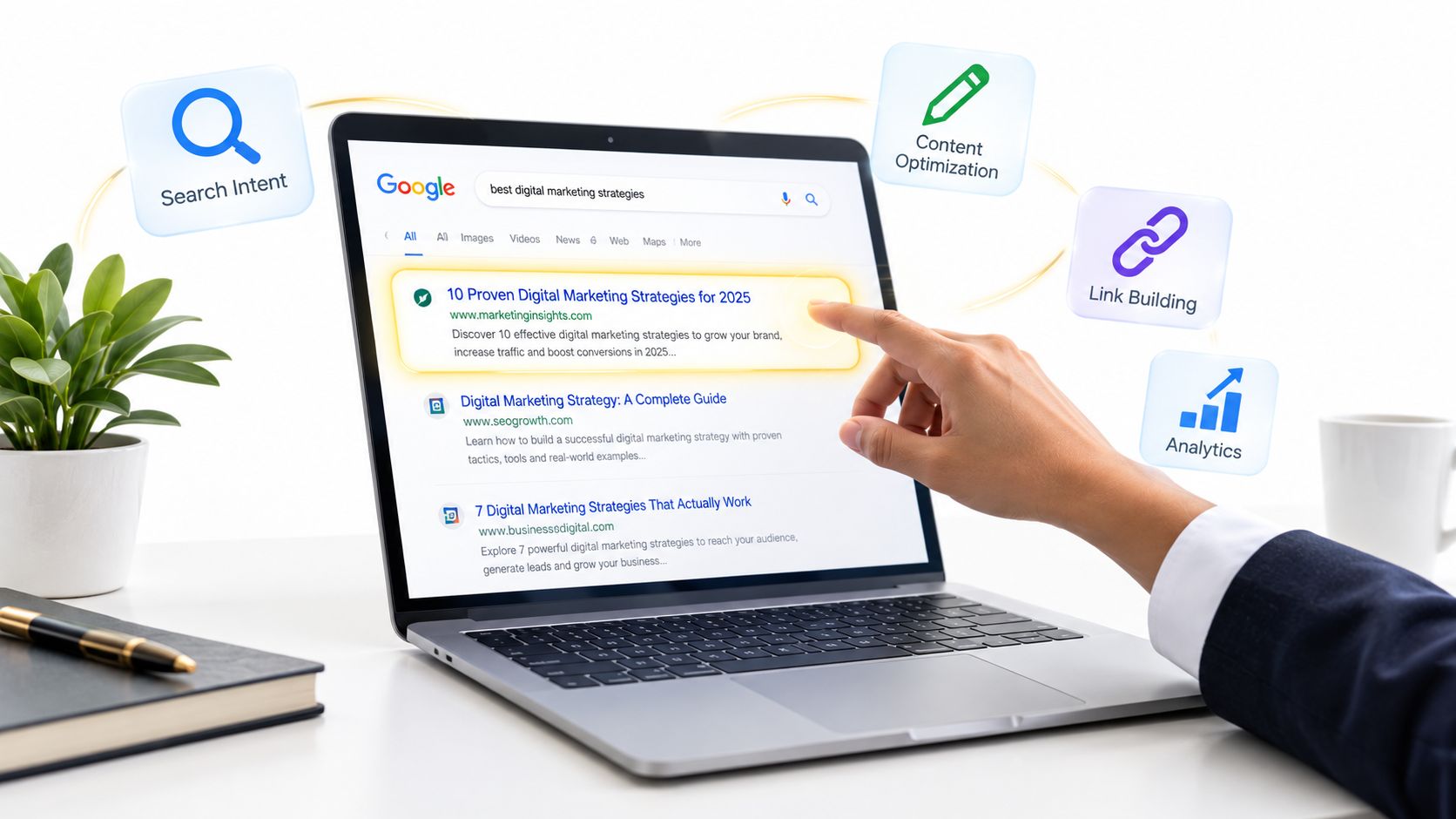
La mayoría de los consejos sobre how to get your website to the top of Google search still sounds like a checklist from another era: add the keyword, publish a long page, collect some backlinks, improve page speed, then wait. That process can produce a technically clean site that remains invisible because it ignores the harder questions, such as whether the page matches the searcher's actual intent, whether the site presents a coherent entity, and whether Google can extract a useful answer for an AI Overview.
I treat SEO as a product discipline, not a collection of ranking tricks. The product is the search experience your page provides. That means studying the live SERP before writing, building evidence of expertise across related pages, earning links from relevant sources, and measuring citations as well as blue-link positions. The target isn't just a number-one ranking. It's the strongest possible presence wherever qualified demand appears.
Tabla de contenido
- The Modern Reality of Ranking on Google
- Reverse Engineering Search Intent and SERP Formats
- Building Topical Depth and Entity Consistency
- Optimizing On-Page Signals and Title Generation
- Executing a Targeted Link Acquisition Strategy
- Tracking Visibility and Adapting to AI Overviews
The Modern Reality of Ranking on Google
The old SEO checklist fails in competitive results because Google evaluates the page in context. Clean metadata, strong backlinks, and sound technical setup can still lose to a page that answers the query more directly, matches the dominant SERP format, or provides clearer first-hand evidence. Google's helpful-content guidance emphasizes helpful, reliable information created for people, and its Helpful Content system became part of its core ranking systems in March 2024.
The wider evidence points to the same operating model. A 2026 expert survey collected 13,665 ranking-factor data points. Relevance was selected by 57.1% of respondents as a top-three signal, followed by backlinks at 54.8% and content quality at 47.6%. Authority and trust reached 36.5%, behavioral and click signals 29.4%, and technical health, including crawlability and indexing, 17.5%, according to the Google ranking factors expert survey. Technical SEO still matters, but it rarely compensates for weak relevance, unclear entities, or a format mismatch.
Position one is valuable, but it isn't the whole strategy
Important pages should still compete for the top blue-link positions. One widely cited study reported an average 27.6% CTR for the first organic result, with that result about 10 times more likely to receive a click than the tenth, as summarized in Google CTR statistics. A separate July 2026 Google US desktop benchmark recorded 20.02% CTR at position 1, 10.36% at position 2, y 3.89% at position 3, según Advanced Web Ranking's organic CTR data. That gap makes positions two through five practical targets for testing titles, improving intent coverage, and strengthening supporting evidence.
The page also competes with the SERP itself. A 2026 study covering 17.8 billion queries across 28 countries reported 41.3% CTR for the first organic result on queries without AI Overviews, compared with 18.6% when an AI Overview appeared, a 54.9% drop. Another 2026 benchmark found that 74.3% of AI Overview SERPs ended without an organic click, as reported in the Google CTR research.
Regla práctica: Optimize for the result page your audience actually sees, including summaries, forums, videos, shopping modules, and local features.
That requires two connected workstreams. Ranking strategy builds a relevant, accessible result with useful content and authority. Citation strategy makes claims easy for search systems to extract, verify, and associate with a consistent entity. A concise, well-supported passage can earn visibility in an AI Overview even when the page does not hold the top blue-link position. Entity consistency and SERP-format fit therefore belong in the workflow from the start, rather than as repairs after rankings stall.
Reverse Engineering Search Intent and SERP Formats
I don't start a content brief with a keyword list. I start with the live SERP. The query tells me what the searcher typed, but the results reveal what Google believes that searcher wants.
For a target query, I record the dominant page types, the intent behind each result, and the features occupying the screen. An informational query may favor a process guide, a comparison, a definition, or a short answer. A commercial query may favor product comparisons and category pages. A transactional query often needs a product, service, or location page rather than another educational article. Those labels are useful, but the winning format is more actionable than the label.
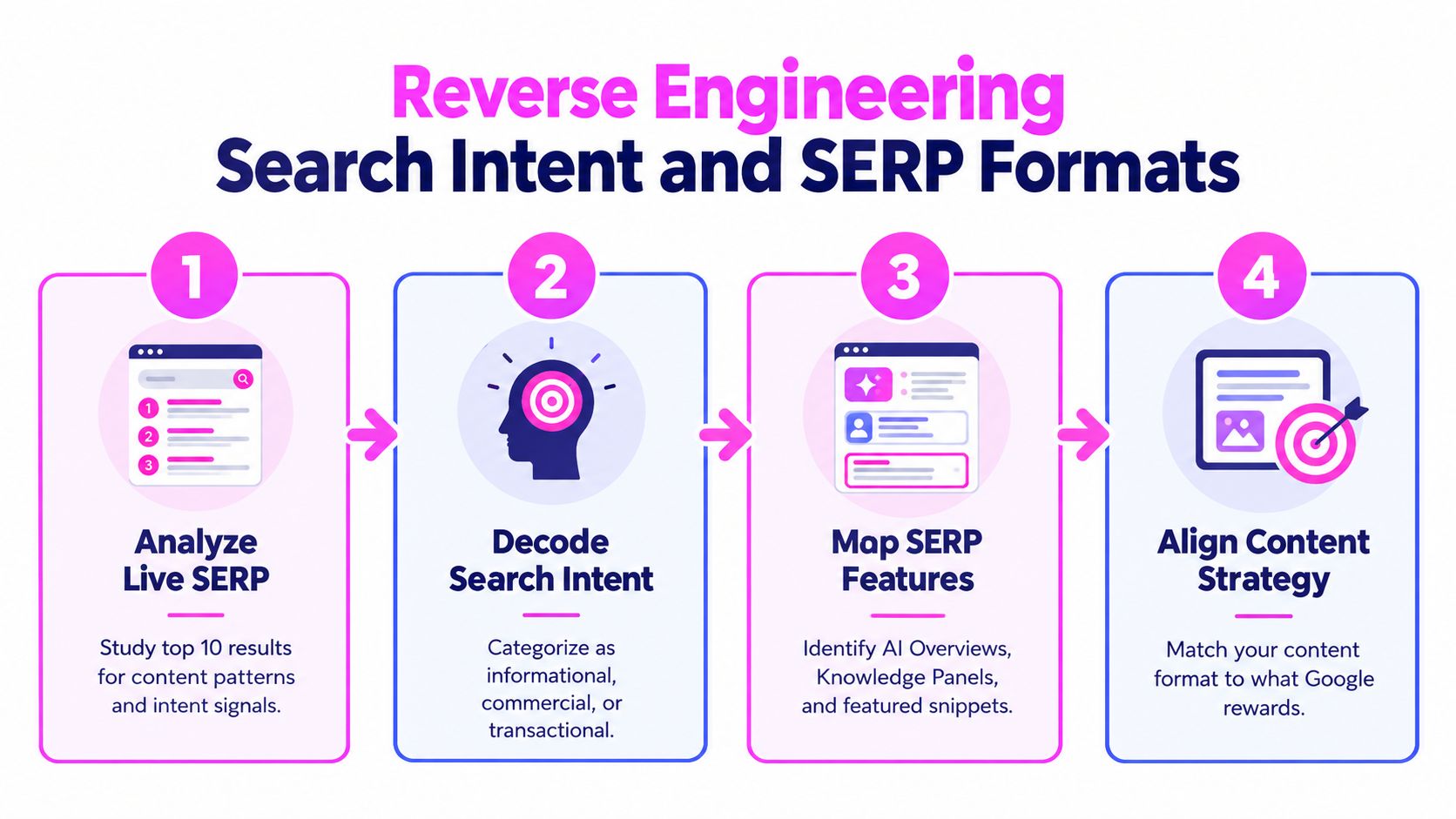
My SERP audit workflow
I use a worksheet with one row per result and capture:
- Page role: Identify whether the URL is a guide, landing page, product page, comparison, forum discussion, video, or another format.
- Intent coverage: Note the question the page answers first, then list secondary questions it handles well or ignores.
- Structure: Record headings, tables, definitions, steps, original examples, and visible evidence of experience.
- Elementos de las SERP: Check for AI Overviews, featured snippets, People Also Ask, local results, videos, image results, and shopping modules.
- Content gaps: Mark missing explanations, outdated details, weak examples, and unanswered objections.
I don't chase an arbitrary word count. I compare coverage and usefulness. A page that says the same thing with more paragraphs won't automatically beat a shorter page that gives the right answer faster. Conversely, a thin page can't satisfy a complex query just by using a polished title.
People Also Ask questions are particularly useful because they expose adjacent intent. I group them by decision stage, such as definition, implementation, troubleshooting, alternatives, and evaluation. I then decide whether each group belongs on the primary URL or deserves its own supporting page. That prevents the common mistake of creating several URLs that all target the same underlying need.
From competitor gaps to one URL target
Next, I compare competitor pages against my own site. I want to know which queries drive visibility to competing URLs, which pages receive that demand, and whether my site already has a suitable URL. A keyword gap report is only useful after I map each opportunity to a page purpose.
A practical mapping might look like this:
| Query pattern | Best URL type | Content response |
|---|---|---|
| Broad educational query | Pillar guide | Explain the topic and link to deeper resources |
| Specific implementation question | Tutorial | Give ordered steps, examples, and failure points |
| Product evaluation query | Comparison page | Clarify differences, fit, limits, and alternatives |
| Brand or service query | Commercial landing page | Make the offer, proof, and next action obvious |
I reject a keyword when the SERP format conflicts with the page I want to promote. That discipline reduces cannibalization. It also keeps the editorial team from forcing a blog post into a query where Google consistently rewards a category page or a direct tool.
Building Topical Depth and Entity Consistency
A competitive page rarely earns durable visibility as an isolated asset. I build a topic system around the primary page, then make sure every part of the site describes the business, expertise, and offer consistently.
Entity consistency means the same organization, people, products, services, and relationships appear clearly across the site. Names, descriptions, author information, contact details, service categories, and supporting profiles shouldn't contradict one another. Search engines need context, and readers need confidence that the page comes from a real practitioner rather than a generic content production system.
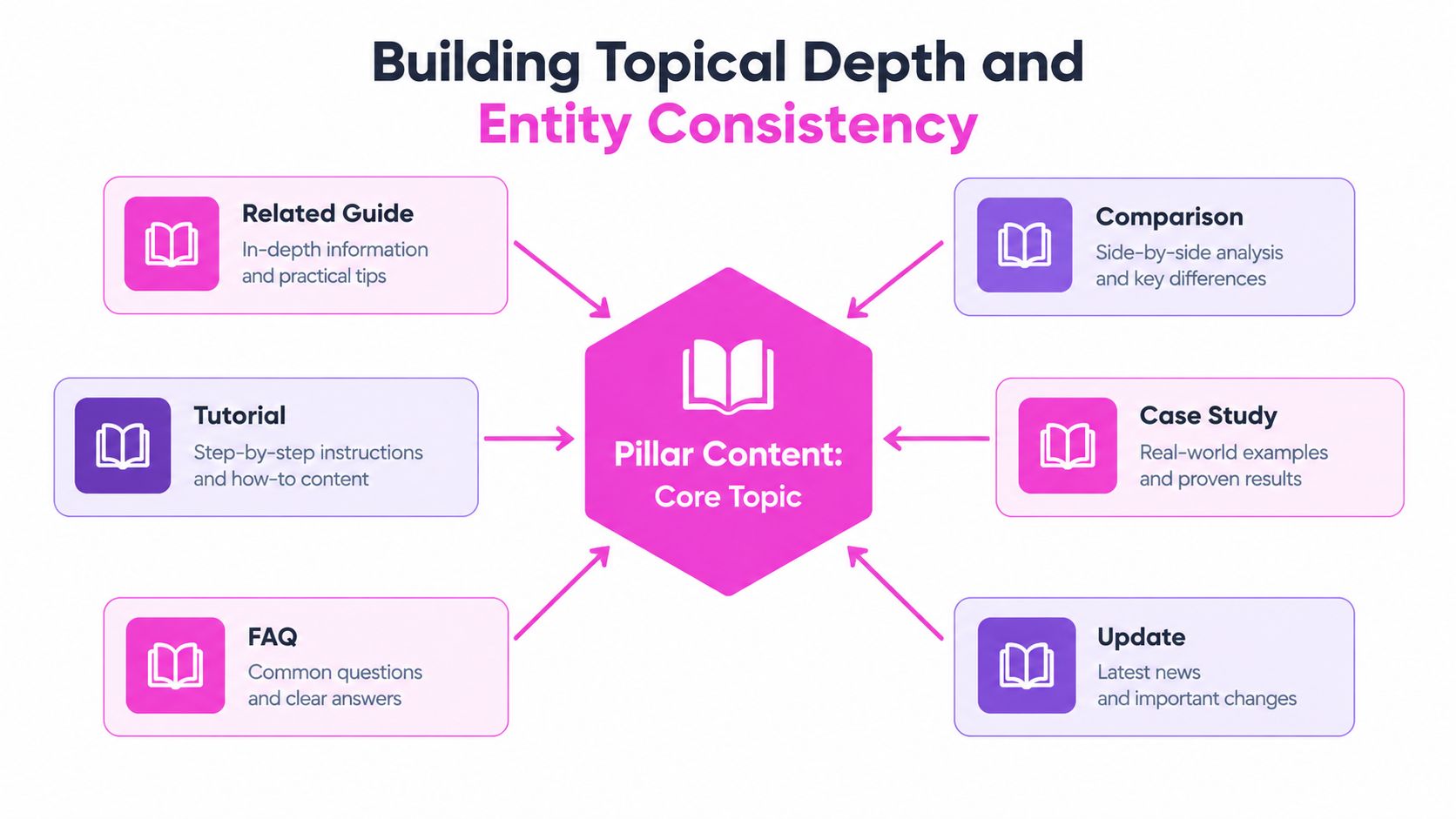
Build the cluster around decisions, not synonyms
I begin with the core problem the pillar page solves. Then I group related queries by the decision they support:
- Foundations: Definitions, prerequisites, terminology, and the conditions under which the advice applies.
- Execution: Tutorials, workflows, templates, and implementation details.
- Evaluation: Comparisons, trade-offs, alternatives, and buying criteria.
- Troubleshooting: Common failures, edge cases, diagnostics, and recovery steps.
- Evidencia: First-hand observations, experiments, examples, and documented outcomes.
Each cluster page gets one clear job. If two pages answer the same question for the same audience, I merge them, redirect one, or change the intent. Publishing near-duplicates to capture minor keyword variations usually creates maintenance debt rather than authority.
Internal links should reflect the reader's next decision. A tutorial can link back to the pillar for context, then forward to a comparison or troubleshooting page. The pillar should link to the strongest supporting pages, using descriptive anchors that explain what the reader will find. This creates a useful information path and gives important URLs prominence within the site.
Prove experience instead of padding the page
E-E-A-T isn't satisfied by adding a generic author box. I look for evidence that a practitioner has done the work: implementation constraints, screenshots where appropriate, failed approaches, diagnostic logic, and explanations of when a recommendation shouldn't be used. A specialist site with fewer pages can compete more effectively when those pages contain observations that a generalist cannot reproduce.
For research-heavy topics, I also document the method. If I analyze public data, I explain what was collected, how it was interpreted, and where the limits are. A resource such as Scrapfly's guide to web scraping projects can help teams develop practical data-collection projects, but the resulting content still needs transparent methodology and editorial judgment.
I audit entity consistency as part of every content update. The business description should match across key pages, authors should have credible profiles, services should use stable terminology, and internal links should reinforce the same topical relationships. This is slower than publishing disconnected articles, but it builds a site that explains what it knows and why visitors should trust it.
Optimizing On-Page Signals and Title Generation
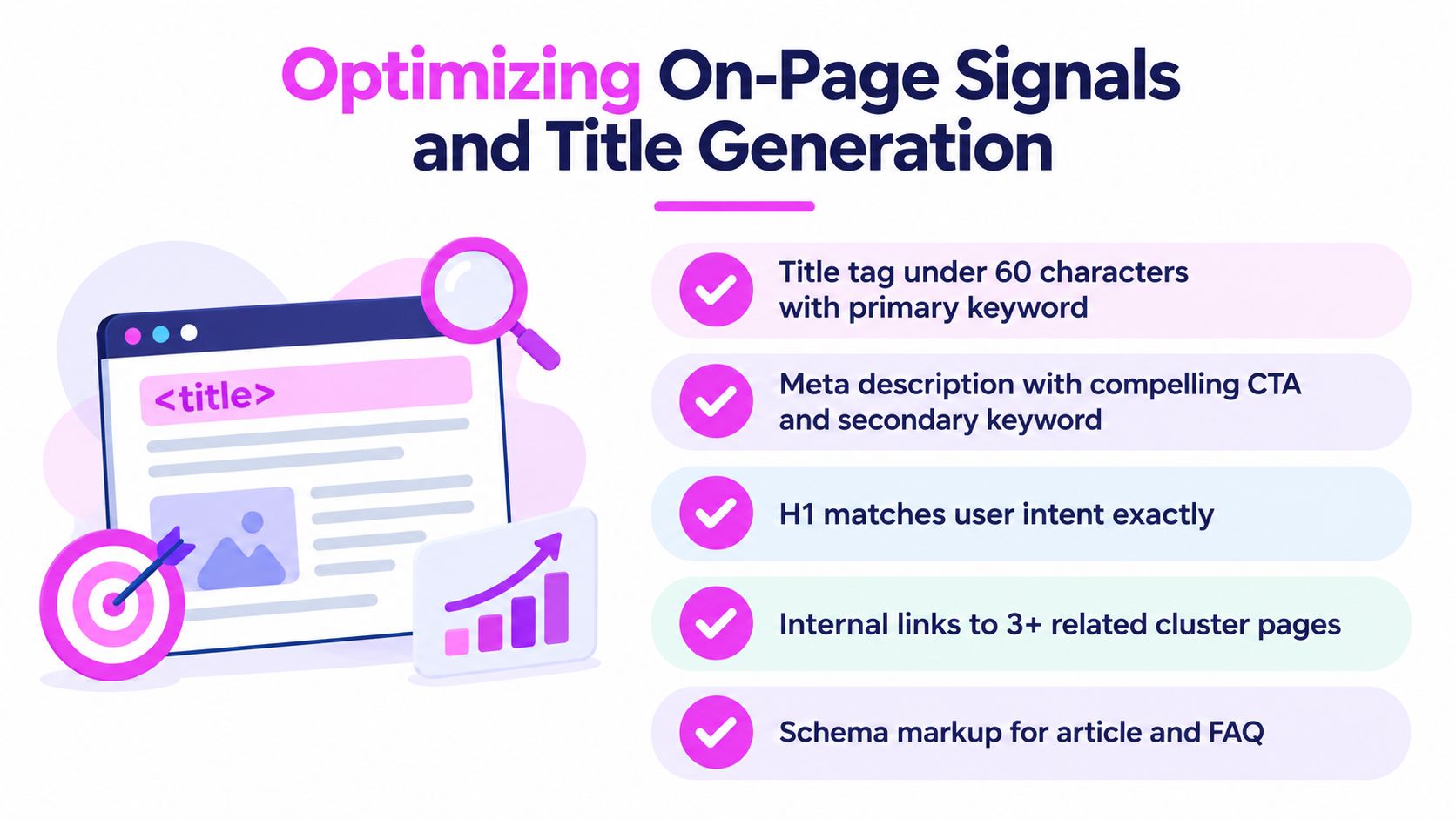
On-page SEO isn't just placing a keyword in a title tag. The page needs a coherent set of signals that helps Google understand the document and helps a searcher choose it. Google can generate a title link from the <title> element, the visible main title, headings such as the H1, og:title, prominent styled text, on-page copy, and anchor text, according to the SEO Starter Guide.
That means I audit the page as a rendered experience, not just as source code. If the title tag promises one thing while the H1, opening paragraph, and internal anchors suggest another, Google has several reasons to rewrite the result.
Make the page agree with itself
My on-page review checks the following:
- Title tag: State the page's actual value and primary intent. Keep it clear and specific rather than forcing multiple keyword variants.
- Visible title and H1: Match the promise made in the search result, while using natural language that a visitor understands.
- Opening answer: Resolve the main query early. Don't make the reader wade through a long preamble.
- Subheadings: Organize secondary intents, objections, and steps in a logical sequence.
- Internal anchors: Describe the destination accurately so users and search engines understand the relationship.
- Structured data: Add relevant markup only when the page supports it. Schema doesn't compensate for weak content.
The familiar “under 60 characters” rule can be a useful drafting constraint, but it isn't a guarantee that Google will display the title unchanged. Google's system may draw from several page elements, so I optimize for consistency and clarity rather than character-count superstition.
I also review low-value content across the domain. Google says the Helpful Content system uses a site-wide signal, meaning weak or thin content in one area can affect how the site is evaluated overall, although it remains only one signal among many, as explained in Google's Helpful Content Update documentation. I prune, consolidate, improve, or noindex pages based on their purpose and value. Fixing one landing page won't necessarily solve a domain-wide quality problem.
Page structure should support both discovery and consumption. A clear answer, useful headings, concise lists, relevant examples, and visible authorship make the document easier to interpret. They also create extractable passages for answer-focused SERP features without reducing the page to a collection of disconnected snippets.
Executing a Targeted Link Acquisition Strategy
Backlinks still matter, but raw volume is a poor operating metric. The expert survey cited earlier placed backlinks among the strongest top-three choices, yet that doesn't mean every directory, guest post, or cheap placement deserves outreach. A link should strengthen the relevance and credibility of the page it points to, not merely inflate a third-party metric.
I start with a backlink gap. I identify domains that link to competing pages but not to the relevant page on my site, then classify those domains by topical fit, editorial context, and likely audience value. A link from a niche publication that sends qualified readers can be more useful than a numerically impressive link from a broad site with no relationship to the topic.
Use a gap list as a research document
For every prospect, I record:
- Linking context: What page links to the competitor, and what specific evidence or resource attracted that link?
- Replacement angle: Can my page offer a better study, clearer explanation, original dataset, tool, or updated reference?
- Audience fit: Would the publication's readers benefit from the destination page?
- Relationship path: Is there an existing mention, contributor, partner, customer, or editorial contact?
- Risk: Does the site appear editorially selective and topically relevant, or does it publish indiscriminately?
I don't send a generic “please link to us” message. I point to the exact place where my resource improves the article and explain the reader benefit. The pitch is stronger when the asset effectively closes a gap.
Unlinked mentions are often the easiest opportunities because the writer already knows the brand. I verify that the mention is accurate, find the most relevant destination URL, and request a link without demanding a specific commercial anchor. Broken-backlink recovery follows the same logic. I locate a dead competitor resource, identify pages that still reference it, and offer a working replacement only where my content fits.
Social distribution can support discovery and relationships, but I don't confuse social engagement with editorial authority. For teams refining that channel, guidance on turning tweets into traffic offers useful context for converting social attention into visits and potential relationships.
What I refuse to optimize for
I won't buy a batch of unrelated links because a vendor promises quick movement. I won't use exact-match anchors repeatedly, and I won't pursue a placement when the page has no audience overlap. Those tactics can produce activity reports while leaving the underlying authority problem untouched.
A focused workflow takes longer to assemble, but it compounds because each successful asset becomes a reference point for future outreach. The SemDash backlink acquisition guide is a useful reference for organizing that process around research, relevance, and outreach rather than indiscriminate volume.
Tracking Visibility and Adapting to AI Overviews
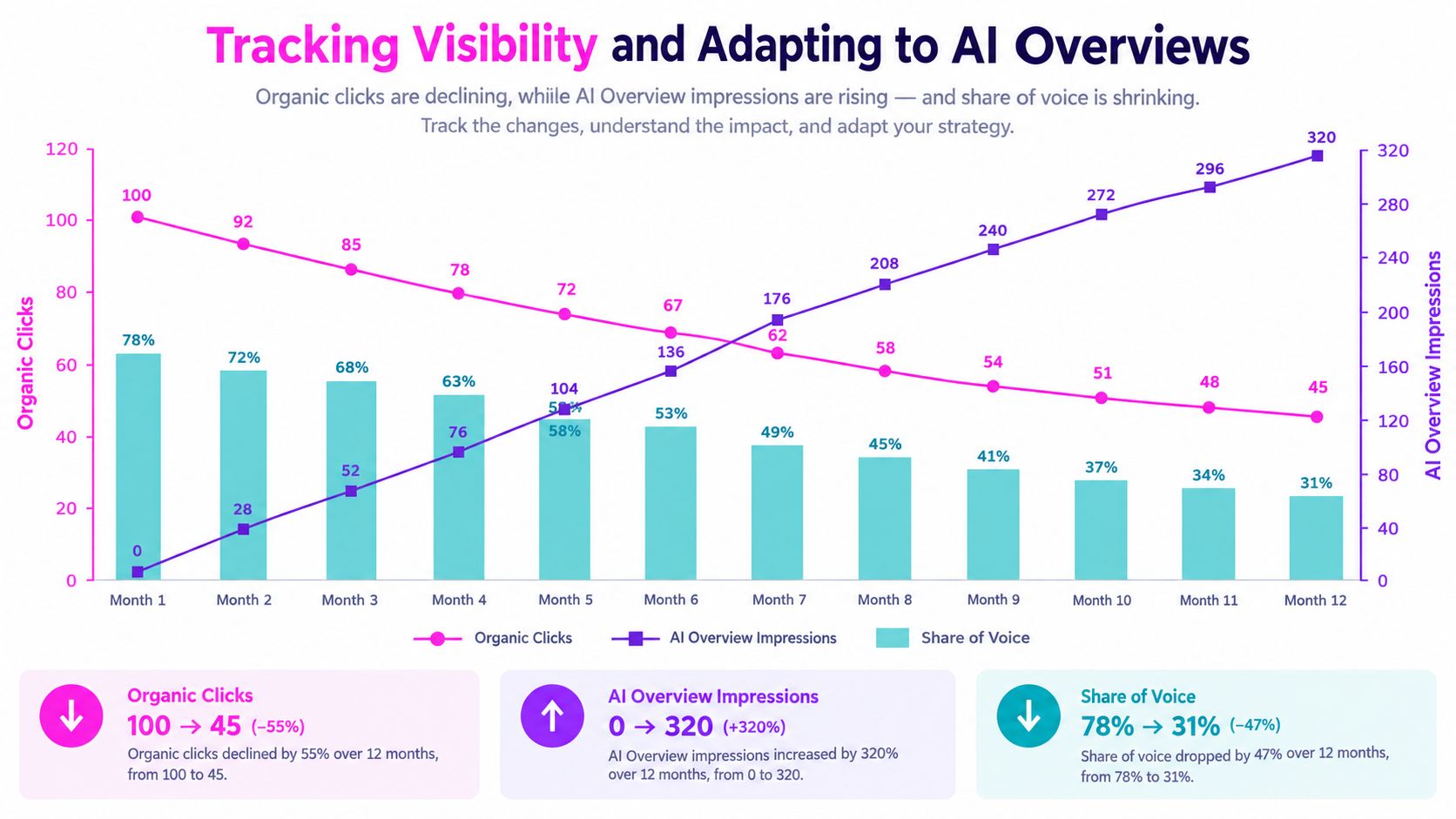
Rank tracking no longer captures the full search picture. For each strategic query set, I maintain two views: blue-link performance y answer-surface visibility. The first records the ranking URL, position, SERP type, impressions, clicks, and click-through rate. The second records whether an AI Overview appears, whether the domain is cited, which URL earns the citation, and which passage or claim supports it.
Separate the ranking test from the citation test
A rise in impressions alongside falling clicks calls for diagnosis before editing. I check whether an AI Overview or another SERP feature changed the click opportunity, compare the page with results using the same SERP format, inspect the title link, and verify whether qualified visits and conversions remain stable.
I place positions two through five in a dedicated testing queue. As benchmarked earlier, the steepest click-through decline occurs after position two, so I test intent alignment, title wording, opening answers, missing subtopics, internal links, and supporting evidence. I change one variable at a time where possible, which makes gains easier to attribute and failed tests easier to reverse.
Citation optimization follows a separate review. Important claims should be easy to locate, supported by descriptive headings, and answered directly. Supporting context belongs close to the claim. Entity references must also remain consistent, so search systems can connect the page with the correct organization, product, author, or subject. The aim is precise writing that a summarizer can quote without removing the intended meaning.
I use AI Overview optimization workflows alongside Search Console and rank tracking, reviewing changes by query group instead of isolated impressions. A citation can reinforce brand recognition without producing an immediate click, but visibility still needs a business connection. If citations increase while qualified engagement stays absent, the page or offer may not match the audience's next step.
SemDash brings keyword, SERP, competitor, backlink, and AI Overview citation data into one research workflow. It helps map ranking opportunities to URLs and monitor blue-link and citation visibility. Visit SemDash to review current gaps, prioritize pages in striking distance, and build an evidence-based plan for qualified Google demand.