
You open your rank tracker before the first meeting and find that several important URLs have fallen. The first instinct is usually personal: a page must have lost relevance, a competitor must have built links, or a recent edit must have damaged performance. That reaction becomes expensive when the entire search market is moving at the same time.
I treat a SERP volatility tracker as a diagnostic layer, not a panic meter. It tells me whether my rankings changed inside a broader market shift, whether only one intent cluster moved, and whether stable blue-link positions are hiding a decline in clicks caused by changing SERP features or AI Overviews. That distinction determines whether I wait, investigate, refresh, consolidate, or change the measurement setup itself.
Tabla de contenido
- Why Raw Rank Tracking Fails Without Volatility Context
- How to Measure and Interpret Volatility Signals
- Setting Up Ongoing Tracking with Historical SERP Data
- Diagnosing Spikes Algorithm Updates vs AI Overviews
- Real-World Use Cases for Volatility Data
- Alerting Best Practices and Workflow Integration
- Building a Resilient SEO Strategy
Why Raw Rank Tracking Fails Without Volatility Context
Raw rank tracking answers a narrow question: where did a URL appear for a keyword when the tool checked it? That information matters, but it doesn't explain whether the result page changed for everyone. If five pages drop together, I need market context before I touch titles, internal links, or content.
I've seen teams interpret simultaneous ranking losses as a site failure, then publish rushed revisions while Google was still reshuffling results. Those edits muddy the evidence. Once several pages change at once, I can no longer tell whether the original content had a problem or whether the intervention coincided with the end of a volatile period.
Regla práctica: A ranking drop is an observation. A diagnosis requires market, competitor, device, intent, and click data.
The March 2026 Google core update provides a useful benchmark for why this context matters. A volatility analysis reported that 79.5% of top-three URLs changed positions, 90.7% of top-ten URLs shifted, and 24.1% of pages in the top ten fell out of the top 100 entirely during the update (Search Engine Land's analysis of the March 2026 core update). Compared with the December 2025 core update, top-three stability fell from 33.1% to 20.5%, while top-ten stability fell from 16.9% to 9.3%, according to the same analysis.
Those figures don't tell me whether my site deserves a content refresh. They tell me that a large share of the market can move during one update window. My first action is therefore to compare affected keyword clusters with external volatility signals and competitor histories.
The difference between a site problem and a market problem
A site-specific pattern usually has a narrow shape. One template loses visibility, one directory stops ranking, or one device segment declines while the others remain steady. A market-wide pattern touches multiple domains and often affects a shared intent category.
I also check whether the apparent ranking loss is really a visibility loss. A page can retain its classic position while an AI-generated answer, a different feature layout, or a source rotation changes how often users see and click it. Rank position alone can't capture that.
The broader trend reinforces the need for a baseline. Historical analysis found that desktop SERPs were 26% more volatile in 2024 than in 2023, while mobile SERPs were 16% more volatile over the same period (Search Engine Land's historical volatility analysis). I read that as a monitoring requirement, not as a reason to make constant changes. A daily series with intent and device segmentation gives me enough context to separate routine movement from an abnormal event.
How to Measure and Interpret Volatility Signals
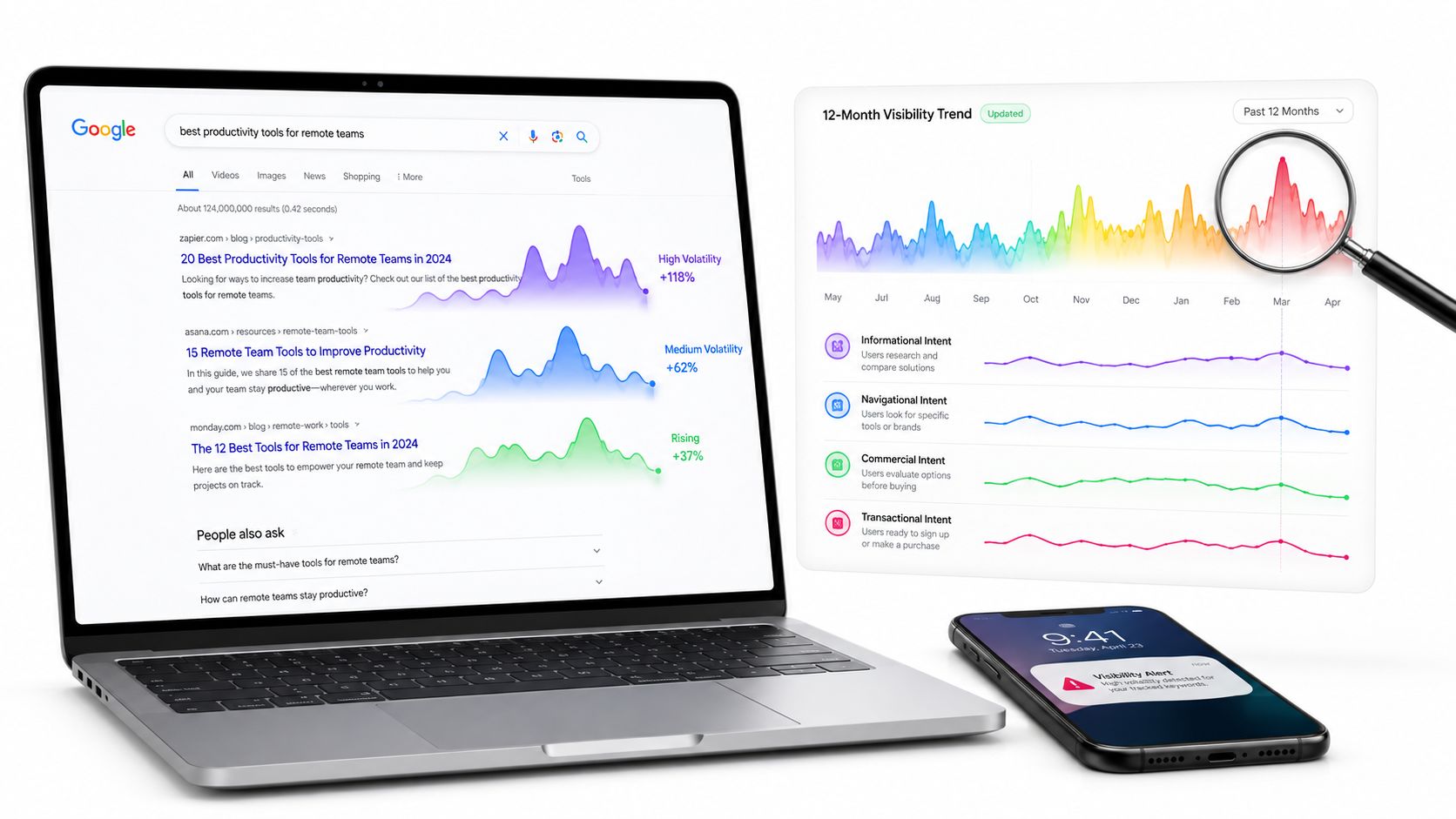
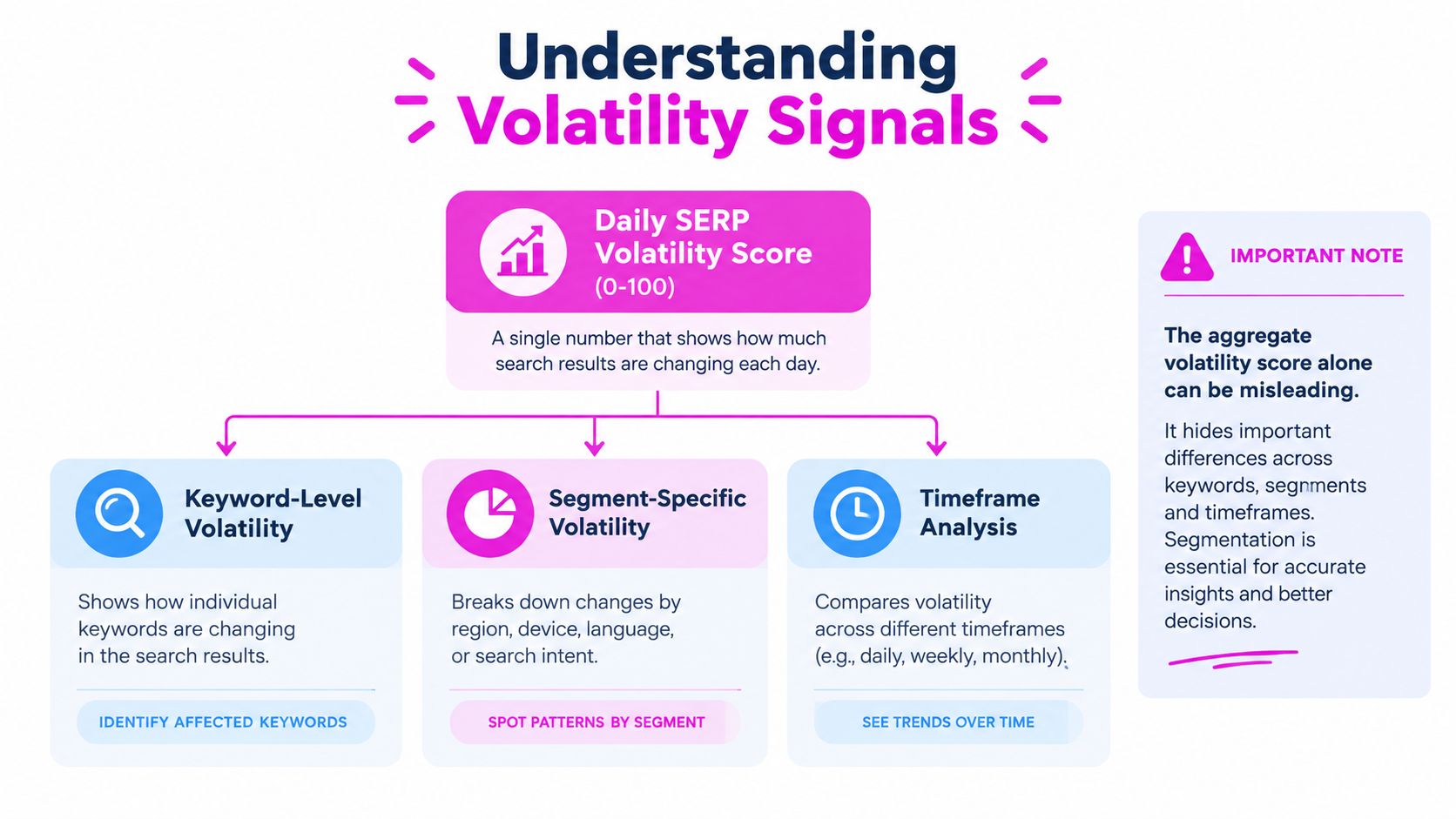
A useful index compresses many keyword-level changes into a signal I can interpret quickly. One current implementation describes a daily 0–100 volatility index that measures ranking movement across millions of keywords, averages the movement, and normalizes it into a bounded score (Keyword.com's SERP Volatility Index). The value isn't the exact formula alone. The value is aggregation. It turns millions of noisy deltas into a market-level indication that many results moved together.
That aggregation can also mislead me if I treat it as a verdict about my site. A broad score may reflect a category I don't target, a device type I don't serve, or an intent group unrelated to my revenue pages. I use the aggregate reading to answer, “Is something happening?” Then I segment my own data to answer, “What happened to me?”
The three cuts I need before making a decision
Keyword level shows whether movement is concentrated in a few terms or spread across a cluster. A handful of isolated changes usually demands less urgency than coordinated movement across related queries.
Intent level exposes shifts in what Google believes the searcher wants. I separate informational, commercial, transactional, and navigational terms where the dataset supports it. If transactional queries move while informational terms remain stable, I investigate product pages, comparison formats, commercial SERP features, and competitor offers rather than rewriting the entire site.
Device level prevents desktop data from masking a mobile-specific event. I compare mobile and desktop histories because layout, feature presence, and user behavior can differ by device. A mobile-only change may point toward a device-specific result composition or technical experience issue, while a parallel shift across devices is more consistent with broader ranking churn.
Semrush Sensor provides a practical category and device-oriented reference model. Its sensor classifies volatility on a 0–10 scale, with approximately 0–2 low, 2–5 normal, 5–8 high, and 8–10 very high (Semrush Sensor methodology and interpretation). I don't use those bands as automatic instructions. I use them to frame the size of the external movement, then compare the relevant category and device against my keyword set.
Read the score as a trigger, not a conclusion
A high external score with broad competitor movement tells me to preserve evidence and avoid premature edits. A quiet external score with a sharp decline in one URL group makes a technical, content, cannibalization, or competitor investigation more likely.
For live result inspection, I pair the index with a comprobador de serps en vivo. I want to see the actual result composition, not just a position number. A tracker becomes useful when it helps me connect a movement to a changed page type, feature, source, or intent pattern.
Setting Up Ongoing Tracking with Historical SERP Data
I can't define abnormal volatility without knowing what normal looks like for my keyword universe. My setup starts with a fixed keyword set, stable targeting, and enough historical depth to expose recurring patterns rather than one unusual day.
I create groups around intent, page type, device, and business importance. For example, a SaaS site might separate product terms, comparison terms, educational queries, and branded searches. I also map every keyword to the URL that should rank. URL-level mapping matters because a ranking change may be a page substitution problem, not a domain-wide visibility problem.
The SERP Checker screenshot below represents the kind of historical view I want available while diagnosing a movement.
My baseline setup
Freeze the keyword universe. I avoid changing the tracked set during an investigation. Adding easier or higher-volume terms can create artificial movement in the aggregate.
Assign intent and target URLs. Each query gets a cluster label and an expected ranking page. When another URL appears, I flag possible cannibalization or a change in Google's interpretation.
Separate devices and locations. I keep desktop and mobile readings distinct and preserve location settings. Mixing them produces a score that may not represent any real searcher.
Review the 12-month history. SemDash's SERP Checker provides historical SERP views across 12 meses, which gives me a rolling context for trend analysis and intent changes. I look for recurring seasonal behavior, repeated feature changes, and whether a recent spike is unusual for that cluster.
Record external events. I annotate confirmed updates, major site releases, migrations, and template changes. The annotation doesn't prove causation, but it makes timing visible.
Track the ranking URL, not only the position. A stable average can hide URL rotation. I want to know whether the same page holds the query or whether Google is testing different pages from my domain.
I keep content ideation separate from diagnosis. If the workflow also includes automated research or drafting, this overview of top SEO AI tools for marketers is useful for evaluating adjacent tools without confusing content production with ranking measurement.
Use the historical chart after the keyword groups are stable, not as a replacement for them.
My daily review starts with the cluster view, then moves to affected URLs and SERP snapshots. I don't need to inspect every keyword manually. I need enough history to identify whether movement is broad, localized, recurring, or tied to a change in the result surface.
Diagnosing Spikes Algorithm Updates vs AI Overviews
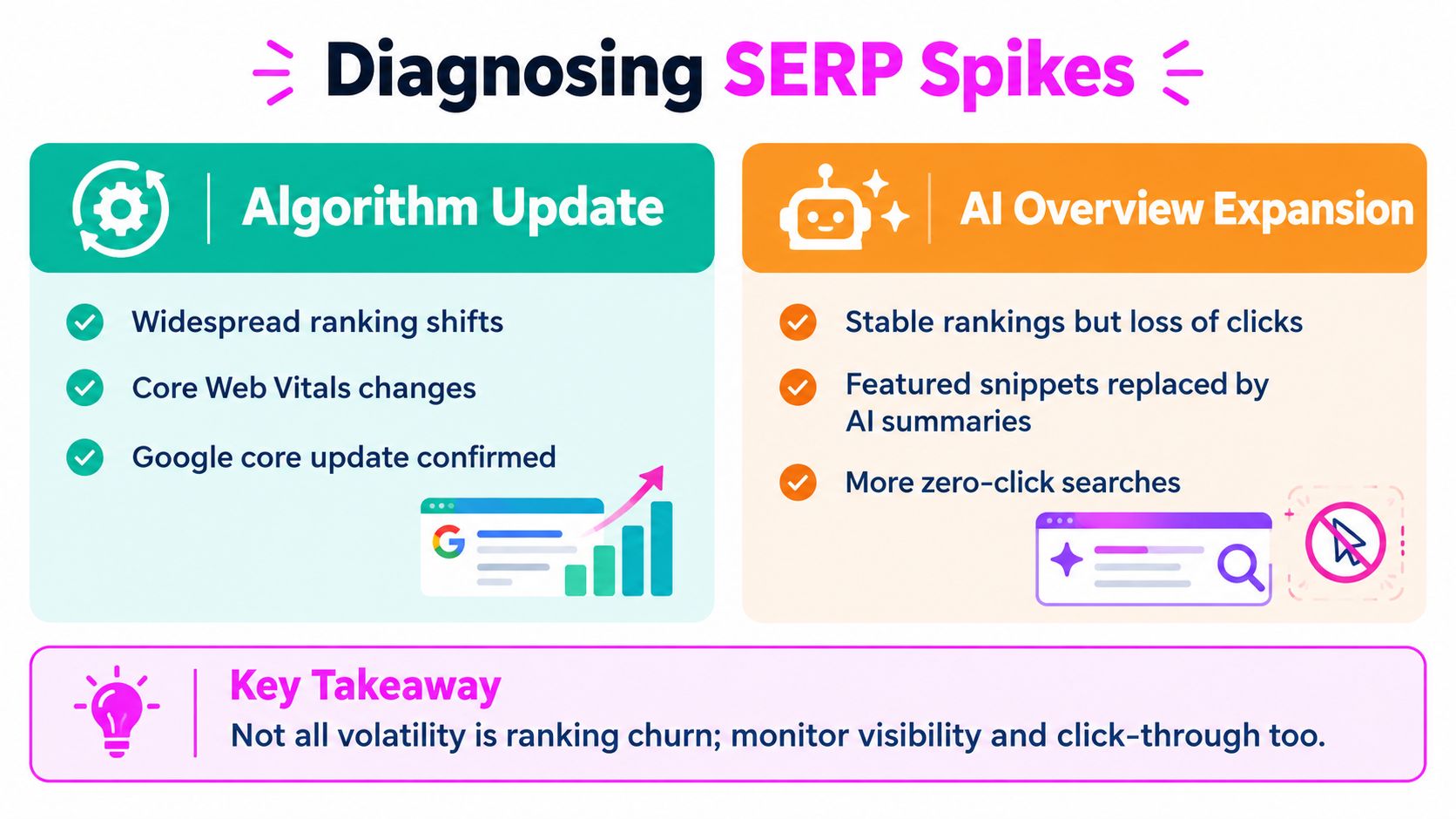
A volatility spike doesn't automatically mean classic algorithm churn. That assumption breaks when the blue-link rankings remain stable but impressions, clicks, or click-through rate decline. The answer surface may have changed even when the URL's recorded position hasn't.
I separate three possibilities: broad ranking recalibration, AI Overview expansion or source rotation, and measurement error. The first changes where pages rank. The second can change how much attention classic results receive. The third comes from inconsistent location, device, keyword sets, SERP personalization, or tracking behavior.
The evidence I compare
| Señal | Interpretación probable | What I inspect next |
|---|---|---|
| Multiple domains and intent groups shift | Broad ranking movement | Update timing, category, device, competitor histories |
| Rankings hold while clicks fall | Visibility or SERP feature change | AI Overview presence, snippets, impressions, click-through rate |
| One tracker spikes while my fixed set stays calm | Coverage or measurement difference | Keyword overlap, location, device, refresh timing |
| My URLs change while competitors hold | Site-specific movement | Technical health, URL mapping, content and intent fit |
I use SemDash's AI Overview tracking workflow to inspect which queries trigger AI-generated answers and which URLs are cited. The key question isn't whether my domain appears. I want to know whether the cited page matches the page ranking in the classic results, whether citations rotate, and whether the affected queries share an intent pattern.
Stable rankings can still hide lost visibility
Suppose a commercial page remains in the same blue-link position, but an AI Overview now summarizes the category above it. If impressions stay similar but clicks decline, rewriting the page may be the wrong first response. I would first record the changed SERP surface, compare the query's historical feature mix, and review whether the page offers original detail that an answer layer cannot easily replace.
The opposite pattern also matters. If rankings fall across several related page types and competitors move at the same time, I treat the event as classic algorithmic volatility until the evidence says otherwise. I don't call it an AI Overview test merely because AI features are present.
Diagnostic principle: A position report measures placement. A visibility report measures the search experience around that placement.
Measurement artifacts deserve their own check. I verify that the tracker uses the same device, location, language, and keyword set across dates. I also compare Search Console impressions and clicks with rank history. When those data sources disagree, I investigate the collection conditions before changing a page.
Real-World Use Cases for Volatility Data
Volatility data becomes valuable when it changes the order of operations. My decision matrix starts with scope, persistence, and business impact, not with the size of a single ranking drop.
If a cluster moves during a broad external spike and competitors show similar movement, I wait and preserve the before-and-after SERPs. I capture affected URLs, changed result types, and the timing of the movement. Editing during the storm often creates more uncertainty than it removes.
If the market stabilizes but one page remains weak, I inspect the current top results against the page's intent. I compare format, depth, first-hand evidence, coverage, and the role of SERP features. A refresh makes sense when the page has a clear relevance or quality gap, not because a chart turned red.
Choosing the right intervention
| Pattern | Response |
|---|---|
| Broad movement across competitors | Monitor, annotate, and avoid reactive rewrites |
| One URL loses while its domain's other pages hold | Audit that page, template, links, and intent match |
| Several similar URLs compete for one topic | Consolidate where overlap is genuine, then redirect carefully |
| A page no longer matches the query's purpose | Rework the format or assign the query to a better URL |
| Rankings hold but clicks decline | Investigate AI Overviews and other SERP features before editing |
| A competitor replaces the page with a stronger result | Run a competitor gap analysis and improve the missing value |
Redirects need restraint. I consolidate only when pages overlap substantially and one destination can satisfy the combined intent. Redirecting merely because one URL underperforms can erase useful topical coverage and makes the diagnosis harder.
Competitor monitoring adds another layer. When a rival drops during the same cluster movement, I don't assume an opportunity is permanent. I inspect whether the competitor lost because of a broad update, changed intent, or a page-specific weakness. If its decline exposes a durable content gap, I prioritize a page that answers the query better instead of copying the displaced result.
For high-value pages, I tie the decision to business impact. A volatile informational term may deserve observation, while a transactional cluster connected to qualified leads needs a faster review of rankings, visibility, and landing-page behavior. The tracker doesn't make that prioritization for me. It supplies the evidence.
Alerting Best Practices and Workflow Integration
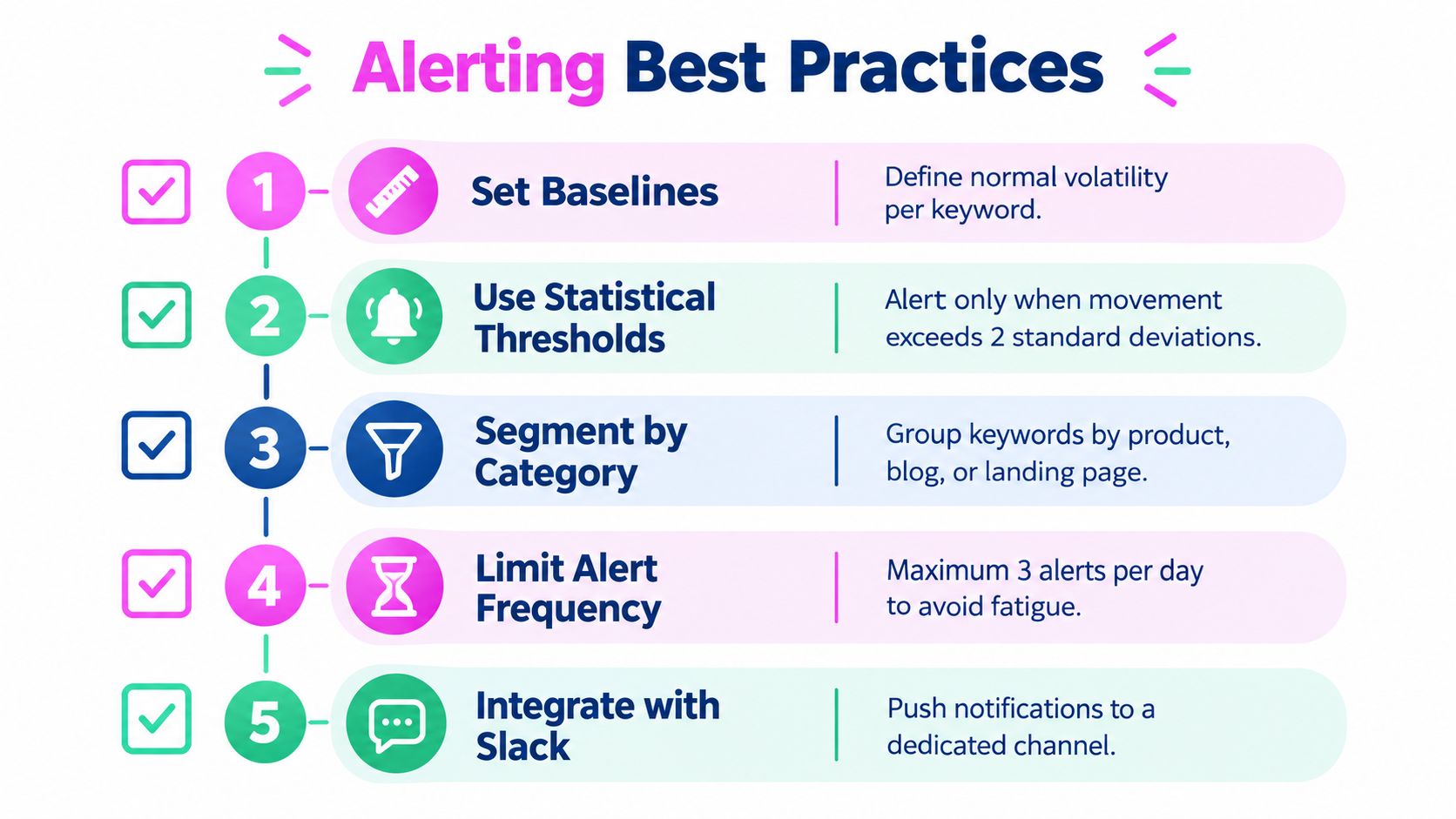
A dashboard that demands constant attention becomes another source of noise. I configure alerts around unusual movement in a fixed baseline, then route only decision-ready signals into Slack or the team's reporting workflow.
One practical model treats the tracker as a daily re-check rate against a rolling recent baseline. In that model, 100% represents a typical recent day, while readings of 0–85% are calm, 85–130% normal, 130–200% above normal, and 200% or higher storm-level volatility (el índice de volatilidad de SERP Dino). I use the bands as context, not as an automatic content-change command.
Another model flags a spike when the day's reading rises above the 95th percentile of the trailing month or jumps 30% or more day over day (SEOJuice's SERP volatility alerting model). Those rules are useful because they focus attention on statistically unusual movement rather than ordinary drift.
The alert payload matters as much as the threshold
Every notification should include the affected segment, device, location, date, average movement, ranking URLs, and competitor direction. “Volatility high” isn't actionable. “Mobile transactional cluster moved, three competitors changed, informational cluster stable” gives the team a starting hypothesis.
I also use severity routing:
- Market alert: external volatility rises and multiple domains move. Log the event and pause reactive edits.
- Segment alert: one intent or device group changes. Assign an analyst to inspect SERP features and URL mapping.
- Site alert: my domain moves while the market remains stable. Start technical and page-level checks.
- Visibility alert: rankings hold but impressions or clicks change. Review AI Overviews and SERP composition.
The alert goes into the weekly report as an annotated event, not as a standalone score. During sprint planning, I convert persistent, site-specific findings into technical, content, or consolidation tasks. That keeps the team from turning every temporary fluctuation into production work.
Building a Resilient SEO Strategy
I no longer treat SERP volatility as an exceptional interruption. Historical analysis showed rising instability across both desktop and mobile results, and the March 2026 update demonstrated how quickly major ranking bands can reshuffle. The operational response isn't to publish faster or edit more often. It's to build a system that tells me when evidence is strong enough to act.
My weekly reporting checklist includes:
- Contexto de mercado: Compare external volatility with the same date range as site movement.
- Fixed segments: Review intent, device, page type, and location separately.
- URL history: Confirm which page ranks for each important query.
- Competitor direction: Check whether comparable domains gained, lost, or held.
- Visibility evidence: Compare impressions, clicks, click-through rate, and SERP features with position data.
- Decision status: Mark each issue as monitor, investigate, refresh, consolidate, or escalate.
The most resilient sites aren't immune to movement. Their teams detect it earlier and avoid confusing market turbulence with a page defect. Historical SERP data gives me the baseline, intent classification gives me the explanation, and alerting keeps the workflow sustainable.
I also review the measurement system itself. If a score combines unrelated markets, devices, or keyword intents, I don't let its precision create false confidence. A smaller, stable keyword set with reliable URL mapping often supports better decisions than a larger, inconsistent dataset.
The goal is controlled adaptation. I want to know when a page has lost relevance, when a competitor has improved, when Google has changed the result surface, and when the data is too unstable to justify intervention. That is how volatility becomes an operating signal instead of a daily emergency.
SemDash combines historical SERP views, URL-level ranking mapping, intent classification, competitor analysis, and AI Overview citation tracking in one SEO research workflow. Visit SemDash to inspect your keyword history, separate ranking churn from visibility changes, and build a calmer monitoring process around the queries that matter most.