


You check a money query on Monday and your product page sits fifth. On Thursday I watch the same search return an old blog post in eighth, while the product page disappears. Neither page is weak on its own, but together we're splitting clicks, links, and trust.
When you ask me what is keyword cannibalization, I don't start by counting URLs. I ask whether two pages are doing the same job for the same searcher, and whether that split is costing you clicks you'd win with one clear owner.
Tabla de contenido
- What Keyword Cannibalization Means in Practice
- Telling Real Overlap From Healthy Intent Variants
- How to Detect It in Your Own Data
- What Cannibalization Costs in Clicks and Revenue
- Which Fix Fits Each Case
- How AI Answers Change the Decision
- Confirm One Query Cluster Before You Merge Anything
What Keyword Cannibalization Means in Practice
Say the query is "best router for small office." You want your current buyer's guide to rank, but Google keeps surfacing a thinner 2021 post with a similar title. I merged the useful specs from the old post into the guide, then redirected the old URL to it. That case captures the problem cleanly.
Keyword cannibalization happens when two or more URLs on your own site compete for the same query, or for queries that need the same answer, so the search engine has to choose between them. I compare it to sending two sales reps to pitch the same client with slightly different decks. The client hears mixed signals, and neither rep closes as well as one rep with a clear brief would.
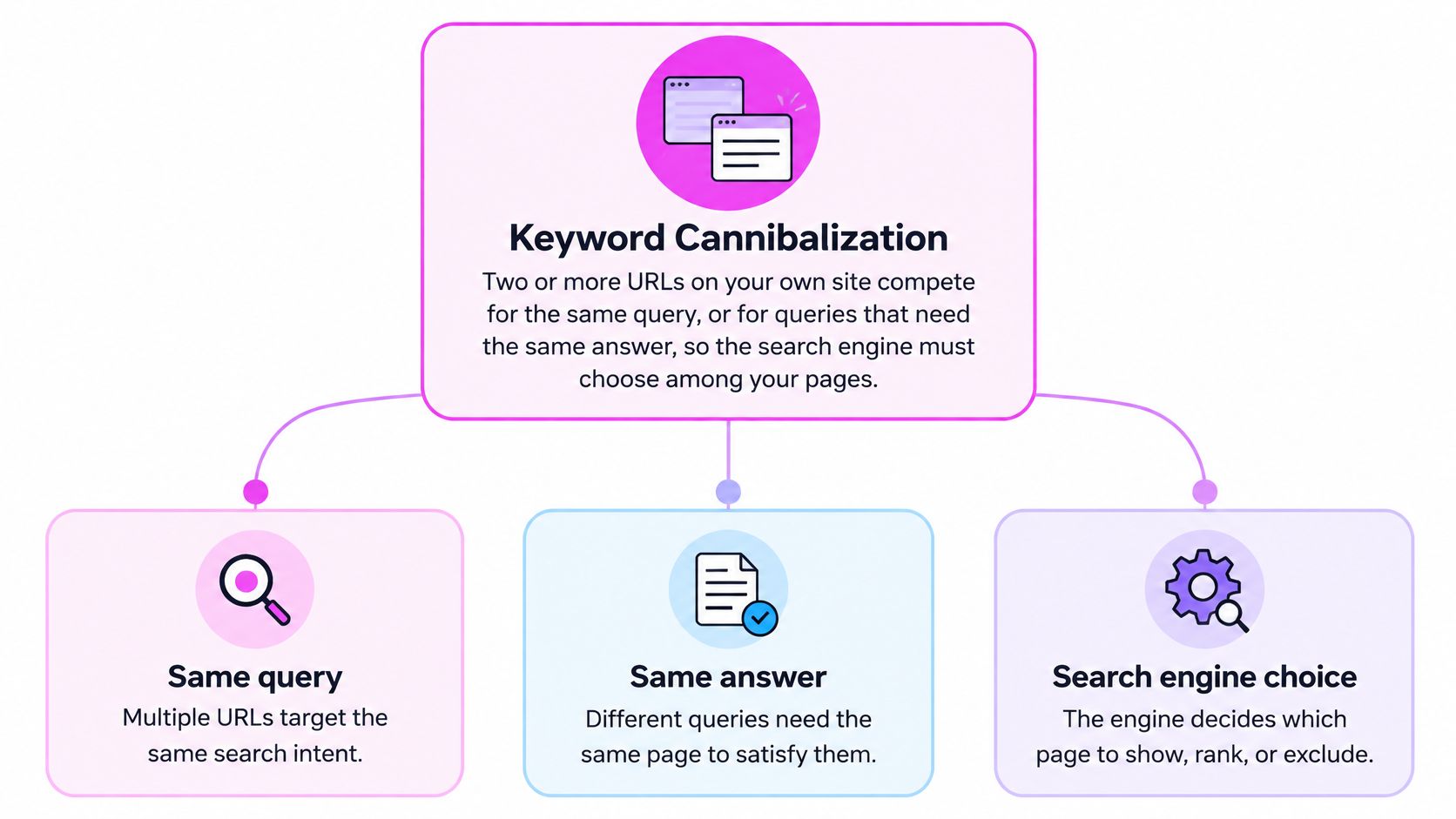
Multiple pages appearing for one query isn't automatically a defect. The Google SEO Starter Guide focuses on reducing duplicate content and redirecting non-preferred URLs to the page that best represents the information. I follow that distinction because pages serving different audiences or purposes can rank side by side without hurting each other.
The Symptoms I Trust
I look for three signals in your reports. First, rankings flip between URLs week to week with no edit to explain it. Second, the wrong page ranks, such as a support article outranking the page built to convert. Third, clicks, internal links, and backlinks spread across several weaker URLs instead of building one strong page.
Cannibalization is your own pages competing for the same job.
I don't diagnose from a keyword list alone. I compare intent and performance, because that's where you'll see whether Google is confused or rewarding two pages with different jobs.
Telling Real Overlap From Healthy Intent Variants
I don't trust URL counts. Two URLs for one query can be healthy, and one URL can still be wrong if it satisfies the wrong intent. I compare what each page promises, what the live results reward, and which URL earns clicks over time.
| Overlap scenario | Intent match | Verdict |
|---|---|---|
| Product page and buyer's guide for the same commercial query | Different intent, buying vs researching | Keep both and link the guide to the product |
| Two blog posts answering the same how-to question | Same informational intent | Merge the weaker post into the stronger |
| City landing pages for plumber Austin and plumber Dallas | Local variants with different places | Keep both and differentiate the content |
| 2019 post and its 2026 rewrite targeting one query | Same intent, one page stale | Consolidate with a 301 redirect |
| Blog post and glossary entry defining one term | Same definition intent | Differentiate the angle or merge |
Run the test yourself before you touch anything. Write the query down, open both URLs, and ask whether a searcher would be fully satisfied by either page. If your answer is yes, I treat the overlap as real, even if the headlines use different wording.
I use a structured method for classifying search intent from the live SERP because my first guess is often too tidy. A practical parallel is planning a business router upgrade, where a buying guide, a replacement checklist, and a product page answer related needs without doing the same job. I keep those pages separate and link them in the order a buyer moves.
If Google alternates between your URLs for weeks, I take that as the tiebreaker. You may see a clear distinction, but the searcher and the ranking system don't. Keep pages with different jobs, fix pages with the same job.
How to Detect It in Your Own Data
I start in Google Search Console because you already own that data and it shows the exact query-to-URL relationship. I don't need a fancy dashboard for the first pass. I need a clean export and enough history to see switching.
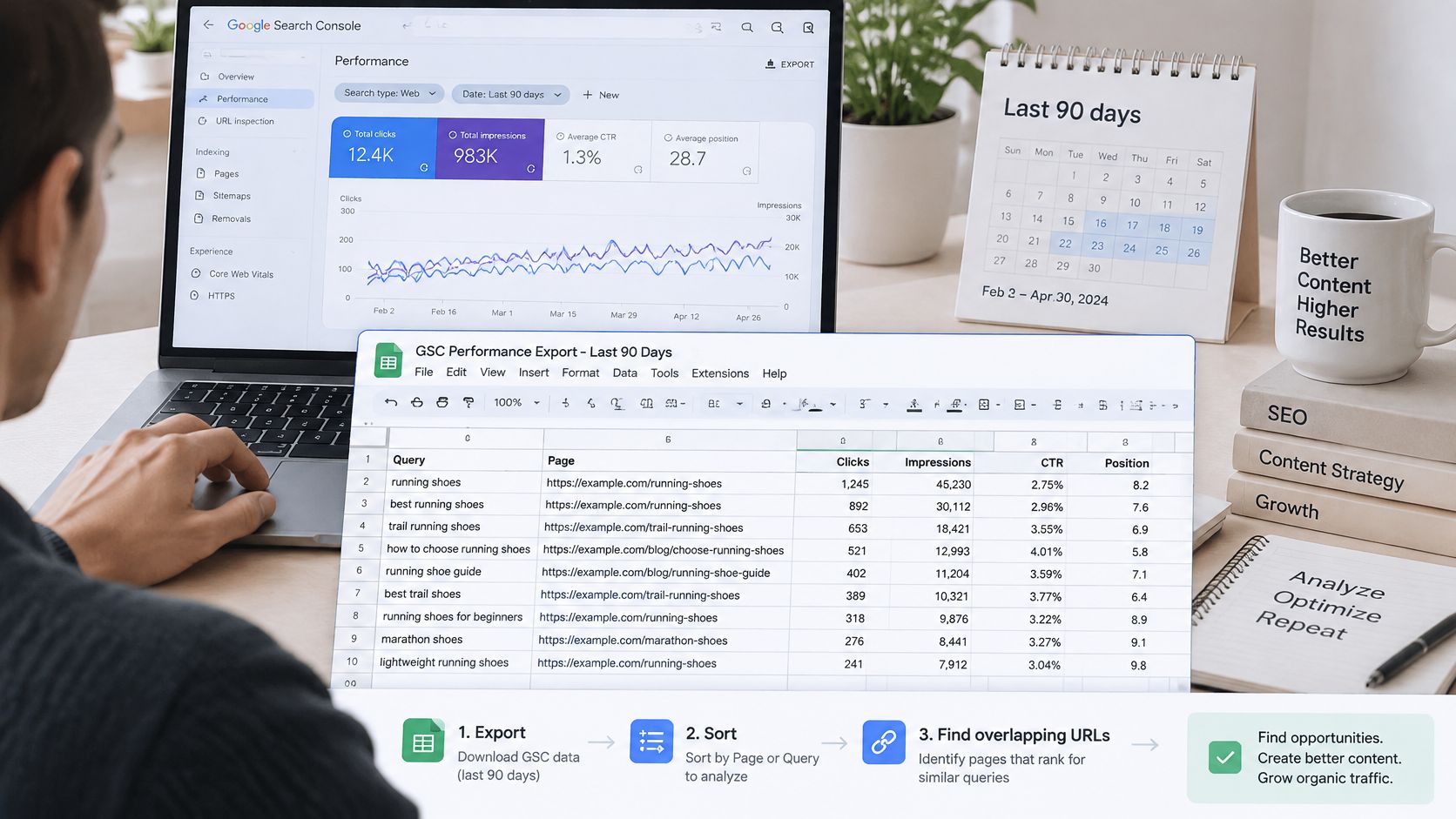
- Export 90 days with the page dimension: I pull query and page together because a query-only export hides which URL earned the impression. Without the page, you can't spot competition.
- Build a candidate list: I filter for queries where two or more URLs earned impressions in the same period. That list is long at first, and that's fine, because most rows won't need action.
- Check the click split: I look for clusters where clicks divide across URLs with no clear winner. A stable leader taking nearly all clicks worries me less than two pages trading places.
- Pull weekly data for 6 to 12 months: I want to see whether the ranking URL switches over time. Constant switching usually costs you, while a brief crossover after a publish or refresh often settles.
- Classify intent from the results: I label each cluster informational, commercial, transactional, or local by reading the top results, not by trusting the keyword wording. A query with product pages dominating results isn't informational just because it contains "how."
- Assign a verdict: I match each cluster to a keep, merge, redirect, or differentiate decision while the evidence is in front of me. I don't leave rows as "review later," because that's how audits die.
What My Spreadsheet Looks Like
I keep one row per cluster with these columns so the decision stays auditable.
- Query and URLs: The exact pages competing, not just the keyword.
- Impressions and clicks: The split that shows whether anyone is winning.
- Switching pattern: Stable, occasional, or constant across the weekly view.
- Intent and verdict: The job the searcher wants done and the fix I chose.
My rule: If you can't name the one URL that should own a query, you haven't finished the diagnosis yet.
What Cannibalization Costs in Clicks and Revenue
I price the problem before I recommend a merge, because a week of consolidation work needs a payoff. Use this illustrative example with your own conversion rate and order value. Say a query gets 1,000 searches a month and you'd rank third with one consolidated page.
| Escenario | Monthly searches | Monthly clicks | Conversion rate | Monthly customers |
|---|---|---|---|---|
| Consolidated page, ranks 3rd | 1,000 | about 100 | 3% | about 3 |
| Split pages, rank 5th and 8th combined | 1,000 | about 60 | 2% | fewer than 3, about 1 |
At a 10 percent click-through rate, that consolidated page wins about 100 clicks and, at 3 percent conversion, about three customers a month. Two split pages in fifth and eighth share roughly 60 clicks in this example, and I've set their conversion lower at 2 percent because the wrong page often carries weaker commercial intent. That's about one customer instead of three, from the same underlying demand.
The visible click gap is only part of the cost. External sites link to both URLs, so neither page collects the full authority that could push it higher. Your internal links also dilute, since related posts point to whichever URL the writer found first, and now you're maintaining, updating, and QA-checking two pages instead of one.
I see teams notice the issue at one specific moment. The page they built for the query loses to a page they never planned for it, often an old post with a few strong links and stale advice. Rankings alone understate that loss, because a fifth-place ranking with the wrong URL can convert worse than a lower ranking with the right one.
Don't judge cost from position reports. Multiply the click gap by your conversion rate and customer value first, then decide whether the cluster deserves a merge this week or can wait behind higher-value fixes.
Which Fix Fits Each Case
I order fixes from most decisive to lightest because reversible tweaks won't cure true duplication. Google clusters duplicate or highly similar pages and selects a canonical as the main page for evaluation, according to Google's canonicalization documentation. That isn't a formal penalty, but it does mean Google may pick a different representative than the one you'd choose.
| Situation | Fix | Why it works | Watch for |
|---|---|---|---|
| Two near-duplicate posts with the same intent | Merge the content, then 301 the weaker URL | The redirect passes incoming links to the page you keep | Redirecting before merging keeps thin content alive |
| Both pages must stay live with the same intent | Set a preferred URL with a self-referencing rel canonical and strengthen internal links | The canonical signals which page should count | The canonical is a hint, so the target must be the more complete page |
| Different intents on one broad topic | Retarget titles, headings and modifiers so each page owns one query | Each page earns a distinct query and SERP | Confirm the new target has its own intent before editing |
| Stale page and its newer rewrite | 301 the old URL to the rewrite | Keeps the older page's link history | Use only when the rewrite covers the same job |
| Legitimate variants such as local or product pages | Keep both and cross-link them | Each page serves its own searcher | Avoid thin city or product pages that differ by one word |
For near-duplicates, I merge first and redirect second. I move the weaker page's unique examples, data, and internal links into the keeper, then apply the Redirección 301, since Google treats redirects as a strong canonicalization signal and passes ranking signals such as incoming links across them. Redirecting to a thin keeper just moves your problem to a new URL.
When both pages must stay accessible, I use a canonical plus stronger internal links to the preferred URL, and I pull the competing page out of prominent topical pathways. I don't rely on the tag alone, because it's a signal rather than a command. Your target has to be clearly more complete, or Google can ignore your preference.
Differentiation is lighter work when intents differ. I retarget titles, H1s, and modifiers so one page owns "cost" and the other owns "how to choose," and I check that each target has a distinct result set before editing. This is the same discipline local service sites need to help homeowners find your business without building thin city pages that swap one place name and compete with each other.
Expect a redirect of a stale page to settle faster than a full differentiation rewrite, which needs recrawling and new click data. I judge early movement cautiously and wait for stable URL ownership, not a single good day.
How AI Answers Change the Decision
A query can still rank well while an AI-generated answer takes up space above the traditional results. Several of your pages may be eligible as sources, yet only one is cited, or none are. The decision is about intent and evidence: will consolidation strengthen one page's chance of being cited, or remove a distinct contribution that the answer could use?
The image below shows the format to assess, with an AI answer appearing before the traditional results.
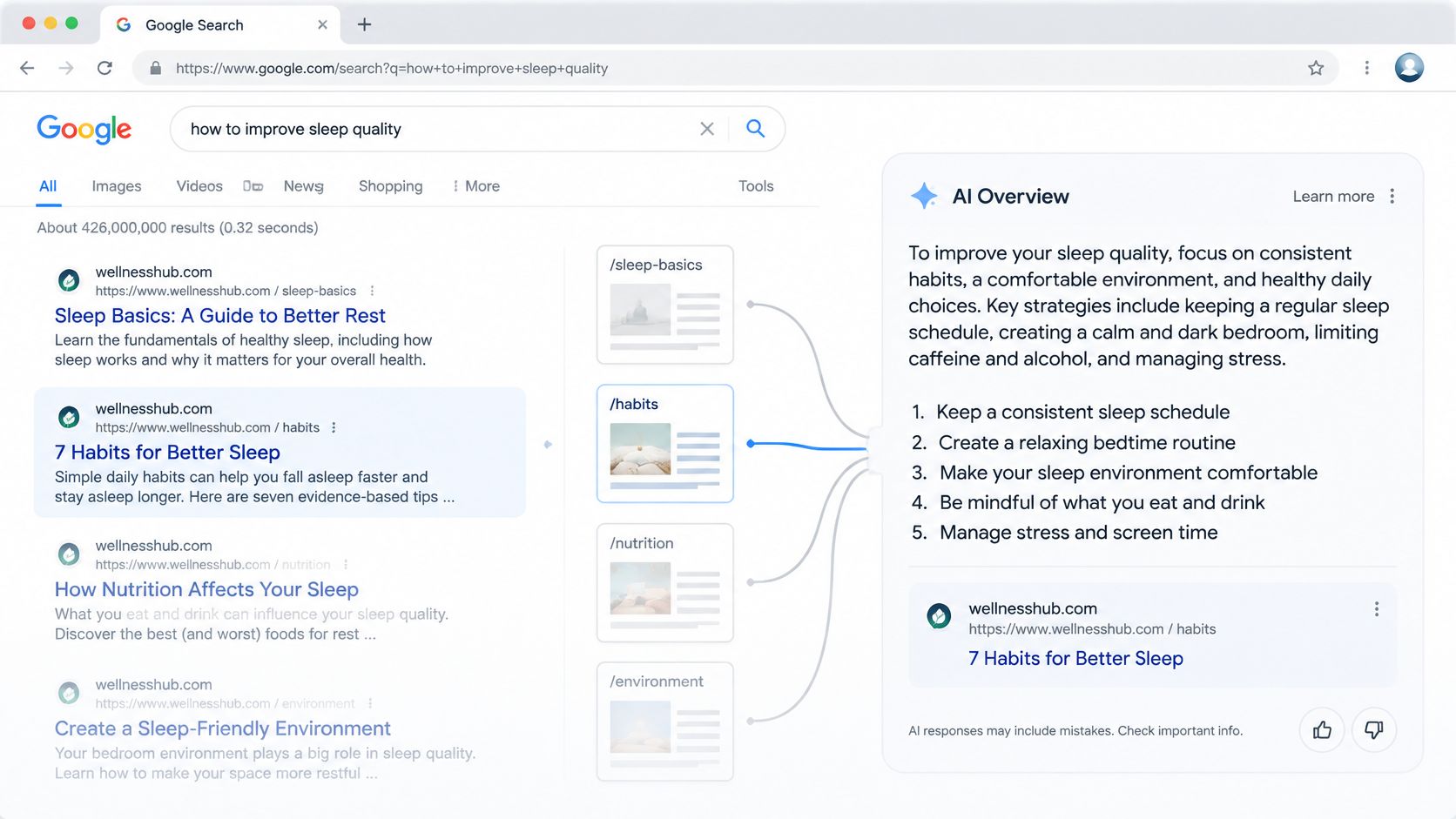
AI Overviews became more prevalent in the cited tracking during early 2025. According to Digiday's AI in publishing analysis, they appeared on about 6.49% of tracked queries in January 2025 y 13.14% in March, then on roughly 20% of U.S. desktop searches by May in that dataset. These figures describe prevalence, not the likelihood that a particular URL will win a citation.
Use the pages' actual contribution to decide. Consolidation is a stronger option when multiple URLs repeat the same claims and provide no distinct cited evidence. Keep pages separate when each offers different evidence, use cases, geography, or funnel intent that can support a separate citation. A URL count alone does not establish cannibalization.
This walkthrough shows how to assess competing sources in an answer block.
For one cluster, record each URL's AI Overview citations, traditional clicks, and conversions before making a change. Merge only that cluster, then compare results in the following weeks. If citations and clicks concentrate on the keeper, the evidence supports applying the approach elsewhere. If the merge removes a distinct citation, retain that learning and adjust the decision before touching other clusters.
Confirm One Query Cluster Before You Merge Anything
Choose one query cluster before changing pages. Start with the candidate that has the highest impressions and the clearest overlap. A small, defined test makes the result easier to interpret than a sitewide cleanup.
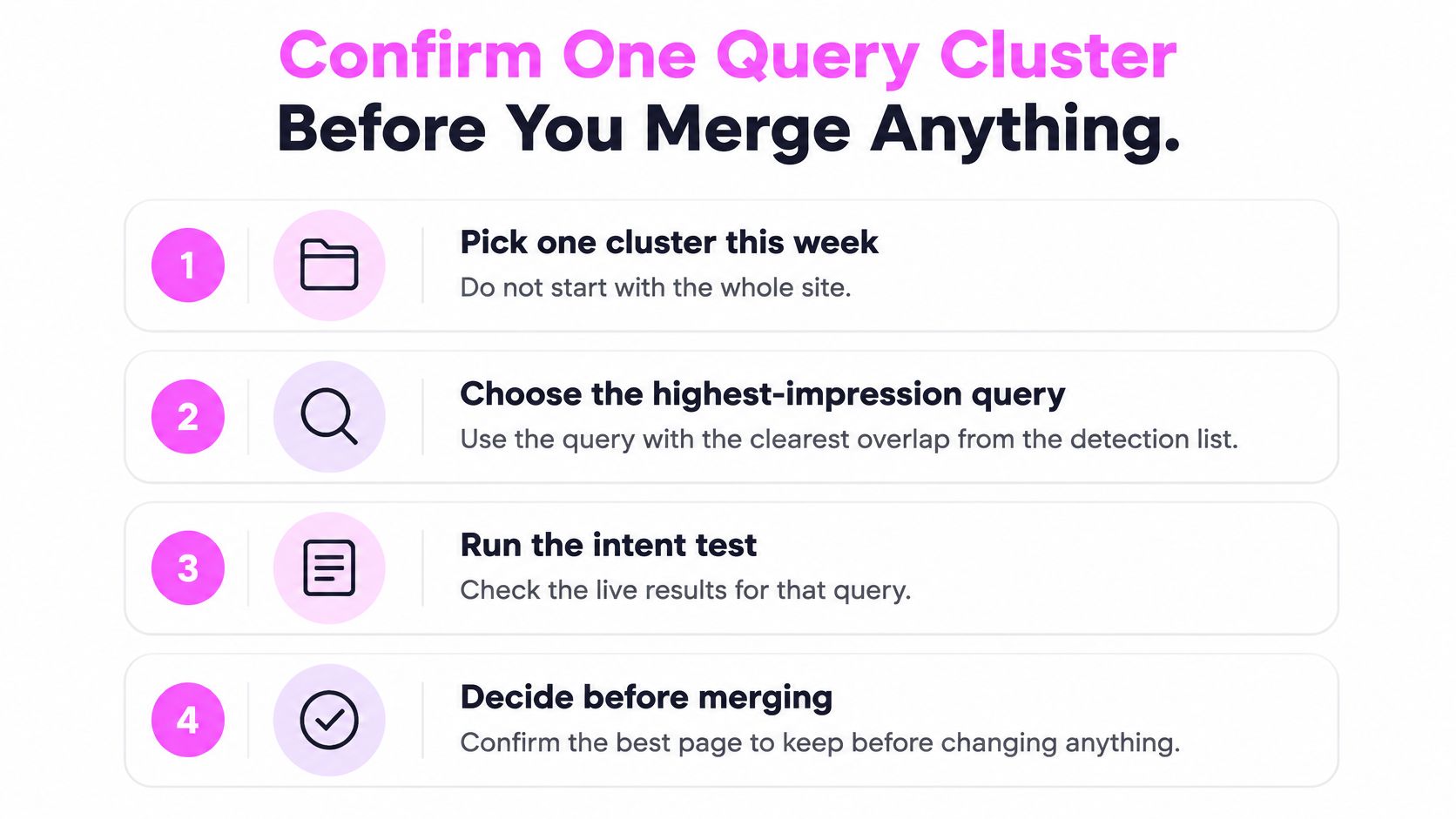
Check the live results for the cluster, then choose the fix that fits the evidence. Before acting, record which URL should own the query and what change in clicks would count as a win. Make one change at a time, whether that means merging pages, setting a canonical, or differentiating their content. Otherwise, you cannot tell which change affected performance.
Utiliza a semantic keyword clustering workflow to group related queries into page-level topics before deciding. A head term alone may hide meaningful differences between the queries in a cluster. Check whether the same URL ranks across those queries, and whether that URL changes over time. SemDash maps keywords to the specific page Google sends traffic to and lets users view SERPs over 12 months. Its Keyword Clustering, SERP Checker, and Historical SERP features help assess topic coverage and ranking changes.
My Pre-Change Checklist
- Stable intent: The live SERP favors one clear page type for the query.
- Impressions on both URLs: The overlap is measurable, not just similar wording in page titles.
- A stronger keeper: The target page will be more complete after the merge.
- Links mapped: List internal links that need updating and check for redirect chains.
- A dated recheck: Schedule a review of the ranking URL and click share.
If the overlap reflects legitimate differences in intent, record the evidence and keep both pages. That decision can prevent the same cluster from being reconsidered without new information.
After the change, compare Search Console data with the expectation you recorded. If the keeper gains the query and holds its clicks, apply the approach to another suitable cluster. If it does not, reassess intent before making another redirect.
For the first audit, combine URL-level keyword mapping, SERP history, and clustering that groups queries into page-level topics. Confirm which page should own the cluster, then use SemDash to examine the mapping before merging anything.