


You launch a new search campaign, keep your “safe” phrase match keywords in place, add a few broad match terms for discovery, and tell yourself the old playbook still applies. Then the search terms report comes back and both match types are pulling queries you didn't expect. Some are useful. Some are expensive. Some look close enough to your keyword that you hesitate to block them, even though the landing page fit is weak.
That's the moment a lot of experienced advertisers get tripped up.
I've rebuilt enough accounts since Google changed phrase match in 2021 to stop thinking about this as a simple control-versus-scale debate. That framing is outdated. Phrase match no longer means rigid word order, and broad match isn't just a looser version of the same thing. Both now rely on Google's understanding of meaning. The question is how much semantic drift your account can handle before performance starts leaking through irrelevant intent, weak ad relevance, or a bad landing page match.
I've seen broad match scale well when the account had clean conversion tracking, enough data for Smart Bidding to make useful decisions, and a negative keyword process that kept drift in check. I've also seen it waste budget fast when teams treated it like a magic expansion button. Phrase match has held up better in accounts that needed tighter intent protection, especially when the offer was narrow, the sales cycle was expensive, or the landing pages were too generic to absorb broad intent.
Tabla de contenido
- Introduction Why This Choice Still Trips Up Even Experienced Advertisers
- What Broad Match and Phrase Match Actually Mean Today
- Head to Head Comparison of Reach Intent and Control
- Performance Tradeoffs What the Data Shows About Efficiency
- When to Use Broad Match and When to Use Phrase Match
- Implementation Workflow for Keyword Targeting and Bidding With SemDash
- My Recommendation and Verification Checklist Before You Launch
Introduction Why This Choice Still Trips Up Even Experienced Advertisers
A pattern I keep seeing looks like this. An account manager inherits a campaign structure built around old broad match modifier logic, tight ad groups, and a belief that phrase match still acts like “same order, plus a little wiggle room.” Then they expand coverage, expect phrase to stay disciplined, and wonder why query quality starts drifting.
That confusion didn't come out of nowhere. In February 2021, Google began folding broad match modifier behavior into phrase match, and by July 2021 advertisers could no longer create new broad match modifier keywords, according to Google's update on phrase match and broad match modifier changes. That shift changed the middle ground. A lot of older structure decisions stopped making sense after that.
What broke in real accounts
The biggest failure I saw was structural inertia. Teams kept old match-type segmentation, duplicated terms across ad groups, and assumed phrase would still guard intent the way legacy BMM once did. It didn't.
Typical symptoms looked like this:
- Search terms felt broader than expected: Queries were still directionally related, but not always commercially aligned.
- Negatives lagged behind expansion: Teams trusted match type to do filtering that negatives should have handled.
- Landing pages carried too much weight: A keyword looked fine on paper, but the page couldn't satisfy the wider interpretation Google matched into.
Regla práctica: Match type is no longer your primary defense. Your real guardrails are negatives, bidding signals, ad relevance, and page alignment.
What I look at before choosing either one
When I decide between broad match and phrase match now, I'm usually checking four things first:
- How specific is the offer? A narrow service usually needs tighter intent protection.
- How strong is conversion data? Broad match gets riskier when the system can't distinguish good traffic from bad.
- Can the landing page absorb adjacent intent? If not, semantic expansion turns into paid research.
- Is someone reviewing search terms and negatives? If the answer is no, broad match can get expensive quickly.
If you're weighing broad match vs phrase match today, don't start with labels. Start with drift tolerance. That's what determines whether broader matching becomes growth or waste.
What Broad Match and Phrase Match Actually Mean Today
The old mental model was simple. Exact meant exact, phrase meant mostly ordered phrasing, and broad was wide open. That model is dead.
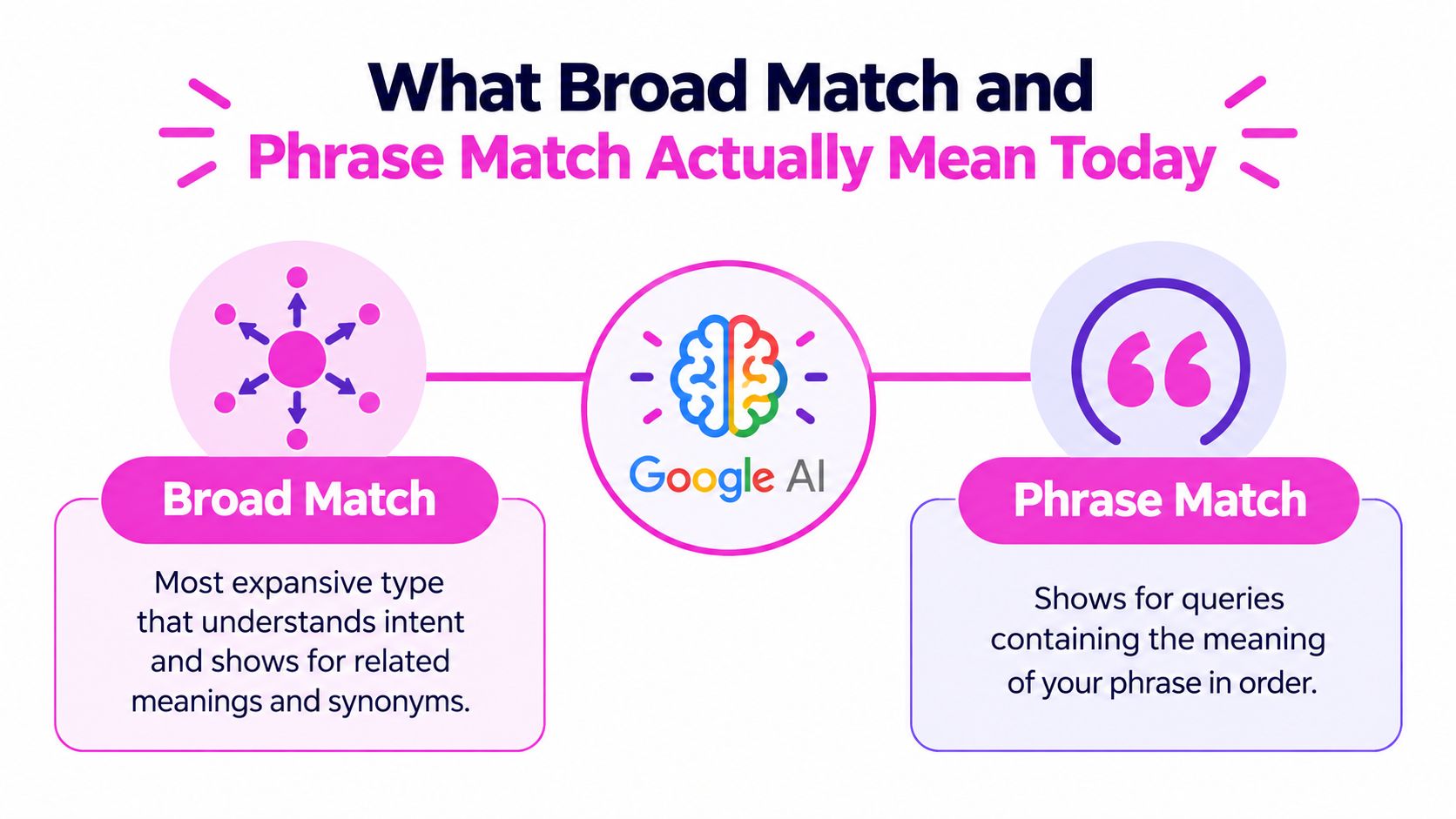
Today, both broad match and phrase match work through meaning, not just literal wording. Google's current match type documentation says broad match is the most expansive type and can show ads for related searches based on meaning, while phrase match is narrower and triggers when searches include the keyword's meaning with words added before or after.
| Match type | What it does today | What I assume in practice |
|---|---|---|
| Broad match | Reaches related searches based on meaning | Best for expansion when bidding and negatives are strong |
| Phrase match | Matches searches that include the keyword's meaning, with extra words before or after | Better when I need tighter control over intent shape |
Phrase match is not word-order protection
A lot of advertisers still treat phrase match like a lightly loosened quote match. That's not how I use it anymore.
de Google close variant rules go beyond plurals and misspellings. They include stemmings, abbreviations, reordered words with the same meaning, and function-word changes. Google even gives the example that a phrase match keyword like red shoes may show for running shoes red in supported languages.
That's why I don't audit phrase match by asking, “Did the words stay in order?” I audit it by asking, “Did the meaning stay commercially useful?”
Broad match is Google's intent-expansion tool
Broad match goes a step further. It isn't just matching looser versions of your keyword. It's designed to identify related queries. That matters because the keyword, ad, and landing page can drift apart fast if your campaign structure isn't built for that.
When I explain this to clients or in-house teams, I usually put it this way:
Phrase match still narrows the meaning boundary. Broad match invites Google to interpret related intent outside that boundary.
If you want another practitioner-oriented angle on this shift, I like this broad vs phrase match guide because it reflects the same practical problem many of us run into after the 2021 changes.
The definition that keeps me out of trouble
Here's the simplest operational definition I use:
- Broad match = “Find more demand around this topic.”
- Phrase match = “Stay closer to this buying intent.”
That framing keeps me from making the common mistake of expecting phrase to behave like an old-school precision lever. It isn't. It's just the narrower semantic option.
Head to Head Comparison of Reach Intent and Control
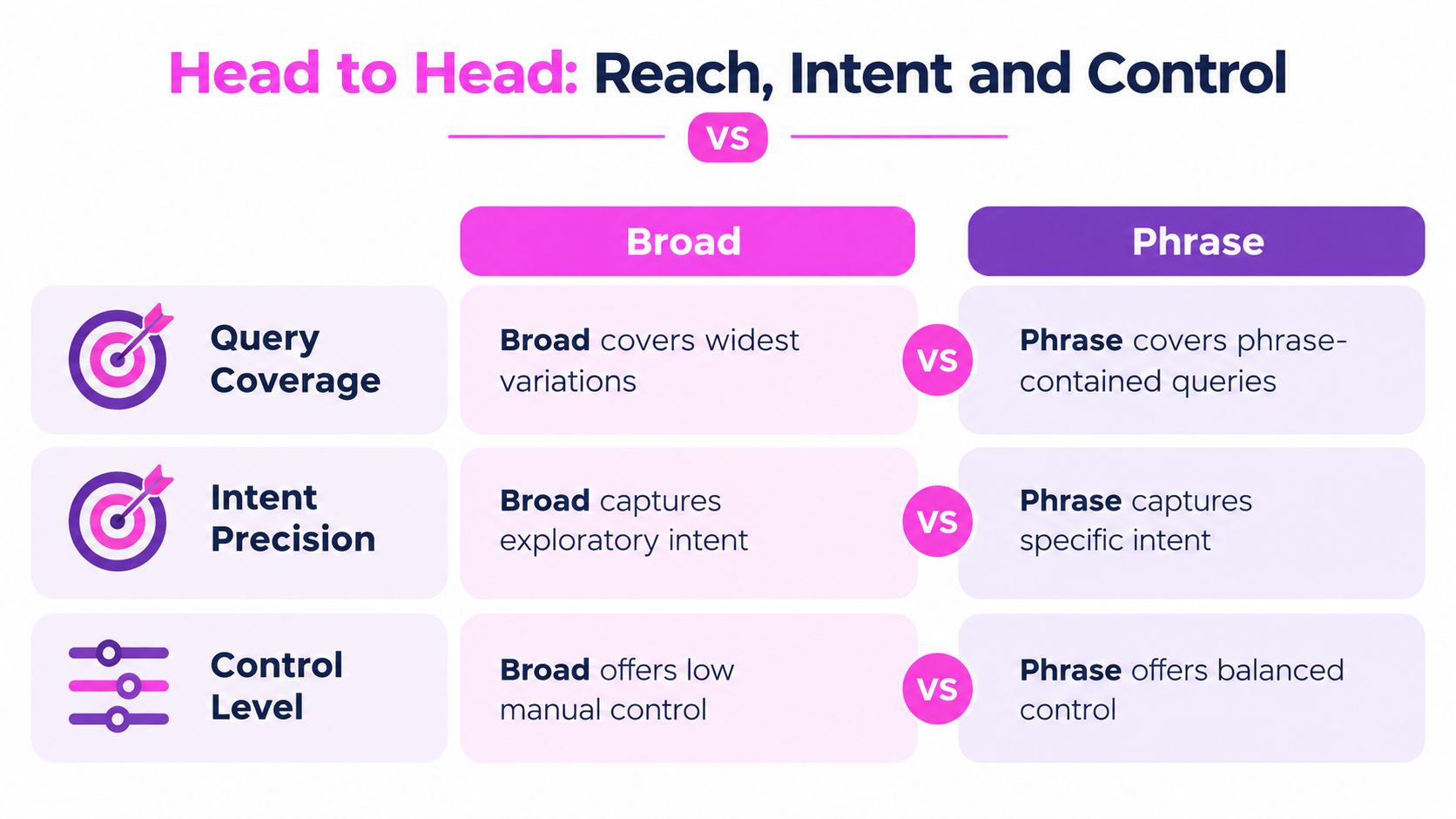
Most broad match vs phrase match discussions get sloppy because they compare opinions instead of mechanics. I prefer to compare both match types against the same three criteria: reach, intent precision, and control.
Reach
Google states that phrase match covers all searches eligible for exact match, while broad match covers all searches eligible for phrase and exact match plus additional related searches. That hierarchy matters operationally.
Reach and Control Comparison for Broad and Phrase Match
| Criteria | Broad Match | Phrase Match |
|---|---|---|
| Query coverage | Covers the widest range, including related searches | Covers narrower meaning-based searches |
| Intent precision | More variable | More consistent |
| Manual control | Lower | Higher |
| Negative dependency | Alto | Moderate to high |
| Landing page sensitivity | Alto | Moderada |
What that means in plain English is this. Broad match can replace stacks of narrower keywords if your goal is coverage. Phrase match still limits that expansion, but it won't lock traffic down the way many advertisers expect.
Intent precision
I see the biggest misuse of broad match.
Broad match can absolutely find useful demand you didn't target directly. It can also match into searches where intent is technically related but commercially weaker. That's the difference between “same topic” and “same buyer.”
Broad match is strongest when your business can monetize adjacent intent. It struggles when each click needs to align tightly to one offer, one stage, and one page.
Phrase match is better at preserving a cleaner query set around core terms. Not perfect. Cleaner.
For teams mapping campaigns by intent, this matters more than volume. If one ad group supports a narrow service, phrase match usually gives me fewer interpretive surprises.
Control
Control today is less about keyword syntax and more about account systems.
I rely on phrase match when I need:
- Cleaner search term themes: Better for ad copy and landing page alignment.
- Fewer irrelevant edge cases: Especially in high-cost lead gen.
- Tighter testing: Easier to diagnose whether the keyword itself is the problem.
Broad match works when I have:
- Solid conversion tracking: So bidding can distinguish useful traffic.
- An active negative keyword routine: Because broad without negatives is just expensive curiosity.
- A page that can serve multiple adjacent intents: Category pages, broader solution pages, or strong site search experiences.
Here's a useful companion read on keyword search intent if you're trying to map query shape to page type before deciding which match type gets the job.
A quick visual usually helps when teams are debating this internally:
My blunt comparison
If I had to compress it into one line for a media plan, it would be this:
Phrase match protects intent better. Broad match expands opportunity faster. Neither fixes weak pages, bad bidding signals, or poor negatives.
That's why I don't ask which one is “better.” I ask which one the account is equipped to support.
Performance Tradeoffs What the Data Shows About Efficiency
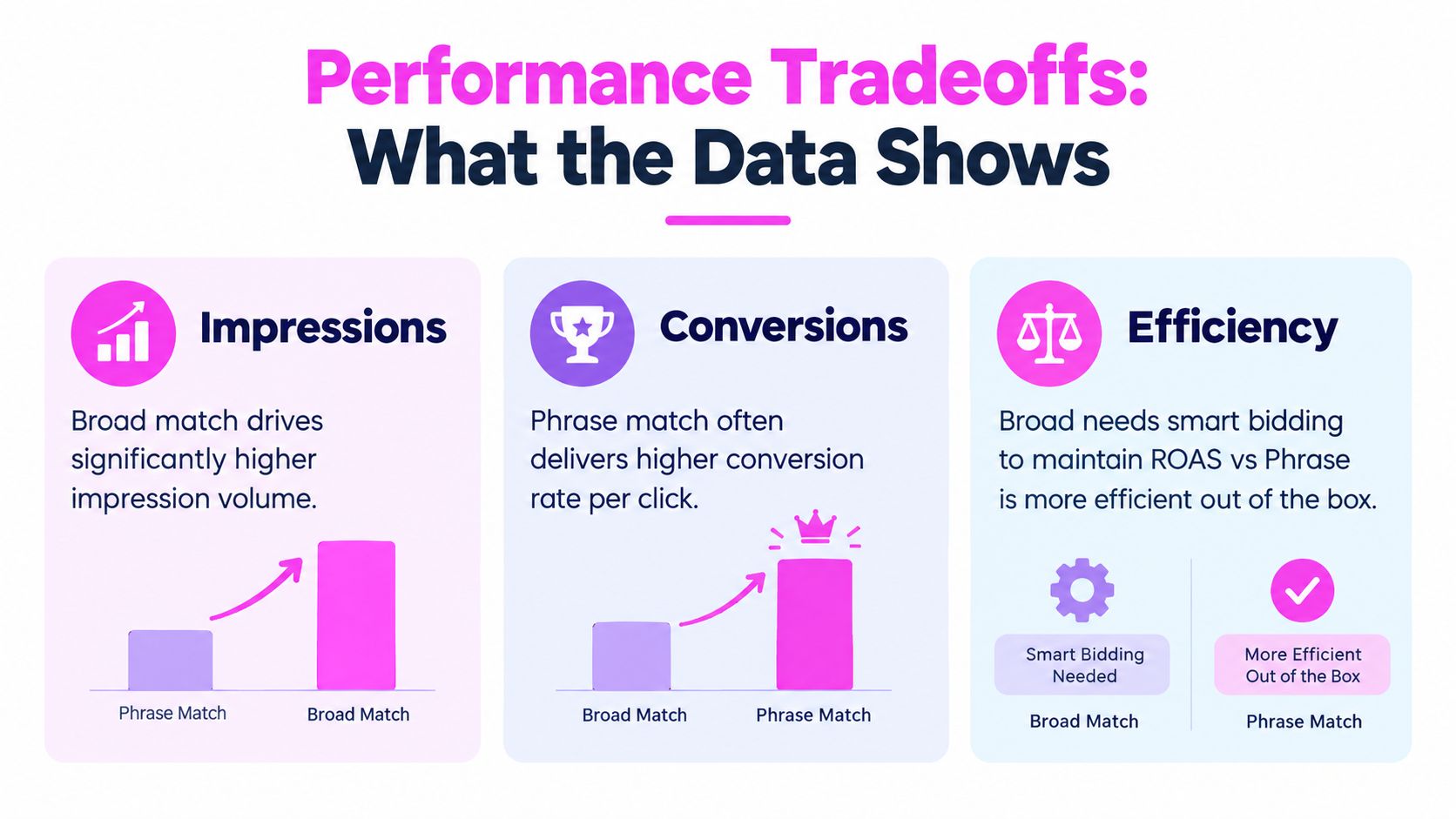
Broad match often looks attractive because it opens the tap. More searches, more impressions, more chances to find demand. But volume can hide inefficiency if you judge the match type too quickly.
In an independent study from Adalysis, broad match accounted for 32% of keywords, drove 39% of impressions and 34% of revenue, but only 25% of conversions in the dataset analyzed, according to the match type performance study. I like this data because it matches what I tend to see in real account reviews. Broad often contributes more reach and revenue than its keyword share suggests, but it can convert less efficiently.
Why that gap happens
Broad match reaches into more query variation. Some of that variation is valuable expansion. Some of it sits further from your highest-converting intent. That creates a familiar pattern:
- More impressions: Because query coverage widens.
- Useful revenue contribution: Because broad can surface demand narrower types miss.
- Weaker conversion efficiency: Because not every related query deserves the same bid.
That doesn't make broad match “bad.” It means you need to evaluate it against the right business objective.
How I interpret performance without fooling myself
If I'm running broad for discovery or scale, I don't expect it to look as tidy as a tightly controlled phrase match campaign. I expect it to do one of two jobs:
- Expand volume while staying within acceptable efficiency
- Surface new query clusters worth breaking out into tighter structures
If it does neither, it's dead weight.
Watch for this mistake: Teams celebrate broad match for increasing revenue, then ignore the fact that the extra volume came with lower query quality and more cleanup work than the account could sustain.
What “good” broad match looks like to me
Good broad match doesn't just spend. It teaches.
I want to see search terms that reveal adjacent commercial intent, missing product language, or category-level demand the account wasn't covering well. If broad only pulls in fuzzy versions of terms my phrase campaigns already capture, it's not adding much strategic value.
Phrase match usually starts with a cleaner path to efficiency. Broad match earns its place when the extra coverage justifies the extra management and looser intent fit. That's the tradeoff. Not ideology, not trend-following.
When to Use Broad Match and When to Use Phrase Match
My default isn't “always use broad with automation” or “always start with phrase.” It depends on the account's readiness for semantic expansion.
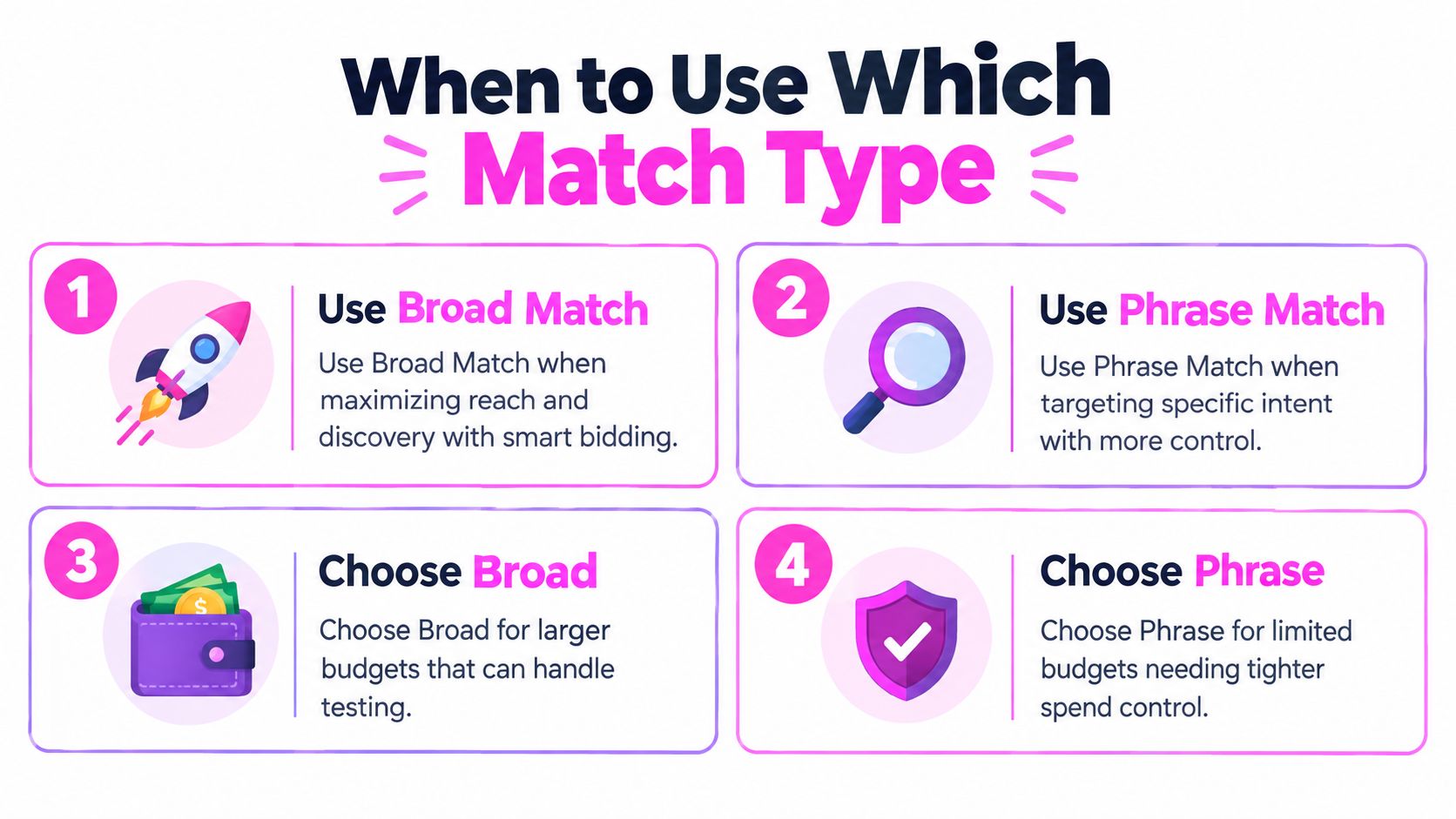
The easiest way to make the choice is to line up the campaign against a few conditions: budget flexibility, conversion signal quality, page depth, and tolerance for search term cleanup.
Use broad match when the account has real guardrails
Google notes that broad match can be the default and can even convert phrase and exact keywords into broad at scale through its tooling, which is part of why I think advertisers need to be deliberate about where they allow that expansion. Google also says phrase match now includes searches containing the keyword's meaning, not just exact wording, so the old broad-versus-phrase framing misses the issue of how much semantic drift you can tolerate, as described in Google's keyword matching options guidance.
I'm comfortable using broad match when these conditions are true:
- The account has stable conversion tracking: Smart Bidding needs signals it can trust.
- The offer can absorb adjacent intent: Category pages and broader solution pages tend to handle this better.
- Negative keywords are actively maintained: Not once at launch. Continuously.
- There's enough budget to buy data: Broad needs room to learn and reveal patterns.
A common example is e-commerce category growth. If I'm advertising a broad product category with plenty of conversion history, broad match can help uncover product language and use-case queries I wouldn't build manually.
Use phrase match when intent protection matters more
Phrase match is where I stay when the downside of drift is high.
That usually includes:
- High-value lead gen: Legal, B2B services, local service categories with expensive leads.
- Narrow offers: One service, one audience, one landing page.
- Accounts with thin data: If the system can't learn from quality conversion signals, I don't ask it to expand aggressively.
- Early-stage campaigns: Cleaner query sets make diagnostics easier.
If your page only answers one version of the problem, phrase match is usually the safer starting point.
The hybrid model I use most often
Most mature accounts don't need a religious answer. They need role clarity.
I'll often structure campaigns like this:
- Phrase match for core commercial themes
- Broad match for discovery around category or problem statements
- Search term mining to promote winners into tighter control
- Negatives to stop broad from cannibalizing useful intent zones
That setup works well in SaaS and lead gen when broad is treated as an exploration layer, not a replacement for precision. It also keeps teams honest. If broad keeps finding valuable themes, I build around them. If it drifts, I constrain it.
What fails most often
The biggest failure pattern is using broad match because Google recommends it, while leaving everything else underdeveloped. Weak pages, generic copy, loose conversion actions, and no negative hygiene create a perfect setup for wasted spend.
Broad can scale. Phrase can protect. The choice only works when the rest of the account is built to support it.
Implementation Workflow for Keyword Targeting and Bidding With SemDash
When I build match-type structures, I don't start in Google Ads. I start by organizing the intent so I know which topics deserve tight control and which ones can handle broader exploration.
My first pass is clustering. I group queries into page-level topics so I'm not creating three ad groups that all point to the same page with slightly different wording. That reduces cannibalization and makes it easier to decide where phrase match belongs versus where broad can test.
My workflow before keywords go live
I use a simple sequence:
- Map topics to pages first: One clear topic per page beats a messy keyword list every time.
- Review competitor terms and gaps: I want to know which intent buckets serious competitors already cover.
- Check the live SERP: If Google treats the query like research intent, broad expansion needs more caution.
- Decide the page's drift tolerance: A broad category page can usually take more expansion than a tightly focused service page.
If you're doing the research side of this systematically, a solid process for SEO keyword research helps because the same clustering logic carries over to paid search structure.
Where teams usually mess this up
The most common implementation mistakes I see are boring, but expensive:
- Duplicating the same keyword across match types without a clear purpose
- Treating phrase match like exact order
- Launching broad match without a negative list
- Sending all intent variants to one generic page
- Judging match type before search terms have been reviewed properly
Those errors create reporting noise and muddy decision-making. Then broad gets blamed for problems the build caused.
I don't trust match type reports by themselves. I trust the relationship between the search term, the ad, the landing page, and the conversion action.
How I handle bidding and negatives
I prefer broad match when Smart Bidding has enough signal to work with and the conversion action reflects real business value. If the account is still learning or the conversion setup is too soft, I'll stay tighter with phrase match until the signals improve.
Negative keyword work is where the account either stabilizes or drifts. I review search terms, identify patterns of low-intent expansion, and block categories of waste rather than playing whack-a-mole with one-off queries. That matters because semantic matching tends to repeat the same kinds of mistakes in slightly different wording.
A useful parallel exists in marketplaces too. If you've worked on retail media, the discipline behind optimize Amazon ad campaigns feels familiar. Query mining, intent separation, and bid control matter there for the same reason they matter here. Match flexibility creates opportunity, but only if structure and cleanup keep pace.
My Recommendation and Verification Checklist Before You Launch
My default view is simple. I use phrase match first when I need intent protection, and I let broad match expand only when the account has earned that freedom.
Google explicitly frames broad match as a way to capture the benefits of multiple match types in one keyword by identifying related queries. That's useful, but it also means broad can move further away from your original wording than many advertisers are comfortable with. Phrase match stays closer to the meaning boundary, which is why I still trust it more as a foundation in tighter accounts.
My launch checklist
Before I scale either match type, I verify these points:
- Conversion actions reflect actual value: Not soft engagement events that teach bidding the wrong lesson.
- Landing pages match the likely query range: Especially important before turning on broad match.
- Negative themes are ready: Competitor terms, job seekers, DIY intent, support intent, and other obvious waste patterns.
- Ad copy fits the traffic source: If the message only fits one narrow query set, broad is a mismatch.
- Search term review cadence is assigned: If nobody owns it, don't pretend the campaign is controlled.
What I watch in the first stretch
The early signals I care about are qualitative before they're numerical. Are search terms staying commercially relevant? Are there repeated intent mismatches? Are broad queries uncovering useful new themes or just bloating volume?
If phrase match starts drifting, I usually tighten negatives or split intent into cleaner ad groups. If broad starts finding useful patterns, I either support them with better negatives and landing pages or graduate them into their own tighter keyword sets.
My recommendation is not “pick one.” It's “assign each match type a job, then verify it's doing that job with search term evidence.”
That's the part too many accounts skip. They choose a match type as a belief system instead of a traffic control mechanism.
If you want to make these decisions with better query mapping and cleaner page-level planning, SemDash helps you cluster topics, spot keyword gaps, and inspect SERP intent before you build campaigns around the wrong match type. I'd use it to separate pages that can handle semantic expansion from pages that need tighter intent control, then build paid structures that reflect that reality.