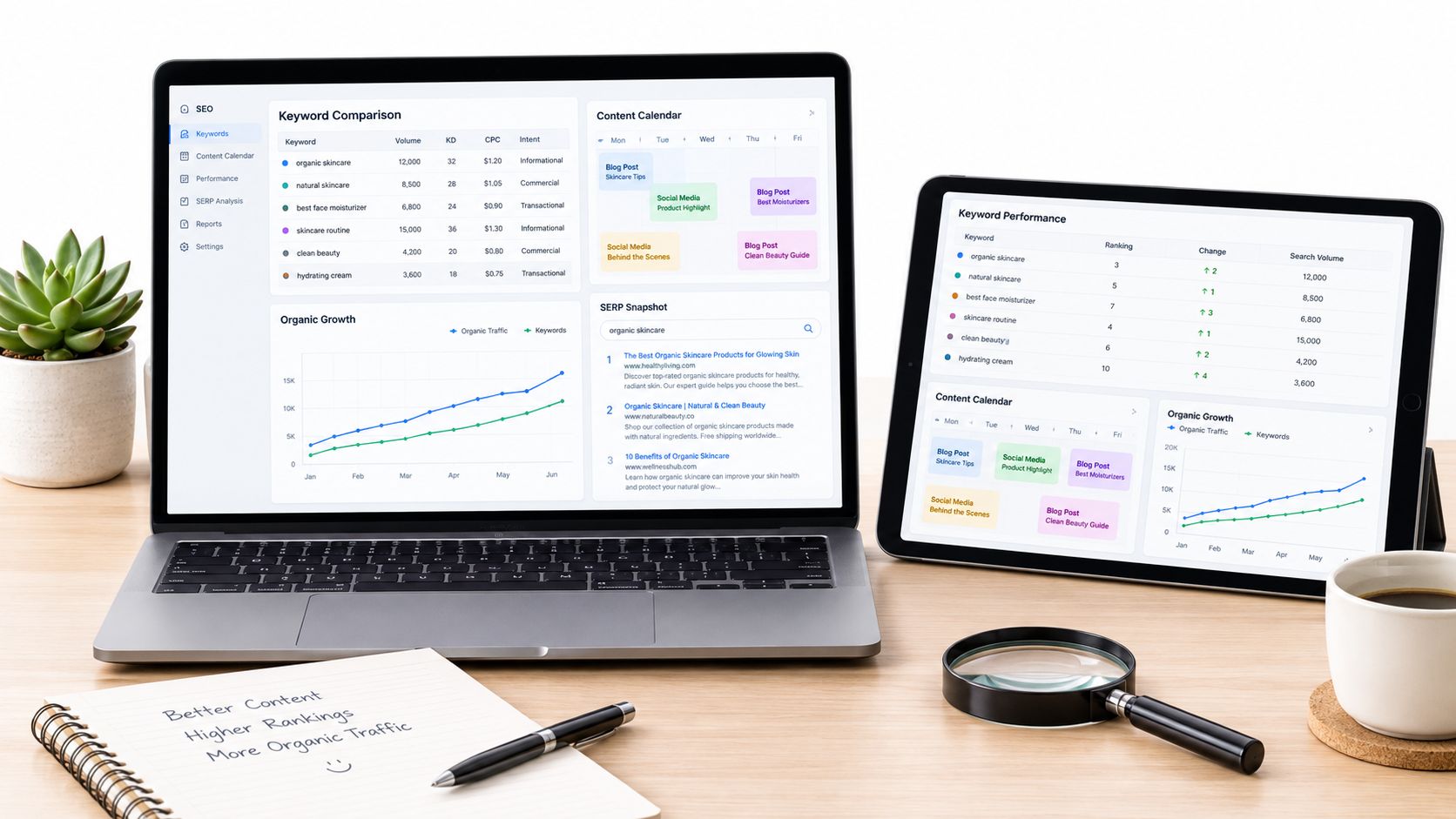


You've probably opened one tool for keyword volume, another for backlinks, and a third for rankings, then tried to turn three incompatible exports into one campaign plan. I've done that often enough to know the problem isn't a lack of data. It's the gap between finding information and making a defensible decision about what to publish, which page to improve, and where to invest outreach.
So, what is an SEO platform? In practical terms, it's a multi-dataset decision system that connects keyword demand, competitor pages, backlink opportunities, SERP behavior, reporting, and increasingly, visibility in AI-generated answers. The useful platform isn't the one with the longest feature list. It's the one that helps you move from market discovery to a prioritized action without losing the reasoning along the way.
Tabla de contenido
- Why I Stop Treating SEO Tools as Separate Apps
- Core Modules That Actually Move Campaigns
- Legacy Keyword Tools Versus Modern Platforms
- A Practical Workflow I Would Run Today
- When You Might Not Need a Full Platform
- Buyer Checklist and Integration Realities
- Lessons I Wish I Had Learned Sooner
- Preguntas frecuentes
Why I Stop Treating SEO Tools as Separate Apps
A promising keyword can still produce the wrong page. I once approved a brief for a term with attractive volume and a reasonable difficulty score, assigned the article, and began outreach after publication. A closer SERP review exposed the mistake: ranking pages focused on comparison and buying guidance, while our article took a broad educational approach.
The keyword tool had not failed. My workflow had. I treated volume as demand instead of checking intent, competing URLs, SERP features, and the authority patterns behind the results before committing production time.
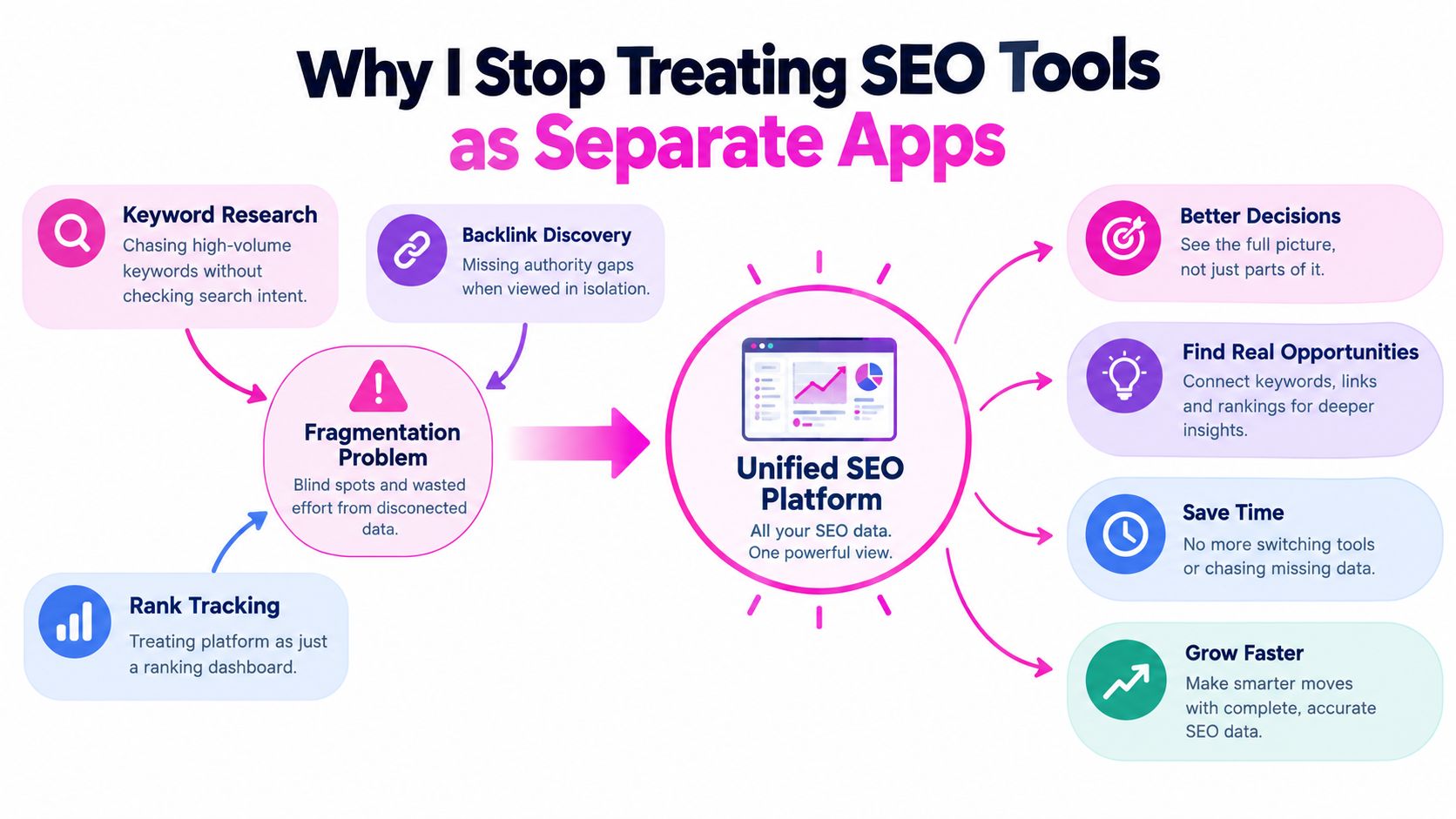
Separate databases create similar blind spots. Backlink research can reveal domains linking to competitors, yet leave unanswered which competitor pages earned those links, which queries those pages target, and whether my page is the right destination. A rank tracker can show a position change, but it cannot by itself identify an intent mismatch, a new SERP feature, a stronger competing page, or a technical fault.
The useful mental model
I use an SEO platform as a market model and decision system. It connects four forms of evidence:
- Demand, from keyword data and query suggestions.
- Competition, from ranking domains, pages, links, and difficulty signals.
- Result-page structure, from SERP features, historical snapshots, and intent clues.
- Execution feedback, from rankings, traffic, conversions, and reporting.
The value is the connection between them. The SEO software and tools market was measured at about USD 74.6 billion in 2024, with a projection of USD 154.6 billion by 2030 at a 13.5% CAGR, según market sizing for SEO software. That scale helps explain why current platforms combine specialized datasets with workflows instead of limiting the product to rank checking.
The same logic applies to the wider marketing stack. Teams comparing disconnected systems can use this guide to marketing tool consolidation to examine duplicated workflows and scattered reporting. In SEO, I apply the principle more narrowly: keep evidence connected from research through prioritization, so each handoff preserves the reason behind the recommendation.
Core Modules That Actually Move Campaigns
A platform earns its place in my workflow when four modules work together. I don't evaluate them as independent checkboxes, because each one answers a different part of the same question: which opportunity can we realistically win, and what must we do to win it?
Keyword discovery starts the investigation
Keyword research should uncover more than phrases and estimated volume. I want search volume, CPC, difficulty, competition, SERP features, related questions, and the pages currently receiving visibility. A keyword database that exposes those fields helps me distinguish a broad topic from a page-level opportunity.
The architecture matters because keyword difficulty and SERP-feature signals affect the content format I choose and the resources I'm willing to commit. A term with strong demand but an entrenched SERP may deserve a supporting page, a narrower cluster, or a later campaign phase. Serpstat's SEO data overview describes the combination of bulk keyword data, backlink graphs, SERP snapshots, and domain intelligence that makes this kind of analysis possible.
Backlink research explains authority gaps
I use backlink data after identifying the pages that compete with my target page. The useful questions are specific:
- Which referring domains link to several competing pages?
- Which pages attract links, and what topic do they cover?
- Are the links editorial, resource-based, partner-driven, or tied to a particular asset?
- Does my proposed page give an outreach prospect a credible reason to link?
Looking only at a competitor's total backlink count isn't enough. The page-level relationship is what turns a link database into an outreach plan. For additional context on monitoring competitors across broader marketing workflows, I refer to top tools for competitor analysis, then return to the specific domains and URLs inside the SEO platform.
SERP history prevents snapshot decisions
A live SERP tells me what appears now. Historical SERP data tells me whether the result page is stable, changing, or serving a different intent over time. I review ranking URLs, SERP features, volatility, and page types before finalizing a brief.
This step has saved me from writing for a temporary result-page pattern. If guides, product pages, videos, and comparison pages rotate frequently, I don't treat the current top result as a permanent template. I build a page that satisfies the underlying intent while leaving room to update the format.
Reporting closes the loop
Reporting should connect visibility to decisions, not display movement. I want to know which pages gained or lost visibility, which keyword groups changed, whether target URLs are still the right URLs, and whether the work affected qualified traffic or conversions.
Regla práctica: A ranking report is useful only when it changes what someone does next.
That's why I prefer platforms that join discovery, competitive analysis, SERP review, and reporting in one workspace. The category has evolved from tactical tools into strategic research systems used for keyword targeting, content planning, link acquisition, and SERP monitoring, as described in the SEO software market analysis.
Legacy Keyword Tools Versus Modern Platforms
Older SEO workflows typically began with a keyword list and ended with a ranking position. That approach still works for a narrow task, but it breaks down when I'm managing multiple content clusters, competitors, countries, or stakeholders.
The core distinction isn't whether a product has a keyword tab. It's the depth, freshness, and relationship between the underlying datasets. Industry reporting describes leading platforms operating with billions of keywords and trillions of backlinks, alongside crawl volumes measured in billions of pages and frequent refresh cycles. The practical consequence is simple: a broader, fresher index gives me a better chance of seeing newly ranking pages, emerging link opportunities, and SERP changes before they become obvious. This comparison of SEO analysis tools discusses those infrastructure differences.
| Aspecto | Legacy Keyword Tool | Modern SEO Platform |
|---|---|---|
| Data scope | Keyword suggestions and basic rank checks | Keywords, backlinks, SERPs, domains, pages, and competitive gaps |
| Refresh cadence | Periodic or unclear updates | Frequent refreshes and historical views |
| Competitive view | Domain-level estimates | Domain and URL-level reverse engineering |
| Workflow maturity | Export data, interpret it elsewhere | Move from discovery to prioritization in one workspace |
| AI visibility | Usually absent | May include AI answer mentions and cited URLs |
The difference becomes obvious during competitor research. A small tool may show that a rival ranks for a phrase. A modern platform can help me identify the exact ranking URL, its keyword group, the links supporting it, and how the SERP has changed. That lets me ask whether I should create a new page, improve an existing one, consolidate overlapping URLs, or pursue links to a stronger asset.
Scale changes what I can see
One comparison of keyword databases reports SE Ranking at 5.4 billion keywords, Ahrefs at 20 billion, and Semrush at 25 billion. The same comparison reports country-level datasets including 659 million U.S. keywords and 652 million U.K. keywords for SE Ranking. Those figures don't prove that one database is automatically better for every project, but they show why coverage is a buyer-level concern, especially for international or highly competitive campaigns. The keyword research comparison provides that dataset context.
For a lighter workflow, I still use focused tools when they're faster. A practical overview of SEO tools from SiteSelf can help when the task is simple and doesn't justify a larger operating layer. I don't want a platform to add complexity where a targeted lookup would do.
A Practical Workflow I Would Run Today
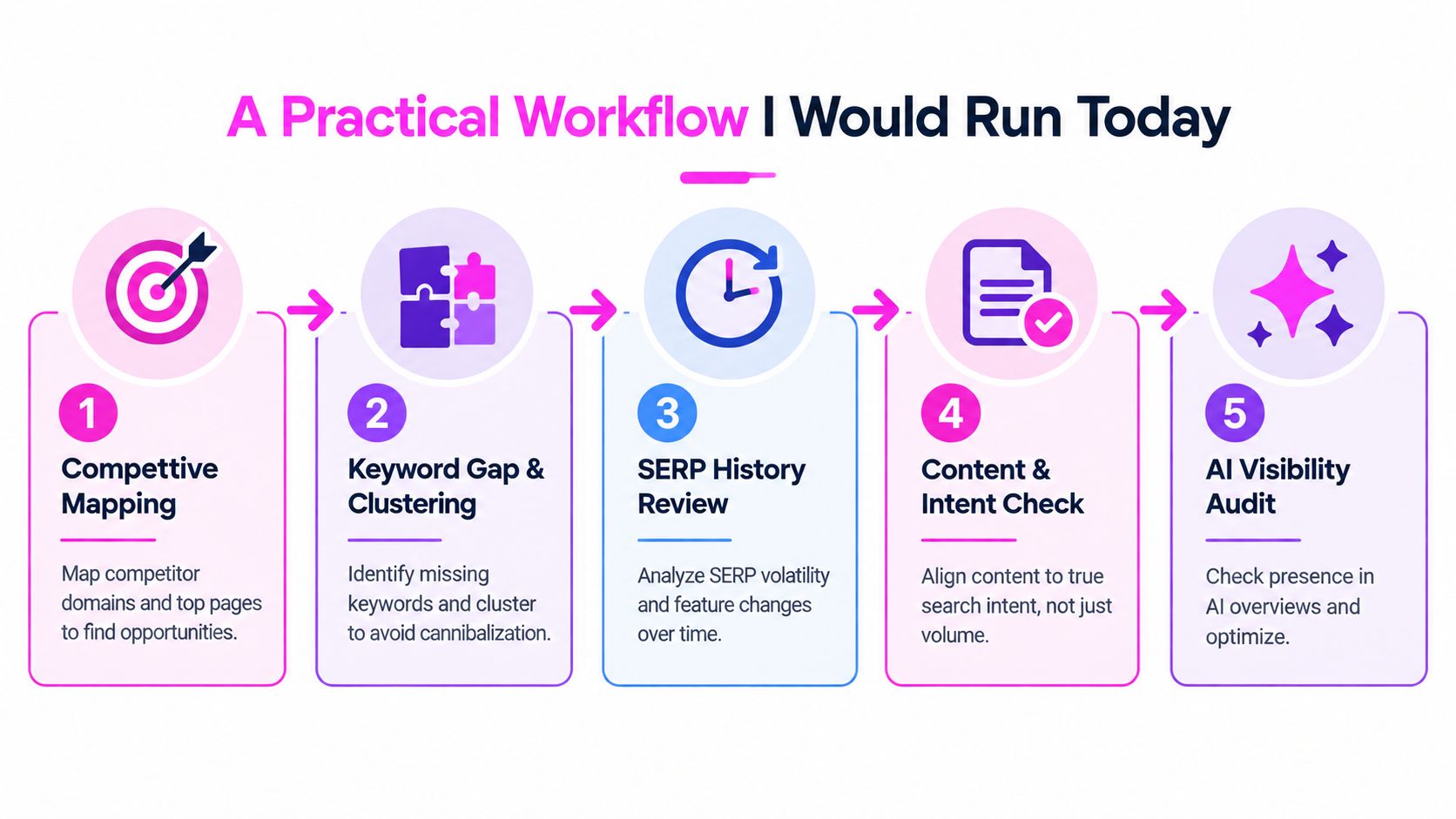
I start with competitors, not a blank keyword field. The reason is that competitors reveal the market's existing page architecture. I can see which domains earn visibility, which URLs carry that visibility, and whether the opportunity belongs to a product page, guide, comparison, template, or another format.
Step 1 map competing domains and pages
I select relevant competitors based on overlapping search visibility, not just brand reputation. Then I review their top pages, ranking keywords, traffic share, and page types. I'm looking for repeatable patterns, such as several competitors winning with detailed category pages or a group of editorial guides attracting links.
Step 2 build a gap and cluster model
Next, I run domain and keyword gap reports. I separate terms where competitors rank and we have no meaningful page from terms where we already have a page that could improve.
I cluster related queries before assigning them to URLs. This avoids the mistake I made earlier, creating several pages that all answer nearly the same question and then wondering why they compete with each other.
Step 3 validate the SERP over time
I inspect the current SERP, then review historical snapshots where available. I check whether the page types remain consistent, whether features dominate the result, and whether rankings shift enough to suggest unstable intent.
Step 4 turn evidence into a brief
The brief should specify the target page, primary topic cluster, supporting questions, intent, competing URLs, content format, internal links, and likely authority requirements. I don't ask a writer to “cover the keyword.” I give them the decision logic behind the page.
Step 5 add AI visibility to the audit
Search discovery increasingly includes answer engines and large language models. Conductor describes newer SEO platforms as organic marketing and AI visibility suites that address traditional search, answer engines, and LLMs such as ChatGPT. That changes my audit. I now record whether target queries trigger AI answers, whether my domain appears, and which URLs receive citations.
For AI Overviews, citation monitoring gives me something concrete to track. A study of 1,000 AI Overviews found an average of 4.2 citations per overview, with observed ranges from 2 to 9 citations depending on intent. The AI Overview citation study supports treating cited URLs as an actionable visibility layer rather than a vague future concern.
I use this checklist before publishing:
- Map competitors: Identify domains, top pages, and page formats.
- Find gaps: Separate missing topics from pages that need improvement.
- Cluster queries: Assign one coherent intent group to each URL.
- Review SERPs: Confirm format, features, and historical stability.
- Plan authority: Match outreach targets to the page's actual value.
- Audit AI visibility: Record mentions, citations, and the URLs being surfaced.
A platform becomes operational. It doesn't replace judgment. It reduces the time I spend stitching evidence together so I can spend more time making the strategic call.
When You Might Not Need a Full Platform
A full platform is not automatically the right purchase. I've seen small teams buy broad subscriptions, open them rarely, then continue working in Search Console, spreadsheets, and a lightweight rank tracker. Unused features create cost and setup work without improving decisions.
A point-tool stack can fit one person managing one site with a narrow objective. Keyword discovery may be enough for a content plan, a SERP checker can validate intent, and a backlink audit may cover a site migration. Paying for centralized roles, client reporting, multiple projects, and large competitor databases adds little if those tasks happen only occasionally.
Match the purchase to the operational pain
A platform earns its place when coordination becomes the constraint. I'd consider one when:
- Several people need the same data: Writers, SEOs, outreach specialists, and executives can work from one current view instead of conflicting exports.
- Competitor research repeats: Recurring gap analysis takes less time when the system joins rankings, pages, and competitors without manual spreadsheet work.
- Multiple domains or clients matter: Centralized projects and permissions reduce repeated setup.
- Reporting consumes campaign time: Automated views replace repetitive spreadsheet preparation.
- AI visibility is part of the brief: Traditional rank tracking cannot show which URLs appear in generated answers.
The market supports both types of buyers, from focused tools to enterprise systems. Its scale reflects demand from large organizations, not proof that every small publisher needs a broad platform.
Startup teams comparing lighter options can use this guide to SEO tools for startups to match software with specific needs before committing. My filter is direct: if a tool does not change how I prioritize work, I do not need its full feature set. A smaller stack is often easier to maintain, easier to audit, and sufficient for a focused campaign.
Buyer Checklist and Integration Realities
I don't start vendor evaluation with “How many features does it have?” I start with “Where does my current workflow break?” A platform should remove a specific operational problem, whether that's inconsistent competitor data, slow reporting, weak URL mapping, or poor visibility into AI citations.
What I check before committing
- Data coverage: Can it cover my countries, search engines, industries, and query types?
- Frescura: Does the vendor explain how often keywords, links, SERPs, and AI visibility data refresh?
- URL-level detail: Can I see the exact page ranking for a term, not just the domain?
- Workflow controls: Are projects, roles, permissions, notes, and exports practical for my team?
- Integration quality: Can the platform connect to analytics, Search Console, a CMS, and client reporting without creating another manual process?
- Historical context: Can I investigate change over time instead of reacting to a single snapshot?
- AI visibility: Does it report mentions and cited URLs, or merely use AI language in its marketing?
| Situation | Platform Fit | Point Tools Fit |
|---|---|---|
| One site and occasional research | Limited unless workflows are expanding | Fuerte |
| Several domains or clients | Strong, especially with shared reporting | Possible but labor intensive |
| Deep competitor reverse engineering | Fuerte | Requires manual exports |
| Recurring content and link planning | Fuerte | Works if the process stays narrow |
| Single technical audit | May be excessive | Fuerte |
| Cross-team governance | Fuerte | Often fragmented |
Integration is where many purchases disappoint me. A platform may contain excellent data, but if the final brief still lives in an unconnected document, the report still requires manual copying. I test the path from research to decision to publication. Can I export the chosen keyword cluster, ranking URLs, intent notes, and links into the place where the team works?
For readers comparing broader suites with alternatives, this overview of Ahrefs alternatives can help frame the decision around workflow and cost rather than brand familiarity. The right choice depends on how much recurring coordination your team needs.
Lessons I Wish I Had Learned Sooner
I used to treat rank tracking as the campaign itself. I'd celebrate a position increase, then discover that the page had gained visibility for an irrelevant variation while the commercial query remained flat. The better practice is to group rankings by intent and page, then connect movement to qualified visits, conversions, and the content decision behind the URL.
I also overvalued volume. A large number looks persuasive in a spreadsheet, but it doesn't tell me whether the SERP matches my offer, whether the result format suits my capabilities, or whether competitors have built a durable advantage. I now inspect the actual pages before approving a brief.
The mistakes that keep repeating
- Treating data freshness as a footnote: Stale links and rankings can send outreach toward sites that no longer matter.
- Ignoring citation visibility: AI-generated summaries can appear above organic results and reduce clicks, so tracking which URLs get cited is now part of visibility analysis. Semrush's AI Overviews study explains why this result-page change matters.
- Automating judgment: Automation can cluster queries, prepare reports, and surface anomalies. It can't decide whether a page genuinely deserves to exist.
- Skipping reverse engineering: Competitor pages show the connection between topic, format, links, and authority. Guessing from keyword volume is faster, but usually weaker.
- Reporting activity instead of outcomes: More tracked keywords or published pages doesn't automatically mean better business performance.
One practical AI Overview process is to keep a fixed set of target queries, check them in incognito, record whether an overview appears, note whether the domain is cited, and repeat the review monthly. An independent guide reports that cited sources can rotate 40% to 60% month over month, which is why a quarterly check can miss meaningful changes. This AI Overview monitoring guide lays out that recurring approach.
My current rule is simple: use the platform to reduce uncertainty, not to outsource strategy. The best workflow still depends on someone who can read a SERP, understand a customer, evaluate a page, and reject a tempting opportunity when the evidence doesn't fit.
Preguntas frecuentes
How long does setup take?
A usable workflow can start quickly if I limit the first pass to one domain, a defined competitor set, and a focused group of target queries. The longer work is not account setup. It's agreeing on naming, page ownership, intent categories, reporting fields, and the actions that follow each alert.
How should a small team evaluate platform fit?
Start with the recurring task that wastes the most time. If you're only doing occasional keyword discovery or a single backlink check, use a point tool. If you manage several domains, repeat competitor analysis, coordinate writers and outreach, or need shared reporting, a platform becomes easier to justify.
What signals suggest a platform overpromises scale?
Look for unclear refresh language, no explanation of country coverage, domain-only competitor reports, and rankings without historical context. I also want to test whether the platform identifies exact ranking URLs and whether AI visibility reporting shows actual cited pages rather than a generic visibility score.
SemDash brings keyword discovery, competitor domains and top pages, backlink research, keyword clustering, SERP history, content briefs, and AI Overview citation tracking into one SEO research workspace. Visit SemDash to map your competitors, validate opportunities, and build a workflow that connects search evidence to the pages you plan to improve.